
What do you actually say in a residency interview when they ask, “So tell me about your leave of absence”?
You already know they’re going to ask. Or at least they’re going to think it, even if they don’t say it out loud. You see “Leave of Absence” on your MSPE, your heart rate jumps, and your brain does that lovely panic move: either overshare everything or dodge like a politician.
You cannot wing this. If you had a leave of absence (LOA), your residency interview answers need to be deliberately constructed. Not fake. Not robotic. But precise, controlled, and practiced.
Let’s go situation by situation and build what you’re actually going to say.
Step 1: Get brutally clear on your own story
Before you think about impressing anyone, you need clarity for yourself. Programs sniff out confusion and defensiveness fast.
Sit down—no phone, no distractions—and write out three things:
- Why you took the leave
- What you did during the leave
- What’s different now that you’re back
Be specific. Not essay-length, just honest bullet points. For example:
Reason:
- Severe depression during second year
- Couldn’t keep up with coursework, failing two blocks
- Working with student affairs → medical LOA
What you did:
- Started weekly therapy
- Adjusted medications
- Took structured time off from academics
- Volunteered 4 hrs/week at local clinic once stable
What changed:
- Back full-time without accommodations
- Passed all remaining courses and clerkships on time
- Good Step 2 score, strong clinical evals
- Still in therapy, stable, with clear coping strategies
If you can’t write this clearly, you’re not ready to explain it clearly. And interviewers can tell.
Here’s the filter: if you feel the need to hide or spin every part of it, your answer will come out weird and defensive. You don’t need to tell them everything, but you do need to know everything for yourself.
Step 2: Understand what programs are actually worried about
Programs are not primarily judging you for having a problem. They’re asking one question:
“If I rank this person, will they be able to show up consistently, safely, and finish residency?”
That’s it.
So for LOA situations, they’re silently screening for:
- Risk of future interruption (another LOA or withdrawal)
- Reliability and professionalism
- Ability to function under stress
- Insight and honesty
Their brains are basically running a tiny risk/benefit calculation. You can’t change that. What you can do is give them evidence that their worst fears are unlikely.
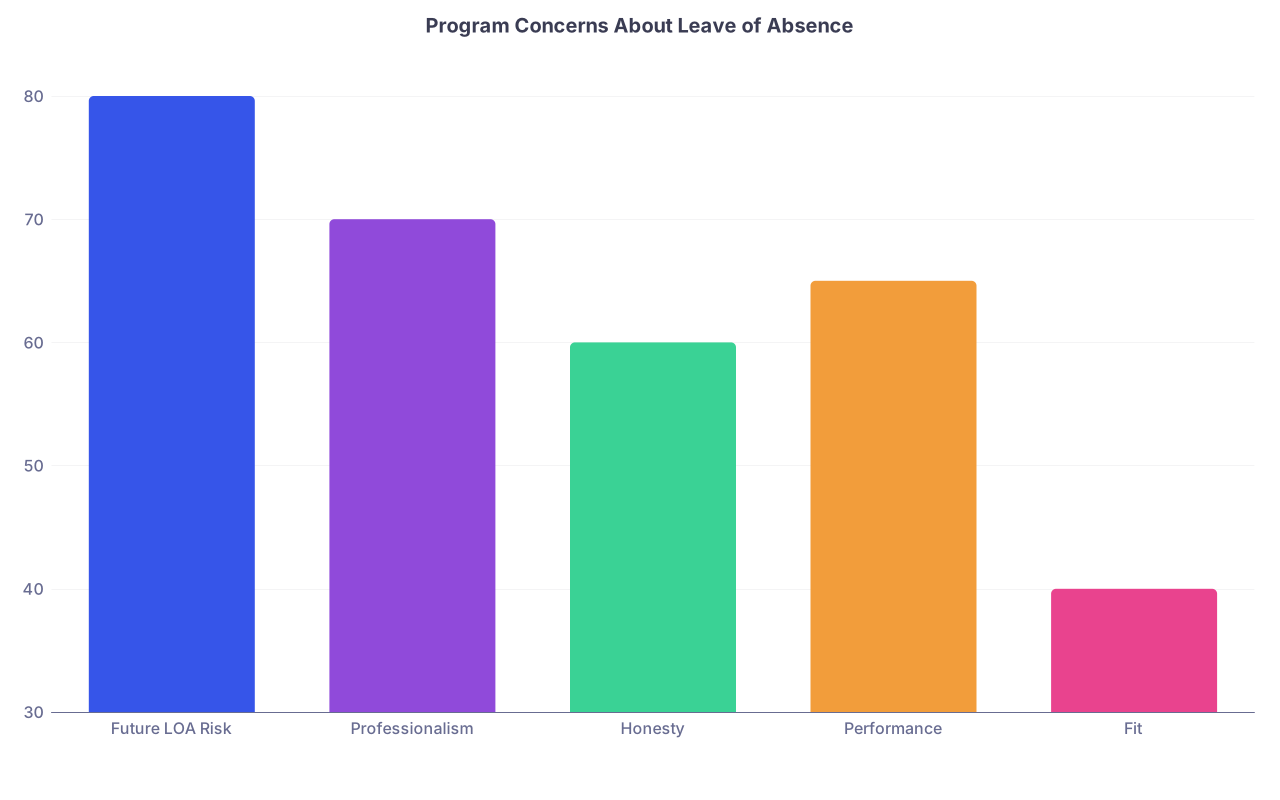
| Category | Value |
|---|---|
| Future LOA Risk | 80 |
| Professionalism | 70 |
| Honesty | 60 |
| Performance | 65 |
| Fit | 40 |
Notice what’s not on that chart: “Did this person ever struggle?” Lots of residents have struggled. They care whether you stabilize, own it, and function now.
Step 3: Build a tight 3-part LOA answer
Your goal: 60–90 seconds. Calm. Simple. No drama.
Use this structure:
- Brief context (what happened, in one or two neutral sentences)
- What you did about it (concrete steps, support, actions)
- Why you’re ready now (evidence and stability)
Example 1: Mental health leave
“During my second year, I went through a period of significant depression. It affected my academic performance and my ability to function day-to-day, and in discussion with student affairs and my physician, I took a medical leave of absence.
During that time, I started regular therapy, got my treatment stabilized, and worked on building better daily structure and coping strategies. Once things were consistently stable, I returned to school full-time.
Since then, I’ve completed all of my remaining coursework and clerkships on schedule, performed well clinically, and maintained my mental health plan. I continue with regular outpatient care, and I feel confident in my ability to manage stress and sustain the demands of residency.”
That’s it. No long backstory. No detailed symptoms. No tears. Clear, responsible, and forward-looking.
Example 2: Family emergency leave
“Midway through third year, a close family member developed a critical illness. I was a primary support person and needed to be physically present, so with my dean’s guidance, I took a leave of absence.
During the leave, I helped coordinate care and logistics for my family member until things stabilized and additional supports were in place. Once that happened, I returned to my rotations and finished the year.
Since coming back, I’ve completed all required clerkships without interruption, maintained strong evaluations, and my family situation is now stable with backup supports, so I don’t anticipate it impacting my ability to be fully present in residency.”
Again—clean, calm, and straight.
Example 3: Academic/Step failure leading to LOA
This one makes people sweat. You can still handle it.
“Early in medical school I struggled with adapting to the volume and pace of the curriculum, and I failed [X exam/block]. After discussing this with our academic support office, I took a leave of absence to address those issues and prepare for remediation.
During that time, I worked closely with learning specialists, changed my study approach, and did regular practice testing. When I returned, I successfully remediated the course and went on to pass my remaining coursework and clinical rotations, as well as Step 2.
Those struggles pushed me to build much more effective study systems, which I still use now on the wards and will bring into residency when I’m preparing for in-service exams and boards.”
Notice: you admit the problem. You emphasize skills gained. You show improved performance afterward.
Step 4: Decide how much detail to share (especially for mental health)
You are not obligated to disclose a specific diagnosis.
You are obligated to be honest about functional impact and whether you’re stable now.
Bad approach:
“I had some personal issues and just needed to step away for a bit. But I’m fine now.”
Interviewer translation: “Unreliable. Hiding something. High risk.”
Better approach (if you don’t want to name a diagnosis):
“I had a significant health issue that impacted my functioning, and in consultation with my physician and the dean’s office, I took a medical leave. During that time, I engaged in treatment and made concrete changes to how I manage my health and stress. I’ve now been back [X months/years] at full capacity, have completed [Y rotations/courses], and have a stable plan in place to maintain that going forward.”
If they push for specifics:
“I’d prefer not to go into diagnostic labels, but I’m happy to talk about how it affected my performance then, what I did to address it, and why I’m confident in my ability to meet residency demands now.”
That’s a firm boundary without sounding evasive.

Step 5: Align your answer with your MSPE and application
You cannot give one story and have your dean’s letter tell a slightly different one. That’s how you get burned.
If your MSPE says:
“Student took a medical leave of absence from Jan–Aug 2023 for personal health reasons.”
Your answer should sound consistent with that. Not:
“I took time off to do research,” when there is zero research listed, and the leave dates match your “personal health” period. Interviewers are not idiots.
What needs to line up:
- LOA dates in your MSPE / transcript
- Any comment in your dean’s letter
- Your ERAS entries (e.g., if you list activities during the LOA)
- Your verbal explanation
If there’s a mismatch—fix it before interview season. Talk to your dean’s office if the language in your letter is misleading, vague in a harmful way, or sounds worse than reality. They sometimes will revise future versions.
Step 6: Pre-emptive vs reactive: When to bring it up yourself
Should you bring up the LOA before they ask?
Rule of thumb:
- If it’s clearly visible in the MSPE/transcript AND significantly shaped your path (e.g., delayed graduation, repeated year, big Step gap) → it’s usually better to address it once in a controlled way, early in the interview.
- If it’s a short, straightforward LOA with clean performance afterward → let them ask if they care.
One way to proactively but calmly include it is when they ask: “Can you walk me through your journey in medical school?”
You might say:
“My path had one major detour I want to briefly mention—a medical leave of absence in my second year—but that experience ended up being a turning point in how I manage stress and structure my work. I’m happy to go into more detail, but the key piece for residency is that I’ve been back [X time], fully engaged, with strong clinical performance and stable supports in place.”
Then let them invite more detail. Or move on. Either is fine.
Step 7: Practice until it sounds boring (to you), not dramatic
You should be sick of hearing your own LOA answer before interview day. That’s the right level of rehearsal.
Here’s how to practice:
Record yourself saying your LOA answer in one take.
Play it back and ask:
- Do I sound apologetic? Angsty? Defensive?
- Did I ramble or go on tangents?
- Did I spend more time on the problem than on the resolution and current stability?
Trim. Swap emotional language for factual language. For example:
- “I completely fell apart” → “My functioning and performance significantly declined.”
- “My family situation was a disaster” → “There were acute family needs that required my full attention.”
Run it by someone who will be blunt. A faculty mentor, resident, or even a friend outside medicine who knows your story. Ask them:
- “Does this sound honest but composed?”
- “Where do I sound like I’m hiding something?”
- “Where do I overshare?”
You want the tone to be: calm, matter-of-fact, slightly future-focused.

| Step | Description |
|---|---|
| Step 1 | Write your full story |
| Step 2 | Condense to 3-part answer |
| Step 3 | Align with MSPE/ERAS |
| Step 4 | Decide on detail level |
| Step 5 | Practice out loud & record |
| Step 6 | Get feedback from mentor |
| Step 7 | Refine to 60-90 seconds |
Step 8: Tie your LOA to real strengths (without milking it)
You don’t need to pretend your leave was “the best thing that ever happened” to you. That kind of fake silver-lining spin smells bad.
But you should connect it to practical strengths you use now. For example:
- Better boundaries and time management
- Earlier recognition of burnout signs
- Efficient study strategies that helped you crush Step 2 after failing Step 1
- Communication and humility when you’re overextended
Concrete way to say this:
“That experience forced me to learn to ask for help early, rather than silently pushing until I break. On rotations since then, I’ve been very intentional about proactive communication when I’m hitting a limit—whether that’s needing clarification on a task or flagging when something may fall through the cracks. That’s something I will absolutely carry into residency.”
Now your LOA isn’t just a red flag—it’s a data point in your growth.

Step 9: Prepare for follow-up questions without spiraling
Some interviewers will just nod and move on. Others will ask follow-ups. You don’t need to panic if they do; you just need guardrails.
Common follow-ups:
- “How do you handle stress now, compared to before your leave?”
- “What supports do you have in place if things get overwhelming in residency?”
- “Is this something you anticipate could recur during residency?”
You should have 1–2 sentence answers ready for each.
Example answers:
Stress handling:
“Before, I tried to power through alone until I was already in trouble. Now I use earlier checkpoints—regular exercise, scheduled downtime, and checking in with my therapist when stress ramps up. I also speak up earlier if expectations aren’t clear. That’s helped me stay functional on busy rotations.”Supports:
“I have an established relationship with a therapist, a PCP who manages my medications, and a small support network of friends and family I actually use. I’ve learned I do better when I don’t isolate, so I’m intentional about that.”Recurrence:
“Nothing in medicine is guaranteed, but I’ve now had [X] years of stable functioning under clinical workload, with systems in place that have worked well. I would not be applying if I did not feel confident that I could meet the demands of residency and address issues early if they came up.”
Notice the pattern: grounded realism, not “It will definitely never happen again.” Overpromising sounds fake.
Step 10: Zoom out – integrate your LOA into your whole story
Your leave of absence is one chapter, not the back-cover summary of your entire book.
You still need strong answers to:
- “Why this specialty?”
- “Tell me about a patient that affected you.”
- “What’s been your biggest challenge in medical school besides the LOA?”
- “What do you do for fun?”
Do not let your LOA become your whole personality for the interview. You hit it once, clearly, and then you show them you’re more than that: a learner, a colleague, a future attending.
| Aspect | Strong Answer | Weak Answer |
|---|---|---|
| Length | 60–90 seconds | 3–5 minutes |
| Focus | Problem → Actions → Current stability | Problem details and emotions |
| Tone | Calm, factual, forward-looking | Defensive, vague, or oversharing |
| Consistency | Matches MSPE/ERAS | Conflicts with written record |
| Takeaways | Concrete skills/insight gained | “It was hard but I got through it.” |
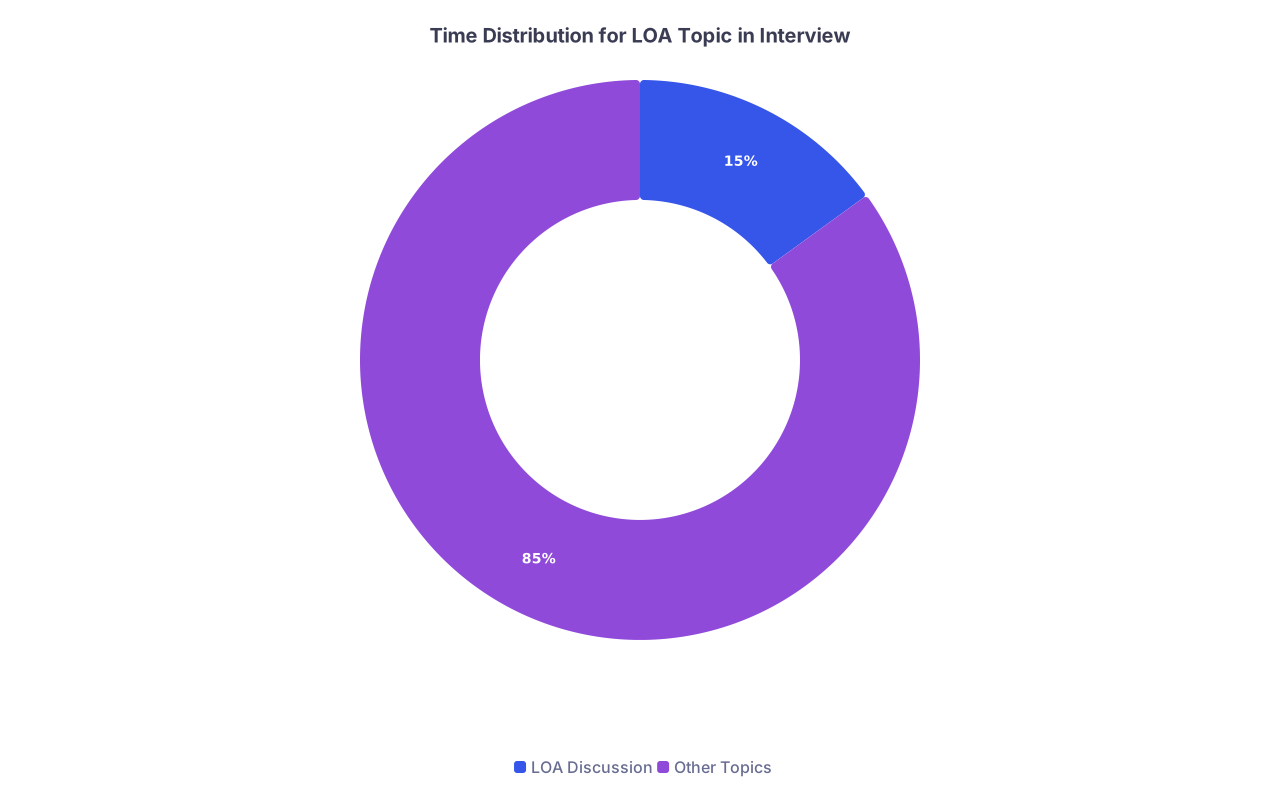
| Category | Value |
|---|---|
| LOA Discussion | 15 |
| Other Topics | 85 |
Aim for that ratio. Your LOA should not eat your whole interview.
FAQs
1. Should I write about my leave of absence in my personal statement?
Usually no—unless your LOA is central to why you chose your specialty or how you practice medicine, and you can write about it without sounding like you’re begging for sympathy.
If you do include it, keep it to one tight paragraph with the same structure: context → what you did → why you’re solid now. Then move on. Do not turn your personal statement into a medical chart or trauma memoir.
In many cases, it’s better handled in the MSPE plus your interview answer, so you don’t frame your entire application around the LOA.
2. What if my school labeled it “academic” but it was really driven by mental health?
This happens more than schools admit. The label in your file might say “academic” if grades dropped, even if depression or anxiety was the root cause.
In the interview, you don’t have to parrot that simplistic label. You can say something like:
“During that period, I was dealing with health issues that affected my academic performance. My school recorded the leave as academic because of the failed courses, but the underlying issue was medical, and I addressed it with appropriate treatment and support. Since then, my performance and functioning have been stable.”
That’s honest, clarifies the discrepancy, and recenters on your current stability. Just make sure your dean’s letter doesn’t outright contradict this.
3. How much time back from my LOA do I need before applying?
Programs like seeing at least several months of clean, continuous performance after your return. A year is more comfortable; two years is even better. But people do successfully match with less, especially if:
- Your clinical performance since returning is strong
- Step 2 is solid
- Your LOA has a clear resolution (not an ongoing crisis)
- You can explain it coherently and calmly
If your LOA ended very recently and you’re still shaky, consider whether waiting a cycle is smarter. Matching into the wrong situation when you’re not stable enough yet is worse than waiting.
You can’t erase a leave of absence. But you can decide how it lives in your story.
If you do the work now—get clear on what happened, shape a clean explanation, align it with your record, and practice until it’s boring—you walk into interviews knowing the “scary” question is actually the one you’re most prepared for.
With that handled, you can focus on the better parts of this process: showing them how you think, how you work with people, and why you’re going to be a resident they’re glad they took a chance on. The LOA chapter is written. Now you get to write the next one.