
You’re sitting in front of your laptop, Zoom camera on, blazer on top and scrub pants below the frame. Your first residency interview is in three days. You’ve run through some practice questions, but there’s one thing you keep circling back to: your path to this point is not “clean.”
Maybe you did a post-bacc after bombing your first undergrad.
Maybe you took six years to finish med school because of a leave of absence.
Maybe you transferred schools. Or you started at a Caribbean school and finished with U.S. rotations.
Maybe there’s a dismissal, academic probation, or a Step failure on that transcript.
Whatever it is, you know it’s going to come up. And you’re worried they’re going to see you as risky. Or broken. Or “too much trouble.”
Let me be blunt: they will notice. If it’s on your transcript, dean’s letter, ERAS, or USMLE transcript, they’ve seen it already. The interview is not where you hide it. The interview is where you own it, control it, and turn it into an asset—or at least neutralize it.
Here’s how to prepare, step by step, when your school history is unconventional.
Step 1: Get Crystal Clear on Your “Red Flag Profile”
Before you can handle questions, you need to know exactly what they’re looking at on the other side of that Zoom window.
Pull up everything:
- ERAS application
- MSPE (dean’s letter)
- Transcript
- USMLE transcript
- Any leaves of absence / remediation letters if you’ve seen them
Now, you’re going to write down, in brutal plain language, the things that might concern a program.

Common “unconventional” items:
- Took >4 years to finish med school
- Leave of absence (medical, personal, academic, family)
- Step 1 or Step 2 failure or multiple attempts
- Course or clerkship failures / remediation
- Academic probation or professionalism concern
- Transferred schools (U.S. to U.S., Caribbean to U.S., DO to MD, etc.)
- Started or completed med school abroad
- Big GPA dip followed by recovery
- Long gap between undergrad and med school or between years
Now, for each of these, answer two questions for yourself:
- What do I fear they’re going to assume about me because of this?
- What is actually true about this situation now?
Example:
- Item: Step 1 fail on first attempt
- Fear: “They’ll think I’m lazy or not smart enough.”
- Reality: “I underestimated the prep, was dealing with undiagnosed anxiety, restructured including therapy and a schedule, and passed with 225 on the second attempt. Since then, I honored Medicine and scored 245 on Step 2.”
You’re doing this because your interview answers need to target their assumed concerns, not your feelings about it.
Step 2: Build a Three-Sentence “Anchor Story” for Each Issue
You are not going to ramble. Rambling screams “I’m still not okay with this.” You need tight, repeatable stories.
For each unconventional item, build a three-part answer:
- Context (short, factual)
- What changed (specific, behavioral)
- Proof it worked (outcomes since then)
Think of it like this formula:
“What happened” → “What I learned + what I changed” → “What my performance looks like now”
Example 1 – Leave of absence (personal/mental health):
- “During my second year, I took a six-month leave of absence due to significant anxiety and depression that were affecting my functioning and academics.”
- “During that time, I worked with a therapist, started medication, and put real structure into my days—consistent sleep, exercise, and scheduled study blocks. I also learned to ask for help early instead of waiting until I was underwater.”
- “Since returning, I passed all subsequent courses on time, honored two core clerkships, and my Step 2 score reflects that stability.”
Example 2 – International / Caribbean start, U.S. finish:
- “I started medical school at a Caribbean program due to limited options after undergrad, but I worked hard to secure all core and sub-I rotations in U.S. teaching hospitals.”
- “I realized early I needed to prove I could perform at the same level as U.S. students, so I sought out high-volume, academically-oriented sites and asked specifically for more feedback and responsibility.”
- “As a result, I received strong clinical evaluations in my U.S. rotations, including comments that I functioned at or above the level of U.S. students on the team, and I scored [X] on Step 2.”
Write these out. Literally. On paper or in a doc.
Then, practice saying them out loud until you can deliver them without your voice getting shaky or your sentences spiraling.
Step 3: Know the Exact Questions You’re Likely to Get
Programs don’t usually ask, “So, explain your unconventional background” in a vague way. They ask specific, slightly uncomfortable questions. Good interview prep is anticipating wording exactness.
Here’s the kind of stuff you’re up against:
- “I see you took a leave of absence. Can you tell me about that?”
- “Can you walk me through what happened with Step 1?”
- “You completed med school at [international school]. How do you think that prepared you for residency here?”
- “I noticed a failed clerkship on your transcript. What happened and what did you change?”
- “You transferred from [School A] to [School B]. What drove that decision?”
- “I see an extended timeline between M2 and M3. Can you explain?”
- “You had an academic probation early on. What did you learn from that experience?”
You’re going to script and rehearse answers to each of these (or whatever version matches your actual history) using your three-part structure.
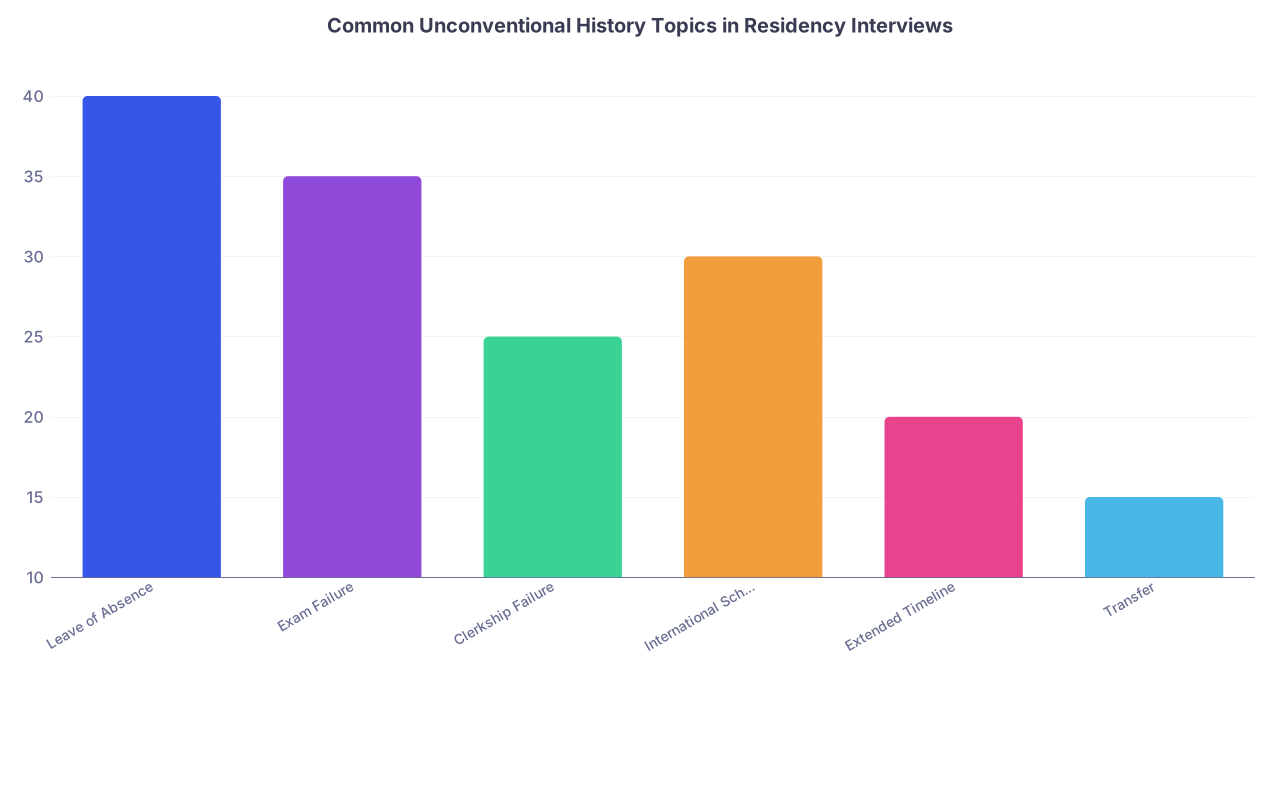
| Category | Value |
|---|---|
| Leave of Absence | 40 |
| Exam Failure | 35 |
| Clerkship Failure | 25 |
| International School | 30 |
| Extended Timeline | 20 |
| Transfer | 15 |
Those numbers aren’t official; they’re proportional to how often I’ve seen these come up in real conversations. LOAs and exam issues are very, very common.
If you’re smart, you’ll also prep for the “meta” questions your past invites:
- “How do you handle stress now?” (after mental health or burnout issues)
- “What systems do you use to stay on top of studying?” (after exam failures)
- “How do you handle feedback and criticism?” (after professionalism or remediation)
- “What did this experience teach you about working on a team?” (after conflict-related notes)
Again: short, specific, behavior-focused answers.
Step 4: Shift from “Defensive” to “Clinical” When You Talk About It
The worst interview posture is apologetic and vague. Programs don’t want to spend 3 years managing your unresolved guilt.
You want to sound like a clinician presenting a case: honest, organized, and not panicked.
Bad:
“I just had a lot going on, and then with COVID and family stuff and I was really overwhelmed, and the school suggested a leave of absence. It was a really hard time, and I felt awful, but I’ve grown from it.”
Better:
“In my second year I hit a point where my anxiety and sleep problems were significantly affecting my performance. I took a leave of absence, worked with a therapist and my primary care physician, and implemented consistent routines. Since then, I’ve had stable performance—no failed courses, and strong feedback on my clinical rotations.”
Notice:
Short. Concrete. Past problem → current stability.
Practice saying it like you’re presenting labs. Not like you’re confessing a crime.
Record yourself. If you sound like you’re pleading for forgiveness, tighten it up. Strip out qualifiers and emotional over-explaining.
Step 5: Build the “Bridge Back” to Why You’re a Strong Resident
If all you do is defend your past, you lose. The point isn’t to walk out of the interview with them thinking “okay, this person isn’t a disaster.” The point is for them to think, “this person has had adversity and now seems resilient, reflective, and capable.”
Your unconventional history must connect directly to residency-relevant strengths:
- Reliability under pressure
- Self-awareness
- Ability to seek help appropriately
- Adaptability (new systems, new countries, new schools)
- Work ethic refined by failure, not crushed by it
- Empathy for struggling patients/learners
After you answer the “what happened?” question, add one more sentence:
“This experience has made me particularly strong in X, which shows up in Y.”
Examples:
- “This experience has made me very proactive about feedback; my attendings often comment on how quickly I incorporate suggestions into my daily work.”
- “Going through that process gave me a lot of empathy for patients with mental health conditions and for colleagues who are struggling but afraid to speak up.”
- “Training in two different systems forced me to be adaptable; I’m very comfortable walking into a new hospital and figuring out workflows quickly.”
If you skip this step, you stay locked in “defense mode” the whole interview.
Step 6: Decide What Not to Say
You do not owe them your entire therapy history. Or every detail of your family’s problems. Or a play-by-play of your worst semester.
There’s a line between honest and messy. You want honest, controlled, and professional.
Things to avoid:
- Oversharing: “My partner cheated on me, my parent relapsed, and then I…” Just no.
- Blame-heavy narratives: “The school was unfair,” “The clerkship director had it out for me,” “USMLE changed the exam style.”
- Vague handwaving: “I just had a lot going on, but it’s better now.”
- Present-tense instability: “I still struggle a lot, but I’m trying.” That terrifies PDs.
How to talk about sensitive causes (depression, family illness, financial crisis) without chaos:
- Use category, not graphic detail: “Significant family health issues,” “a personal mental health issue that required focused treatment,” “financial instability that required me to work more than I should have.”
- Keep timeframe clear and in the past: “During that six-month period…” not “I still kind of…”
- Always end with structure: treatment, strategies, changed habits, proven stability.
If you’re not sure whether something crosses the line, assume the program wants to know:
- Are you stable now?
- Will you show up consistently?
- Can you pass exams / handle the workload?
Answer those. Leave the therapy-session level stuff for your therapist.
Step 7: Strategically Use Your Strengths to Offset Concerns
Programs don’t look at one data point. They look for patterns and counterweights. You should too.
If you have a Step failure but a strong Step 2 and solid third-year performance, that’s your counterbalance.
If you have an LOA for mental health but then three years of clean, on-time performance, that’s your counterbalance.
If you trained at an international school but crushed U.S. rotations at teaching hospitals, that’s your counterbalance.
Lay it out for them explicitly, especially if they seem hung up on the unconventional step.
Example:
“I understand my Step 1 failure can be concerning. What I’d want you to weigh that against is my subsequent Step 2 score of 243, my strong Medicine and Surgery clerkship evaluations, and feedback from attendings that I function at an intern level in the hospital. The systems I built after failing Step 1 are the same ones I use now to stay on top of complex patients and new information.”
You’re basically doing their risk-benefit calculus for them.
Step 8: Practice Under Mild Pressure, Not Just in Your Head
Silent rehearsal is useless. You know this from OSCEs. You need to say the words under some degree of stress.
Practice with:
- A brutally honest friend or partner
- A resident you know (ideal)
- A faculty advisor / dean
- Your phone camera + a timer
Have them ask you:
- “Tell me about yourself.” (Your unconventional history should not be the first thing here.)
- “Can you walk me through this [issue]?”
- “What did you learn from that?”
- “How will this affect you in residency?”
- “Is there anything else in your record you think we might be concerned about?”

| Step | Description |
|---|---|
| Step 1 | Identify Red Flags |
| Step 2 | Write 3-Sentence Stories |
| Step 3 | Anticipate Questions |
| Step 4 | Rehearse Out Loud |
| Step 5 | Get Feedback |
| Step 6 | Refine Answers |
| Step 7 | Mock Interviews with Pressure |
| Step 8 | Final Review Before Interview Day |
Have them push back a little:
“I hear what you’re saying, but residency is a big step up in stress. How can we be sure this won’t happen again?”
You want to feel that discomfort now, not for the first time in front of a PD.
Step 9: Control the Narrative in Your “Tell Me About Yourself”
You don’t lead with your worst moment. “Tell me about yourself” is not, “Well, I failed Step 1 and took an LOA.”
Start with who you are as a future resident:
- Your background in 1–2 sentences (geography / prior career / quick context)
- Your clinical interests and what draws you to this specialty
- 2–3 strengths that are directly relevant to residency
- Optional: Brief nod to overcoming challenges
Example:
“I grew up in a small town in Arizona and was the first in my family to graduate from college. I came to medicine a bit later, after working in community outreach, which is probably why I’m most drawn to internal medicine in underserved settings. Clinically, attendings describe me as steady under pressure and very coachable—I seek feedback early and adjust quickly. Along the way I’ve had to course-correct academically, but those experiences forced me to build sustainable systems that I know will serve me well as a resident.”
See how the unconventional history is implied, but not the headline? That’s what you want.
Step 10: Be Ready for the “Quiet Test”: Nonverbal and Vibe
Programs are reading your vibe as much as they’re listening to your words. Especially if you have any red flags.
They’re asking themselves silently: Does this person seem:
- Stable?
- Grounded?
- Bitter?
- Overly fragile?
- Blaming?
- Scattered?
So when you talk about your history:
- Sit still; don’t fidget like you’re waiting for judgment.
- Keep your voice steady and at a normal volume.
- Don’t over-smile or laugh when talking about serious stuff.
- Don’t go monotone and dead-eyed either.
Aim for: calm, matter-of-fact, reflective.
If you get emotional easily when discussing it, rehearse more. Or shrink the detail level until you can get through it calmly. “I dealt with significant personal health issues” is sometimes as far as you should go verbally, and that’s okay.
Step 11: Handle Direct or Awkward Questions Without Melting
Occasionally, you’ll get someone who is…less tactful.
Examples I’ve heard:
- “So…why should we trust you not to fail again?”
- “We’ve had a bad experience with a resident from [your school]. Why will you be different?”
- “If you struggled in med school, why do you think you can handle residency hours?”
Here’s the move: acknowledge → re-anchor to facts → link to current functioning.
Example:
“That’s a fair question. The failure happened in a very specific context—poor study structure and untreated anxiety—which I’ve addressed with specific changes: regular therapy, a set weekly schedule, and early help-seeking when I’m struggling. Since then, I’ve passed all subsequent exams and rotations on time, scored [X] on Step 2, and received feedback that I manage stress on the wards effectively. Those are the patterns I’d be bringing as a resident.”
You don’t have to love the question. You do have to answer it like an adult.
Step 12: Decide Your Line If They Push Too Far
Very rarely, someone will cross the line—digging into mental health details, family trauma, pregnancy plans, etc.
You’re allowed to set a boundary politely.
For something like mental health:
“I’m comfortable sharing that I experienced a mental health issue that was appropriately treated and has been stable for several years. I’m not comfortable going further into personal details, but I can tell you how I manage my health now to ensure I’m reliable as a resident.”
If they keep pushing into clearly illegal territory (marital status, kids, pregnancy plans), you can pivot:
“I’m fully committed to my career and completing residency training, and I have the support systems in place to do that successfully.”
You’re not going to win points by fighting them in real time, but you also don’t need to bleed personal details all over the floor.
Step 13: Make Your Unconventional Path an Asset in Your “Why This Program” Answers
Programs get a lot of cookie-cutter answers. Your unconventional path gives you a natural angle if you use it right.
You can say things like:
“Training in two very different systems taught me how important good structure and mentorship are. I’m drawn to your program’s clear curriculum and strong resident support—the wellness half-days, the open-door policy with chiefs—because I know from experience that those systems matter.”
or
“Having had to fight a bit harder for opportunities, I’m very comfortable with a high-workload, high-responsibility environment like this county hospital. I’m not intimidated by complexity; it’s kind of been the norm for me.”
You’re signaling: I’ve been through some things; I know what I’m getting into; I’m choosing you with eyes open.
Quick Reality Check: How Programs Actually Think
Behind closed doors, conversations sound like this:
- “Yes, they failed Step 1, but look at the Step 2 and third-year evals. They clearly turned it around.”
- “International grad, but their U.S. letters are strong and they worked at our affiliate hospital. The residents liked them.”
- “LOA for mental health, but it’s been years, and they were very clear and stable talking about it.”
Or:
- “I’m more worried about how evasive they were than the actual LOA.”
- “They blamed everyone else for their failure. Hard pass.”
- “Their story didn’t match the MSPE. Something feels off.”
Your goal: Make them say the first set of things, not the second.
What to Do Today
Do not “think about” this later. Do one concrete thing right now.
Open a blank document and:
- List every unconventional or “red flag” element in your academic history.
- For each one, write:
- One sentence: what happened (factual, short).
- One sentence: what you changed.
- One sentence: how your performance looks since then.
You’ll probably hate the first version. That’s fine. But get the words on the page.
Then read each one out loud, alone in your room. If you hear yourself apologizing, rambling, or blaming, revise until it sounds like you’re presenting a stable patient, not confessing a secret.
That’s your starting point. From there, mock interviews and polish actually work. Without that foundation, you’re just hoping they “don’t ask.”
They will. So get ready now.