
You’re sitting in front of your laptop staring at your first residency interview invite. Your stomach drops when you remember the thing they’re definitely going to notice: you transferred medical schools. Different school on your transcript. Different name on your white coat. A neat little “explain me” flag right in the middle of your ERAS.
You can already hear the question:
“So, tell me about your transfer. Why did you switch schools?”
Here’s how to handle it. No fluff. No drama. Just a clean, credible story that does not tank your interview.
1. Understand Exactly What Interviewers Worry About
First, be clear on what you’re up against. Most program directors do not care that you transferred. They care what it might mean.
These are the questions silently running in their head:
- “Was this student in trouble academically or professionally?”
- “Are they going to bail on us if they’re unhappy?”
- “Is there a professionalism or behavior issue I’m not seeing?”
- “Was this about not getting along with people?”
- “Is there some big drama here we’ll only find out after we rank them?”
They’re trying to avoid risk. Not punish you.
If your transfer was for solid, boring reasons—spouse relocation, school closure, family illness, better support for a disability, immigration/visa, geographic change—you’re already in good shape. You just need to signal stability and close the loop.
If your transfer was related to academic issues, code of conduct, or conflict with your original school, you can still recover—but you must own it and show growth. Not spin. Not excuses.
Goal in the interview:
Turn “hm, red flag?” into “ah, makes sense” in under 60 seconds.
2. Build a Tight, Boring Transfer Story (That’s Good)
You want your transfer explanation to be:
- Short
- Straightforward
- Boring in the best possible way
If they walk away thinking, “That’s reasonable,” you’ve won.
Step 1: Write your one-sentence core reason
You only get one main reason. Not five.
Examples of clean, safe cores:
- “My spouse matched into residency in X city, so I transferred to be near them.”
- “My original school announced its closure, so I transferred to complete my degree.”
- “I had a significant family health situation that required me to relocate closer to home.”
- “I transferred from an international school to a U.S. school to complete clerkships and better prepare for residency here.”
- “I realized early that my school’s curriculum and support structure weren’t a good fit for how I learn, and transferring allowed me to succeed academically.”
If your real story is messy, pick the most honest, defensible core reason and center that.
Step 2: Add 1–2 sentences that show maturity and stability
You’re not telling a saga. You’re proving you handle change like an adult.
Example frames:
- Show you did not make a reckless decision
- Show you respected both institutions
- Show things have been stable since the transfer
Step 3: End with “and here’s how it’s gone since”
You must close the loop with how things are now:
- Academic performance
- Clinical experience
- Professional growth
This says: “Story is over. No ongoing drama. I’m fine.”
3. Plug-and-Play Scripts You Can Adapt
Let’s build some scripts you can steal and tweak. Say them out loud until they sound like you.
Script A: Spouse / Partner Relocation
“During my second year, my spouse matched into residency in [City]. After a lot of discussion with my school and family, I decided to transfer to [New School] to be in the same city. It was a logistical challenge, but the transition went smoothly, and since transferring I’ve done all my core clerkships at [New School] and built strong relationships there. It ended up being a really positive move both personally and educationally.”
What this does:
– Clear reason.
– Shows planning and communication.
– Ends on stability and positives.
Script B: Family Illness / Caregiving
“In my preclinical years, a close family member developed a serious health condition, and I needed to be closer to home to help. I spoke with my original school about options and ultimately transferred to [New School], which is near my family. Once I settled there, I was able to refocus fully on my training. Since then my clinical evaluations and Step scores have been strong, and I’ve really appreciated the support system at [New School].”
Key move: Notice the phrase “once I settled there, I was able to refocus fully.” That’s what interviewers want to hear.
Script C: School Closure / Structural Change
“My original medical school announced it would be closing and no longer able to support students through clinical rotations. They helped us identify transfer options, and I moved to [New School] to complete my degree. I finished all my core and most of my electives there, and I’ve had consistent evaluations and good mentorship, which has prepared me well for residency.”
Zero drama. Just cause and effect.
Script D: Academic Fit / Struggles (Honest but Safe)
This is for you if you had some rough semesters, maybe a leave, then transferred.
“In my first two years, I struggled with [brief, precise issue: the pace of an accelerated curriculum / a pure pass–fail system where I didn’t get much feedback / a problem outside of school that affected my performance]. I worked with our academic support office, and through that process I realized I’d do better in a program with [smaller class size / more structured support / different curriculum style]. I transferred to [New School], where I repeated [X requirement if applicable] and since then my academic record has been solid. I’m glad to say that my clinical evaluations and Step 2 performance now reflect my true abilities.”
The key pieces:
- You name the problem without oversharing.
- You show you acted to fix it.
- You prove the fix worked with your later performance.
If you had probation or a professionalism issue, you need a slightly stronger ownership:
“I failed [X course/block] in my first year and was placed on academic probation. That was a hard but important wake-up call. I worked closely with our dean and learning specialists to change how I studied and used resources. Part of that process involved transferring to [New School], which had a curriculum and support system that fit me better. I successfully completed all requirements there, have not had any further academic issues, and my clinical evaluations and Step 2 score reflect the changes I made.”
Do not blame the old school. Ever. That’s how you sound like a problem.
4. How to Answer When They Ask Directly in the Interview
Picture this: you’re in a Zoom interview. PD glances at your application and says:
“I see you transferred between schools. Can you tell me about that?”
You do not need a five-minute essay. The answer should be around 30–60 seconds.
Framework:
- Start with the one-line core reason.
- Add 1–2 lines on how you handled it maturely.
- Finish with specific evidence that you’re stable and thriving.
Example:
“Yes, I did transfer after my second year. My spouse matched into residency here in [Region], and we decided it was important to be in the same city. I worked with my original school and [New School] to make the transition as smooth as possible. Since transferring I’ve completed all my cores and several electives at [New School], with strong evaluations and great mentorship in [your specialty], and I feel very well prepared for residency.”
Then stop talking. Silence is your friend here. If they have follow-ups, they’ll ask.
If they don’t ask about the transfer at all? Do not force it into every answer. You’re not obligated to reopen a file they decided not to investigate.
5. Align Your Story Across Everything (Dean’s Letter, PD Letter, You)
The biggest thing that makes interviewers uneasy is when the story doesn’t match.
You: “I transferred mainly due to family needs.”
MSPE / dean’s letter: “Student had academic difficulties and was advised to transfer.”
Old PD on a phone call: “We had some concerns about reliability.”
That mismatch is deadly.
You want:
- Your ERAS application explanation
- Your MSPE language (if it mentions the transfer)
- Anything your deans would say on the phone
- What you say in interviews
…all to point in the same direction.
You can’t rewrite the MSPE. But you can know what’s in it and frame your story to include both elements.
Example of integrating:
“The transfer happened at a time when I was dealing with both [family situation] and struggling in a couple of preclinical courses. My dean and I discussed options, and transferring to [New School] closer to home gave me both the support I needed and a curriculum structure that worked better for me. I repeated [X requirement if true], and from that point forward my performance has been consistent. I’m confident those early challenges pushed me to develop better habits that I’ve carried into my clinical years.”
Now the academic issue doesn’t feel “hidden.” It feels addressed and closed.
6. Use the Transfer as a Strength—Carefully
You don’t need to apologize for transferring forever. You can mine it for a couple of strengths, if you do it without sounding like you’re selling something.
Legitimate angles you can pull:
- Adaptability: You handled a major institutional change and still succeeded.
- Systems perspective: You’ve seen two different curricula, eval systems, cultures.
- Empathy: You know what it’s like to be “the new person” joining a team midstream.
- Resilience: You rebounded from disruption and still hit your goals.
How it might sound in an answer about “Tell me about a challenge”:
“A major challenge was transferring between medical schools after my second year. I had to learn a new electronic record for clerkships, adjust to a different evaluation system, and build relationships from scratch while staying focused on patient care. I made a point of seeking feedback early from residents and faculty so I could calibrate quickly. In hindsight, that experience made me more adaptable—I’m comfortable walking into a new environment, figuring out how things work, and integrating into the team.”
Notice: you’re not glorifying the transfer. You’re showing what you did with it.
What you should not do:
- Trash your old school: “Their administration was terrible and I had to leave.”
- Oversell: “Transferring was the best thing ever; everyone should do it.”
- Sound like a victim: “I was forced out by circumstances beyond my control.”
Programs want residents who can live in reality and function.
7. Handle Specialty-Specific Concerns (Especially Competitive Ones)
If you’re applying to a more competitive specialty (derm, ortho, ENT, ophtho, etc.), you’re dealing with PDs who are hyper-tuned to “risk signals.” A transfer draws their eye.
That doesn’t mean you’re sunk. It means you tighten everything:
- Your explanation must be crisp and boring, not dramatic.
- Your post-transfer record needs to be clearly strong:
– Clinical evals
– Step 2
– Specialty letters
| Area | Weak Signal | Strong Signal |
|---|---|---|
| Step 2 Score | Just at cutoff / barely passing | Comfortably above program average |
| Clinical Evals | Mixed, with “needs improvement” | Consistently “above expectations” |
| Specialty LORs | Generic, from non-core faculty | Enthusiastic letters from key faculty |
| Continuity | Many scattered electives | Clear, focused specialty exposure |
If your transfer was from a Caribbean/IMG school to a U.S. MD/DO, the subtext in some PD’s mind is: “Could they not cut it?” You kill that thought with:
- Clean explanation: “I wanted to do all clinical training in the U.S. for better residency preparation.”
- Strong U.S. performance: “Since transferring, all my rotations and letters are from U.S. institutions.”
- Zero defensiveness in your tone.
8. Practicing the “Transfer Question” Without Over-Rehearsing It
You can absolutely tell when someone is reciting a memorized script vs. owning their story. PDs can too.
Run this practice plan:
- Write your 3-part answer (reason → how you handled it → how you’ve done since).
- Say it out loud 10–15 times on different days.
- Each time, change a few words but keep the structure.
- Record yourself once or twice. Listen for:
- Do you sound defensive?
- Do you sound guilty?
- Do you ramble?
- Then stop obsessing. Over-practice just makes you sound stiff.
Try a transition sentence to keep it conversational:
- “Yeah, that’s a good question.”
- “Sure, I’m glad to explain that.”
- “Absolutely, I can walk you through that briefly.”
Then go straight into your 30–60 second answer. Don’t preface it with long context.
9. Be Ready for Tough or Slightly Rude Variants
Occasionally you’ll get the blunt version from an older PD or an annoyed faculty:
- “Why did you have to transfer?”
- “What was wrong at your first school?”
- “Were you in trouble?”
Do not get flustered. Keep your tone level and your answer the same.
Example:
“I wasn’t in disciplinary trouble. The main issue was [core reason—family, school closure, academic fit, etc.]. I worked with my dean to find a solution, which led to transferring to [New School]. Since then my record has been stable, and my clinical performance and Step 2 score are a much better reflection of the physician I am now.”
If they keep pushing into territory that feels invasive or inappropriate, you can set a gentle boundary without being combative:
“I’m happy to talk about how that transition affected my training and performance. The short version is that I’m in a very good place now and fully prepared for residency.”
Then stop. If someone insists on digging for gossip, that says more about their program than about you.
10. Integrate the Transfer Into Your Whole Narrative (Without Making It the Star)
The biggest mistake I see: people make their transfer the centerpiece of their story. It shouldn’t be. It’s a chapter, not the book.
In the rest of your interview:
- When they ask, “Walk me through your journey in medicine,” you mention the transfer once, in one line, and keep moving.
- When they ask about your strengths, weaknesses, or patient stories, choose examples from either school—but do not apologize for where they occurred.
- When they ask, “Why should we rank you?” your answer should have nothing to do with the transfer. It should be about who you are as a clinician and colleague.
Think of the transfer as:
- A known data point that you explain once, clearly.
- A background factor that shaped you a bit.
- Not something you cling to as your main personality trait.
If you do this right, by the end of the interview the PD is thinking about:
- Your letters
- Your clinical acumen
- Your fit with their culture
- Your communication style
And the transfer is just a footnote in their brain: “Oh yeah, that was because their spouse was here / their school closed / they had a family issue. Fine.”
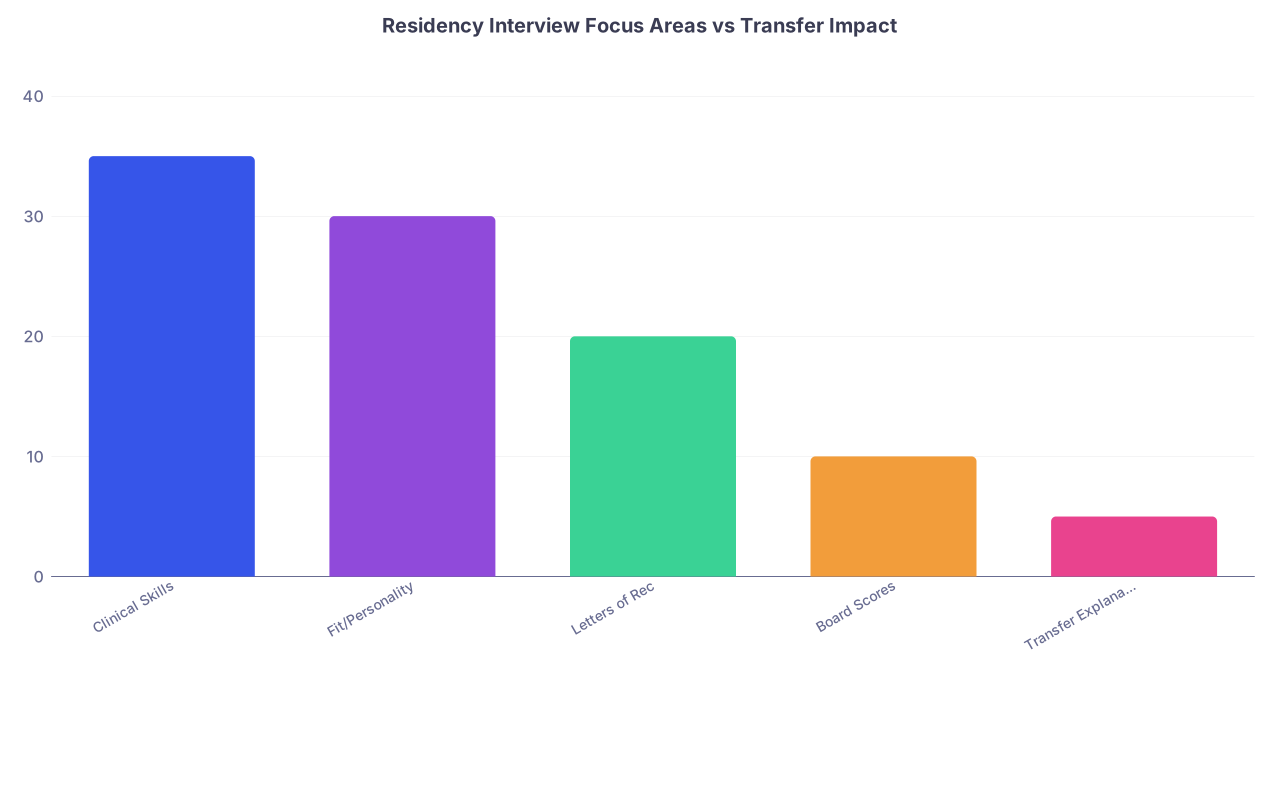
| Category | Value |
|---|---|
| Clinical Skills | 35 |
| Fit/Personality | 30 |
| Letters of Rec | 20 |
| Board Scores | 10 |
| Transfer Explanation | 5 |
11. Concrete Prep Checklist for You Right Now
If you’re weeks away from interviews, here’s what to do this week—not in theory.
Get your story straight
Sit down and write your 3-part answer in under 150 words. Reason → how handled → how doing now.Read your MSPE / dean’s letter
Make sure your story doesn’t contradict what’s in there. If there’s something ugly in writing, you must at least nod to it and show growth.Identify 1–2 “growth” points
How did the transfer actually make you better? Not fake lessons. Real ones. Maybe it forced you to get organized fast. Maybe it made you more proactive in finding mentors.Practice with a human who’ll be blunt
Friend, advisor, resident you know. Ask them: “Do I sound defensive? Am I oversharing? Does this feel like too much drama?”Decide what you will NOT say
Lines you will not cross: trashing your old school, naming specific people in conflict, blaming everyone but yourself.Then focus back on what matters more
Most of your prep should be on:
– Patient stories
– Why this specialty
– Why this program
– Strengths/weaknesses
– Times you worked in teams, handled conflict, made mistakes, learned
The transfer is an item on your prep list. Not the whole list.
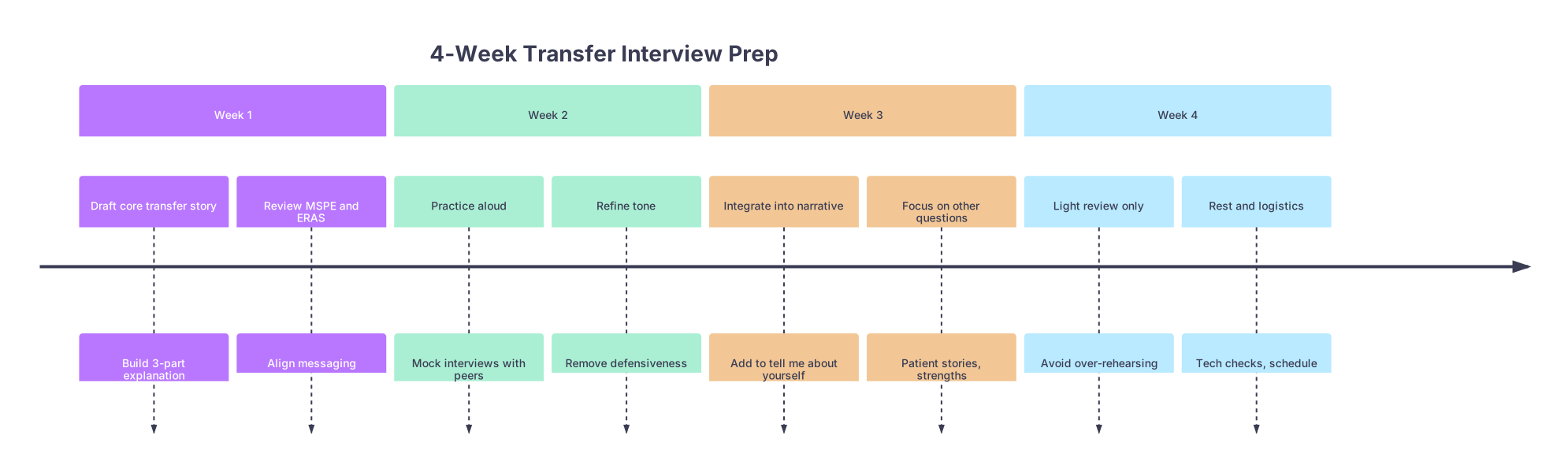
| Period | Event |
|---|---|
| Week 1 - Draft core transfer story | Build 3-part explanation |
| Week 1 - Review MSPE and ERAS | Align messaging |
| Week 2 - Practice aloud | Mock interviews with peers |
| Week 2 - Refine tone | Remove defensiveness |
| Week 3 - Integrate into narrative | Add to tell me about yourself |
| Week 3 - Focus on other questions | Patient stories, strengths |
| Week 4 - Light review only | Avoid over-rehearsing |
| Week 4 - Rest and logistics | Tech checks, schedule |

12. If Your Transfer Was Actually Messy
If this whole time you’ve been thinking, “Yeah, but my situation was ugly,” here’s the blunt version.
You still have to:
- Tell some truth
- Own your part
- Show a clear, clean track record since then
Example of a messier but survivable script:
“In my second year, I had a serious conflict with how things were handled around [brief, non-gossipy phrase]. I did not manage that situation well. I was frustrated and didn’t communicate effectively with faculty, which contributed to a breakdown in the relationship. After a lot of difficult conversations with my dean and mentors, I decided to transfer to [New School] to get a fresh start and finish my training. At [New School], I made a point of seeking feedback early and often and being transparent with faculty, and since then my evaluations have been consistently strong. That experience pushed me to grow a lot in professionalism and communication.”
Is that a glowing story? No. But it’s honest, it owns your behavior, and it shows change.
Sometimes that’s enough. Sometimes it’s not. But the alternative—lying or blaming everyone else—almost always sinks you.

Key Takeaways
- Your transfer is a data point, not a death sentence. Have a short, honest, boring explanation that matches your MSPE and your later performance.
- Use a clear structure: why you transferred, how you handled it professionally, and how you’ve done since—then stop talking.
- Do not let the transfer dominate your narrative. Address it cleanly once, then spend 90% of the interview showing who you are as a clinician, teammate, and future resident.