
You are not “bad at interviewing.” You are unpracticed at saying the right things out loud, on command, under pressure. That is fixable.
This is the playbook I wish more applicants actually used: a concrete, step-by-step spoken script you can rehearse. Not vague tips. Words. Phrases. Structures. So when you are in front of a PD who has already seen 40 applicants this week, you sound clear, organized, and like someone they can trust at 3 a.m.
Use this as a literal script to practice out loud. Alone, with a friend, or into your phone. Several times.
1. Set Up Your Practice Environment (10–15 minutes)
Do not skip this. The way you practice is the way you perform.
A. Physical setup
You want to practice in “interview conditions” as much as possible:
- Wear at least business-casual. It changes how you carry yourself.
- Sit at a table or desk, feet flat, back supported.
- For virtual practice: use your laptop, not your phone.
- Good lighting facing you, quiet background, neutral wall if possible.
B. Your tools
Have this in front of you:
- Printed list of common residency interview questions.
- A notepad with 3 bullets only:
- 3 stories you will reuse (clinical, conflict, leadership/initiative).
- 3 program-specific reasons you like this place.
- 3 strengths you want them to remember.
- Your CV and personal statement.
Put your phone on Do Not Disturb. Close all non-essential tabs. You are in “rehearsal,” not just “thinking about interviews.”
2. Core Answer Framework You Will Use Repeatedly
If you practice random answers with no structure, you will ramble.
For 80% of residency interview questions, use a simple structure:
For stories / behavioral questions (Tell me about a time…):
- Context (1–2 sentences) – Where were you, what was your role?
- Problem (1–2 sentences) – What was at stake or what went wrong?
- Action (2–3 sentences) – What you did. Not your team. You.
- Result (1–2 sentences) – Outcome and what changed.
- Reflection (1–2 sentences) – What you learned and how it affects you now.
Call it CPARR if you want a mnemonic.
For opinion / motivation questions (Why this specialty, why our program):
- Hook (1 sentence) – Direct answer up front.
- Evidence (2–3 sentences) – Specific past experiences that support that answer.
- Connection (1–2 sentences) – How this ties to their program.
- Forward look (1 sentence) – What kind of resident you aim to be there.
You are going to plug content into these structures. Over and over. Out loud.
3. Script for the Most Important Question: “Tell Me About Yourself”
This is your opening. If you improvise this, you are wasting the easiest question.
Structure
- Present: Who you are now as a medical trainee.
- Past: 1–2 key experiences that shaped you.
- Bridge: Why this specialty.
- Future: What you are looking for in residency / who you want to be as a resident.
Out-Loud Practice Script
Read this first as written. Then customize the details.
“I am a fourth-year medical student at [School], currently applying into [Specialty]. Clinically, I have been most drawn to [short, concrete aspect: ‘longitudinal relationships in primary care’ / ‘acute decision-making in the ICU’ / ‘procedural work in the OR’].
Before medical school, I [one sentence: ‘studied biomedical engineering and worked on device design,’ or ‘worked as a scribe in a busy ED,’ or ‘was a teacher for several years’]. That background really shaped how I approach patients and teams—especially around [pick 1: communication, systems-thinking, teaching, etc.].
During medical school, a couple of experiences really solidified my interest in [Specialty]. One was [1–2 sentence clinical story that shows you in action]. Another was [1 sentence: research, leadership, or longitudinal clinic relevant to the field].
Going into residency, I am looking for a program where I will see a diverse patient population, get strong hands-on training early, and work with faculty who are invested in teaching. Ultimately, I want to become the kind of [specialist] who [1 sentence about your long-term goal: academic, community, educator, hospitalist, etc.].”
Now, your job:
- Fill in the brackets.
- Time yourself. Target: 60–90 seconds.
- Record yourself saying it.
- Listen once. Identify:
- Where you sound unsure.
- Any filler (“um,” “like,” “you know”).
- Sentences that are too long.
Edit the script once. Practice again from the updated version until it feels natural but not memorized. You should be able to say the outline without reading after 4–5 reps.
4. Scripts for the Big Three: Why This Specialty, Why This Program, Why You
If you do nothing else, practice these three out loud until you can say them half-asleep.
A. “Why this specialty?”
Template:
“I am drawn to [Specialty] for three main reasons.
First, I really enjoy [day-to-day nature: ‘the mix of acute and longitudinal care,’ ‘team-based procedures in the OR,’ ‘the diagnostic puzzle of complex patients’]. On my [rotation / sub-I], I found that I consistently looked forward to [specific task or patient interaction].
Second, I value [something about culture/role of that specialty: ‘working closely with families in difficult moments,’ ‘thinking in systems and coordinating care,’ ‘immediate feedback from procedures’], and [Specialty] gives me that routinely. For example, during [brief story], I realized how much I enjoyed [thing you just mentioned].
Third, my long-term goals align with [field]. I see myself [teaching residents, doing QI, subspecializing in X, working in a community setting], and this specialty provides the best platform for that.
Altogether, the clinical work, the culture of the field, and my long-term goals all line up best in [Specialty].”
Practice notes:
- Do not recite generic values (“I like helping people”). Everyone says that.
- Ground each reason with one real moment from your training.
Say it out loud now. Aim for 60–90 seconds.
B. “Why our program?”
This is where weak applicants sound identical: “strong clinical training, diverse patients, supportive environment.” Empty calories.
Pick 2–3 specific program features and tie each to something in your background or goals.
Template:
“There are three specific reasons your program is at the top of my list.
First, the [concrete feature]. For example, your [‘county hospital with high acuity,’ ‘X-track in medical education,’ ‘global health pathway,’ ‘4+2 structure’]. On my [experience you have], I found that I really thrived in [similar environment], and I want more of that.
Second, the culture I have seen here. Talking with [resident names if you remember them] today, I heard phrases like [quote something they actually said: ‘we back each other up,’ ‘our attendings give real autonomy’], and that matches what I am looking for in a team.
Third, your graduates go on to do what I hope to do: [examples: fellowships, hospitalist roles, community practice]. Looking at your recent graduates, many have [specific outcomes: ‘gone into academic general internal medicine,’ ‘matched into competitive fellowships,’ ‘stayed on as teaching faculty’], which is exactly the trajectory I am hoping for.
So the patient population, the training environment, and the outcomes for residents make this a very strong fit for me.”
Practice this tailored to one real program out loud. Then swap specific pieces for other programs.
C. “Why should we rank you highly?”
This is not the time for false humility. You need a clean, confident 3-part answer.
Template:
“There are three reasons I think I would be a strong resident here.
First, reliability. On my rotations, I have consistently been the person who [concrete: ‘arrives early, knows my patients well, and follows through on tasks’]. For example, on my [rotation], I [brief story that illustrates this].
Second, teamwork and communication. I work well with nurses, residents, and attendings, and I seek feedback without being defensive. A senior on my [service] actually told me [short quote of positive feedback].
Third, fit with your program’s priorities. You value [autonomy, underserved care, QI, education—pick what is true], and I have already invested in that through [specific: projects, leadership, research]. I would come in ready to contribute to [one concrete thing: resident-run clinic, QI committee, teaching medical students].
My goal is to be a resident whom co-residents and attendings can trust with the sickest patients at 3 a.m., and I am ready to work toward that here.”
Say it out loud. Notice if your voice drops on “reasons I think I would be a strong resident.” If it does, practice that sentence 5 times until it sounds normal and unapologetic.
5. Scripted Practice for Behavioral Questions (“Tell Me About a Time…”)
You cannot script every story word-for-word. You can script the structure and rehearse 3–5 core stories until they are sharp.
Pick 3 scenarios from your experiences:
- A conflict or challenging interaction.
- A time you made a mistake or fell short.
- A time you took initiative / leadership.
You will reuse these in multiple questions.
Generic Behavioral Question Framework (CPARR Again)
Speak this structure out loud first so it becomes natural:
“On my [rotation] at [hospital], I was working as a [role] with [team] when [Context].
The main challenge was that [Problem: what was at stake, what was going wrong].
I decided to [Action 1], and then I [Action 2]. I also made sure to [Action 3: communication, follow-up, or safety step].
As a result, [Result: what changed, measurable if possible].
That experience really reinforced for me the importance of [Reflection: communication, owning mistakes, early escalation, etc.], and I have applied that since by [how you changed your behavior].”
Now plug in specific content for common questions:
A. “Tell me about a conflict with a team member.”
“On my [medicine/surgery/etc.] rotation at [hospital], I was the only medical student on a busy team. One day, I noticed that a resident and nurse were disagreeing about [very brief description of issue]. I found myself caught in the middle because [your role].
The challenge was that the disagreement was delaying [patient care action], and tension was building during rounds. I was concerned that our patient’s [condition / discharge] would be affected.
I decided to clarify my understanding by [what you did], and then I approached [resident/nurse] separately and said something like, ‘I am hearing that [state each side neutrally]. Is there a way we can [goal]?’ I also made sure the attending was aware by [brief explanation].
As a result, we were able to [resolution], and the team agreed on [plan]. The nurse later told me [brief positive feedback], and the resident acknowledged that [something constructive].
That experience reinforced for me the value of staying patient-focused, clarifying misunderstandings early, and using neutral language when tensions rise. Since then, when I sense conflict, I try to address it before it escalates.”
Practice this twice. Then tell the same story again in 60 seconds or less, focusing on clear structure.
B. “Tell me about a time you made a mistake.”
You will stand out by owning it cleanly and showing growth. Not by pretending your “mistake” was caring too much.
“On my [rotation], I made a mistake that taught me a lot about [attention to detail / asking for help]. I was responsible for pre-rounding on a patient with [brief description].
The issue was that I misinterpreted [lab/imaging/clinical sign] and presented it incorrectly on rounds. The attending caught it, and although there was no harm to the patient, it could have led us down the wrong path.
I immediately clarified the data, apologized to the team for the error, and corrected it in my note. After rounds, I reviewed [topic] more deeply and asked the resident to walk me through how they had thought about it. I also started using a checklist when reviewing labs and imaging to make sure I did not miss key trends.
As a result, I did not repeat that type of error, and my presentations became more accurate and concise over the next few weeks. The resident later commented that they appreciated how seriously I took feedback and how quickly I improved.
That experience reinforced that owning a mistake quickly, understanding why it happened, and putting a concrete system in place to prevent it is essential. I carry that forward by [specific habit you still use].”
Say it out loud. Make sure:
- You clearly call it a mistake.
- You avoid making excuses.
- You end on how you changed.
6. Rapid-Fire Practice Script: Common Short Questions
You also need crisp 20–40 second answers for the “checklist” questions.
Here is a set you can literally read and then customize:
“What are your strengths?”
“Three strengths I bring as a resident are reliability, clear communication, and coachability.
Reliability: I consistently show up prepared and follow through on tasks; my attendings on [rotation] commented that they trusted me to [specific action].
Communication: I can explain plans clearly to patients and nurses, and I am comfortable asking for clarification when I do not know something.
Coachability: I seek feedback regularly and apply it. For example, after being told my notes were too long, I worked with my resident to streamline them, and by the end of the rotation they were being used as templates for the team.”
“What are your weaknesses?”
No, you cannot use “I am a perfectionist.” You need a real, non-fatal, improving weakness.
“One area I have been working on is being more concise in both my oral presentations and written notes. Earlier in third year, I tended to include every detail, which made it harder for the team to quickly grasp the key issues.
After feedback from an attending, I started using a checklist to prioritize problems and practiced summarizing each patient in two sentences before I spoke. I also asked a senior to review my notes and give concrete suggestions.
I am still refining this, but over the last few rotations I have consistently been told that my presentations are much clearer and focused, and I plan to keep working on that in residency.”
Practice each out loud. Trim anything that feels like fluff when you hear it.
7. Build a 30–40 Minute Out-Loud Practice Session
You do not need to “practice interviewing” for three hours. You need focused, repeated reps.
Here is a simple structure you can use 2–3 times per week in the month leading up to interviews.

| Step | Description |
|---|---|
| Step 1 | Start Timer 30-40 min |
| Step 2 | Tell Me About Yourself x3 |
| Step 3 | Why Specialty x2 |
| Step 4 | Why This Program x1 |
| Step 5 | Behavioral Story 1 x2 |
| Step 6 | Behavioral Story 2 x2 |
| Step 7 | Strengths & Weaknesses x1 each |
| Step 8 | Questions For Us x1 |
| Step 9 | Listen to 1-2 Recordings & Adjust |
Suggested session
“Tell me about yourself” x3
- First time reading.
- Second time glancing at notes.
- Third time with no paper.
“Why this specialty?” x2
“Why this program?” x1
- Use one real program and your actual reasons.
Two behavioral stories (“conflict,” “mistake,” “initiative”) x2 each.
Strengths and weaknesses x1 each.
“Do you have any questions for us?”
- Ask 2–3 questions out loud, not silently.
Pick 1–2 recordings to listen to.
- Only fix one thing per day: pace, filler words, clarity, or structure.
45 minutes max. Close the laptop. You are done for the day.
8. Script: Smart Questions To Ask Them (Said Out Loud)
You will be judged by your questions. Having none is bad. Having generic ones is almost as bad.
Practice saying these (or your version of them) out loud:
On resident culture:
“How would you describe the culture among residents here, especially on the busiest rotations?”
On feedback and teaching:
“How do attendings here typically give feedback to residents? Is it structured, informal, or both?”
On autonomy and supervision:
“At what point in training do residents start to feel truly autonomous in managing their own patients, and how is supervision balanced with that?”
On program changes:
“What are some recent changes the program has made based on resident feedback?”
On fit:
“What kind of resident tends to thrive here, and what qualities do you find do not fit as well?”
Practice asking these as if speaking to a real PD or resident. Tone matters: curious, not interrogating.
9. Fixing Common Out-Loud Problems (With Specific Drills)
You are going to notice issues when you hear yourself. Here is how to fix them.
Problem 1: Rambling answers
Fix: Force a structure and a time cap.
Drill:
- Set a 60-second timer.
- Answer: “Why this specialty?”
- When the timer goes off, stop mid-sentence.
- Repeat, but this time:
- 1 sentence: direct answer.
- 2–3 sentences: evidence.
- 1 sentence: tie to future.
Do this 3 times. Rambling will shrink.
Problem 2: “Um, like, you know” every other word
Fix: Deliberate pauses.
Drill:
- Answer any question slowly, intentionally inserting a one-second silent pause between sentences.
- Your brain will hate the silence; keep it.
- Record 1–2 answers this way.
- Then answer normally.
- The pauses will start to replace fillers.
Problem 3: Monotone voice
Fix: Exaggerated emphasis practice.
Drill:
- Take one answer (e.g., “Tell me about yourself”).
- Read it too dramatically: emphasize key words, vary volume slightly, change pace.
- Then scale it back by 50%.
- The exaggerated version resets your baseline upward.
Problem 4: Sounding memorized or robotic
Fix: Practice the outline, not exact sentences.
Drill:
- For each major answer, write down only 3–4 bullet points.
- Hide your full script.
- Answer using just the bullets.
- Each time, vary one phrase intentionally.
- You will keep the structure but sound more natural.
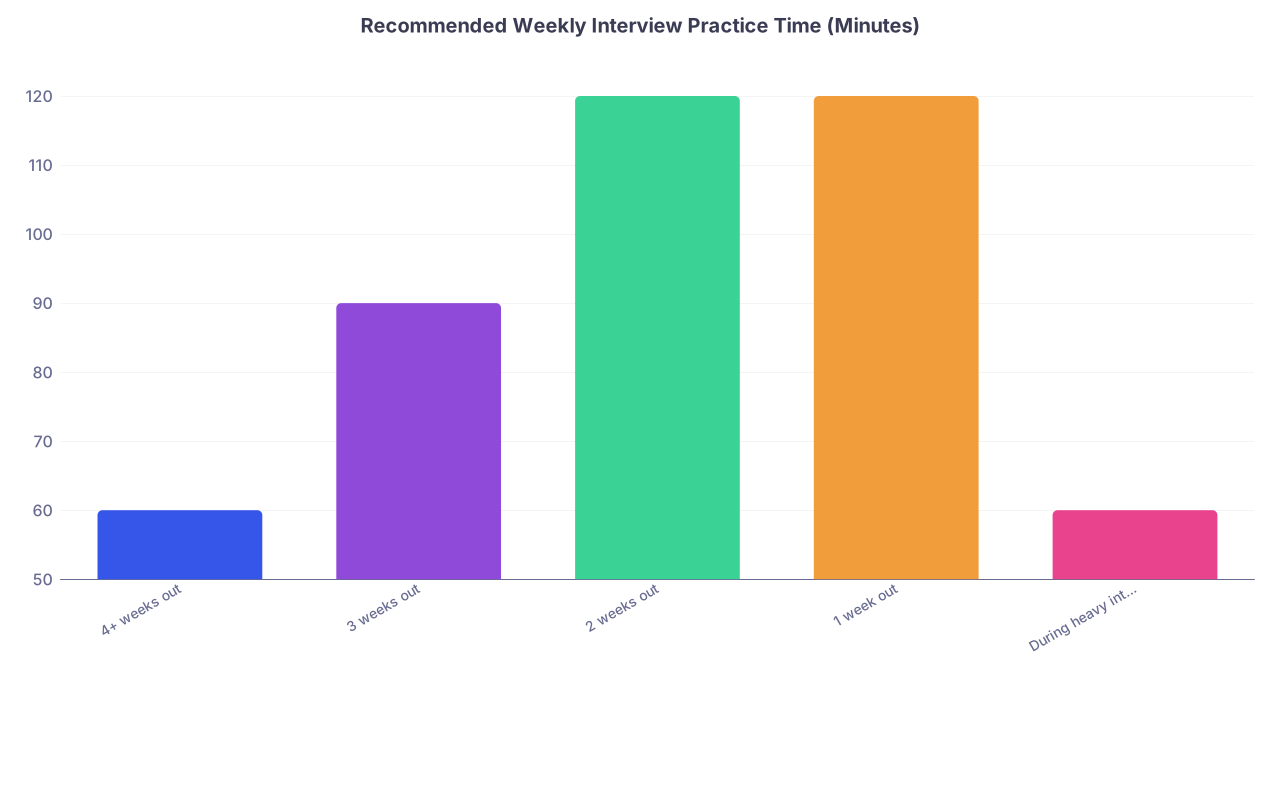
10. Timing Your Prep Over the Interview Season
You do not need to “cram” interview practice the night before. Space it.
| Category | Value |
|---|---|
| 4+ weeks out | 60 |
| 3 weeks out | 90 |
| 2 weeks out | 120 |
| 1 week out | 120 |
| During heavy interview weeks | 60 |
Rough schedule:
4+ weeks before interviews:
- 2 sessions per week, 30 minutes each.
- Focus: basic scripts (tell me about yourself, why specialty, core stories).
2–3 weeks before:
- 3 sessions per week, 30–40 minutes.
- Add: program-specific “why us,” refine behavioral answers.
Week of an interview:
- 1–2 shorter run-throughs (20–30 minutes).
- Night before: single light review, no new content.
During peak season (multiple interviews/week):
- 10–15 minute warm-up the morning of or night before:
- “Tell me about yourself.”
- “Why this specialty?”
- “Why this program?” (for the specific program).
- 10–15 minute warm-up the morning of or night before:
11. Put It Together: One Full Mock Interview Script
Use this as a skeleton. Have a friend or mentor ask these, or ask yourself on camera.
- “Tell me about yourself.”
- “Why this specialty?”
- “Why our program?”
- “What are your strengths?”
- “What are some areas you are working on?”
- “Tell me about a time you had a conflict on the team.”
- “Tell me about a time you made a mistake.”
- “Tell me about a patient who impacted you.”
- “Where do you see yourself in 5–10 years?”
- “Do you have any questions for us?”
You already have structures for answers 1–8. For 9:
“In 5–10 years, I see myself as a [role: academic hospitalist, community pediatrician, subspecialist, etc.] who is heavily involved in [teaching, QI, leadership, community work]. I would like to be at an institution where I can [specific: lead a curriculum, run a QI project, mentor trainees]. The training here would prepare me well for that by [name 1–2 program features].”
Run this full set once or twice with a timer. Keep the whole thing under 30–35 minutes.
12. Last 48 Hours Before the Interview: Minimal, Targeted Reps
Do not rewrite your script the night before. You are tuning, not rebuilding.
Two days before:
- 30 minutes:
- “Tell me about yourself” x2.
- “Why this specialty” x1.
- Behavioral story you feel weakest on x2.
- Review specific notes on the program and update your “Why us?” answer.
Night before:
- 15–20 minutes:
- One clean run of:
- “Tell me about yourself.”
- “Why this specialty.”
- “Why this program.”
- Review 3–4 questions you will ask them.
- One clean run of:
Stop. Sleep.
Day of, before you log on / walk in:
- 5–10 minutes solo:
- Say “Tell me about yourself” and “Why this program” out loud once.
- That is it.
Key Takeaways
- Do not “wing it.” Use simple, repeatable structures (CPARR and 3-part answers) and rehearse them out loud until they feel natural.
- Build and reuse 3–5 strong stories for behavioral questions, and script your openers: “Tell me about yourself,” “Why this specialty,” “Why this program,” and “Why you.”
- Practice in short, focused sessions with recording and review, fixing one issue at a time. That is how you turn vague anxiety into controlled, predictable performance on interview day.