
The way most applicants “prepare” for residency interviews is broken. Endless Google Docs, 30 open tabs, and scattered notes guarantee one thing: you will forget something important when it matters.
A one-page prep sheet for each residency program fixes that problem. It gives you a tight, battle-ready summary you can actually use the night before and the morning of interviews—without drowning in information.
Here is how to build it, step by step, so it actually helps you perform better, not just feel busy.
Step 1: Decide the Exact Structure of Your One-Page Sheet
You do not need a beautiful template. You need a consistent, brutal, functional structure you can scan in under 60 seconds.
Your sheet must answer four questions:
- Why this program?
- Why me for this program?
- What do I need to remember about them?
- What do I need to ask them?
Organize your page into these sections (this layout works in Word, Google Docs, or Notion):
Top 1/4 of the page – “Program Snapshot”
- Program name, city, and state
- Track (categorical, advanced, prelim, TY)
- Interview date / interviewer names (if known)
- 3–5 bullet “Why this program”
- 2–3 “Potential red flags / concerns to clarify”
Middle 1/2 of the page – “Key Details & Fit” Left column:
- Training structure & curriculum highlights
- Patient population & hospital system details
- Call schedule / hours / wellness details
- Research and fellowship outcomes
Right column:
- Your tailored personal pitch points
- Specific experiences that match their strengths
- Any shared connections (alumni, faculty, mentors)
Bottom 1/4 of the page – “Questions & Logistics”
- 5–7 high-yield questions (sorted by who to ask)
- Program-specific quirks (EMR, night float, didactics style)
- Travel / Zoom logistics + time zones
- Post-interview notes space
You are aiming for one printed page or one screen view. No scrolling. If you have to scroll, it will not be used under stress.
Step 2: Build a Reusable Blank Template
You will not survive interview season if every prep sheet is freestyle. You need a master template.
Create a blank version that looks roughly like this:
| Section | Content |
|---|---|
| Header | Program name, city/state, track, interview date, interview format |
| Program Snapshot | 3–5 'Why this program' bullets, 2–3 'Concerns / questions' |
| Curriculum & Training | Key rotations, unique tracks, schedule structure |
| Patient Population & System | Hospital type, patient demographics, catchment area |
| Outcomes & Opportunities | Fellowships, research strengths, leadership roles |
| Your Fit & Pitch | 4–6 tailored talking points linking you to program |
| Questions to Ask | 5–7 questions, tagged for PD, residents, faculty |
Copy/paste this template for every program. Fill it in using the same structure, same order, same format.
Why this rigid structure works:
- You build muscle memory. Your brain learns where the important info lives.
- During a 5‑minute prep between back‑to‑back Zoom sessions, you know exactly where to look.
- After 10+ programs, patterns jump out—making your rank list decisions easier.
Step 3: Gather Only the Information That Actually Matters
Most applicants treat program websites like research projects. They read everything, remember nothing, and overload their pages.
You do the opposite: collect only what changes behavior on interview day or affects your rank list.
A. Program Snapshot (Top of Page)
From program website, FREIDA, and any info packet:
Program name and track
Example: “University of X Internal Medicine – Categorical (NRMP #1234560C0)”Location & affiliated hospitals
- Main hospital (county, VA, academic, community)
- Any key satellites you will rotate through
3–5 ‘Why this program’ bullets
These should be your spoken answers, not their marketing slogans.
Example:- Strong county experience with underserved patients (aligns with my FQHC background)
- Robust clinician-educator track; I want to teach and build curriculum
- Graduates consistently match cards/GI at strong fellowships
Avoid fluff like “strong clinical training” and “supportive environment.” Everyone says that. Focus on specifics you can point to.
- 2–3 “Concerns / questions to clarify”
This is where you are honest.
Examples:- Recent expansion in class size – has this affected case volume or autonomy?
- No night float listed – what does overnight coverage look like in reality?
- Only 2 elective months PGY-2/3 – enough time for research?
These become targeted questions later.
Step 4: Lock Down Curriculum, Hours, and Patient Population
This is where people either over-collect or under-collect. You want signal, not noise.
Curriculum & Schedule (middle left)
Pull from program website, info sessions, and resident forums (take Reddit with a grain of salt, but do not ignore trends).
Capture:
Structure
- 4+1, 6+2, or traditional firm system?
- How many months of wards, ICU, electives, ambulatory each year?
Unique rotations / tracks
- Urban underserved track, global health track, research pathway
- Dedicated ultrasound curriculum, simulation, bootcamps
Call / night structure
- Night float vs 24‑hr calls
- Typical ward caps (e.g., 10–14 patients)
- Weekends: q2, q3, or something else
Write this as rough bullets, not prose. For example:
- 4+1 model – clinic every 5th week
- PGY-1: 4 wards, 1 ICU, 2 ED, 2 electives, 2 ambulatory
- Night float PGY-2+, no 24‑hr calls
- Ward cap 12+2 (intern+senior)
These become talking points. If they ask, “What questions do you have about our curriculum?” you have them on tap.
Patient Population & System
Interviewers love when you can describe their patient population correctly.
Capture:
Hospital identity
- County vs private vs VA vs academic
- Trauma center level if relevant (for surgery/EM/IM)
Population
- Predominantly underserved? Immigrant communities? Rural referrals?
- High prevalence of particular conditions (HIV, sickle cell, substance use, advanced heart failure)
Write this in 2–4 bullets:
- County + VA + tertiary academic
- Large immigrant and Spanish-speaking population
- High HIV/hepatitis C, substance use, advanced CHF/COPD
Now you can say, “I am particularly drawn to your large immigrant population because…” and connect to your experience.
Step 5: Map Their Strengths to Your Story (Your Fit & Pitch)
Here is where most people fail. They collect facts about the program but never connect them to their application. So their answers sound generic.
Your goal: turn your prep sheet into a script for tailored answers.
Your “Your Fit & Pitch” section should have 4–6 bullets, each structured like:
Their strength → Your experience → The bridge you say out loud
Example bullets:
- Strong clinician-educator track → I developed a near-peer teaching series in medical school → “I want to continue formal training in medical education.”
- Heavy county exposure with underserved patients → 2 years at free clinic + QI project on hypertension in uninsured patients → “I want to keep working with structurally marginalized groups.”
- Robust research infrastructure in health services / outcomes → MPH with outcomes project on readmissions → “I want to be in a place where I can do implementation-focused research.”
Write them like this on the sheet:
- Clinician-educator track → my med ed curriculum + lectures → tie to long-term goal in teaching
- County hospital / underserved → FQHC + QI → tie to desire for safety-net setting
- Outcomes research support → MPH project → tie to academic career aim
That is the glue that turns “Why this program?” from generic to surgical.
Step 6: Write Smart, Program-Specific Questions
If your questions could be asked at any program, they are weak.
You need 5–7 questions total, grouped by person:
- 2–3 for residents
- 2–3 for program director / APD
- 1–2 for faculty / interviewer
And at least half of them should be clearly custom to that program.
Examples of strong program-specific questions:
For residents:
- “I noticed the program moved from a traditional call system to night float. How has that affected your sense of ownership on patients and your fatigue?”
- “You have a mix of county and private hospital time. Where do you feel you learned the most, and why?”
- “The website mentions a wellness half-day. In practice, how often does that actually happen, and what do people use it for?”
For PD/APD:
- “Your graduates match into a wide variety of fellowships and also primary care. How intentionally do you individualize mentorship early on?”
- “You expanded from 18 to 24 residents per year recently. What did you put in place to protect educational quality and patient volume per resident?”
- “How do you identify residents who are struggling early, and what does real support look like here?”
Write these on the sheet as short triggers, not full sentences:
- Ask residents: night float → ownership & fatigue
- Ask residents: county vs private – where do you learn most?
- Ask PD: class expansion – impact on volume & support
During the interview, you can then turn them into full sentences naturally.
Step 7: Capture Logistics So You Do Not Make Amateur Mistakes
Nothing tanks confidence like scrambling for Zoom links or time zones 10 minutes before.
On the bottom of your sheet, reserve a small block for logistics:
- Interview format: Zoom vs in-person
- Time block: 9:00–1:30 Pacific (translate into your local time)
- Platform: Thalamus, Zoom link, or proprietary portal
- Dress code if specified
- Contact email/phone if tech issues
If you are doing multiple interviews across time zones, use a quick visual:
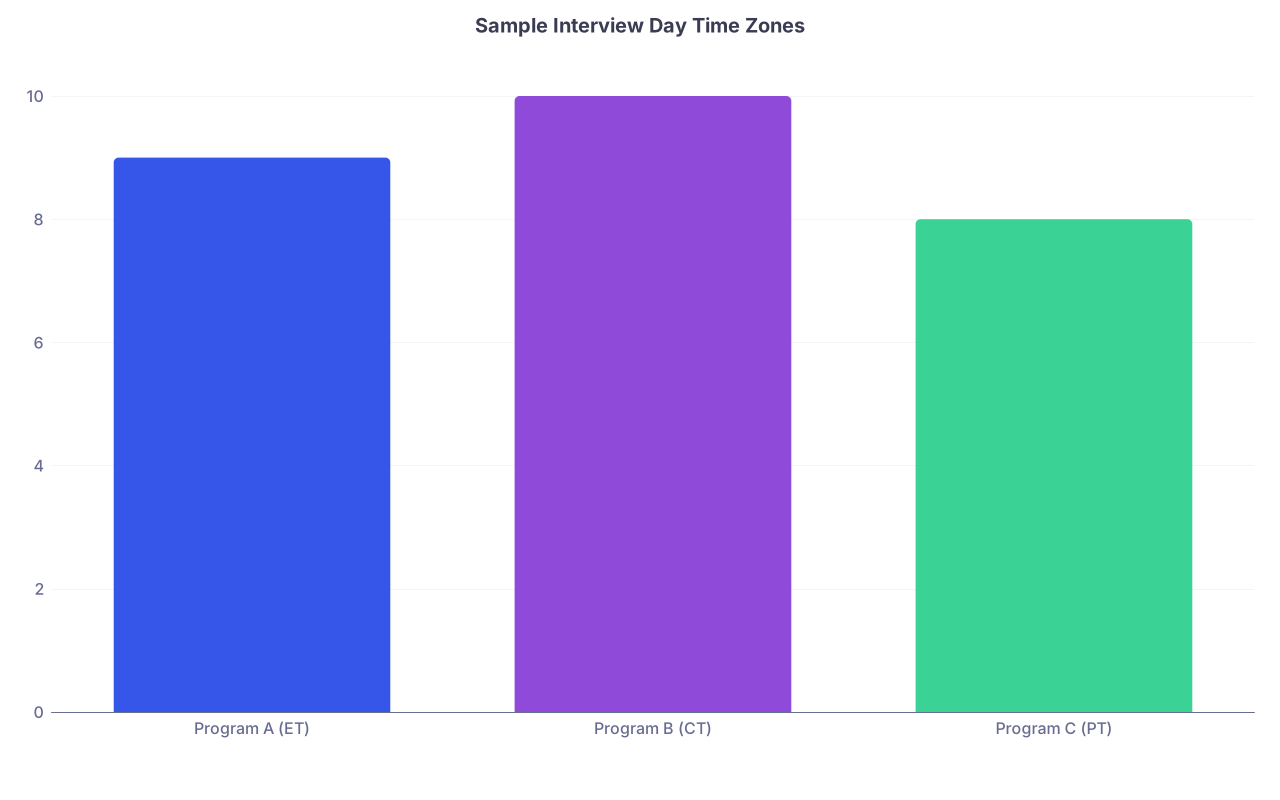
| Category | Value |
|---|---|
| Program A (ET) | 9 |
| Program B (CT) | 10 |
| Program C (PT) | 8 |
Interpretation (do this as a note to yourself):
- Program A: 9:00–1:00 ET (your local)
- Program B: 8:00–12:00 CT → 9:00–1:00 ET
- Program C: 9:00–12:00 PT → 12:00–3:00 ET
Write it on your sheet in your own words:
“Local time: 12–3 pm. Log on by 11:45.”
That 10 seconds of prep avoids the classic “wrong time zone” disaster.
Step 8: Build a System to Produce These Fast
If each sheet takes you 2 hours, you will not keep up.
You are aiming for:
- 30–40 minutes for the first 2–3 sheets
- 15–20 minutes per sheet once you are in rhythm
Here is a simple workflow that works:
Open three things only:
- Program website (curriculum + residents/faculty pages)
- FREIDA or similar database
- Your application (personal statement, ERAS experiences)
Fill sections in this order:
- Program Snapshot (5–7 bullets)
- Curriculum / patient population (6–8 bullets)
- Your Fit & Pitch (4–6 bullets)
- Questions (5–7)
- Logistics (copy from email)
Set a hard time cap:
- 20 minutes. When the timer hits, you stop.
- If you are still stuck, you are perfectionizing, not preparing.
To visualize the workflow:

| Step | Description |
|---|---|
| Step 1 | Open Template |
| Step 2 | Scan Program Website |
| Step 3 | Fill Program Snapshot |
| Step 4 | Add Curriculum & Population |
| Step 5 | Link Your Experiences |
| Step 6 | Draft Program-Specific Questions |
| Step 7 | Add Logistics & Time Zones |
| Step 8 | Print or Save as PDF |
You are not writing an essay. You are building a tactical tool. Feel free to leave blanks if something is not available. The act of looking was already valuable.
Step 9: Use the Sheet Correctly Before and During Interview Day
Most people prepare and then ignore their notes on the actual day. That is like training for a marathon and leaving your shoes at home.
Here is how to actually use the one-page sheet.
Night Before
- 10–15 minutes: Read your sheet out loud.
- Practice:
- “Why this program?” using your top bullets.
- 1–2 tailored examples linking your experiences to their strengths.
- A couple of your questions as if you are asking them to a resident.
You are not memorizing lines. You are burning in concepts and transitions.
Morning Of
- 3–5 minutes: Scan only:
- Program Snapshot section
- Your Fit & Pitch bullets
- First 2–3 questions you really want to ask
This gets the right names, phrases, and themes at the top of your mind.
Step 10: Capture Post-Interview Notes While It Is Fresh
Half the value of the sheet is after the interview. You think you will remember what you felt. You will not—especially after 10+ programs.
Immediately after you log off or leave:
On the bottom or back of the sheet, jot:
Overall vibe: 2–3 short bullets
- “Residents tired but honest; good camaraderie.”
- “PD very transparent about program weaknesses.”
- “Fellowship aspiration supported but not overemphasized.”
Pros you discovered that were not obvious from website
- “Senior resident described real autonomy in ICU.”
- “Clinic truly protected; no pages, phones held by nurses.”
Cons or concerns that matter
- “High rent + low salary – residents living with 2–3 roommates.”
- “Recent leadership turnover; still in transition.”
Rank list gut reaction
- Straight, brief statement: “Currently top 3,” “mid tier,” or “below X program.”
You are not writing a love letter. You are archiving your actual experience for rank list season.
You can later build a simple comparison from your sheets:
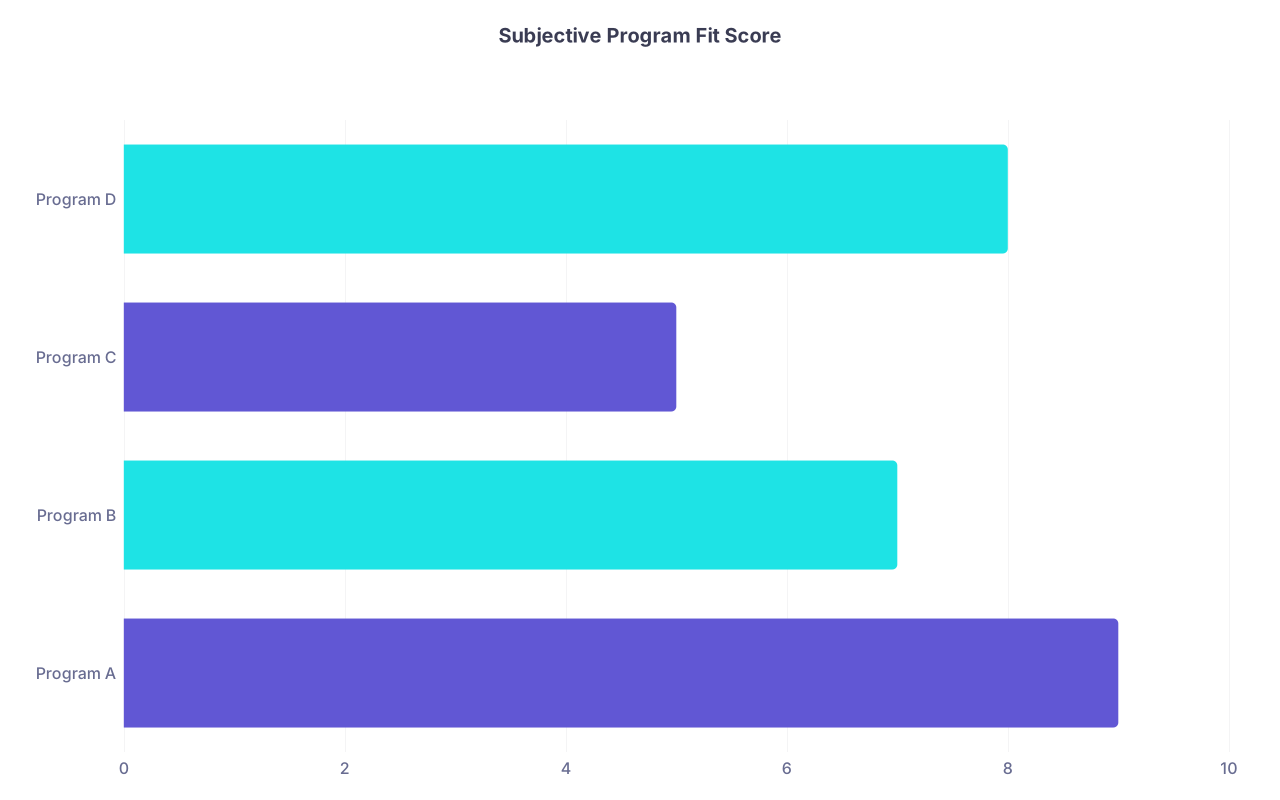
| Category | Value |
|---|---|
| Program A | 9 |
| Program B | 7 |
| Program C | 5 |
| Program D | 8 |
Just use a 1–10 gut score on “fit” after each interview and jot it on the sheet. When you finally rank, this chart mirrors how you actually felt over time, not what you vaguely recall.
Step 11: Digital vs Paper – Decide and Commit
Do not bounce between methods. Pick one.
If you like paper:
- Export each sheet as PDF and print.
- Use a physical folder with tabs labeled by program.
- Bring sheets (discreetly) for in-person interviews; keep them in your bag for pre-day review.
If you prefer digital:
- Keep a folder: “Residency Interview Prep Sheets” with one file per program, named
Program – Specialty – Date. - Before each interview, open that single sheet on your laptop or tablet.
- For Zoom interviews, have the sheet next to the Zoom window (but do not read it obviously while on screen).
Either way, do not juggle multiple docs or tab overload. The entire point is simplicity.
Step 12: Avoid the Most Common Mistakes
I have watched very strong candidates undermine themselves with lazy prep. Here is what not to do:
Do not copy-paste their mission statement as your “why this program.”
It sounds generic and insincere. Translate it into your language or skip it.Do not list 20 questions.
You will ask 3–5 max. Pick the best ones. The rest are clutter.Do not ignore your concerns.
If you are genuinely worried about fellowship placement, hours, or toxicity, put it on the sheet and address it with smart questions.Do not waste time on irrelevant micro-details.
You do not need to memorize every single faculty name or every elective. Focus on system-level structure and the 2–3 areas that really affect your life.Do not treat every program identically.
Copy-pasted answers are obvious. Your sheet forces a minimum level of customization. Use it.
Step 13: Customize Slightly by Specialty (If Needed)
Different specialties care about different things. Adjust one section of your template accordingly.
For example:
Internal Medicine:
- Emphasize fellowship outcomes, ICU exposure, continuity clinic model.
Emergency Medicine:
- Emphasize trauma level, volume, peds exposure, procedures.
General Surgery:
- Emphasize operative volume, autonomy, fellow vs resident case competition.
Psychiatry:
- Emphasize psychotherapy training, consult-liaison, integrated care models.
Add one short specialty-focused block in the middle:
“Specialty-Specific Highlights”
- EM: trauma level I, annual volume, ultrasound curriculum
- Surgery: chief cases per grad, early PGY-2/3 OR time
- Psych: number of therapy supervision hours, integrated clinics
This keeps your prep honest about what actually matters for your field.
Step 14: Turn the System On Now
Do not wait until the week of your first interview. By then you will be catching up, not preparing.
Here is your concrete next step:
- Open a blank document and paste in the template structure from Step 2.
- Pick the first program on your interview list.
- Set a 20‑minute timer.
- Fill in:
- Program Snapshot
- 3 bullets in Your Fit & Pitch
- 3 program-specific questions
Stop at 20 minutes, even if it is imperfect.
You now have your first functional one-page interview prep sheet.
Open your calendar and schedule a 30‑minute block tomorrow to build the next two.