
Your weak rotation evaluation is not the problem. How you handle it is.
Program directors do not expect perfection. They expect adults. People who get punched in the face by a bad month and respond with insight, humility, and a concrete plan. If you do this right, that “Needs Improvement” or lukewarm comment can become one of the strongest answers you give in residency interviews.
I have watched applicants with mediocre comments like “could be more proactive,” “occasionally late,” or “struggled with organization early in the rotation” turn those exact phrases into convincing stories of growth that programs actually respect.
You are not here to be flawless. You are here to be coachable and accountable.
Here is exactly how to fix this.
Step 1: Get Completely Clear on What Actually Went Wrong
Hand-waving is what sinks you. You cannot say “I had a tough rotation but I learned a lot” and expect interviewers to nod along. You need precision.
Start with the evidence.
1. Collect every data point
Pull together:
- The formal evaluation text (end-of-rotation form, narrative comments)
- Any mid-rotation feedback you received
- Email feedback from residents/attendings (if any)
- Your own memory of specific incidents that probably triggered the comments
Then categorize the issues. Do not sugarcoat. Use their words.
Common buckets:
- Professionalism: tardiness, responsiveness, reliability
- Work habits: organization, follow-through, note quality, attention to detail
- Initiative: being passive, not owning patients, not following up
- Communication: with nurses, team, patients, consultants
- Knowledge/skills: slow fund of knowledge, slow with presentations, exam skills
Make a simple table so you can see the pattern clearly:
| Category | Exact Comment | Your Example Situation |
|---|---|---|
| Professionalism | "Occasionally late to rounds" | Post-call day where you overslept |
| Initiative | "Could be more proactive" | Did not check on new consult independently |
| Organization | "Slow to update problem lists" | Missed medication change documentation |
| Communication | "Sometimes unclear plans" | Vague plan during intern presentation |
Now you are looking at reality, not vague anxiety.
2. Pick one rotation story to build around
If you have multiple weak spots, do not spray them all over your interviews. Choose:
- The rotation with:
- The clearest, most teachable problem
- A specific, memorable turning point
- Real, demonstrable improvement afterward
Example good candidates:
- Surgery month where you were late twice and got called out in front of the team
- MICU month where your notes were consistently delayed and attending flagged it
- OB/GYN where a nurse complained you were hard to reach
You are going to build one core “weakness → insight → action → result” story. You can reuse that story in multiple questions: weakness, feedback, conflict, professionalism.
Step 2: Translate the Mess Into a Clean, Ownable Problem
Interviewers are listening for three things:
- Do you own the problem without excuses?
- Do you understand why it was a problem?
- Can you explain it simply and concretely?
You need a one-sentence “problem statement” that you can say out loud without flinching.
Formula:
“On my [X] rotation, I struggled with [specific behavior], which showed up as [concrete impact].”
Examples:
- “On my surgery rotation, I struggled with time management in the mornings, which meant I was late to prerounding twice and barely on time for sign-out.”
- “On my MICU rotation, I was too passive about speaking up on rounds, so my attendings saw me as less engaged and less prepared than I actually was.”
- “Early in my OB/GYN rotation, I was slow to close the loop with nurses after talking to the resident, which led to confusion about the plan for a couple of patients.”
No passive voice. No “it was perceived that…” You say “I was” or “I did” or “I failed to.”
Own it. Cleanly.
Step 3: Do a Ruthless After-Action Review (Before They Ask You)
Weak applicants wait for programs to ask about the eval.
Strong applicants have already dissected it.
Use a short, military-style after-action review:
- What was supposed to happen?
- What actually happened?
- Why did it happen?
- What will I do differently next time?
Example for a student who was late and disorganized on inpatient medicine:
- Suppose: Be on the floor by 5:30, preround efficiently, have plans ready by 7.
- Actual: Arrived 5:45–6:00 several times, rushed prerounds, incomplete data on patients.
- Why:
- Underestimated how long prerounding would take.
- Tried to preround on too many patients.
- Did not have a structured prerounding checklist.
- Different:
- Backward-plan wake-up time.
- Night-before prep of pre-round list.
- Standardized checklist for every patient.
This exercise gives you language and structure that interviewers recognize as mature thinking.
Step 4: Build a Tight, Four-Part Story (The Framework You Will Use)
You need a reusable structure. Otherwise you ramble, overexplain, or sound defensive.
Use this framework:
- Context – Short, 1–2 sentences.
- Problem – Exactly what went wrong and its impact.
- Feedback & Insight – What you were told and what clicked.
- Action & Result – Specific steps + concrete improvement.
Keep the whole thing to 60–90 seconds when spoken at a normal pace.
Example story: “Weak evaluation for initiative”
Context
“On my third-year internal medicine rotation, I was transitioning from mostly outpatient experiences to my first busy inpatient month on a large teaching service.”
Problem
“In the first week, I waited for explicit instructions for almost everything: calling consults, following up on labs, or updating families. On my mid-rotation evaluation, my attending wrote that I ‘could be more proactive in patient care,’ which was accurate. I was functioning more like an observer than a primary team member.”
Feedback & Insight
“My attending sat me down and said, ‘You are competent and kind, but the team cannot teach you ownership. You have to claim it.’ That stuck with me. I realized I was avoiding making suggestions out of fear of being wrong, which ironically made me less useful to the team.”
Action & Result
“I asked the resident to sit with me that afternoon and outline what ‘owning’ a patient looked like on our service. I created a daily checklist: overnight events, vitals trends, labs, imaging, active problems, my assessment, and a proposed plan. Before rounds each day, I would run my plan by the resident. Within two weeks, my attending commented in my final evaluation that I had become ‘significantly more proactive’ and was now ‘reliably presenting thoughtful, patient-centered plans.’ I carried that same checklist system into subsequent rotations and have consistently received comments about strong ownership since then.”
That is a story programs can work with.
Step 5: Create Real Behavioral Change (Not Just a Pretty Story)
Here is where many applicants fail: they “reframe” the weakness but never actually fix the underlying behavior. Interviewers can usually tell.
You need to implement simple, visible systems that directly address the weakness. Something you can describe in detail.
Below are concrete interventions by problem category.
If your issue was: Time management / lateness
Do this:
- Backward-plan your mornings
- Determine: What time do I need to be at the hospital, ready to go?
- Work backward:
- Time to park / walk in
- Time to preround (minutes per patient × number of patients)
- Morning routines (shower, breakfast)
- Use a non-negotiable alarm protocol
- Two alarms: phone + independent alarm clock
- Place at least one across the room (forces you out of bed)
- Night-before prep
- Print or load patient lists
- Pre-chart key labs and imaging where possible
- Plan your prerounding order
That gives you a story like:
“After that feedback, I changed my routine—two alarms across the room, backward-planned my prerounds, and started pre-charting the night before. I have not been late for a shift since, and later evaluations specifically commented on my reliability in early-morning settings.”
If your issue was: Lack of initiative / passivity
Do this:
- Standard pre-round plan formulation
- For every patient, write:
- 1–2 sentence summary
- Problem list
- Your plan bullets before rounds
- For every patient, write:
- Commit to one suggestion per patient per day
- Even if it is small: adjust fluids, change pain regimen, clarify discharge timeline
- Pre-brief with your resident
- “Can I run my proposed plans by you before rounds to be sure I am on the right track?”
You then say:
“I set a rule for myself: one concrete plan suggestion per patient per day. At first I was wrong a lot, but my residents respected that I was thinking ahead. By the end of the rotation, my attending noted that I had become ‘appropriately proactive’ and ‘engaged in patient management decisions.’”
If your issue was: Disorganized / slow documentation
Do this:
- Use a templated structure for notes
- Same HPI structure, same A/P format, same problem order
- Time-block your day
- Hard blocks for:
- Morning: prerounds and data gathering
- Midday: rounding and orders
- Early afternoon: notes only, no phone checking
- Hard blocks for:
- Micro-deadlines
- “First two notes done by 11:30.”
- “All notes drafted by 3:00, final edits by 4:00.”
Then you can say:
“I built a strict template and micro-deadlines into my day—two notes done by late morning every day. The difference was obvious: by my next rotation, my evals described my documentation as ‘timely and thorough,’ the exact opposite of the earlier comment.”
If your issue was: Communication / being hard to reach
Do this:
- Tighten your pager/phone routine
- Always keep phone/pager on you, volume up
- Use a watch or device with haptics if you miss vibrations
- Standardize closed-loop communication
- Repeat back important orders to nurses/attendings
- Document key conversations as brief notes or task lists
- Check-ins
- Nurse stations: “Anything you need from me for my patients before I head to conference?”
- Resident: “Any pages or calls I should be watching for while you are tied up?”
Again, you will have very tangible details to describe.
Step 6: Reframe the Evaluation in Your Application Materials (Without Lying)
You cannot undo the evaluation. But you can contextualize it.
1. MSPE / Dean’s Letter
If your weak eval shows up there, you want your later evals and narrative to clearly contrast it.
You cannot edit the MSPE, but you can:
- Make sure other rotations highlight opposite strengths:
- “Exceptionally reliable and punctual”
- “Demonstrates strong initiative in patient care”
- Ask letter writers who saw your growth to comment explicitly:
- “I understand there was feedback earlier in the year about X. By the time I worked with [Name], I saw none of that. In fact, I saw the opposite.”
You are engineering a “before and after” arc.
2. Personal statement (optional, but powerful if done right)
You do not need to confess every misstep in your personal statement. But for some applicants, a short paragraph about a key professional growth moment is smart—especially if the weakness is visible in your file.
Example:
“Midway through third year, I received feedback that, while kind and hardworking, I was too hesitant to take initiative in patient care. That criticism stung because it was accurate. I was afraid of being wrong, so I waited for instructions rather than thinking ahead. I deliberately changed my approach: I began drafting concrete daily plans for each patient and running them by my senior resident. The habit transformed my training. By the end of the year, attendings were commenting on my ownership and clinical reasoning—skills I have continued to refine and which I am eager to bring to residency.”
Brief. Honest. Forward-looking.
3. Letters of recommendation
If possible, ask a letter writer who:
- Knows about the prior weakness, and
- Has seen you after you fixed it.
You do not need them to write an essay about your past flaw. You want them to demonstrate, through their examples, that the behavior is no longer present.
You might say to them:
“Earlier in third year I struggled with [X], which shows up in my MSPE. I made a specific effort to improve, and on your rotation I focused on doing [Y]. If your experience of me was different from that earlier eval, I would be grateful if your letter could reflect how I functioned on your team.”
That is a professional way to connect the dots.
Step 7: Practice Actually Saying This Out Loud
You can have the best story on paper and still blow it by:
- Sounding defensive
- Over-explaining
- Throwing others under the bus
- Emotionally collapsing mid-answer
You need live reps.
Record yourself answering these questions:
- “Tell me about a time you received critical feedback.”
- “What would your worst evaluation say about you?”
- “Have you ever had an unprofessional incident or concern raised during medical school?”
- “What is your biggest weakness as a clinician?”
For each, use the same four-part framework:
- Context
- Problem
- Feedback & insight
- Action & result
Watch the recording and check:
- Do you blame the system, the rotation, or the attending?
- Do you ramble on about how “overwhelmed” you were?
- Do you spend 80% on the problem and 20% on the solution? (Flip that.)
- Do you name concrete actions and measurable results?
If you keep tripping over specifics, your story is still too vague. Go back and sharpen the details.
Step 8: Anticipate Tough Follow-Up Questions
Good interviewers will probe.
Here is how to be ready.
Likely follow-ups and strong response angles
| Question | Your Focus |
|---|---|
| "Could this happen again in residency?" | Specific systems you now use |
| "How did your peers react at the time?" | Humility, openness, lack of drama |
| "What did you do on the *next* rotation?" | Concrete evidence of sustained change |
| "What would you do differently now?" | Clear plan reflecting better judgment |
You do not need memorized lines, but you do need clear themes:
- No, this is not an ongoing pattern, because:
- You put XYZ system in place.
- Later evaluations contradict the early weakness.
- You learned to seek feedback earlier:
- “Now I actively ask for mid-rotation feedback so I can correct earlier.”
- You can handle future criticism:
- “I have learned not to wait until the end of a rotation to clarify expectations.”
Step 9: Use Visual Tools to Track Your Growth (For Yourself)
If you are dealing with multiple weaker spots, sometimes seeing progress helps.
You can track your own evaluations or feedback themes over time:
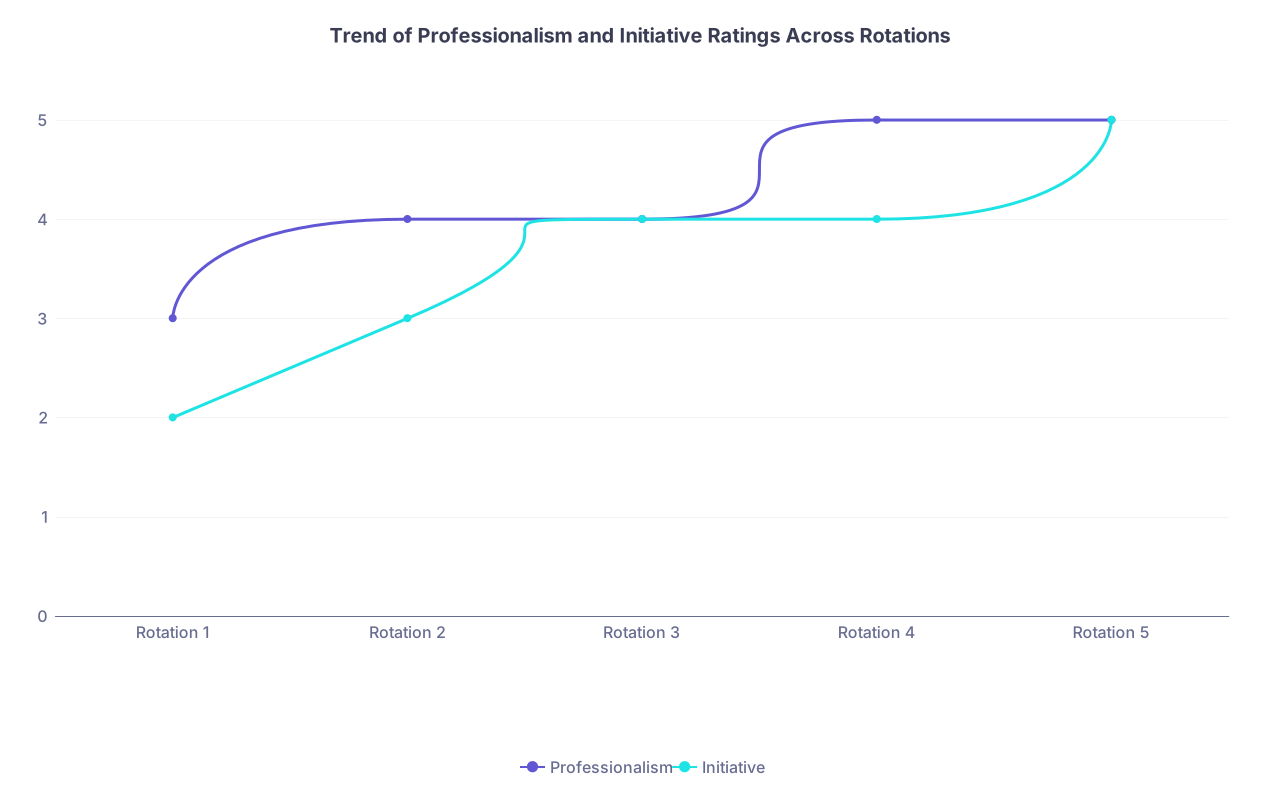
| Category | Professionalism | Initiative |
|---|---|---|
| Rotation 1 | 3 | 2 |
| Rotation 2 | 4 | 3 |
| Rotation 3 | 4 | 4 |
| Rotation 4 | 5 | 4 |
| Rotation 5 | 5 | 5 |
You will not show this to programs, obviously. But for you, watching the line go up keeps you honest and confident.
Step 10: Make This One of Your Strongest Interview Weapons
Here is the twist: handled correctly, your weak evaluation story can become an asset.
Why?
Because most applicants:
- Give fake weaknesses (“I care too much”)
- Dodge real criticism
- Project fragility
If you can sit down in front of a program director and say, calmly:
- “Here is where I failed.”
- “Here is what I learned.”
- “Here is the system I built.”
- “Here is the evidence it worked.”
You are already ahead of a lot of people with “perfect” records on paper.
You are signaling:
- Emotional maturity
- Coachability
- Self-awareness
- Problem-solving skills under pressure
Residency is four years of getting continuous feedback. They want people who do not crumble when they hear it.

| Step | Description |
|---|---|
| Step 1 | Receive Weak Evaluation |
| Step 2 | Clarify Specific Issues |
| Step 3 | Select One Core Story |
| Step 4 | Do After-Action Review |
| Step 5 | Implement Concrete Changes |
| Step 6 | Collect Evidence of Improvement |
| Step 7 | Build 4-Part Interview Story |
| Step 8 | Practice and Refine Delivery |
| Step 9 | Use Confidently in Interviews |
Rapid Checklist: Before Your First Interview
Use this as a pre-interview audit.
- Have you:
- Identified the exact text of your weak evaluation?
- Written a one-sentence problem statement?
- Completed an after-action review on that rotation?
- Implemented at least two concrete systems to address the weakness?
- Seen documented improvement in later evaluations?
- Built a 4-part, 60–90 second story that:
- Owns the problem without excuses
- Names the feedback you received
- Describes specific, practical changes
- Ends with clear, credible improvement?
- Practiced saying it out loud on video at least 3 times?
- Prepared answers for:
- “Could this happen again?”
- “What did you do on the next rotation?”
If any item above is “no,” fix it now. Not the night before your interview.