
You are sitting in your apartment at 10:30 p.m., laptop camera staring you down. You just recorded yourself answering, “Tell me about yourself,” for the sixth time. You play it back.
You sound like a Step 1 Anki card came to life.
Every sentence is polished. Every pause is identical. You hit every “talking point” from that YouTube video. And it is painfully obvious you’ve rehearsed this.
You know you need to practice. You also know programs hate canned, robotic answers. So you are stuck in this weird space: rehearse enough to not ramble, but not so much that you sound like ChatGPT with a tie.
Here is how to fix that.
Step 1: Get Your Mindset Right (Or You Will Sabotage Practice)
Before scripts, mock interviews, STAR format, all of it—fix your mental model of what “practice” means.
Most applicants do this wrong in three ways:
- They memorize full paragraphs.
- They copy someone else’s style.
- They focus on sounding “impressive,” not “clear and human.”
You want the opposite.
Anchor on ideas, not sentences
You do not rehearse words. You rehearse structures and beats.
For any common question, you should know:
- The 2–3 key points you must hit.
- One concrete example you can pull.
- A clean way to start.
- A clean way to stop.
That is it.
If you can say the same answer three times in a row with different wording but the same idea structure, you are rehearsing correctly. If it sounds like you hit “play” on an internal teleprompter, you are rehearsing wrong.
Aim for “structured conversation,” not “performance”
Programs are screening for:
- Can I talk to this person at 3 a.m. without wanting to die?
- Do they know their own story?
- Do they understand this specialty and themselves?
They are not grading you on:
- Perfect grammar
- TED-talk pacing
- Whether your answer matches some Reddit template
Your goal: controlled, intentional answers that still sound like you just said them for the first time.
Hold this idea in your head: “I’m not performing. I’m explaining my story clearly to a colleague.”
Step 2: Build Answer Frameworks, Not Scripts
Now we get tactical.
You are going to build reusable frameworks for the high-yield questions. This is where most people try to script every word, then wonder why they sound like a robot.
Use “skeleton outlines” for common questions
For each major question type, build a 3–4 bullet skeleton. For example:
1. “Tell me about yourself.”
Skeleton:
- Present: Who you are now (MS4, school, intended specialty).
- Past: A short arc of how you got here (1–2 key pivots).
- Proof: 1–2 concrete experiences that show fit for the specialty.
- Future: What you are looking for in residency.
Notice: No full sentences. Just anchors.
2. “Why this specialty?”
Skeleton:
- Initial exposure (moment or phase, not a cliché “I love helping people”).
- One or two specific elements you enjoy (procedural, longitudinal care, pathology, team structure).
- Experience that confirmed it (rotation, sub-I, longitudinal clinic).
- Tie-in: How your traits match those elements.
3. “Why our program?”
Skeleton:
- One genuine, specific program feature (curriculum, patient population, niche strength).
- One culture/fit reason (resident vibe, mentorship, size).
- Link to your goals (what you want to grow into).
- Brief closing: “So this feels like a place where I could… [train, grow, etc.].”
Do this for:
- Strengths / weaknesses
- Conflict with a team member
- Failure / challenge
- Time you showed leadership
- Research involvement
- Career goals (5–10 years)
You are not trying to memorize clever phrases. You are trying to create guardrails so you do not ramble or blank.
Use one story multiple ways
You must reuse experiences intelligently. No one has 40 distinct life-defining events.
Pick 5–7 core experiences:
- A heavy patient encounter
- A conflict on a team
- A time you got hard feedback
- A research or QI project
- Leadership / teaching role
- Something non-clinical that shows you’re a human
Then map them to different prompts.
| Experience | Question Types It Can Answer |
|---|---|
| Difficult patient encounter | Challenge, empathy, communication, resilience |
| Team conflict in rotation | Conflict, professionalism, growth, feedback |
| Research or QI project | Initiative, problem-solving, systems thinking |
| Leadership in student group | Leadership, organization, working with others |
| Non-clinical hobby or interest | Tell me about yourself, balance, wellness |
Same story. Different angle. Different emphasis. Keeps you real and consistent without repeating verbatim canned answers.
Step 3: Practice in “Rounds,” Not One-Off Sessions
The next mistake: people “practice interviews” by doing one full mock, getting smashed with feedback, then disappearing for a week.
That is like taking one NBME, reading the score, and not reviewing the questions.
You need short, focused rounds.
Round 1: Content only (no polish)
Goal: Make sure your stories and logic make sense.
Protocol:
- Pick 3–5 common questions.
- Jot down your skeleton bullets for each (2 minutes per question).
- Record yourself on Zoom/Phone audio only answering each one once, no restarts.
- Listen back and ask:
- Did I actually answer the question?
- Did I give at least one concrete example?
- Did I ramble or repeat myself?
If an answer is incoherent, fix the structure, not the phrasing. Add or remove bullets. Tighten the logic.
Do 2–3 of these sessions before you worry about delivery.
Round 2: Delivery with “messy repetition”
Now you practice sounding natural.
Rule: You are not allowed to say the answer the same way twice.
Protocol:
- Pick one question, e.g., “Why this specialty?”
- Answer it 3 times in a row, out loud, with:
- Same skeleton
- Different phrasing, different starting point if you want
- Optional: Record round 2 and listen to only the third take.
You will hear something interesting. First answer is stiff. Second is messy. Third is usually the most natural. That third answer is the style you want to reproduce: same logic, less stiffness.
Do this for all the common questions over several days.
Round 3: Time-boxing and trimming
Robotic can also come from over-talking. You sound like you are reciting a monologue because you never shut up.
You want:
- 60–90 seconds for most answers
- Maybe up to 2 minutes for complex behavioral questions
Protocol:
- Set a 90-second timer.
- Answer the question. When the timer goes off, stop.
- If you did not finish, you are trying to cram too much in.
- Force yourself to:
- Cut one example.
- Use fewer adjectives and more facts.
Then run it again, same skeleton, but through a “less is more” filter.
Step 4: Fix Your Voice, Pace, and Non-Verbal Cues
You can have perfect content and still sound robotic because your delivery is flat, monotone, or creepily polished.
Time to tune the instrument.
Listen for “robot flags” in your voice
Record yourself answering 2–3 questions and scan for these:
No pitch variation
You sound like you are reading a grocery list.
Fix: Exaggerate slight emphasis on emotionally important words: “I was frustrated,” “It was honestly humbling,” “I was excited to see…”Identical sentence length
Every sentence is the same length and cadence. Your brain is auto-playing scripts.
Fix: Mix a short sentence in. Then a longer one. Use a natural “Yeah, so…” or “What ended up happening was…” now and then.No breaths / rushing
Nervous rambling feels robotic because it sounds like you are hitting “play” and hoping you reach the end before time runs out.
Fix: Intentionally insert micro-pauses between thoughts. Two beats. Not ten.Scripted intros
If every answer starts with, “That’s a great question” or “I think that’s a very important topic,” you sound fake.
Fix: Drop filler. Start with the answer: “For me, the turning point was…” or “I’ll give you one example.”
Body language that kills natural delivery (even on Zoom)
Staring at yourself
You look distracted and self-conscious.
Fix: Move your own video tile to the top near the camera or hide self-view. Look at the camera when speaking, at the interviewer when listening.Zero movement
Sitting frozen = unnatural. Real humans move a little.
Fix: Allow small hand gestures within frame. Slight head nods. Minimal, not theatrical.Over-smiling
The “I read an article that told me to smile a lot” look.
Fix: Neutral, relaxed face as baseline. Genuine smile when something is actually light or warm.
For in-person:
- Practice your entrance: walk in, eye contact, firm but not crushing handshake, sit once invited. Do this 3–5 times with a friend or mirror so it is not the first time on interview day.
Step 5: Use Mock Interviews Correctly (Most People Don’t)
Most mock interviews are wasted.
What usually happens:
- You do one long 40–60 minute mock.
- You get flooded with generic feedback about “word choice” and “confidence.”
- You feel worse and more scripted.
You need high-yield, granular practice instead.
Structure your mocks into segments
Ask whoever is helping you (faculty, resident, advisor, friend) to follow this format:
Segment A – Core Questions (15–20 minutes)
- Tell me about yourself
- Why this specialty?
- Why our program?
- Strengths and weaknesses
- Any red flags (LOA, low score, gap year)
After each answer, ask for:
- “What was unclear?”
- “Where did I sound rehearsed?”
- “What part actually landed well?”
Segment B – Behavioral Questions (15–20 minutes)
- Time you had a conflict.
- Time you made a mistake.
- Time you went above and beyond.
- Time you received hard feedback.
Focus feedback on:
- Did the story actually match the question?
- Was the example concrete?
- Did I reflect, or just narrate events?
Segment C – Rapid Fire (10 minutes)
Shorter, less predictable prompts:- What do you like to do outside of medicine?
- What frustrates you about this specialty?
- What are you most worried about in residency?
- How would your co-residents describe you?
Here the goal is spontaneity. No perfect answers. Just real, concise responses.
Focus the feedback
When you ask for feedback, be specific. Try:
- “Where did I sound like I was giving a memorized speech?”
- “Did any answer feel too long or too polished?”
- “Which story felt most authentic and which felt like I was forcing it?”
Then pick one thing to fix next time. Not ten.
Step 6: Build a Flexible Interview “Playbook”
You are going to be interviewing at multiple programs, maybe multiple specialties if you are doing prelim/transition year plus advanced.
You need a simple, portable system so you are not re-inventing answers nightly.
Create a one-page “cheat sheet” (not a script)
One page. Not a binder.
Sections:
3-sentence bio
Different from your full “Tell me about yourself,” but overlaps. Use it for intros and small talk.5–7 core stories
Bullet each story as:- Situation (one line)
- What you did (one line)
- Outcome/lesson (one line)
Specialty bullets
3 reasons you chose the specialty, in fragment form:- “Longitudinal relationships, outpatient continuity.”
- “Procedural + immediate feedback on skill.”
- “Team-based, multidisciplinary care.”
Program-specific bullets
For each upcoming interview, add:- 2–3 specific things about that program (curriculum, tracks, patient population).
- 1–2 questions you genuinely want to ask.
This sheet lives next to you before virtual interviews or in your folder for in-person ones. You glance. You refresh anchors. Then you talk like a human, not a reader.
Step 7: Add Controlled Spontaneity
You want to sound like you prepared. But you do not want to sound pre-packaged.
So you intentionally leave 10–20% of every answer unplanned.
Techniques to keep answers alive
Change the entry point
For the same question, sometimes start with:- The moment (“On my sub-I, I took care of a patient who…”)
- The principle (“I chose EM because I like rapid decision-making…”)
- The pivot (“Initially I thought I wanted surgery, but…”)
Keeps your own brain awake.
Allow micro-pauses to think
If you get a curveball, you are allowed to say:- “That is a good question, let me think for a second.”
- Short pause. Two seconds. Then answer.
This is how actual humans respond in real conversations. Someone who answers instantly with perfectly formed, essay-like paragraphs? Obviously rehearsed.
Use “here’s one example” as a bridge
For many questions, a natural way to sound less scripted:- “I’ll give you one example.”
Then tell the story. Different examples on different days if you want.
- “I’ll give you one example.”
Keep one unscripted detail in each story
One small, specific, but non-critical detail you do not pre-plan.- The patient’s hobby.
- The exact time (night float, 3 a.m.).
- The phrase a senior resident said.
You pick it on the fly. It forces your brain to engage with the story, not just play it back.
Step 8: Practice Handling the Traps Without Sounding Defensive
Here is where many applicants sound robotic or insincere: red flags, weaknesses, discomfort questions.
You try to polish the answer so hard it loses all authenticity.
Red flags (low score, LOA, remediation)
Framework:
- Very brief context (do not re-litigate the whole situation).
- Ownership: what you did wrong or what was hard.
- Concrete steps you took afterward.
- Evidence that the issue is resolved or managed now.
You should rehearse this. But do not sanitize emotion out of it.
Bad robotic version:
“I experienced a challenge during my second year which provided a learning opportunity and I have since grown significantly from that experience.”
Better:
“During my second year, I failed Step 1 on my first attempt. That was hard to swallow. I realized I had been relying too much on passive learning, so I met with our learning specialist, built a daily question schedule, and treated studying like a job. On my second attempt, I passed with a comfortable margin and since then I have passed all clerkships and Step 2 on the first attempt. I am happy to answer more questions about it, but the main thing I learned was how to ask for help early and build a realistic plan.”
Notice:
- Straightforward.
- Specific.
- Not dramatic.
- Not trying to spin it into some heroic triumph.
That balance kills the “robot PR statement” vibe.
Step 9: Simulate the Real Thing, Not a Classroom Exercise
Eventually you have to stop tinkering and run full reps.
Do at least 2 full-length simulations
For each:
- Dress how you will dress.
- Use the same setup (Zoom, camera, location, or in-person setting).
- Have someone you are slightly uncomfortable with interview you (attending, faculty advisor, senior resident, not your best friend).
- No pausing, no “Can I try that again?”
Record the entire thing.
Afterwards, do a brutally focused review:
- Pick 2 questions where you sounded the most robotic or rehearsed.
- Rebuild only those answers: simplify skeleton, change examples, drop filler phrases.
- Run them again in isolation with messy repetition (Step 3).
You do not need ten full mocks. Two good ones plus targeted drills beat six unfocused sessions.
Track your progress like a real project
Once you are 1–2 weeks from interview season ramping up, keep a short log:
- Date
- Practice type (rounds, mock, solo recording)
- 1 thing that went better
- 1 thing to fix next time
This keeps you out of the vague, anxious “I’m bad at interviews” headspace. You are now tweaking a system, not your personality.
Step 10: The 48-Hour Pre-Interview Protocol
Last thing: what you do right before interviews matters. People destroy weeks of practice by cramming the wrong way.
Here is a simple protocol for the 2 days before any interview.
48 hours before
- Revisit your:
- 5–7 core stories
- Specialty reasons
- Program-specific bullets
- Do ONE round of messy repetition:
- “Tell me about yourself”
- “Why this specialty?”
- “Why our program?”
No more than 30 minutes.
24 hours before
- Do a single 20–25 minute light run:
- 3 common questions
- 2 behavioral questions
- 2–3 personal/wellness questions
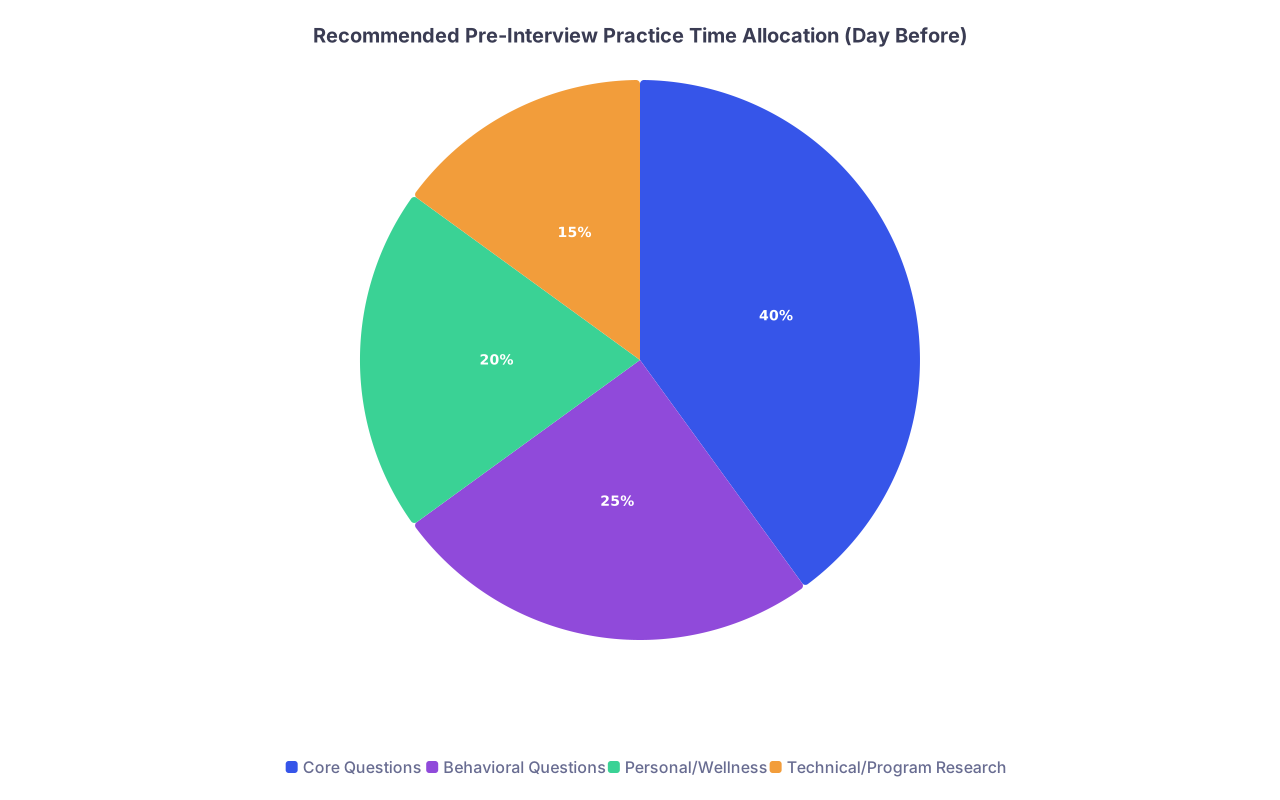
| Category | Value |
|---|---|
| Core Questions | 40 |
| Behavioral Questions | 25 |
| Personal/Wellness | 20 |
| Technical/Program Research | 15 |
Stop. Do something non-medical for at least a couple of hours. Go outside. Lift. Watch trash TV. Whatever.
Morning of (or 1–2 hours before)
- 5–10 minutes:
- Glance at your one-page cheat sheet.
- Say your 3-sentence bio out loud once.
- Answer “Why this specialty?” once.
- 5 minutes:
- Posture/voice warm-up: sit up, a few deeper breaths, a couple of sentences out loud to wake your voice up.
Then you are done. More “practice” in that last hour will not make you better. It will make you stiffer.

| Step | Description |
|---|---|
| Step 1 | Identify Common Questions |
| Step 2 | Create Skeleton Outlines |
| Step 3 | Select 5-7 Core Stories |
| Step 4 | Round 1: Content Practice |
| Step 5 | Round 2: Delivery & Messy Repetition |
| Step 6 | Mock Interviews with Targeted Feedback |
| Step 7 | Full-Length Simulations |
| Step 8 | 48-Hour Pre-Interview Protocol |
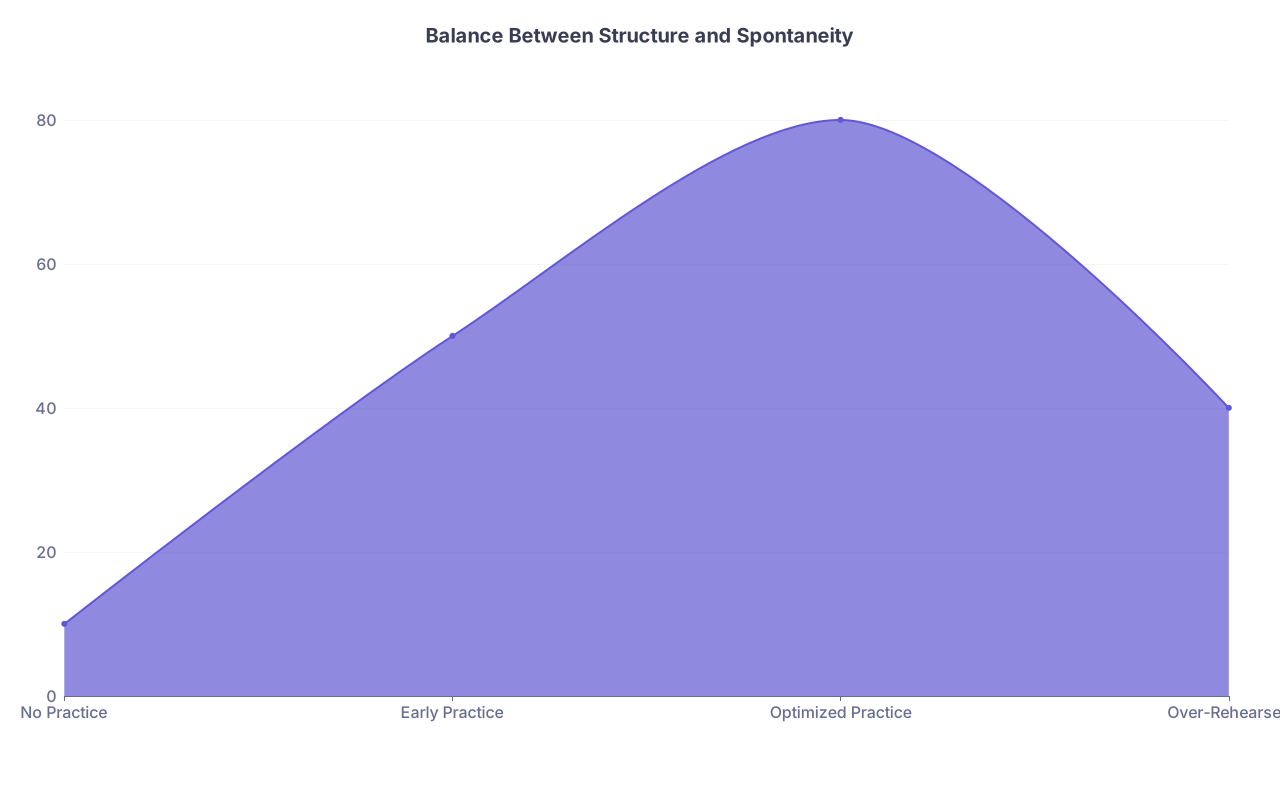
| Category | Value |
|---|---|
| No Practice | 10 |
| Early Practice | 50 |
| Optimized Practice | 80 |
| Over-Rehearsed | 40 |

Key Takeaways
- Stop memorizing full scripts. Build skeleton outlines and 5–7 reusable stories, then practice saying them in different ways.
- Practice in structured rounds: content first, then delivery with messy repetition, then timed trims, then a couple of full simulations with targeted feedback.
- Protect spontaneity. Leave 10–20% of each answer unplanned, change entry points, and use real micro-pauses so you sound like a prepared human, not a polished recording.