
The panic you feel when you blank on a residency interview question is not the problem. How you handle the next 10 seconds is.
People do not blow interviews because they do not know every answer. They blow them because they unravel on camera. I have watched strong candidates crash in real time after one bad question—and weaker candidates recover beautifully and still get ranked highly—purely based on how they handled a blank moment.
You are not going to know every answer. That is fine. Your job is to look like someone I can trust at 2 a.m. on call when things are unclear and imperfect.
Here is how you do that.
Step 1: Recognize the Blank Before It Owns You
Blanking is not silent ignorance. It has a pattern:
- Your mind flicks to “I should know this.”
- You feel your face get hot, chest tight.
- You hear the interviewer finish the question and your brain returns: nothing.
- You start word-salad rambling to fill the space.
You must interrupt that loop immediately.
Use a 3-second micro-protocol:
- Stop your mouth. Do not start talking to “buy time” with nonsense.
- Breathe once—slowly. Inhale through nose, exhale through mouth. One full cycle.
- Name it in your head. “I am blanking. That is OK. I will structure this.”
You might think that pause will feel like an eternity. It does not. A calm 2–3 second pause reads as “thoughtful” to interviewers. A frantic, unstructured answer reads as “unsafe.”
This is mental triage. You are stopping the bleed before you do anything else.
Step 2: Use a Stock Phrase to Buy Clean Thinking Time
You need a planned sentence that comes out of your mouth when your brain goes offline. Not improvisation. A script.
Choose 2–3 of these and practice them out loud until they are automatic:
- “That is a great question. Let me take a moment to organize my thoughts.”
- “I have not been asked that before. I am going to think through it out loud if that is alright.”
- “There are a couple of ways to look at that. I want to be precise, so let me pause for a second.”
What these do:
- They normalize the pause.
- They signal maturity and thoughtfulness.
- They give you 3–5 extra seconds where silence feels intentional, not panicked.
What you must avoid:
- “Umm… I do not know… I guess…” (screams insecurity)
- Nervous laughter.
- Apologizing (“Sorry, I just totally blanked”) as your first move. That comes later, if at all.
You are not buying time to stall. You are buying time to choose one of three paths: reframe, partial answer, or honest admission.
Step 3: Decide Which Kind of Question You Are Dealing With
Not all blanks are equal. When you forget a specific lab value vs when you freeze on “Tell me about yourself” are very different problems.
You need a rapid internal triage:

There are three main categories of questions you can blank on:
Behavioral / personal
- “Tell me about a time you failed.”
- “What is your biggest weakness?”
- “Explain a conflict you had on the team.”
Program / specialty motivation
- “Why our program?”
- “Why this specialty over others?”
- “Where do you see yourself in 5–10 years?”
Clinical / knowledge-based
- “How would you manage new-onset atrial fibrillation in X scenario?”
- “Walk me through your differential for chest pain in a 65-year-old.”
You handle each differently. Let us break them down.
Step 4: Recovery Protocol for Behavioral or Personal Questions
These are the ones that sting because you feel like you “should” have a hundred stories ready. When you blank here, it is usually not because you have no experiences. It is because they are all slamming the front door of your brain at once.
A. Use a “story starter” template
If you blank on a story-based question, fall back on a generic but flexible structure: STAR (Situation – Task – Action – Result). The point is not buzzwords; it is order.
Example question: “Tell me about a time you made a mistake.”
If you blank:
- Buy time: “I appreciate that question. Let me think of a concrete example rather than speaking in generalities.”
- In your head, ask yourself:
- “When did someone give me critical feedback?”
- “When did something go wrong and I felt bad afterward?”
- Choose any legitimate story, even if it feels small. The structure saves you.
Then answer:
- Situation: “During my third-year medicine rotation, I was following a patient with decompensated heart failure.”
- Task: “I was responsible for reconciling medications and presenting overnight changes.”
- Action: “I missed documenting a dose change on his diuretic, which led to confusion on rounds the next day.”
- Result & reflection: “We caught it without harm, but I felt I had compromised the team’s trust. Since then, I created a checklist I run before sign-out and I double-check EMR orders against my written list. My sign-outs are now much tighter and I have not repeated that error.”
If you can remember STAR under pressure, you will not freeze for long. You always have something.
B. If you truly cannot think of an example
Once in a while, your mind goes to static.
Use this move:
“I am honestly blanking on a perfect example right this second, but I can tell you how I try to approach [failure/conflict/feedback] generally, and if something more specific comes to me I will circle back.”
Then give a concrete general approach:
- “When I realize I have made a mistake, my first step is to own it quickly to the team, without excuses. Then I…”
- “When I sense conflict with a coworker, I usually start with a 1:1 conversation to clarify expectations before escalating.”
Side note: It is completely fair after 10–15 minutes to say, “Circling back to your question about X, a specific example came to mind…” Interviewers love this. It shows meta-cognition and follow-through.
C. Practice the “core four” stories
You reduce blanking by over-preparing categories of stories, not exact scripts:
At minimum have ready:
- A failure / mistake.
- A conflict with a colleague.
- A leadership moment.
- A time you went above and beyond.
You can reuse these across dozens of questions by changing which part you emphasize. This is not cheating. This is efficient.
Step 5: Recovery Protocol for “Why This Program / Specialty” Questions
If you blank on “Why us?” it reads as laziness, not performance anxiety. Painful but true.
Here is how to salvage it when your mind empties anyway.
A. Use the three-bucket framework
For “Why this program?” you need at least one point in each of these buckets:
- Training structure
- Rotations, schedule, autonomy, fellow vs resident balance.
- People / culture
- Camaraderie, resident happiness, diversity, mentorship.
- Fit with your goals
- Academic vs community, research niche, patient population.
If you blank, mentally run:
Structure – People – Fit.
Then say:
- “There are three things that stand out to me about your program. First, the training structure… Second, the people and culture… Third, how this ties directly to my goal of X.”
If you did even basic homework on the program, you can fill the details.
B. If you truly did not research well (and it shows)
Do not fabricate specifics you do not know. Program directors can tell when someone is making up “your renowned research in cardiology” when they have no cardiology.
Instead:
- Anchor in something real: geography, hospital type, or interaction so far.
- Then tie to your values and goals.
For example:
“I will be honest that my exposure to your program has been limited to speaking with residents and reviewing your website, but even from that I have noticed two things…”
Then plug:
- “The patient volume and acuity here at a safety-net hospital line up with my interest in caring for underserved communities.”
- “Every resident I have talked to highlighted how approachable the faculty are, which is essential for the kind of mentorship I am looking for.”
Not ideal. But vastly better than generic fluff.
C. “Why this specialty?” when your brain blanks
Here, you already know your reasons. You just lost the words.
Fallback structure:
- Origin spark – when it first clicked.
- Sustaining evidence – rotations, sub-Is, concrete experiences.
- Future self – what you see yourself doing 10 years out.
Example:
“I first became interested in psychiatry during my pre-clinical neuro block, but it really solidified during my third-year rotation when I… Since then, I have kept coming back to it because… 10 years from now, I see myself…”
If you memorize those three headings—spark, evidence, future—you will never be fully blank on this again.
Step 6: Recovery Protocol for Clinical or Knowledge-Based Questions
This is where most people panic. Especially in more academic or competitive specialties (IM with heavy cards/CC, anesthesia, surgery).
Here is the truth interviewers rarely say out loud:
I do not care that you cannot recite every management algorithm. I care how your brain works when you do not know.
A. Clarify the question first
If you blank, make sure you actually understand what they are asking.
Use:
- “Just to be clear, are you asking specifically about initial ED management, or ongoing inpatient care?”
- “Is the patient hypotensive or hemodynamically stable in this scenario?”
This does two things:
- Buys you time.
- Narrows the cognitive load so your brain can latch onto something.
B. Think out loud in a structured way
Even if you do not know the “perfect” answer, almost every clinical question can be broken into steps:
- Identify if the patient is stable vs unstable.
- List initial priorities: ABCs, monitoring, basic interventions.
- Give a very short differential or main considerations.
- Mention that you would seek help appropriately as a trainee.
Example: You blank on “How would you manage new-onset AF with RVR?”
You could say:
“First I would assess whether the patient is hemodynamically stable—mental status, blood pressure, signs of shock. If unstable, I know this can be an indication for urgent cardioversion and I would call my senior and the attending immediately while getting the defibrillator and appropriate monitoring in place.
If stable, I would focus on rate control and address reversible causes—checking electrolytes, volume status, infection, etc. As an intern, I would absolutely discuss the specific medication choices and dosing with my senior and the cardiology team, but my priority framework is stability, rate vs rhythm, and underlying triggers.”
That is a safe, honest, structured answer. You did not fake expertise. You did not say “I don’t know” and stop.
C. When you truly have no idea
Sometimes the question is outside your lane. A pediatric neurosurgery-level detail in a general surgery interview. Fine.
Use this:
“I will be honest that I do not know the exact management steps for that scenario off the top of my head. What I would do in real life is [general approach]…”
For example:
“I do not know the exact chemotherapy regimen for that oncologic scenario offhand. In practice, I would focus on recognizing the red-flag features, stabilizing the patient, and then looping in the appropriate consultants—hemonc and ICU as needed—while reviewing current guidelines.”
If you give me a safe, patient-centered, team-based approach, I am not docking you for not being UpToDate on rare regimens as an MS4.
Step 7: What Not to Do When You Blank
Some behaviors are interview poison. I have seen them turn a “maybe” into a hard no.
Do not:
Lie or bluff confidently.
Making up guidelines, lab values, or fake experiences is the fastest way to the “do not rank” pile. Faculty know their field. They will catch you.Over-apologize.
One brief acknowledgment is fine: “I am blanking for a moment.” Ten “sorrys” make you look fragile.Blame others.
“I have not had good teaching on that” or “Our school does not cover that well” sounds defensive and immature.Collapse into silence.
A pause is fine. A 20-second wordless meltdown is not.Talk in circles.
Rambling without structure is worse than a concise admission of partial knowledge.
Your job is not perfection. It is stability under imperfect conditions.
Step 8: A Pre-Built “Blank Recovery Script” You Can Practice
Here is a full sequence you can run when you feel the panic rising. Memorize it. Customize the words a bit so it sounds like you, not like you swallowed a coaching manual.
- Pause and breathe once.
- Say a stock phrase:
“That is a thoughtful question. Let me take a second to organize my response.” - Silently choose the lane:
- Personal/behavioral → STAR.
- Program/specialty → Structure–People–Fit or Spark–Evidence–Future.
- Clinical → Stable vs unstable → priorities → “I would involve my senior/attending.”
- Answer slowly, shorter than you think.
Do not chase every tangent. - If still stuck after 8–10 seconds:
“I am honestly blanking on the perfect example/detail right now. Let me tell you how I would generally approach this.” - Deliver a clean, general framework.
- Optional recovery later:
“To circle back to your earlier question about X, a specific example came to mind…”
Practice this out loud with a friend, resident, or just your phone. Record. Cringe. Repeat until your voice sounds calm even when you are improvising.
Step 9: Train the Skill Before Interview Day
Blanking is not solved by “hoping it doesn’t happen.” That is magical thinking. You need reps.
A. The 10-question drill
Once a day for a week, do this:
- Pull 10 random common residency interview questions from a list.
- Set a timer.
- Answer each in 60–90 seconds, out loud, with no pausing to think beforehand.
- Force yourself to use your recovery script on at least two questions, even if you do not truly blank.
Goal: Make the sequence of pause → stock phrase → structure automatic.
B. High-pressure simulation
Ask:
- A resident you know.
- A mentor.
- Or a classmate who is willing to be ruthless.
Tell them:
“I want you to throw 5–7 left-field questions at me and keep a straight face. Do not rescue me if I am floundering. I need to practice recovering.”
Examples they can use:
- “Teach me something non-medical in 1 minute.”
- “What is something you believe that most of your classmates do not?”
- “Defend a position you disagree with.”
These are not typical interview questions. That is the point. You are training comfort with on-the-spot thinking, not memorizing content.
C. Quick physical reset routine
Your body gives you away when you blank: fidgeting, bouncing legs, avoiding eye contact.
Before each interview (or mock):
- Two slow, deep breaths.
- Uncross legs and plant both feet on the floor.
- Drop your shoulders, literally. They tend to ride up.
- Hands resting loosely on your lap or desk, not clenching.
You are teaching your nervous system: “This is not danger. This is just talking.”
Step 10: Reframe the Blank as a Data Point You Control
Programs are not looking for automatons who recite scripts. They are looking for:
- Emotional regulation.
- Intellectual honesty.
- Team-safety mindset.
- Ability to think under uncertainty.
Blanking on a question is one of the few moments in an interview that reveals all four.
Handled well, a blank can actually help you. I have watched faculty write comments like:
- “Great composure when she forgot a detail—owned it and gave a thoughtful framework.”
- “Admitted knowledge gap without ego, emphasized patient safety and asking for help.”
That matters more than nailing some canned answer about your “biggest weakness” that sounds like it came off Reddit.
| Situation | Bad Response Example | Better Response Example |
|---|---|---|
| Behavioral story blank | “Umm… I can’t really think of anything… sorry.” | “I’m blanking on a specific story, but generally when I fail, I first own it and then…” |
| Program-specific question | “I like your reputation and the location.” | “Three things stand out: your training structure, the resident culture, and my fit with X.” |
| Clinical management question | “I’m not sure… maybe I’d just give antibiotics?” | “I’d first assess stability, then focus on ABCs and loop in my senior while we…” |
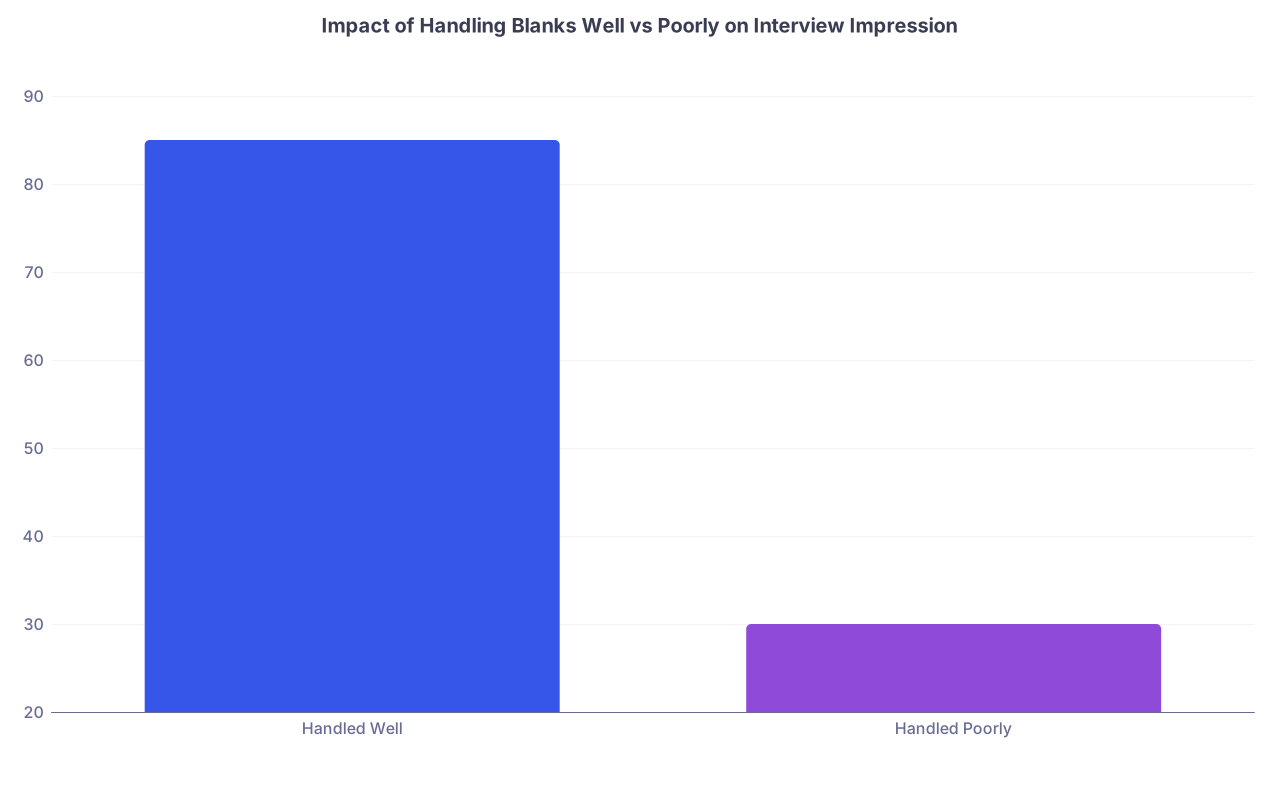
| Category | Value |
|---|---|
| Handled Well | 85 |
| Handled Poorly | 30 |
(Illustrative percentages of interviewer ratings: candidates who recover calmly from blanks often still score highly; those who panic or bluff drop sharply.)

| Step | Description |
|---|---|
| Step 1 | Hear Tough Question |
| Step 2 | Pause & Breathe |
| Step 3 | Answer with Structure |
| Step 4 | Use Stock Phrase |
| Step 5 | Use STAR Story |
| Step 6 | Use 3-Point Framework |
| Step 7 | Give Safe, Stepwise Approach |
| Step 8 | Optional: Circle Back Later |
| Step 9 | Know the Content? |
| Step 10 | Question Type |

Quick Day-Of Checklist: If You Blank on an Interview Question
Print this mentally and take it into the room:
- Pause. One full breath.
- “That is a good question. Let me think for a moment.”
- Categorize: behavioral / program / clinical.
- Apply structure:
- Behavioral → STAR.
- Program → Structure–People–Fit.
- Specialty → Spark–Evidence–Future.
- Clinical → Stable vs unstable → priorities → ask for help.
- If you still cannot land it:
“I am blanking on the perfect example/detail right now, but here is how I would approach it…” - Move on. Do not carry that question into the next one.
And afterward? Do not obsess mid-day. Fix it that night. Write the question down. Build a better answer. You just patched a hole in your armor for the next program.