
Most applicants blow the conflict question because they treat it like a personality test instead of a clinical scenario.
You are not being asked if you are “nice.” You are being tested on whether someone can trust you at 2 a.m. when the nurse is angry, the attending is impatient, and the patient is crashing.
Let me show you how to turn “Tell me about a conflict” from a trap into an easy, high-yield question you almost hope they ask.
1. What This Question Is Really Testing
Interviewers are not asking about conflict because they enjoy drama. They are screening for:
- Judgment under pressure
- Emotional self-control
- Ability to work in teams
- Accountability vs defensiveness
- Communication skills
- Professionalism when others are difficult
If you answer this question with a story that makes you look like a victim, a hero, or a gossip, you fail the test. If you answer it like you would present a complicated patient on rounds—organized, objective, focused on solutions—you pass.
Think like this:
“Conflict” = “Interpersonal complication that affected patient care, workflow, or learning.”
They want to know:
- Do you escalate everything?
- Do you avoid problems?
- Do you throw people under the bus?
- Can you function with people you do not like or agree with?
Your answer must prove you are someone they can put on their team without worrying you will generate drama or collapse under it.
2. The Most Common Ways Applicants Screw This Up
You fix problems faster if you know where people typically fail. Here are the big errors I see over and over.
A. The Vague, Useless Story
Example:
“I had a conflict with a classmate on a group project because we had different working styles, but we communicated and resolved it.”
No details. No stakes. No insight. That story tells the interviewer nothing about what you actually did.
Why it fails:
- No clear conflict
- No specific actions
- No measurable outcome
- Sounds like filler, not like a real event
B. The “I’m Perfect, They Were the Problem” Answer
Example:
“I am very organized and I always like to be on time, but my co-resident was constantly late and unprepared. I tried my best, but they just did not care.”
You just told the interviewer:
- You judge colleagues openly
- You frame yourself as morally superior
- You have no idea how to take shared accountability
- You might be difficult to work with
If your story ends with: “And then I realized they were just lazy / incompetent / unprofessional,” you are dead in the water.
C. The Ethical / Safety Disaster You Mismanaged
Example:
“The attending was doing something unsafe during a procedure and I did not say anything at the time because I was scared. The patient was harmed.”
This is not a conflict story. That is a safety and professionalism minefield. You might discuss something like this in a different question with a very careful framework, but it is usually the wrong choice for the generic conflict prompt.
Conflict stories should involve:
- Peers
- Nurses
- Allied health
- Occasionally residents / attendings, but where you handled it appropriately and safely
Not catastrophic harm you failed to address.
D. The “I Avoided It and It Went Away” Story
Example:
“I did not get along with a classmate, so I just tried to focus on my own work and eventually things got better.”
Translation for the interviewer:
- You avoid hard conversations
- You do not manage issues proactively
- You let problems smolder instead of resolving them
Conflict resolution requires actual resolution behavior. Not just silence and time.
E. The Overly Personal / Gossipy Story
Example:
“My co-resident was going through a divorce and was very emotional, and it affected our work.”
Too personal. Too much speculation. You should not be sharing colleagues’ private issues or armchair diagnosing.
3. The Only Structure You Need: CARER
You need a predictable, repeatable structure. You do not “wing it” on this question.
Use CARER:
- C – Context
- A – Action by the other person (what created the conflict)
- R – Response (your actions)
- E – Effect / Outcome
- R – Reflection (what you learned, what you do differently now)
It is a slight twist on the classic STAR method, but tailored to conflict.
Step-by-step CARER breakdown
Context (10–15 seconds)
- Who, where, what were you doing
- Why the situation mattered (patient care, team function, etc.)
Action by the other person (10–15 seconds)
- Brief, factual description
- No character assassination
- Focus on behavior, not personality labels
Response – what you did (45–60 seconds)
- How you approached the person
- How you framed the problem
- What communication tools you used
- What steps you took to resolve it
Effect / Outcome (15–25 seconds)
- Clear resolution or at least improvement
- Impact on patient care, workflow, or relationship
- Any objective indicators (fewer delays, better coordination, etc.)
Reflection (20–30 seconds)
- What you learned
- How you apply it now
- How this will make you a better resident / colleague
Your total answer should land around 90–120 seconds. Long enough to be substantive. Short enough you are not rambling.
4. Choosing the Right Conflict Story (This Matters More Than You Think)
Most people lose this question before they even open their mouth because they pick the wrong story.
You want a scenario that is:
Professional, not personal
Family drama is not residency interview content. Keep it in the clinical or academic world.Moderate stakes, not catastrophic
Missed teaching session, scheduling conflict, poor communication about orders, assignment distribution, call coverage disagreements.
Not: severe patient harm, lawsuits, or criminal behavior.Recent enough to be credible
Ideally during:- Clinical rotations
- Sub-internships
- Work as a scribe, MA, EMT, RT, nurse, etc.
If you are still in med school, do not go back to high school unless there is absolutely nothing else.
You had some agency
You were not just an observer. You took concrete actions.You do not look unprofessional
Skip any story where you:- Yelled
- Sent an angry email
- Talked trash about someone
- Broke policy
Here is a simple decision filter:

| Step | Description |
|---|---|
| Step 1 | Brainstorm potential conflicts |
| Step 2 | Discard |
| Step 3 | Keep as candidate story |
| Step 4 | Professional setting? |
| Step 5 | Moderate stakes? |
| Step 6 | You had real agency? |
| Step 7 | You acted professionally? |
Keep 2–3 stories that pass this filter. You will reuse them across multiple behavioral questions.
5. Plug-and-Play Example Answers (With Commentary)
Let’s build a solid answer and then dissect why it works.
Example 1: Conflict with a Nurse about Orders
Answer:
“On my medicine sub-internship, I was covering a patient with decompensated heart failure who was getting progressively more short of breath. Late in the evening, I placed orders for IV diuresis and a repeat chest X‑ray.
The bedside nurse called me sounding frustrated, saying she did not feel comfortable giving the higher dose I ordered because a different resident had used a much lower dose earlier in the day. She felt I was changing the plan without communication.
I took a minute to clarify what she had seen earlier in the day and pulled up the chart while we were on the phone. I realized I had read the cardiology note but not the most recent resident progress note, so there was a discrepancy in the recommended dose. I acknowledged that and explained my reasoning based on the patient’s current exam, labs, and cardiology’s recommendations. I also apologized for not communicating the change more clearly before placing the order.
Then I went to the bedside, reassessed the patient with her, and we reviewed the plan together. I documented the updated plan and messaged the senior resident to make sure everyone was aligned for overnight care.
The nurse agreed with the updated plan once we had gone through it, the patient responded well to the diuresis, and there were no further issues overnight. The nurse later told me she appreciated that I came to the bedside instead of just insisting over the phone.
That situation reinforced for me that when there is conflict about an order, there is usually a communication gap or a piece of information someone is missing. Now, whenever I am changing a plan that others have been following, I make a point to communicate proactively with the bedside nurse and my senior before I flood the chart with new orders.”
Why this works:
- Professional setting, clear stakes (patient care)
- Nurse is not villainized; her concern is valid
- You take accountability for your part (did not read final note, poor communication)
- You move from phone conflict → in-person collaboration
- Concrete outcome (patient improved, relationship improved)
- Reflection translates directly to residency behavior
Example 2: Conflict with a Classmate on a Project
Answer:
“In my fourth year, I worked on a quality improvement project with two classmates focused on reducing unnecessary lab orders on our internal medicine service. Halfway through, one teammate stopped responding consistently and was missing agreed-upon deadlines, which put the IRB and data collection timeline at risk.
At first I was frustrated and vented briefly to the other teammate, but I realized that complaining behind their back was not going to fix anything and could make the dynamic worse. I scheduled a quick meeting with the classmate who was falling behind and approached it from a problem-solving angle rather than accusation. I said something like, ‘We are behind on two key tasks, and I am worried we will miss the deadline. Can we talk about what is realistic for you right now and how we can redistribute work?’
During that conversation, I learned they were balancing an unexpected family issue and a sub‑I at the same time and were overwhelmed. Together, we re‑prioritized the project tasks, I took on the data extraction they were supposed to do, and they focused on the literature review, which was more flexible. We also set very specific check-in points with dates so nothing was vague.
We ended up submitting the project on time, and it was accepted for a poster presentation. More importantly, the working relationship recovered, and there was no lingering resentment.
That experience taught me to address conflict directly but with curiosity, because what looks like irresponsibility from the outside can sometimes be burnout or overload. As a resident, I plan to carry that forward by checking in early when team members fall behind instead of letting frustration build in the background.”
Why this works:
- Shows initial instinct (venting) but rapid course correction
- You do not portray yourself as saintly; you admit a normal reaction
- Specific phrasing used in the conversation (interviewers like to hear exact language)
- Clear redistribution of work, not magical “we communicated and it got better”
- Outcome more than “people felt happier”—there was a poster, deadline met
6. Sentence Templates You Can Steal
You do not have time during interviews to invent perfect phrasing. Use ready-made lines that sound calm, professional, and emotionally intelligent.
Describing the other person’s behavior (without attacking)
- “We had different expectations about…”
- “They strongly preferred to do X, while I believed Y was safer/more effective because…”
- “There was a mismatch between what I thought had been communicated and what they understood.”
- “From my perspective, the key issue was…”
Notice: no labels like “lazy,” “toxic,” or “unprofessional.” Only behavior and perspectives.
Opening a conflict conversation
- “Can we talk for a few minutes about how we are working together on X?”
- “I wanted to check in because I am concerned about [specific impact: delays, confusion, missed labs].”
- “I might be missing something, but I noticed…”
- “Our current approach seems to be causing [problem]. Could we look at another way to handle this?”
Showing accountability
- “Looking back, I realized I contributed to the conflict by…”
- “I did not communicate as clearly as I should have about…”
- “I made an assumption that turned out to be wrong, which escalated the tension.”
Describing your learning / reflection
- “Now I try to address issues earlier, before frustration builds.”
- “This changed how I give feedback—I am more specific and less accusatory.”
- “I learned to separate my emotional reaction from the facts of the situation and respond more deliberately.”
Use these as Lego pieces. Plug into the CARER structure.
7. Practice Protocol: How to Be Ready in One Week
Stop “hoping it goes well.” Build a deliberate mini-training plan for this one question.
| Day | Focus | Output |
|---|---|---|
| 1 | Story selection | 3 conflict scenarios chosen |
| 2 | CARER outlines | Bullet framework for each |
| 3 | First spoken run | Record 3 rough answers |
| 4 | Tightening & trimming | Get each to 90–120 seconds |
| 5 | Peer or mentor feedback | At least 1 outside review |
| 6 | Refinement | Edit based on feedback |
| 7 | Mock interview | Full run with all behavioral Qs |
Day 1–2: Build your story bank
Write out bullet points (not essays) for 3 conflict stories using CARER. One involving:
- A nurse or allied health professional
- A peer / classmate / co-resident
- A supervisor or attending (only if you truly handled it professionally)
Day 3: Talk it out — messy is fine
Record yourself answering “Tell me about a conflict you had with…” for each scenario:
- Set a 2-minute timer
- Do not read from notes
- Just talk, even if it is clumsy
The goal: get used to hearing yourself describe conflict without panicking or oversharing.
Day 4: Trim and sharpen
Listen to each recording and:
- Cut any long background that does not affect the conflict
- Remove unnecessary emotions (“I was so, so, so upset…”)
- Add one or two crisp numbers or concrete details
- Re-anchor to CARER if you wandered
You are aiming for clean, tight, specific.
Day 5: Get an outside audit
Ask a mentor, recent resident, or honest friend to listen to 1–2 answers:
Tell them specifically what you want feedback on:
- Do I sound defensive?
- Do I sound like a victim?
- Is the story clear?
- Do I actually show what I did?
You are not asking, “Was that good?” You are asking, “Where do I sound off?”
Day 6–7: Integrate and stress test
Refine based on feedback. Then:
- Have someone rapid-fire behavioral questions:
- “Tell me about a time you disagreed with a supervisor.”
- “Tell me about a time you worked with someone difficult.”
- “Tell me about a time you made a team member upset.”
- Use your 2–3 conflict stories to answer different prompts, adjusting the emphasis each time.
This stress testing is what separates people who have “a nice answer” from people who can field any behavioral question without blinking.
8. Red Flags to Eliminate from Your Answer
You should do a quick audit of your story for these landmines:
Blaming language
“They were just lazy / difficult / irrational.”No self-critique
If you cannot point to any way you could have handled it better, you sound unaware.Self-heroizing
“Everyone else was upset, but I calmly fixed everything and they were grateful.”
This sounds fake.Disclosing confidential or sensitive details
Anything that violates privacy or professionalism is an instant problem.Unresolved outcome
“We never really resolved it, but we just avoided each other.”
That is a confession of poor conflict management, not a success story.Overdramatizing
Residency is hard enough. Programs do not want someone who turns every disagreement into a saga.
If any of these show up, rewrite. Do not try to “soften” them in the moment.
9. How This Scales To Other Behavioral Questions
Here is the hidden bonus. Once you master this structure for conflict, you use the same skeleton for:
- “Tell me about a time you made a mistake.”
- “Tell me about a time you received critical feedback.”
- “Tell me about a time you had to work with a difficult team member.”
- “Tell me about a time something did not go as planned.”
It is the same pattern:
- Context
- What went wrong / who did what
- What you did to address it
- Outcome
- Reflection and future change
You are not learning 10 different frameworks. You are learning one and reusing it.
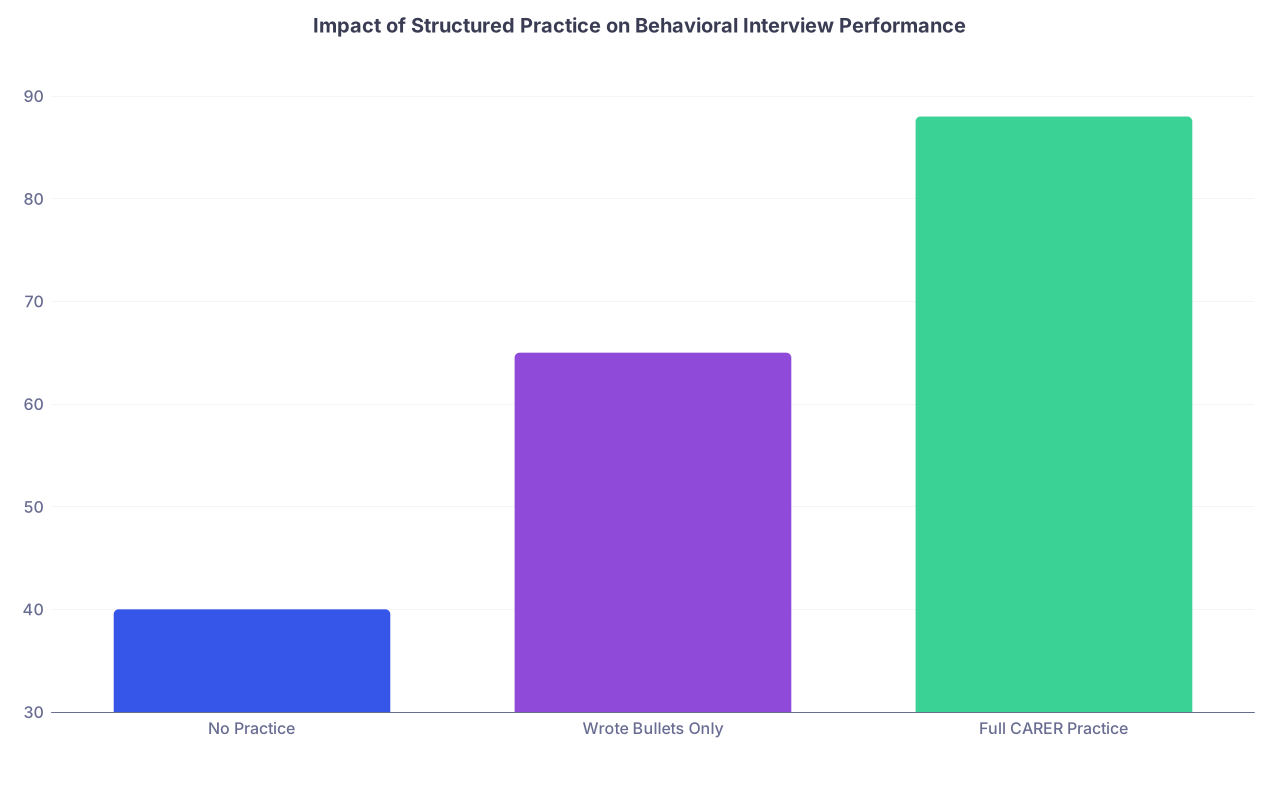
| Category | Value |
|---|---|
| No Practice | 40 |
| Wrote Bullets Only | 65 |
| Full CARER Practice | 88 |
(Those numbers are approximations from what I have seen reviewing dozens of mock interviews. The difference is very obvious.)
FAQ (Exactly 4 Questions)
1. Should I ever use a preclinical or non-clinical conflict story for residency interviews?
Yes, if it is strong and genuinely shows your conflict management skills. A high-quality story from a research lab, job as a scribe, or leadership position is better than a weak, vague clinical story. That said, if you are in your clinical years, at least one of your conflict stories should involve patient care context, because that is what residency programs care about.
2. Is it acceptable to talk about conflict with an attending or supervisor?
Yes, but be very cautious. You must show respect, appropriate hierarchy awareness, and professionalism. The conflict should center on communication, expectations, or feedback—not on you accusing them of incompetence or harm. You should show how you sought clarification, possibly involved a senior or program leadership only when appropriate, and focused on protecting patient care and the relationship.
3. What if I honestly hate conflict and usually just avoid it?
You are not alone, but avoidance is not an acceptable long-term strategy in residency. The good news: you can still answer this question well by picking a time you did address something, even if it was uncomfortable. Emphasize that it did not come naturally at first, but you forced yourself to have the conversation, saw the benefit, and since then have been more willing to address issues early rather than let them simmer.
4. How much emotion is appropriate when answering a conflict question?
You are allowed to say you were frustrated, anxious, or disappointed. You are not there to perform emotional intensity. Keep your tone calm and professional, like presenting a complicated case. Briefly name the emotion, then move quickly to what you did with it—how you paused, reframed the situation, and chose a constructive response. That balance shows maturity: you feel things, but you are not ruled by them.
Key takeaways:
- Treat “Tell me about a conflict” as a clinical scenario: organized, factual, solution-focused.
- Use the CARER structure and a pre-selected, moderate-stakes, professional story.
- Practice out loud with ruthless editing until your answer is 90–120 seconds of clear, confident, reflective content.