
The fastest way to turn a borderline Step score into an automatic red flag is to talk about it the wrong way in your interview.
You do not fix a low Step score by explaining it to death. You fix it by not making it the star of your interview.
Let me walk you through the most common disastrous interview answers I’ve heard from applicants with low Step scores—and what to say instead.
The Single Biggest Mistake: Volunteering Your Score
If you remember nothing else, remember this:
Do not bring up your low Step score unless they directly ask.
I’ve watched applicants walk into perfectly neutral interviews and drag their own Step 1 or Step 2 CK into the spotlight for no reason. The faculty had glanced at it, shrugged, and moved on. Then the applicant spent three minutes apologizing for it. Guess what the committee remembered? The apology.
Common self-inflicted wounds
Here are answers you must kill immediately:
- “So I know my Step score isn’t the strongest, but…”
- “The first thing I should probably address is my Step 1 score.”
- “I just want to explain what happened with my boards.”
- “I don’t think my Step really reflects what kind of resident I’ll be.”
Every one of those sentences does the same thing:
It tells the interviewer, “Look here. This is the problem. Focus on it.”
You’re taking a number they already know, and you’re reframing it as the defining feature of your application. That’s a tactical error.
What to do instead
If they do not mention your Step score:
- Focus on your strengths.
- Talk about your clinical performance, work ethic, and fit for the program.
- Let your low score stay as ink on a page, not the centerpiece of the conversation.
If they do ask? Then you answer calmly, briefly, and with a forward-looking frame. We’ll get to that. But stop preemptively confessing.
Answer Type #1: The Excuse Monologue
Nothing torpedoes a shaky Step score faster than a 5-minute sob story.
You know the genre:
- “During that time my grandmother was sick, and I had to travel a lot…”
- “Our school switched to online learning and that really hurt my studying…”
- “I had test anxiety, then Prometric issues, then a fire alarm went off…”
I’ve sat in rank meetings where someone actually said, “They had a 215, and then spent the whole interview explaining how the world conspired against them.” That applicant dropped on the rank list. Not because of the 215. Because of the mindset.
Why this is so damaging
When your answer is 90% circumstances and 10% ownership, you’re telling them:
- You externalize problems.
- You’re fragile under stress.
- You may do the same thing with in-training exams, boards, or patient care errors.
Program directors are not allergic to adversity. Many of them had rough patches in training. What they’re allergic to is defensiveness and blame.
A better structure
If asked, “Can you tell me about your Step score?” you want an answer that:
- Acknowledges the fact without drama.
- Takes clear responsibility.
- Shows what you learned and how you changed.
- Ends with evidence you improved.
Bad version:
“My Step 2 was low because my school didn’t prepare us well and we had a lot of schedule changes, and then I got sick…”
Better version:
“My Step 2 score is lower than I aimed for. I underestimated how early I needed to start dedicated prep, and I didn’t build in enough question practice. I adjusted by treating my shelf exams almost like mini-boards—building a weekly practice question habit, reviewing my misses thoroughly, and meeting with faculty to tighten my study approach. You can see that shift in my later clerkship evaluations and my in-house exam performance.”
Notice the ratio:
1 sentence of fact. 1 sentence of responsibility. 2–3 sentences about growth and evidence. Done.
Don’t write a novel. Don’t relive the trauma. You’re not in therapy; you’re in an interview.
Answer Type #2: The Overcompensation Speech
The second big mistake is overcorrecting and turning your low score into a weird motivational slogan.
These are the “I’m going to work twice as hard as everyone else” answers. They sound noble. They actually terrify people on selection committees.
Typical lines:
- “I know my Step is low, but I’ll be the hardest-working resident you have.”
- “I’ll always be the first to arrive and last to leave to make up for it.”
- “I’ll say yes to everything to prove you didn’t make a mistake.”
- “My low score just means I’ll grind harder than anyone else.”
On paper, you might think: “What’s wrong with being dedicated?”
Here’s the problem.
What interviewers actually hear
When you oversell relentless hustle, attendings hear:
- “Burnout risk.”
- “No boundaries. Will say yes to unsafe workloads.”
- “Might cut corners because they feel behind.”
- “Fragile self-worth tied to overworking.”
Programs want residents who are:
- Consistent, not manic.
- Coachable, not desperate.
- Sustainable over 3–7 years, not sprinting for 6 months before crashing.
How to show work ethic without sounding unstable
Instead of promising superhuman effort, show:
- Specific systems you built to improve.
- Consistency over time (not just “I’ll work hard in residency”).
- Concrete examples from clinical rotations.
Try something like:
“My Step score isn’t where I wanted it, and I responded by making my habits more disciplined, not by just working longer. On medicine, I used a structured reading plan tied to my patient list and did a set number of questions every evening. That rhythm helped my clinical reasoning and exam performance, and my attending comments reflect that. I plan to bring that same structured, sustainable approach to residency.”
That sounds like someone who will:
- Show up.
- Learn.
- Not combust in PGY-1.
Answer Type #3: The “It Doesn’t Matter” Dismissal
Do not insult the exam. Or the system. Or the people who passed it easily.
I’ve seen candidates try to spin a low Step score as a philosophical stance:
- “Standardized tests don’t reflect real clinical ability.”
- “Step is just a memorization game; I’m more of a hands-on learner.”
- “I don’t believe one test should define a doctor.”
- “The USMLE is biased and doesn’t measure what matters.”
Here’s the uncomfortable truth:
Program directors may agree with some of that privately. They still use scores. Every year. Because they have to triage thousands of applications.
Why this answer backfires
When you minimize the importance of the exam, you signal:
- Difficulty accepting reality.
- Poor insight into how selection actually works.
- Possible resistance to future required exams (in-training, boards, etc.)
You can’t walk into an interview and tell them their screening tool is meaningless. That’s not “confident.” It’s tone-deaf.
How to acknowledge limitations without dismissing reality
You’re allowed nuance. You’re not allowed denial.
Use this angle instead:
“Step is one piece of the picture. It certainly doesn’t capture all of clinical performance, but it does measure the ability to learn and retain a lot of information under time pressure. My score shows I have more room to grow in test-taking, and I’ve treated that seriously. At the same time, my clinical feedback and later exam performance show that I can integrate feedback and keep improving.”
You’re respecting the rules of the game and presenting other evidence.
Where Low Scores Quietly Kill You: “Weakness” Questions
The sneakiest trap for low Step scorers is the generic “weakness” question.
They ask:
“Tell me about a weakness,” or “What’s an area you’ve struggled with?”
You immediately think: “Step score. I should be honest.”
And then you blow 2–3 minutes rehashing the same topic they already saw in ERAS.
Why this is a strategic error
- You’re re-centering your worst metric.
- You’re missing a chance to show self-awareness in a more nuanced way.
- You’re doubling down on the narrative of “I’m the low-Step applicant.”
Does that feel honest? Maybe. Is it smart? No.
You can be honest without being self-sabotaging.
Better approach
Unless they explicitly say “Tell me about your Step score,” choose a different weakness that:
- Is real but manageable.
- You’ve actively worked on.
- Does not reinforce “I’m not smart enough.”
Examples that usually work:
- Struggling with perfectionism and learning to prioritize.
- Initially being slow with documentation and building efficiency tools.
- Being hesitant to ask for help and learning to loop in seniors earlier.
Bad answer:
“My weakness is definitely standardized tests. I’ve always struggled with them, and my Step score shows that…”
Better answer:
“Earlier in clinical rotations, I struggled with efficiency. I’d spend too long on each note because I wanted every detail perfect. My seniors pointed out that I was staying later than necessary. I started using templates more effectively and asking attendings what they really cared about in notes. Now I still aim for accuracy, but I’m more realistic about what matters, and my recent rotations reflect that.”
You’re still human. Still imperfect. But not re-opening your biggest wound.
The Subtle Trap: Comparing Yourself to “High Scorers”
Another mistake I see: using your answer to draw a bright line between you and the “smart” kids.
Listen for phrases like:
- “I’m not one of those people who get 260s.”
- “I’m not naturally gifted like some applicants.”
- “I may not have the top score, but I have heart.”
- “I’m not the 260 guy, but I’m the team player.”
That does two bad things at once:
- It reinforces that your score is clearly below their ideal.
- It makes you sound resentful or insecure.
Programs don’t want resentment between residents. They want you to be able to work with the entire spectrum—from genius to just-gets-by.
A healthier frame
You can acknowledge differences without self-deprecation.
Try something like:
“Some applicants prove themselves primarily through test scores. For me, the stronger parts of my application are my clinical work and how I function on teams. I worked hard on my exams and learned a lot through that, but the feedback I’m proudest of is from attendings and residents I’ve worked with directly.”
You’re not bashing people with high scores. You’re clarifying where your strengths show up.
When They Press You: “So Why Was It Low, Really?”
Sometimes an interviewer won’t let it go. They’ll ask again. Or push for more detail. This is where applicants panic and either overshare or crumble.
Let’s build you a script that holds up under pressure.
Your three-part backbone
When heavily pressed, stick to this structure:
- One clear, non-dramatic cause
- Specific change in behavior
- Concrete evidence of improvement
Do not:
- Introduce five new excuses.
- Start crying.
- Reveal chaotic study habits or last-minute cramming adventures.
Example of a solid, pressure-proof answer:
“The main reason my Step 1 score wasn’t where I wanted is that I didn’t align my daily habits with my long-term goal early enough. I treated preclinical exams and Step prep as separate projects, and by the time I shifted into serious question-based studying, I was behind the curve. I fixed that before Step 2 by integrating UWorld questions into my clerkships from day one, not just during dedicated. You can see that shift in my shelf scores and in my in-house comprehensive exam, which were significantly stronger than my Step 1 performance.”
You’ve given them:
- A cause that’s believable.
- A fix that’s mature.
- A result that’s verifiable.
If they keep pressing after that, that’s on them, not you. Stay calm and keep redirecting to growth and current performance.
How Programs Actually Look at Low Scores
You’ll think more clearly about your answers if you understand what’s in the back of their minds.
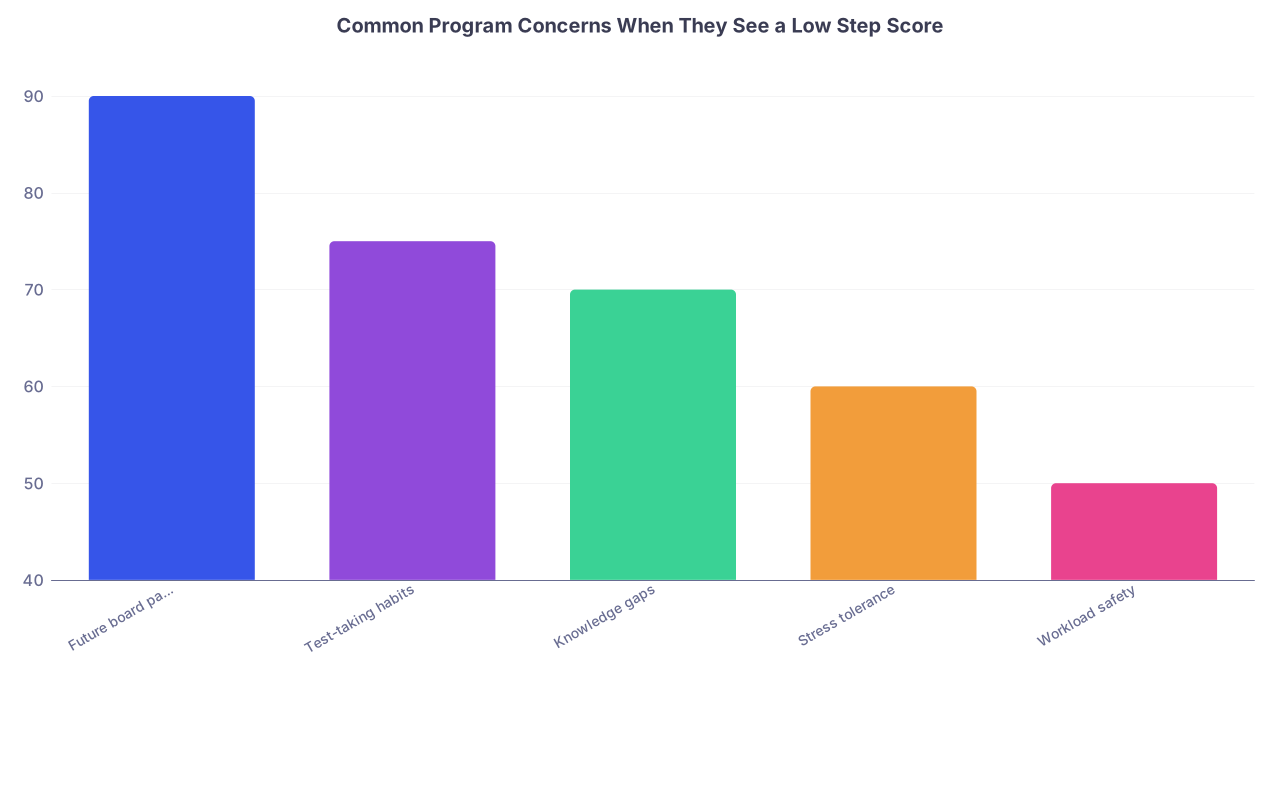
| Category | Value |
|---|---|
| Future board pass rate | 90 |
| Test-taking habits | 75 |
| Knowledge gaps | 70 |
| Stress tolerance | 60 |
| Workload safety | 50 |
Those numbers aren’t from a specific study; they’re the rough hierarchy I’ve heard repeatedly in meetings.
The big one: future board pass rate. Programs are judged—and sometimes penalized—on how many residents pass boards. A low Step score scares them mainly because they worry you’ll fail future exams.
So your interview job is to answer an unspoken question:
“Why should we be confident that this person will pass the next big test?”
Bad answers highlight:
- Chaos
- Drama
- Uncontrolled anxiety
- Magical thinking (“I’ll just work harder”)
Good answers highlight:
- Systems
- Habits
- Evidence of recent improvement
- Realistic insight into past mistakes
Your Step score is a lagging indicator. Use your interview to show them leading indicators that are trending in the right direction.
Table: Bad vs Better Ways to Address a Low Step Score
| Situation | Avoid This Answer | Use This Instead |
|---|---|---|
| They ask directly about your score | Long story about personal crises and unfair circumstances | Brief acknowledgment, responsibility, specific changes, evidence of improvement |
| They ask about weaknesses | “My biggest weakness is standardized tests” | A different real but manageable weakness you’ve actively worked on |
| They ask about work ethic | “I’ll work twice as hard as anyone to make up for my low score” | “I built structured, sustainable study and work habits that improved my clinical performance” |
| They ask how you handle stress | “Tests just make me shut down; I’ve always been that way” | “I used to spiral under exam stress; now I have specific routines that kept me steady on later high-stakes exams” |
| They ask what your score says about you | “It doesn’t reflect me at all; these tests are useless” | “It shows I have room to grow in test-taking, and I’ve already started closing that gap while developing strong clinical skills” |
Practice: Rewrite Your Worst Answer Now
You can’t wing this. When you’re nervous, you’ll default to oversharing, apologizing, or defending yourself. I’ve seen it too many times.
So here’s the specific, actionable step you need to take today:
- Open a blank document.
- Write out, word for word, how you think you’d answer:
“Can you tell me about your Step score?” - Then run it through this filter:
- Are you volunteering extra painful details?
- Are you blaming other people, systems, or bad luck?
- Are you promising to “work twice as hard” or “do anything” to prove yourself?
- Are you re-emphasizing that tests are your lifelong weakness?
- Cross out every sentence that does one of those things.
- Rewrite the answer using this spine:
- One calm sentence acknowledging the score.
- One clear sentence of personal responsibility.
- 2–3 sentences describing specific changes in how you study/work.
- 1–2 sentences pointing to better recent performance.
Do that now, not the night before your interview. Then say it out loud until it sounds like something you’d actually say, not something you memorized off Reddit.
Your low Step score is already on the page. The only question is whether you’re going to spotlight it in neon during your interview—or quietly demonstrate that it no longer predicts who you are.
Open that document and write your current Step answer word for word. Read it as if you were on the selection committee. Would you rank you? If not, fix it.