The biggest lie about low Step scores is that “a score is just a number.” It is not. Behind closed doors, your number controls which hidden flags get slapped on your file—and those flags can quietly save you or quietly bury you.
You will not see them in ERAS. You will not hear about them from official webinars. But the coordinators, PDs, and selection committee members are absolutely using them.
Let me walk you through what really happens to a low-Step applicant’s file and which specific flags can flip your application from “auto-discard” to “keep and discuss.”
What Programs Actually Do With Low Step Scores
Here’s the part no one spells out: most programs don’t read every application. They screen first, read second.
Most places I’ve seen or worked with use some combination of:
- A Step 2 CK cutoff (often 220–230 for mid-tier IM/FM, 240+ for competitive fields)
- A Step 1 “soft” cutoff (even now that it’s Pass/Fail, failures still sting)
- A GPA/Class rank filter
- Home school or affiliation preference
- Visa/citizenship filters
The coordinator runs a filter. A huge chunk of files never hits a human brain. They’re dead before any narrative, letter, or “I overcame adversity” paragraph matters.
But then there’s the messy middle category: the “maybe” pile.
This is where low Step score applicants can survive. And this is where the hidden file flags live.
Most programs I know maintain some version of internal tags—either literally inside ERAS’s internal notes, or external spreadsheets, or color-coded PDFs. Nobody likes to admit it, but it’s standard.
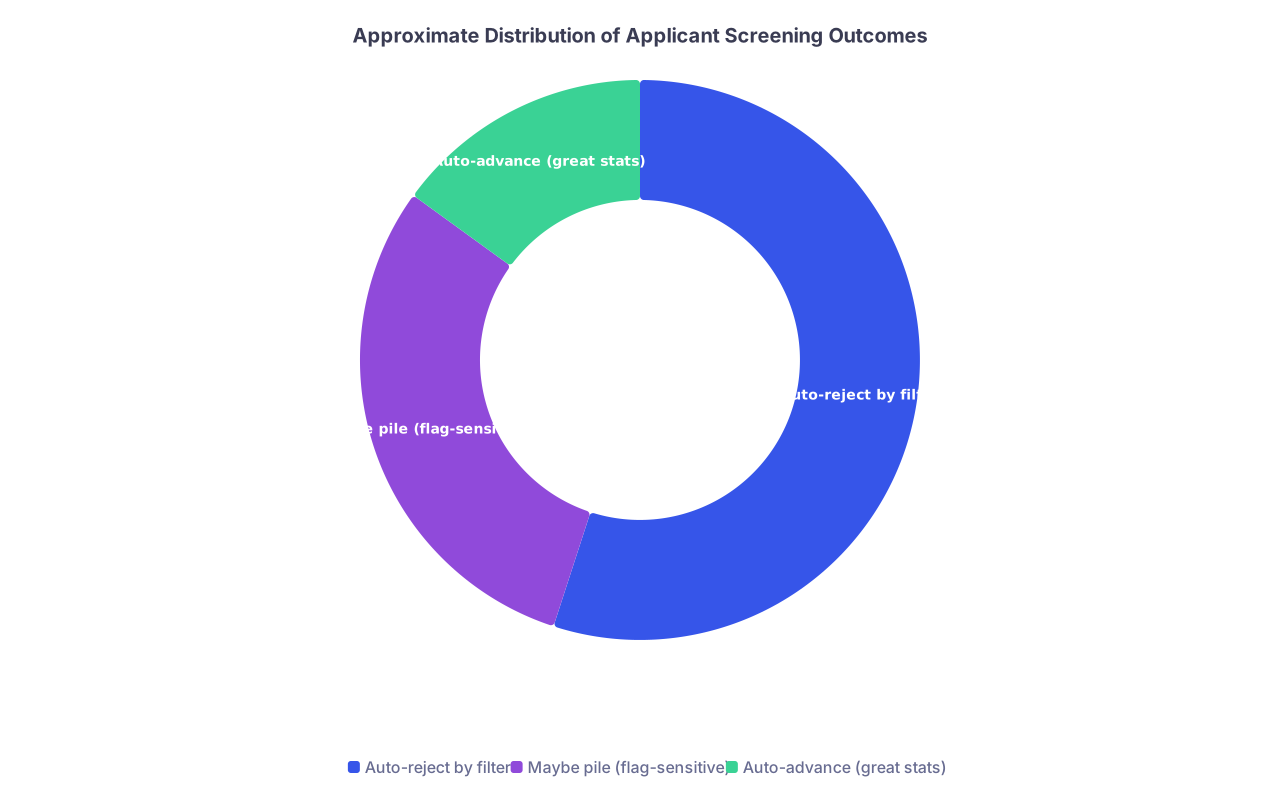
| Category | Value |
|---|---|
| Auto-reject by filter | 55 |
| Maybe pile (flag-sensitive) | 30 |
| Auto-advance (great stats) | 15 |
The “maybe” pile is where red flags, yellow flags, and redeeming flags get debated. Your job, with a low score, is to build so many redeeming flags that someone in that room says:
“Yeah, the Step is low, but this is not a ‘no’ file. Keep it.”
Let’s talk about the flags that actually do that.
The Core Hidden Flags Programs Use
Every program names them differently, but the patterns are the same. I’ve seen them as tags in spreadsheets, comment blurbs in ERAS, or literally sticky notes on printed files at smaller programs.
1. “Known Quantity” / “Trusted Source” Flag
This is the single most powerful protective flag for a low score.
What it means in plain language:
Someone the program actually trusts is willing to vouch for you.
Not generic “great student” praise. I’m talking about phrases like:
- “I would absolutely take this student into our residency.”
- “Will fit well in your program, strong team player, I recommend interview.”
- “Please look favorably on this applicant.”
Insiders know the code. When Dr. X from a known partner institution writes that sort of line, people in the room literally say, “OK, we need to pull this one out of the reject pile.”
How this flag appears:
- Internal note: “Strong letter from Dr. ___ (we know him), override screen”
- Spreadsheet column: “Faculty rec: YES”
- Email from PD to coordinator: “Make sure we invite Applicant ID #######”
How you create it (with a low Step):
You need at least one of the following:
- A home program attending who is connected to that residency
- An away rotation attending with a reputation in the field
- A division chief or chair who has actually picked up the phone or sent a direct email
No, a random letter from an associate professor at a community site will not do this. These trusted-source flags are based on relationships between attendings and PDs, not on titles alone.
So when you’re asking for letters, your real ask is:
“Would you feel comfortable recommending me strongly to programs X, Y, Z? Including mentioning me by name if they reach out?”
If the attending hesitates, that’s not a trusted-source flag. That’s just a generic LOR.
2. “Excellent Clinical Performance” Flag
There’s a specific scenario that keeps coming up at rank meetings:
“Low Step, but shelves and clerkships are strong. And the evals are glowing.”
Programs use this to counterbalance board scores. Not every PD cares about your Step 1 horror story. But they’ll absolutely look at Step 2 + clinical performance as a tighter representation of your readiness.
What triggers this flag:
- Honors or High Pass in medicine/surgery/core clerkships
- Above-average or high percentile shelf scores, especially in the specialty you’re applying to
- In written evals: words like “one of the top students I’ve worked with in the past few years,” “functions at intern level,” “would gladly work with again”
I’ve literally seen someone say:
“Yeah, Step 1 was 205, Step 2 is 224, but every IM rotation comment says ‘top 10% of students.’ That’s a keep.”
The files that die are the ones with low boards + mediocre shelves + bland evals.
Your move if your score is low:
- In your MSPE and personal statement, connect your clinical performance with your current capability. Make it obvious that you’ve already shown competence where it matters.
- Ask letter writers to compare you to your peers explicitly: “top third”, “top quartile”, “top 10%” language gets noticed.
- If your school gives a clerkship summary (distribution of evals), that context helps. Some schools bury it; dig for it.
Programs like concrete contrast: “Yes, the score is low, but the clinical data says otherwise.” That’s enough for a “clinically strong, consider despite Step” note on your file.
3. “Personality / Fit” Flag (From Rotations or Virtual Interactions)
Programs absolutely maintain off-the-record lists of:
- “Great student—would love to have”
- “Fine but forgettable”
- “Under no circumstances”
Your goal is the first category, especially if your score is dragging you down.
This fit flag usually comes from:
- An away rotation at that program
- Longitudinal electives with their faculty
- A strong virtual sub-I/acting internship where you actually interacted with them
- A PD or APD-conducted “informal” Zoom who afterwards emails, “Flag this person”
Attending comments that trigger the personality/fit flag:
- “Great team player, interns loved working with them.”
- “Took feedback well, no drama, mature.”
- “Good for nights/ICU—calm under pressure.”
Here’s the ugly truth: with a low Step score, you cannot afford to be “fine but forgettable” on an away. You need someone to walk into the selection meeting and simply say:
“This person was excellent on our service. I don’t care about the Step; we should interview.”
That’s how you beat a number.
4. “Local / Ties to Area” Flag
This one is more powerful than people admit, especially at mid-tier academic and community programs.
Programs want residents who will:
- Show up
- Be stable
- Not bolt after a year
- Understand the patient population
So, a low Step applicant with deep, believable ties to the region frequently gets flagged as “likely to rank us, low flight risk, good fit for our population.”
How it’s quietly used:
- Coordinator notes: “Local, grew up here, family nearby”
- “Spouse works in city”
- “Did undergrad + med school in-state”
- “Speaks Spanish/Arabic/other dominant local language”

What makes this real versus fluff:
- Being from that city or state
- Multiple years living there
- Family living there now
- Spouse/partner job that locks you to the region
- Prior work in local hospitals or clinics
Not enough: “I really like your city” or “I visited once and loved it.” Programs roll their eyes at that.
If you’re low Step and have real geographic ties, you need to hit that in:
- Personal statement (only for that region’s programs; use a region-specific PS)
- ERAS experiences (local volunteering, work, school)
- Supplemental ERAS geographic preference
- Any pre-interview communications or secondary questions
This flag often surfaces in meetings as:
“Numbers aren’t great, but they’re from here, family here, less likely to leave. Keep.”
5. “Late Bloomer / Upward Trajectory” Flag
Direct quote from a PD during file review:
“Step 1 was ugly, but Step 2 is 243. That’s not a bad story.”
Programs love a clean narrative, even if the numbers aren’t perfect.
The upward trajectory flag shows up when:
- Step 1 (if numeric) is low, but Step 2 CK is significantly higher
- Early basic science grades were rough, but clinical years are strong
- There’s a documented reason and clear improvement afterward (illness, family crisis, language adaptation, etc.), backed by performance later
This usually gets marked as:
- “Upward trend—do not auto-reject”
- “Improved significantly by Step 2, keep in pool”
If your Step 2 is not amazing but better than Step 1 (or your early academic record), you need to spell out the arc:
- Briefly acknowledge the initial struggle (1–2 sentences, not a sob story)
- Explicitly highlight what changed: study approach, language skills, health, support system
- Tie it to concrete evidence: “Since then, I have passed all clerkships on first attempt, honored X, and scored a 232 on Step 2 CK.”
Programs are not charities. They like improvement when it predicts you will not be a problem for their board pass rates. That’s how this flag buys you life.
6. “Workhorse / Grit” Flag (For Service-Heavy Programs)
Some residencies—especially busy community or safety-net hospitals—care more about whether you can grind than whether you scored a 250.
They look for signs that you:
- Held jobs through school
- Supported family
- Took on major responsibilities
- Have non-fragile life experience
Selection committee language here sounds like:
- “They’ve been working since undergrad, strong work ethic.”
- “First-gen, worked nights as CNA, likely to handle volume.”
- “This person won’t crumble on q4 call.”
This is not pity. This is predictive of resilience.
You build this flag by making your experiences specific and concrete:
- “Worked 20–25 hours per week as medical assistant throughout MS2–MS4.”
- “Primary caregiver for ill parent while maintaining full-time coursework.”
- “Supported family financially with weekend hospital shifts.”
And you let your letter writers back that up. The best is when a faculty member says:
“Despite significant responsibilities outside school, they performed at the level of our top students.”
That’s gold in a low score file.
How These Flags Stack Against Your Score
Let me show you how this actually plays out when a committee is sorting the “maybe” pile.
| Applicant Profile | Step 2 CK | Flags Present | Likely Outcome |
|---|---|---|---|
| A: Low Step, no flags | 214 | None | Quiet reject |
| B: Low Step, strong trusted-source letter | 214 | Trusted-source, fit | Interview at that program, maybe a few others |
| C: Low Step, great clinicals, local ties | 220 | Clinical, local | Interview at some regionals, kept on list |
| D: Low Step, upward trend, workhorse | 225 | Trajectory, grit | Interview at service-heavy / community programs |
| E: Low Step, multiple flags | 218 | Trusted-source, clinical, fit, local | Often treated like a “normal” applicant despite score |
Look at Applicant E. Same basic score range as Applicant A. Totally different fate.
This is what most students never understand: with low scores, you are no longer playing a “stats game.” You are playing a flag accumulation game.
Where and When These Flags Get Applied
There are three main points where these flags land on your file.
1. Pre-screen Stage (Before Invitations)
This is often just the coordinator and one PD or APD.
They’ll see a list filtered by whatever hard cutoffs they use. The goal here is to decide:
- Auto-reject
- Auto-advance
- Put in “needs review” bucket
Flags that help most at this stage:
- Trusted-source (“PD from X emailed about this applicant”)
- Local ties
- Big upward trajectory (noted in MSPE or summary notes)
If you know you’re below a typical cutoff, you need some pre-screen advocacy. That might mean:
- Your letter writer emailing the PD directly
- You doing an away and making sure they remember you
- Your dean’s office contacting specific PDs for a short list of programs
Yes, advocacy really happens. And no, schools rarely advertise which students they’ll do it for. You have to ask.
2. Committee Review Stage (Building the Interview List)
Now it’s multiple people around a table or a Zoom grid, often with:
- PD
- APDs
- A few core faculty
- Sometimes chief residents
They’ll pull up your file, and this is where the notes and flags get read aloud.
Example of how it sounds:
“Next, Applicant 3471. Step 2 is 219. From our own med school. Honors in IM, strong evals. Dr. S wrote, ‘I’d love to have them here.’ Local, family in town. No red flags. I’d say keep.”
Or, for someone with no flags:
“Next, Applicant 2019. Step 2 is 219. No ties to area. Average evals. Generic letters. I’m not seeing a reason to interview.”
Same score. Different narrative. Different fate.
This stage is where stacking multiple flags truly matters. One weak flag will not save you if everything else is average.
3. Post-Interview / Rank Meeting
By now your score is old news. What matters is:
- Interview performance
- Consistency with what was in the file
- How you landed with residents
- Whether anyone is actively advocating for or against you
But here’s the kicker: those original flags still sit in the background. People absolutely say:
“Remember, this is the student Dr. X called us about.”
“This is the local applicant whose partner works here.”
“This is the one with a rough Step 1 but strong clinicals.”
The low score may keep you from being in the very top rank tier, but with enough flags, you stay on the list. A lot higher than you think.
How To Intentionally Build These Flags With A Low Step Score
Let me be blunt. If your Step is low, you can’t be passive.
You have to engineer these flags.
Here’s how, in practical terms:
Identify 10–20 realistic programs where your profile isn’t absurdly off. Think home program, regional community, mid-tier academics with strong service missions.
For each, ask:
- Do I have or can I build a personal connection?
- Can I rotate there (in-person or virtual) and earn a fit flag?
- Do I have any local/regional ties I can highlight?
Prioritize rotations where:
- The PD or APDs actually see students on the wards
- Students have real responsibility (not shadowing)
- Letters can be written by known figures in the field
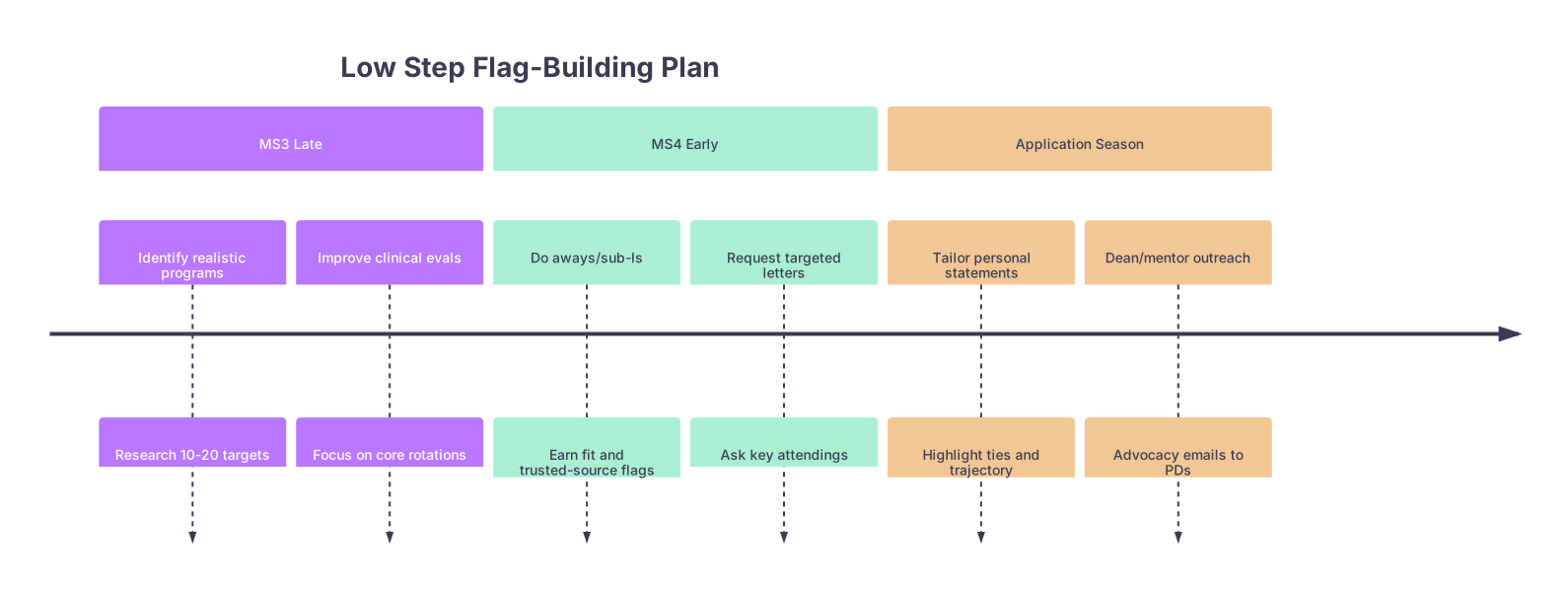
| Period | Event |
|---|---|
| MS3 Late - Identify realistic programs | Research 10-20 targets |
| MS3 Late - Improve clinical evals | Focus on core rotations |
| MS4 Early - Do aways/sub-Is | Earn fit and trusted-source flags |
| MS4 Early - Request targeted letters | Ask key attendings |
| Application Season - Tailor personal statements | Highlight ties and trajectory |
| Application Season - Dean/mentor outreach | Advocacy emails to PDs |
- When requesting letters, script the ask directly:
“Given my lower Step score (XXX), programs will want evidence I can perform clinically. Would you feel comfortable commenting specifically on my clinical performance compared to other students, and—if you feel it’s appropriate—encouraging programs to consider me despite my board score?”
If they’re uncomfortable, pick someone else. You cannot afford lukewarm.
Use your personal statement surgically, not as therapy.
One or two lines to contextualize the score, then pivot hard to:- Concrete clinical strengths
- Local ties
- Work ethic
- Upward trajectory evidence
Have your dean or advisor explicitly advocate to 3–5 programs (not 50).
Many offices are willing to do that, especially if you give them a realistic target list and a coherent story.
FAQ (Exactly 3 Questions)
1. My Step 2 is under 220. Is it even worth trying for a categorical spot?
If you have zero flags—no strong letters, no local ties, no aways, average clinicals—then most mid-tier academic programs will quietly filter you out. But if you can build multiple flags (trusted-source letter, strong clinical comments, serious local ties), you still have a shot at community and some regional academic programs, especially in less competitive specialties. The key is to be brutally realistic with your list and aggressively intentional about relationships.
2. Should I directly mention my low Step score in my personal statement?
If your score is a glaring outlier and you have a legitimate, concise story plus clear subsequent improvement, a short acknowledgment can help support the “upward trajectory” flag. Do not write a full essay about it. Two or three sentences max: “X happened, I underperformed. I changed Y. Since then, I have done Z (specific successes).” If you have no real improvement to point to, it may be safer to let your MSPE and letters carry that context.
3. Can a single amazing away rotation override a low Step score everywhere?
No. One rotation can strongly flag you at that specific program and sometimes at a small network of places where that attending is known. It will not magically erase your score nationally. Think of a great away as a sniper rifle, not a bomb: deadly effective in a small, precise radius. So pick those locations strategically, where you’d actually be happy to match, and where the word of that faculty or PD carries real weight.
Key takeaways:
Low Step scores are not a death sentence, but they force you into a different game. You are no longer competing on numbers; you are competing on flags. Accumulate trusted advocates, strong clinical evidence, and believable ties so that, when your file hits the “maybe” pile, someone in that room says, “Keep this one. Despite the score.”