
The most damaging thing you can do with a low Step score is pretend your personal statement is a generic formality. It is not. With a weak score, every cliché sentence and sloppy choice amplifies the red flag.
Let me be clear: you cannot erase a low Step score with a personal statement. But you can definitely make it look worse. And many applicants do exactly that.
Below are 11 specific personal statement mistakes that turn a single number into a full‑blown narrative problem in the eyes of program directors.
1. Ignoring Your Low Step Score Completely
Silence is not neutral. In residency applications, silence is interpreted as avoidance.
Here is the mistake:
- You have a Step 1 fail or a low Step 2 CK score.
- You write a generic, “I have always been passionate about medicine” essay.
- You never once show insight into struggle, learning, or course correction.
What programs see:
- “This applicant hopes we do not notice.”
- “No reflection. No ownership. No growth.”
- “If they hide this, what else will they avoid dealing with?”
You do not always need a full “score explanation paragraph,” but you must:
- Show you can identify weaknesses.
- Demonstrate a pattern of response: What did you change? How did you adapt?
- Indirectly reassure them this is not a professionalism or work‑ethic issue.
Bad example:
“Throughout medical school, I have consistently worked hard and excelled academically…”
With a 205 Step 2, that line is not just unconvincing. It is dishonest.
Better approach:
“Early in medical school, I underestimated how much structure I needed to learn efficiently. After underperforming on a major exam, I rebuilt my study system from the ground up—moving from passive reading to scheduled active review and question‑based learning. Since then, my clerkship evaluations and in‑service performance have reflected that change.”
You have not named the score. But you have:
- Acknowledged struggle.
- Demonstrated adaptation.
- Shown a positive trajectory.
The mistake is pretending nothing happened.
2. Turning Your Score into a Confessional Essay
On the other end of the spectrum is over‑explaining.
The “I must justify every point I lost” essay is a disaster:
- Paragraph 1: Childhood.
- Paragraph 2: Step 1 score trauma.
- Paragraph 3: Detailed breakdown of personal crisis, family issues, COVID, breakup, illness, etc.
- Suddenly the whole statement is about your score.
What programs read between the lines:
- “This applicant is fragile.”
- “This person may struggle under residency pressure.”
- “Everything becomes a crisis.”
You are not writing a therapy note. You are making a professional case.
If you must explicitly address a low score or a fail:
- One short paragraph.
- Neutral, professional tone. No drama.
- Clear causal story → specific adjustments → improved outcomes.
Bad:
“My Step 1 score was devastating. I cried for days and questioned my worth as a future physician…”
Better:
“During the period leading up to Step 1, a family health crisis disrupted the study plan I had set. I did not adjust quickly enough, and my score reflects that. In response, I worked closely with our academic support team to build a more realistic structure and began integrating dedicated question blocks daily. This change was critical in my improved performance on subsequent exams and strong clinical evaluations.”
Own it. Explain it once. Move on.
3. Writing a “Passion-Only” Statement With No Evidence
With a low Step score, saying “I am passionate” without proof is almost insulting to the reader.
The mistake:
- Paragraph after paragraph of “I love internal medicine because…”
- Zero concrete behaviors that show discipline, reliability, or academic stamina.
Program directors are not fooled. They know:
- Everyone “loves” the specialty they are applying to.
- Scores are imperfect, but they still correlate with in‑training exam performance.
- They need evidence you will not be the resident constantly on remediation.
Your personal statement must compensate where the numbers are weak:
- Depth of clinical engagement.
- Consistent work ethic.
- Long‑term commitment to learning.
- Ownership of patients and follow‑up.
Weak example:
“I am deeply passionate about family medicine and love building long-term relationships with patients.”
Stronger:
“On my family medicine rotation, I began tracking my panel of continuity patients in a spreadsheet—lab results, follow-up plans, unresolved questions—so I could prepare before each clinic session. That habit continued into my sub-internship, where I routinely called patients after discharge to ensure follow-up appointments were scheduled.”
Details like that say: dependable, organized, invested. That is how you counterbalance a shaky number.
4. Overcompensating with Arrogance or Empty Bravado
This one is more common than people admit.
A low score applicant, often after bad advising, tries to “project confidence” by:
- Declaring they are “uniquely prepared.”
- Claiming they will be “the hardest working resident in any program.”
- Dismissing standardized tests as unimportant.
What programs hear:
- “This person lacks insight.”
- “They might be difficult to supervise.”
- “They do not respect objective measures.”
You cannot pretend scores do not matter. Program directors live and die by board pass rates.
Avoid phrases like:
- “Standardized tests do not reflect my intelligence.”
- “My score does not define me.” (True, but trite and defensive.)
- “I know I will excel far beyond my peers once given the chance.”
If you need to comment on tests, keep it grounded:
“While my standardized test performance has been modest, my clinical supervisors consistently describe me as thorough, reliable, and highly responsive to feedback. I expect residency to be similar: a setting where daily repetition, mentorship, and direct patient care allow me to build steadily on a strong clinical foundation.”
Confident, but not delusional.
5. Choosing the Wrong “Core Story” When You Have a Weak Score
Every good personal statement has a central thread. With a low Step score, choosing the wrong thread can sink you.
Two particularly dangerous narrative choices:
The “I have always struggled academically” story
- Intention: show resilience.
- Impact: “This is a pattern. They may fail boards again.”
The “I hate exams” or “I do not test well” story
- Intention: explain scores.
- Impact: “They will not prioritize board preparation in residency.”
Programs want to see:
- You can face difficulty.
- You can improve performance.
- You do not romanticize struggling.
Better core themes for low-score applicants:
- System-building and organization (study systems, patient tracking, checklists).
- Responsiveness to feedback (specific examples of change after critique).
- Work under pressure that went well (busy rotations, night float, codes).
- Longitudinal growth from MS1 to sub‑I, with concrete milestones.
Choose a story that says: “This number is not who I am now.”
Not: “This kind of struggle is just my brand.”
6. Writing a Generic Statement That Could Belong to Anyone
If your scores are weak, you cannot also be generic. That is application suicide.
The lazy personal statement:
- Could be copied and pasted into any specialty with two word changes.
- Contains no program‑relevant specifics: procedures, pathologies, patient types.
- Uses filler phrases: “ever-changing field,” “lifelong learning,” “multidisciplinary care.”
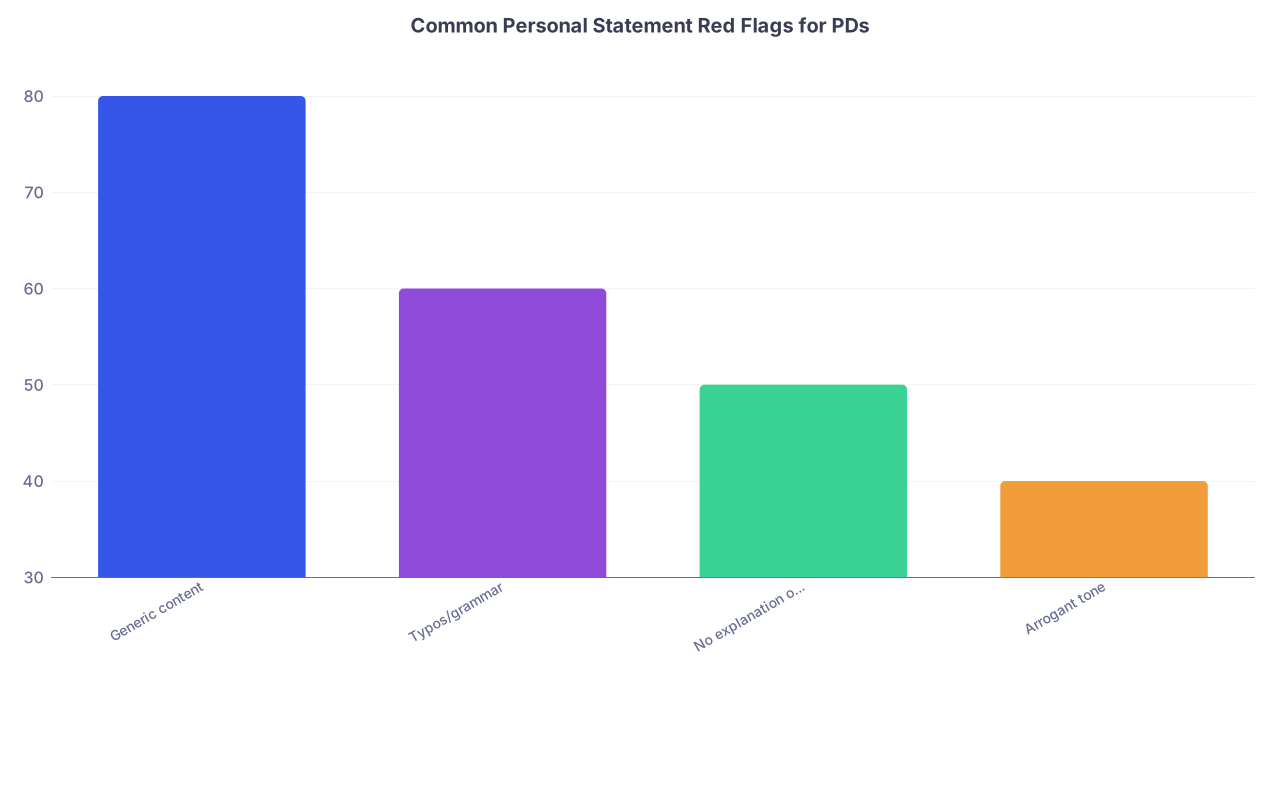
| Category | Value |
|---|---|
| Generic content | 80 |
| Typos/grammar | 60 |
| No explanation of gaps | 50 |
| Arrogant tone | 40 |
With a low Step score, generic = forgettable at best, rejected at worst.
You need:
- Specific clinical moments that clearly belong in your specialty.
- Details that show you know the day‑to‑day grind, not just the brochure version.
- Evidence you have thought about this exact field, not “some residency somewhere.”
Instead of:
“Surgery appeals to me because it is hands-on and allows immediate impact.”
Say:
“In vascular surgery clinic, I followed a patient from initial claudication to post-operative recovery after femoral-popliteal bypass. Those months of adjusting medications, walking with him in the hallway, and later checking his incisions every clinic visit showed me how much of surgery happens outside the OR.”
That level of detail says: this person has actually been there. They are not guessing.
7. Overloading the Statement with Excuses and Context
Context is useful. Excuses are poison.
Common pattern:
- Step failure.
- Personal loss.
- Visa issues.
- Financial stress.
- COVID disruptions.
- All crammed into one statement.
The reader finishes and thinks: “This person’s life is chaos. They will have constant problems.”
You cannot dump your entire hardship history into 650–800 words.
A disciplined way to handle real adversity:
- Decide what is relevant to training performance.
- Mention only events that:
- Directly impacted academics or training.
- Led to clear changes in behavior or systems.
- Use one short, factual paragraph. No emotional flooding.
Bad:
“During this time my grandmother died, my relationship ended, and I was struggling financially, which all contributed to my low score…”
Better:
“During my dedicated study period, a close family member required unexpected hospitalization. Balancing travel and caregiving with exam preparation affected my performance. Since then, I have strengthened my support systems and developed structured study routines that I have used successfully on subsequent in-training exams.”
The mistake is turning your statement into a list of reasons you deserve pity. Programs are not choosing who to feel sorry for. They are choosing who can do the job.
8. Ignoring Fit and Program Concerns about Low Scores
Program directors do mental math as they read your file. With low scores, they worry about:
- Board exam pass rates.
- Ability to handle academic demands.
- Need for constant hand‑holding.
Your statement can either:
- Confirm those fears, or
- Quiet them.
Common mistake:
- No evidence you can handle academic rigor.
- No mention of self-directed learning.
- Zero signal you have a plan for future board exams.
You absolutely must hint at a board-conscious mindset. Not by obsessing over numbers, but by:
- Showing your approach to mastering complex material.
- Referencing in-training exam improvement, if you have it.
- Mentioning how you build and follow study plans.
Example:
“On each rotation, I created a short list of high-yield topics from patient cases and scheduled time twice a week to review them using questions and primary literature. That habit, and the interest I found in connecting guidelines to my patients, helped me steadily improve on shelf exams despite a slower academic start.”
This says:
- “Yes, I know exams matter.”
- “Yes, I have a process.”
- “No, you do not have to drag me across the finish line.”
9. Letting Sloppy Writing Confirm Their Worst Fears
Here is a brutal but real truth: If your Step score is low and your writing is full of errors, most readers will assume you are careless.
Common unforced errors:
- Typos, misspellings, random tense shifts.
- Long, meandering sentences that say nothing.
- Incorrect specialty names (“family medicine” vs “family practice” depending on country/program).
- Using the wrong program or specialty name because you recycled statements.
Programs already wonder:
- “Will this person triple‑check orders?”
- “Will they document accurately?”
- “Will they care enough to be precise?”
A messy personal statement answers “no.”
| Error Type | Impact on Reader |
|---|---|
| Typos/grammar | Assumes carelessness |
| Wrong program name | Assumes mass-application |
| Vague, generic lines | Assumes low insight |
| Overly dramatic tone | Assumes emotional volatility |
You cannot afford these mistakes. Especially if you are an IMG or have multiple red flags.
Have:
- At least two people read it—ideally one in your specialty.
- One person who is not in medicine read it for clarity.
- Yourself read it out loud, slowly. You will catch clunky phrasing and repetitions.
Sloppy writing turns “low Step” into “low Step + low professionalism.”
10. Making the Entire Statement About “Proving Yourself”
There is a subtle trap many low-score applicants fall into: turning everything into a referendum on their worth.
Tell‑tale lines:
- “All I need is a chance to prove myself.”
- “I am determined to show that I am more than a number.”
- “Given the opportunity, I will demonstrate my true potential.”
The problem:
- The entire essay becomes defensive.
- The focus shifts from patient care and specialty fit to you vs the exam.
- It feels like an argument rather than a professional narrative.
Residency is not a redemption arc. It is a job.
Instead of writing like you are on trial, write like a junior colleague explaining:
- How you work.
- What you value.
- What your attendings can reliably expect from you at 3 a.m.
If you feel compelled to push back against the score, fold it into a broader frame:
“While my exam scores have been modest, the qualities that supervisors consistently highlight—reliability, follow-through, and team communication—are the same ones I will bring to residency. My focus is not on disproving a number, but on showing up for patients and colleagues with the same consistency I have developed throughout my clinical years.”
See the difference? Same content. Different posture.
11. Failing to Give the Reader Anything Memorable Besides the Low Score
Here is the harsh reality: if you give them nothing else to remember, they will remember the number.
You need one or two clean, specific images or moments that stick:
- A particular patient encounter that changed how you think.
- A concrete habit that illustrates your work style.
- A mentorship moment that reveals how you learn.
Without that, your file is:
- Low Step score.
- Generic statement.
- Forgettable.
With at least one sharp, real moment, your file becomes:
- “The applicant who called their patients after discharge to check on follow-up.”
- “The one who built a protocol summary binder for the entire team.”
- “The one who learned Spanish to better serve their clinic population.”
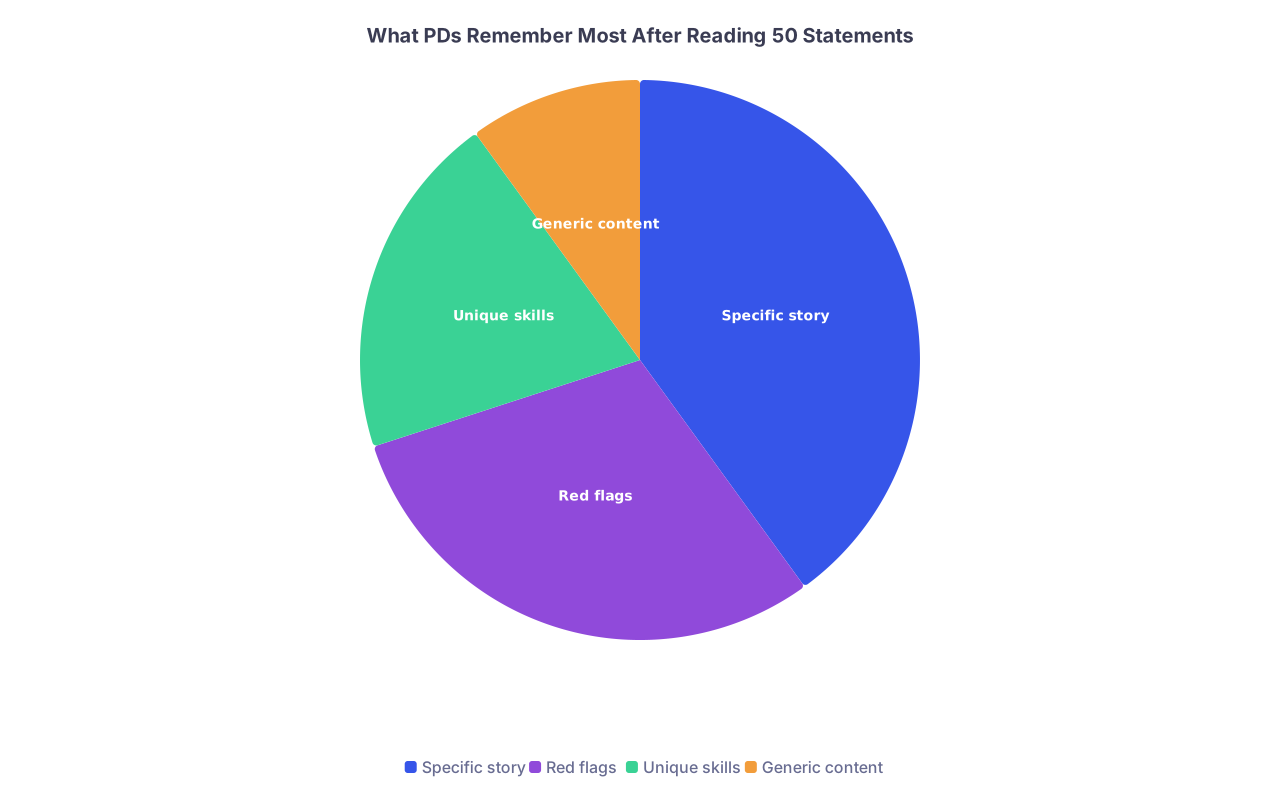
| Category | Value |
|---|---|
| Specific story | 40 |
| Red flags | 30 |
| Unique skills | 20 |
| Generic content | 10 |
You want to be filed under “specific story + unique skills,” not just “red flag.”
If your Step score is low, your personal statement must carry more of the load:
- One or two well-chosen, concrete anecdotes.
- Tied directly to the core qualities your specialty values.
- Told cleanly, without melodrama.
That is how you pull attention away from the number without pretending it does not exist.

| Step | Description |
|---|---|
| Step 1 | Opening patient or work scene |
| Step 2 | Link to why this specialty |
| Step 3 | Core qualities with concrete examples |
| Step 4 | Brief, factual low-score/context paragraph if needed |
| Step 5 | Evidence of growth and current strengths |
| Step 6 | Forward-looking closing about residency |
Use that as a skeleton. Deviate carefully, not randomly.
FAQ (Exactly 4 Questions)
1. Do I have to explicitly state my Step score or mention “low scores” in my personal statement?
No. You do not need to write the number or label it as “low.” You only need to explicitly address it if there is a major anomaly (fail, dramatic drop, long gap) that would raise questions about reliability or professionalism. Even then, keep it to a short, factual paragraph focused on what changed afterward. The rest of the statement should highlight strengths, not argue with the score.
2. Can a strong personal statement actually overcome a low Step score?
It cannot erase it, but it can move you from “automatic discard” to “worth an interview,” especially at programs that look holistically or in less competitive specialties. A strong statement can:
- Reduce concern about future board failures by showing systems and maturity.
- Make you memorable in a positive way.
- Reinforce strong parts of your application (clinical evaluations, letters, research, service).
It is not magic, but it is one of the few parts you still control.
3. Should I write different versions of my personal statement for community vs academic programs if my score is low?
You do not need radically different essays, but small, targeted adjustments are smart. For academic programs, subtly highlight scholarly curiosity, teaching, or QI involvement. For community programs, emphasize reliability, patient ownership, and team communication. In all cases, avoid anything that makes you look high‑maintenance or fragile; low-score applicants must project stability first and foremost.
4. How long should my personal statement be if I have a lot to explain about my exam history?
Do not exceed typical length (about 650–800 words) just because you have more to explain. That is one of the classic mistakes. Keep your explanation short—3–6 sentences maximum. If more detail is truly necessary, use your application’s “additional information” sections, a dean’s letter addendum, or a separate document if a program requests it. Your main personal statement must still function as a professional, forward-looking portrait, not a lengthy defense brief.
Open your current personal statement draft right now and highlight every sentence that refers to struggle, scores, or “proving yourself.” If that is more than one short paragraph, you are feeding the red flag instead of shrinking it.