
The way most low Step candidates “email programs” is a waste of time.
One generic sob story paragraph. A pasted CV. Mass-send to 200 coordinators. Then shock when nobody replies.
You are not doing outreach. You are generating spam.
If your Step score is low, email is one of the few levers you still control. Used correctly, it can get you:
- Extra interview looks
- Courtesy reviews instead of auto-filters
- A second chance at programs that would otherwise screen you out
Used poorly, it just burns your name into their “ignore” list.
Here is how to build a serious, targeted email outreach campaign that treats this like what it is: a numbers game that rewards precision, not desperation.
1. Understand What Email Can (and Cannot) Do
Let me reset your expectations before we talk tactics.
What email can do for a low Step candidate
- Get a file pulled from the auto-reject pile and actually read
- Turn a “borderline” app into an interview, if you match something they need (geography, language, niche interest, scheduling gap)
- Secure a courtesy interview at places where you have a strong connection (home institution, rotation sites, strong mentor tie)
- Put you on the radar for preliminary or off-cycle positions that never hit ERAS
What email will not do
- It will not magically erase a 198 or 205
- It will not turn a noncompetitive profile into a Mass General categorical spot
- It will not fix a weak application strategy (too few safety programs, bad specialty choice)
So you use email as:
- A multiplier on a rational program list
- A signal boost for your strengths
- A workaround for blunt Step cutoffs
If your underlying strategy is wrong (e.g., low Step, no research, no connections, only applying to hyper-competitive academic programs), outreach is just fancy begging. Fix the strategy first.
2. Build a Program Tiering System: Who You Actually Email
Random emailing is how you waste time and annoy people. You need a clear system for who gets outreach and why.
Start with your full ERAS list. Then segment it.
| Tier | Description | Email Priority |
|---|---|---|
| A | Strong fit, real connection, realistic chance | Very High |
| B | Moderate fit, some hook (geography, interest) | High |
| C | Long-shot but still plausible | Medium |
| D | Extreme reach or no fit | Skip / Rare |
Tier A – Your “must try hard” list (10–25 programs)
Criteria:
- You rotated there (away or sub-I)
- Your home program or same hospital system
- You grew up in their city/state and can prove real ties
- You share med school / prior institution with PD or faculty
- They explicitly mention “holistic review” / “no Step cutoff” on website or FREIDA
- Your Step is low but not wildly below their posted averages
These programs deserve:
- Multiple touch points (pre-ERAS, early season, late-season update)
- Highly customized emails with program-specific content
- Strategic use of faculty advocates or mentors
Tier B – Targeted “good fit” list (20–60 programs)
Criteria:
- Geographic regions you actually want and will write about convincingly
- Community programs, newer programs, or less famous academic centers
- Programs with higher IMG percentages (if you are IMG) or DO-friendly (if you are DO)
- Step cutoffs flexible or vaguely stated
These get:
- One solid, personalized email once your ERAS is complete
- Possible second touch late season if you are still unmatched and they have unfilled spots / SOAP risk
Tier C – Long-shots with some rationale (variable size)
Criteria:
- Well-known academic or competitive places where you have some hook:
A faculty connection, former research collaboration, or very niche interest that matches them
These get:
- Rare, highly strategic emails if (and only if) you can use a very strong connection (“Dr. X, my research mentor and your colleague, suggested I reach out…”)
Tier D – Fantasy or no-fit programs
Criteria:
- Hyper-competitive academic powerhouses with no tie, no interest match, and clearly high Step averages
- Programs outside your realistic geography with zero connection
- Programs stating strict cutoffs above your score
Do not email these. You signal that you do not understand your position.
3. Build the Data Backbone: A Real Outreach Tracker
If you are serious, you treat outreach like a project, not a flurry of Gmail drafts.
At minimum, you need a spreadsheet with:
| Column | Purpose |
|---|---|
| Program Name | Identify the target |
| Specialty | Some apply in 2 specialties |
| State / City | For geographic ties |
| Tier | A/B/C/D |
| Contact Name | PD, APD, or coordinator |
| Contact Role | PD / APD / PC |
| Contact Email | Actual address used |
| Outreach Date | When you sent |
| Email Type | Intro / Post-ERAS / Update |
| Response | Yes/No/Maybe |
If you prefer to see workflow visually, map it:

| Step | Description |
|---|---|
| Step 1 | Build Program List |
| Step 2 | Assign Tiers |
| Step 3 | Collect Contacts |
| Step 4 | Write Email Templates |
| Step 5 | Customize by Program |
| Step 6 | Send in Batches |
| Step 7 | Log in Tracker |
| Step 8 | Monitor Responses |
| Step 9 | Prepare Thank You |
| Step 10 | Optional Update Later |
| Step 11 | Interview? |
You do not keep this in your head. I have seen people resend nearly identical emails to the same PD 3 weeks apart. That is a fast track to the trash folder.
4. Identify the Right Person and the Right Address
Sending to the wrong person is the hidden way candidates sabotage themselves.
Who you actually email
Priority order:
Program Coordinator (PC)
- Gatekeeper. Tracks ERAS, schedules, PD inbox.
- More likely to read and file appropriately.
- Safest default, especially for initial outreach.
-
- Use when:
- You have a strong connection
- Smaller community programs where PD clearly handles everything
- Keep emails short and focused. They skim.
- Use when:
Associate / Assistant PD (APD)
- Good target for academic programs where APDs often handle recruitment.
- Especially useful if your interest matches their niche.
How to find accurate information
- Program websites: Often outdated, but start here
- FREIDA / ACGME list: Verify PD name, sometimes coordinator
- Doximity / institutional directories: Cross-check roles
- Ask your attendings: “Who runs the residency there now? Is this email still good?”
If you cannot confirm a PD email, send to the coordinator and address them by name.
5. Timing: When to Send What
Timing is not trivial. You do not spray everything out on September 15 and call it done.
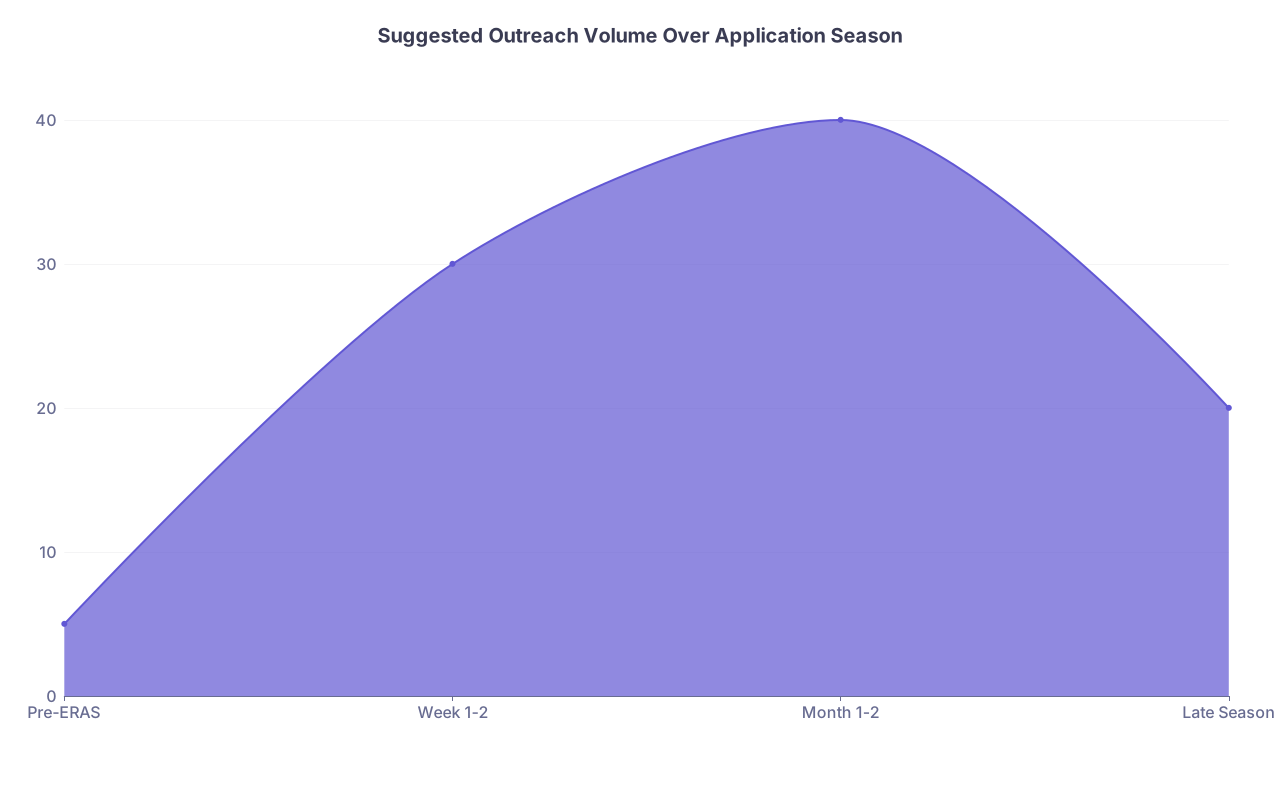
| Category | Value |
|---|---|
| Pre-ERAS | 5 |
| Week 1-2 | 30 |
| Month 1-2 | 40 |
| Late Season | 20 |
Phase 1: Pre-ERAS (late July–early September)
Good for:
- Tier A programs where you have a strong tie (home, away rotation, strong geography)
- Simple “I am very interested and will be applying” messages
Goal:
- Put your name in their head before the flood
- Signal clear interest to programs that actually care about that
Do not overdo it. You are just setting the stage.
Phase 2: Early ERAS (Sept 15 – Oct 15)
This is where you focus.
Actions:
- Send your main personalized outreach to Tier A and Tier B after your application is submitted
- Mention explicitly that your ERAS file is complete and ready for review
Your email is now actionable. They can literally go into ERAS and pull your application while your name is fresh.
Phase 3: Mid-season (Oct–Dec)
At this point:
- Many interviews are sent, but not all
- Programs are dealing with cancellations and no-shows
- Some start to realize their SOAP risk
Good plays:
- Short update emails to Tier A where you have:
- New exam score (Step 2)
- New publication / presentation
- Strong letter added
- Tactical outreach to programs you suspect may struggle to fill: newer/community programs, lower reputation regions
Phase 4: Late-season / Pre-SOAP
High-risk, but sometimes necessary.
Use:
- Ultra-concise “still very interested, still available” messages to selected Tier A / B programs you never heard from
- Express willingness for prelim, off-cycle, or future PGY-2 opportunities if that is realistic for your specialty
Do not send pity emails. These are business communications.
6. Writing Emails That Actually Get Read
Let me be blunt: most residency outreach emails are terrible. Bloated. Emotional. Unclear.
Your job is to send sharp, respectful, skimmable messages that answer three questions immediately:
- Who are you?
- Why are you emailing this program?
- What do you want them to do?
Core principles
- Subject lines: direct, searchable, not dramatic
- Length: 150–250 words, tops
- Tone: professional, neutral, forward-looking (no Step-score trauma dumping)
- Structure: name → connection → acknowledge weakness briefly → strengths → specific ask → close
Example subject lines
For initial outreach:
- “Application for [Program Name] – [Your Name], [Med School], Step [Score]”
- “[Your Name] – Applicant with [regional tie/interest] to [City/Program]”
For update:
- “[Your Name] – Step 2 CK update and continued interest in [Program]”
Avoid:
- “Desperate IMG seeking chance”
- “Low step candidate begging for consideration”
- Anything emotionally loaded or clickbait-ish
Model email for a low Step candidate (initial outreach)
You will adapt this, not copy-paste it. But here is the skeleton.
Dr. [Last Name] / [Mr./Ms. Coordinator Last Name],
My name is [Full Name], a [US-IMG / DO / MS4 at X] applying to Internal Medicine this cycle. I submitted my ERAS application to [Program Name] on [date] and wanted to express my strong interest in your program.
I recognize that my Step [1/2 CK] score of [XXX] is below your usual average. I have worked hard to address this by [brief concrete response: strong clinical performance, Honors in medicine rotations, strong Step 2, etc.]. My recent [Step 2 CK 24X / Sub-I evaluations / letters] reflect the physician I am now, rather than that earlier score.
I am particularly drawn to [Program Name] because of [2–3 specific, real reasons: training environment, patient population, curriculum feature, regional tie]. Having grown up in [city/state] / completed a rotation at [hospital] / worked with [Dr. X], I would be very excited to train and contribute here.
I know you receive many strong applications, but if you are able to review my file despite the lower Step score, I would be very grateful. I would be thrilled to interview at [Program Name] and am confident I would be a hardworking, reliable resident in your program.
Thank you for your time and consideration.
Sincerely,
[Full Name]
AAMC ID: [#######]
[Med School], Class of [Year]
[Phone] | [Email]
Key details:
- You name the weakness once. Then move on. No long narrative about “test anxiety since childhood.”
- You tie your interest to specific features. Not “your excellent training.”
- You include AAMC ID so they can find you in under 10 seconds.
7. Customization Without Burning All Your Time
Yes, you should customize. No, you should not write 120 unique essays.
Use a template with modular sections:
- Block 1: Intro (same for all)
- Block 2: Step acknowledgement and mitigation (same for all, minor tweaks)
- Block 3: “Why this program” (customized 2–3 sentences)
- Block 4: Ask and sign-off (same for all)
Make yourself a mini “library” of reasons:
- For community programs: “broad clinical exposure, autonomy, underserved populations”
- For academic: “research in X, subspecialty Y, academic career interest”
- For specific cities/states: “family nearby, prior residence, long-term plan to practice here”
Then plug the right one only when it is true, and add 1–2 genuinely specific details pulled from:
- Their website (categorical vs. prelim structure, tracks, unique rotations)
- Program video (emphasis on teaching, wellness, etc.)
- Things you heard from residents / faculty
8. Handling the Step Score Directly (Without Sounding Defensive)
Too many people either:
- Ignore their low Step, hoping nobody notices (they do), or
- Anchor the entire email around their “story of hardship”
You do neither.
You:
- State it once, concisely.
- Show what changed since.
- Shift focus to current performance.
A good pattern:
“I recognize that my Step 1 score of 205 is below your usual average. Since then, I have significantly improved my test performance, scoring 244 on Step 2 CK, and have consistently honored my core clinical rotations in Internal Medicine, Surgery, and Pediatrics.”
If Step 2 is also low:
- Lean harder on:
- Clerkship performance
- Strong letters
- Direct feedback from residency faculty
- Leadership or prior healthcare experience
Example:
“My USMLE scores (Step 1: 204, Step 2 CK: 219) are not reflective of my clinical performance. On the wards, I have consistently been evaluated as one of the top students in my cohort, with comments emphasizing my reliability, bedside manner, and team contribution. I have strong letters from [name 1, role] and [name 2, role] who supervised me directly on inpatient services.”
Do not pretend the numbers are not low. Acknowledge, reframe, redirect. Then stop talking about it.
9. Volume, Batching, and Response Expectations
You are playing a volume game within a targeted structure.
Reasonable outreach volume
- Tier A: 10–25 programs
- Tier B: 20–60 programs
- Tier C: 0–15 programs (only with real connections)
Overall: 30–80 personalized emails across the entire season is realistic and sustainable.
If you claim you “personalized” 150+ emails, you probably just changed the program name.
Batch strategy
- Send in batches of 5–10 per day
- Track each send in your spreadsheet immediately
- Reserve 60–90 minutes per day for 1–2 weeks to get the bulk out
This pace keeps quality high and avoids obvious copy-paste errors like “I am very interested in [wrong program name]”.
Response reality
Most coordinators and PDs will:
- Not respond at all, even if they actually look at your application
- Send a brief “Thank you, we will review your ERAS file”
Both outcomes are fine. Silence does not mean you failed. You are not trying to start a conversation. You are trying to nudge them to open your ERAS file.
10. Using Mentors and Connections Correctly
The most powerful outreach is not from you. It is from someone they already respect.
Here is where people mess up:
- They ask mentors for “a letter of recommendation” only, not for advocacy
- They never explicitly ask: “Would you be willing to send an email on my behalf to [Program]?”
You do it differently.
How to frame the ask to a mentor
“Dr. X, I know you are very busy, but [Program Y] is one of my top choices and I suspect my Step scores may hurt my chances in their initial screen. Since you trained / worked there, would you be comfortable sending a brief email of support to their PD or one of the faculty you know, just to encourage them to take a closer look at my application?”
Then you:
- Provide a 3–4 bullet summary of your strengths
- Attach your CV and personal statement
- Provide the PD/coordinator email they can use.
A faculty-to-faculty email saying “This student is excellent; please take a look despite a low Step 1” is worth 50 self-written outreach messages.
11. Follow-Up and Updates: When to Ping Again
You do not repeatedly badger programs that never respond.
But you can send a later-season update if:
- Your Step 2 CK improved your testing profile
- You matched in a preliminary spot but still seek categorical for next year
- You gained a major new achievement (publication, chief year in prelim, etc.)
Keep this second email shorter:
“I reached out in October regarding my application to your program. Since then, I have [brief update]. I remain very interested in [Program Name] and wanted to share this update in case you are still reviewing applications or developing a waitlist.”
If they never engaged the first time, you get one follow-up, max. Then drop it.
12. Common Mistakes That Kill Your Effort
I have seen these exact errors multiple times:
Mass BCC blasts with no personalization
- PDs can smell this from the first sentence.
Oversharing personal hardship
- Mention briefly if relevant. Do not write trauma essays in cold emails.
Arguing with programs about their cutoffs
- “I know your published cutoff is 220, but you should make an exception…”
- No. You ask for consideration, not policy changes.
Sending attachments in the first email
- They hate random attachments. Use ERAS. At most, link to your ERAS AAMC ID.
Writing like a fan, not a colleague
- “I have always dreamed of your prestigious program…”
- You are a future physician colleague. Sound like one.
13. Putting It All Together in a Two-Week Plan
If you are late and scrambling, here is a concrete 14-day sprint:
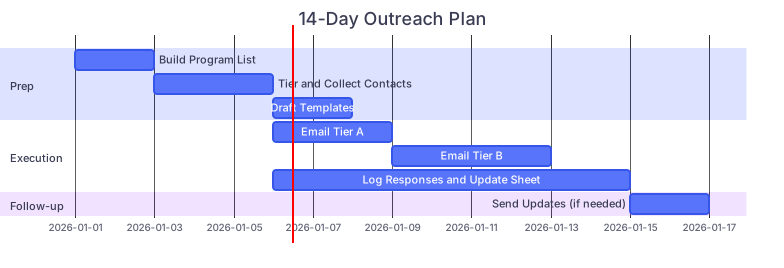
| Task | Details |
|---|---|
| Prep: Build Program List | a1, 2026-01-01, 2d |
| Prep: Tier and Collect Contacts | a2, after a1, 3d |
| Prep: Draft Templates | a3, after a2, 2d |
| Execution: Email Tier A | b1, 2026-01-06, 3d |
| Execution: Email Tier B | b2, after b1, 4d |
| Execution: Log Responses and Update Sheet | b3, 2026-01-06, 9d |
| Follow-up: Send Updates (if needed) | c1, 2026-01-15, 2d |
You wake up each day knowing:
- Which 5–10 programs you are emailing
- What template you are using
- How you log it when done
To keep yourself honest, you can even track time:
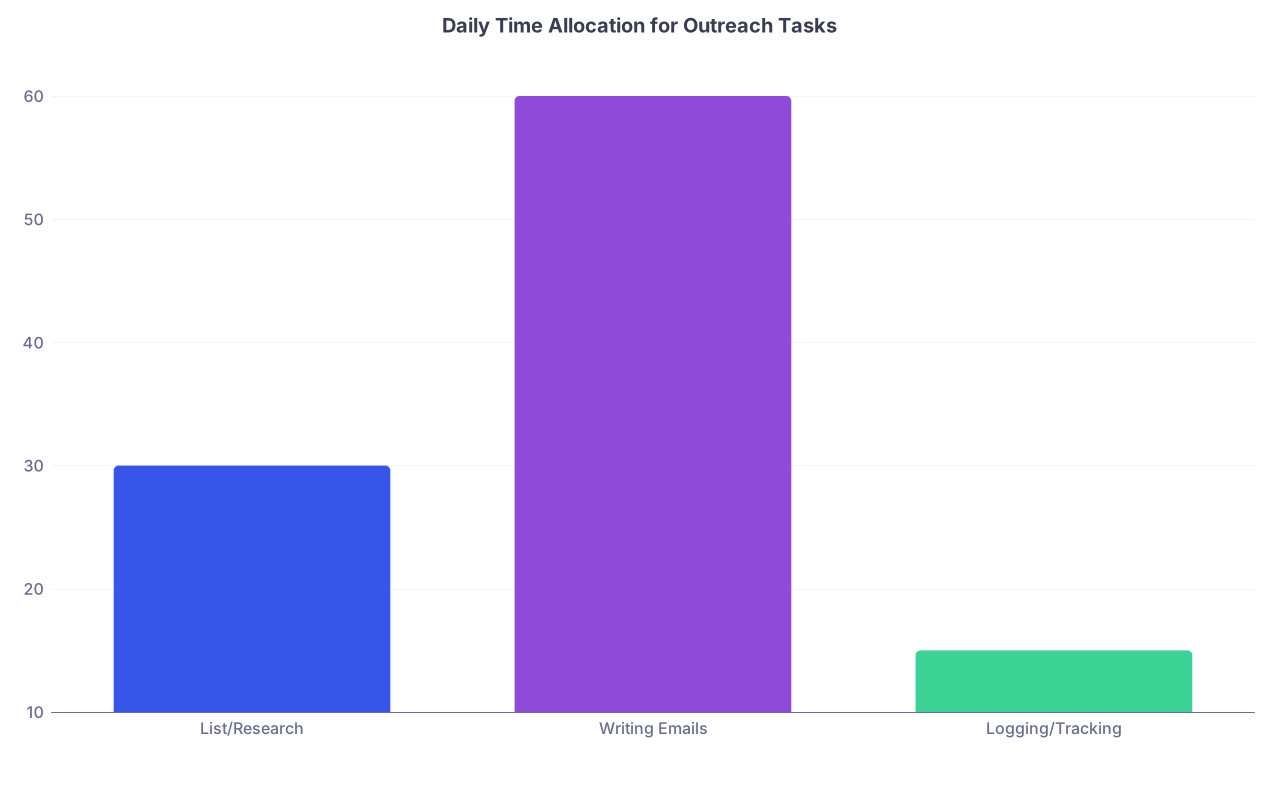
| Category | Value |
|---|---|
| List/Research | 30 |
| Writing Emails | 60 |
| Logging/Tracking | 15 |
14. Final Reality Check
You can run a flawless outreach campaign and still receive fewer interviews than you want. That is not failure. That is competition.
Email is not magic. But for low Step candidates, it is one of the very few strategic tools that:
- Costs almost nothing
- Scales across dozens of programs
- Directly addresses the one thing working against you: automated screening
If you treat it like a serious project, not a last-minute Hail Mary, you give yourself a real chance to be seen as a full applicant, not just a test score.
Keep three points in mind:
- Target ruthlessly – only email where you have some plausible fit or angle.
- Write like a colleague – concise, specific, honest about your score, focused on your strengths.
- Systematize everything – tracker, tiers, templates, and timing turn random emailing into an actual campaign.
You cannot rewrite your Step score. You can absolutely change how many people judge you solely by it.