
It is late September. Your Step 2 score report is in. The number is lower than you wanted, and now ERAS is open. You have a half-finished program list, twenty tabs of residency explorer tools, and a knot in your stomach. You are not asking “Can I match?” anymore. You are asking, “Where can I match—and how do I build a list that actually gives me a shot?”
That is what this is about. Not mindset. Not “stay positive.” A concrete, step-by-step workflow to design a program list that respects your score, leverages your strengths, and minimizes avoidable rejection.
I am going to assume three things about you:
- Your Step 1 and/or Step 2 score is below your specialty’s average.
- You are not planning a total specialty pivot this week.
- You want a clear system so you are not guessing.
Good. Let us get to the system.
Step 1: Get Honest About Your Starting Point
You cannot design a smart list if you are fuzzy about where you stand.
1. Benchmark your score against reality
Pull up the most recent NRMP Charting Outcomes and specialty-specific data (Step 2 is increasingly central, but Step 1 data still shows competitiveness trends).
You need three numbers for your specialty:
- Mean Step 2 score for matched US MD
- Mean Step 2 score for matched US DO
- 25th percentile Step 2 score for matched applicants (if available)
Now compare.
| Specialty | Mean Matched Step 2 | 25th Percentile Matched | Your Score |
|---|---|---|---|
| Internal Med | 246 | 238 | 228 |
| Pediatrics | 245 | 235 | 228 |
| General Surgery | 252 | 243 | 228 |
| Psych | 244 | 235 | 228 |
If your score is:
- > 5–7 points below the 25th percentile for your target specialty: you are in a high-risk zone. You need an aggressive, strategically heavy list and possibly a backup specialty.
- Within 5–7 points below mean but above 25th percentile: you are below average but not out. The list needs to be wide and selectively ambitious.
- Near or above mean: this article is not really for you. You can still use the workflow, but you are not in “low score” territory.
2. Know your “offsets”
Low board score is not the whole file. The question is: do you have anything that compensates?
Offsets include:
- Strong clinical performance (Honors in core rotations, strong Sub-I evals)
- Significant research (especially first-author, specialty-aligned)
- Home program with strong support in that specialty
- Away rotations with great letters
- Non-traditional strengths (prior career, unique language skills, etc.)
- Clear geographic “hooks” (family, spouse job, long-term residence)
Write these out in a 2-column list:
Left: weaknesses (low Step, failed Step, late exam, gaps).
Right: offsets.
You will use this later when you tier programs.
Step 2: Set a Hard-Nosed Application Strategy
You are not just building a random list. You are building a strategy.
1. Decide: single specialty vs dual application
Blunt truth: Some low scores in competitive fields without strong offsets demand a backup.
If you are in:
- IM, FM, Peds, Psych, Neurology: Often possible to match with a low Step, with the right list.
- Gen Surg, EM, OB/GYN, Anesthesia, Radiology: Low score, no strong offsets → you must at least consider a dual-application or prelim/transitional plus reapply strategy.
- Ultra-competitive (Derm, Ortho, Plastics, ENT, Optho, Neurosurg): A significantly low Step score almost always requires a serious backup plan.
You are not deciding your entire career today. You are deciding probabilities.
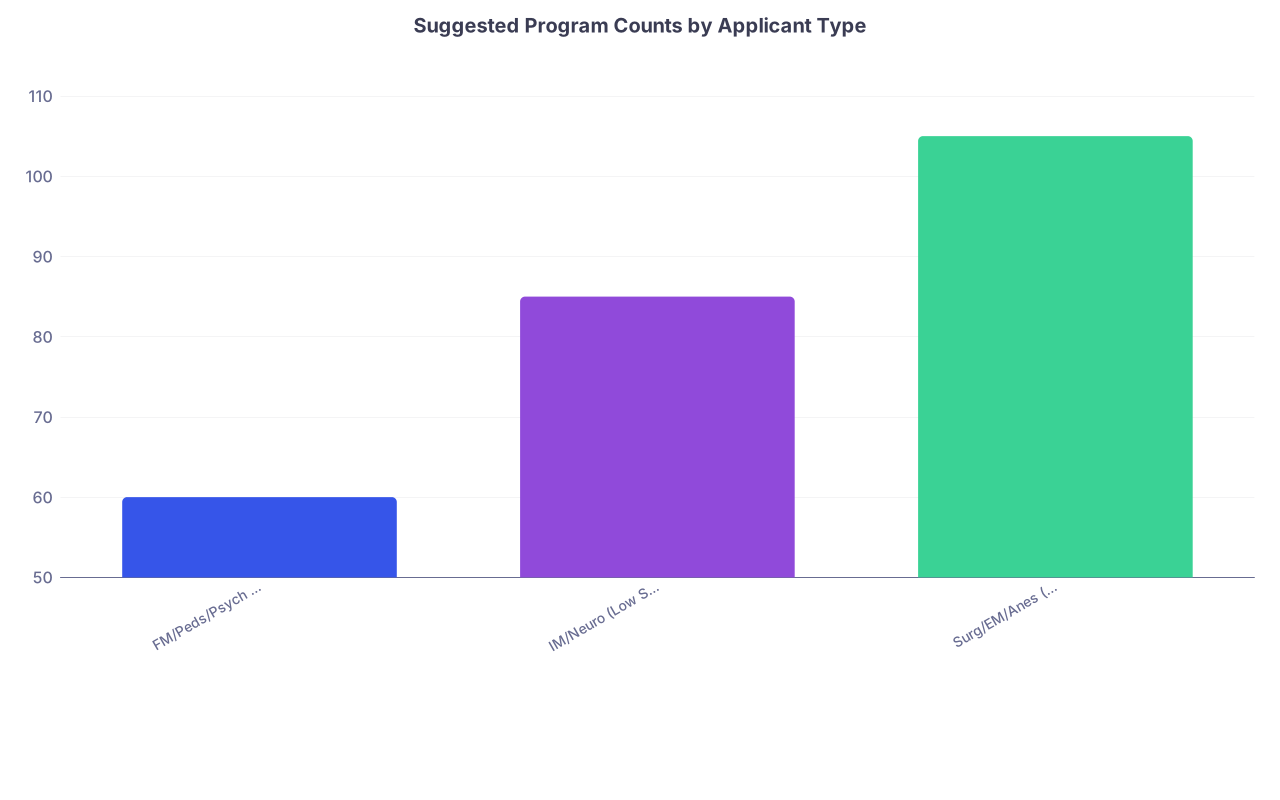
2. Set a target number of applications
For low scores, under-applying is the dumbest mistake I see. Every year someone with a 220 applies to 25 categorical IM programs and then acts shocked in February.
Use this rough rule (for US MD/DO, adjust upward for IMGs):
- Less competitive specialties (FM, Peds, Psych)
- Standard applicants: 25–40 programs
- Low Step applicants: 45–70 programs
- Moderately competitive (IM, Neurology, OB/GYN)
- Standard: 40–60
- Low Step: 70–100+
- Competitive (Gen Surg, EM, Anesthesia, Rads)
- Standard: 45–70
- Low Step: 80–120+ (plus backup specialty)
| Category | Value |
|---|---|
| FM/Peds/Psych (Low Step) | 60 |
| IM/Neuro (Low Step) | 85 |
| Surg/EM/Anes (Low Step) | 105 |
If fees worry you, fine, but do the math. One unmatched year—lost attending salary, another year of rent, extra exams—dwarfs the ERAS fees.
Step 3: Build the Raw Program List (No Filtering Yet)
Now you need a big, dumb, unfiltered universe of programs.
Aim for at least 1.5–2x your target number of applications. You will cut it down later.
Sources:
- AMA FREIDA
- Residency Explorer
- Program websites
- Colleagues, residents, your dean’s office, alumni lists
1. Create a working spreadsheet
You are going to live in this sheet for a while. Do not try to keep this in your head.
Suggested columns:
- Program name
- ACGME ID
- City, State
- Specialty
- Program type (academic, community, hybrid, county)
- Size of program (number of residents per year)
- Step 2 typical score band (if available)
- Explicit cutoffs listed? (Yes/No, what value)
- Accepts DO? (Y/N)
- IMG friendly? (Y/N)
- Geographic region
- “Connection” (home state, family, med school state, etc.)
- Red flags (cutoff above your score, no IMGs, etc.)
- Initial tier (Reach / Realistic / Safety)
- Final decision (Apply / Do not apply)
Do not worry about perfect accuracy at this stage. You just want volume.
Step 4: Identify and Exclude Hard Stops
Now you start cutting ruthlessly. But intelligently.
1. Hard filters to apply early
You will eliminate programs that are almost certainly wasted applications. Not “I might not like it.” Not “seems competitive.” Actual structural or policy barriers.
Hard stops include:
- Published minimum Step 2 score above your score
(“We require Step 2 ≥ 235” and you have 224 → gone.) - Explicit “No DOs” (if you are DO) or “No IMGs” (if you are IMG)
- State/visa restrictions you cannot meet (no visa sponsorship, must be citizen, etc.)
- “We do not consider applicants with any exam failure” if you failed a Step
Do NOT try to “manifest” your way around explicit cutoffs. They screen hundreds of apps. They use filters. If your score is below a hard cutoff they publicize, that application is essentially charity to ERAS.
2. “Soft red flags” (do not auto-cut yet)
These are caution signs, but not automatic no’s:
- Program boasts about “average Step 2 of 255+”
- Heavy research powerhouse with multiple NIH T32 grants, etc.
- Tiny categorical programs (2–3 spots per year) in hyper-desirable locations
- Ultra-competitive sub-track (physician-scientist track, integrated research track)
Mark these in a “Risk” column, but keep them for now. Some will become “reach” programs.
Step 5: Tier Every Program: Reach, Realistic, Safety
Now the part most people screw up. They make a “dream” list and a “rest of them” list. That is lazy.
You need three buckets and a forced distribution.
1. Define each tier specifically for low Step scores
Reach
You are materially below their likely average on boards or competitiveness, but not in hard-cutoff territory. You need help (great letters, niche interest, geographic connection).Realistic
Your profile fits or is slightly below what they probably see. They may lean less heavily on Step scores, or have a track record of interviewing applicants like you.Safety
Programs that regularly interview and match applicants with scores at or below yours, in specialties or locations less flooded with high-score applicants. Not glamorous. But they answer the phone in February.
2. How to actually tier them
Use a simple scoring template. For each program, give 0–2 points in categories:
- Step friendliness (low published averages, emphasis on holistic review)
- DO/IMG friendliness (if relevant)
- Geographic connection
- Program competitiveness (perceived prestige, location desirability)
- Size of program (bigger generally means more room for variability)
- Any clear low-score success stories (alumni, residents you know)
Total out of 10.
As a rough guide (you can tweak thresholds):
- 0–3 points → Reach
- 4–7 points → Realistic
- 8–10 points → Safety
You will get some weird edge cases, fine. Adjust a few manually. Just do not let emotion override everything.
| Category | Value |
|---|---|
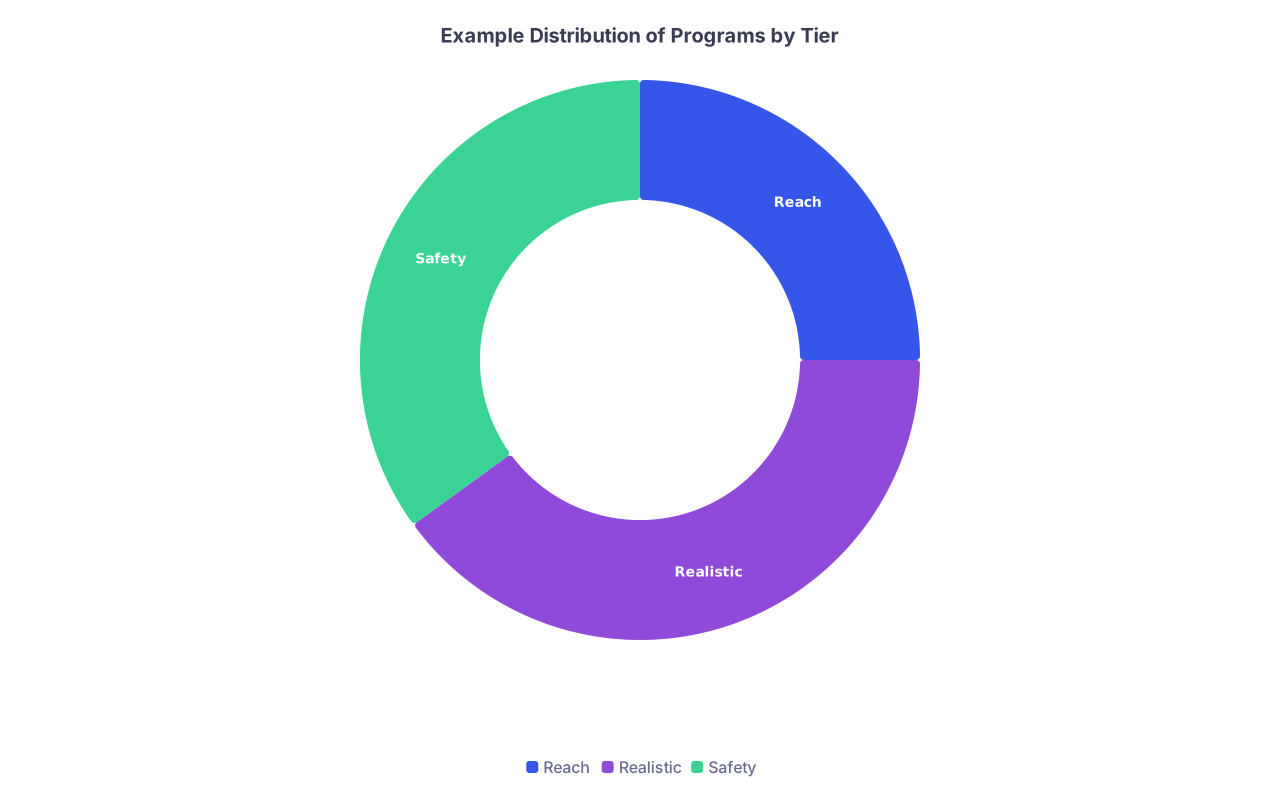
| Reach | 25 |
| Realistic | 40 |
| Safety | 35 |
Step 6: Balance Your Final List by Tier
Now you know your reaches, realistics, and safeties. Next step: balance.
Here is where people with low scores sabotage themselves: 60% of their list is reach programs in big coastal cities. Then they act shocked when they get 2 interviews.
1. Use tier percentage targets
For a low Step applicant, a rational distribution for your final applied list looks like:
- Reach: 15–25%
- Realistic: 45–60%
- Safety: 25–35%
If you end up with:
35–40% reach programs → your interview risk skyrockets
- <20% safety programs → you are betting too much on kindness from PDs
2. Example: Internal Medicine, Step 2 = 225
Say you decide to apply to 90 IM programs.
A healthy breakdown:
- Reach: ~15–20 (top academic centers, strong locations, higher averages)
- Realistic: ~45–55 (mid-tier university, solid community, hybrid systems)
- Safety: ~20–25 (less popular locations, community-heavy, IMG/DO friendly)
If your draft list is:
- 40 reach / 30 realistic / 20 safety
You must cut ~20 reach programs and replace them with realistic or safety programs. Non-negotiable.
Step 7: Leverage Geography Without Being Delusional
Geography is a big swing factor. Used well, it helps. Used poorly, it just clusters low-yield applications in overrun markets.
1. Identify your “geographic hooks”
Legitimate hooks:
- Grew up in the state or region
- College or med school there
- Spouse/partner job or contract there
- Family caregiving responsibilities
- Military ties
Weak, generic “I just really like Boston” is not a hook.
Mark genuine connections in your spreadsheet. In tight regions (Northeast, California, major coastal cities), a geographic hook can bump you from “total longshot” to “maybe.”
2. Spread risk across regions
Do not overcluster in a single competitive region if you have a low score.
Better pattern:
- Anchor 1–2 regions where you have real ties
- Supplement with programs in:
- Midwest
- South/Southeast
- Less saturated parts of Mountain West
- Secondary cities rather than capitals or major metros

Step 8: Use Data Tools Like an Adult, Not Like a Vending Machine
Residency Explorer, FREIDA, all those sites—useful, but they do not replace judgment.
1. How to read “average Step” data correctly
If the average Step 2 is 250, that does not mean every resident has 250+. It means:
- Some are at 240
- Some are at 260
- A few may be under 235 with strong stories
What matters for you:
If average = 250, and you are 225, that is a reach, not an auto-delete. You decide whether to burn a reach slot on it.
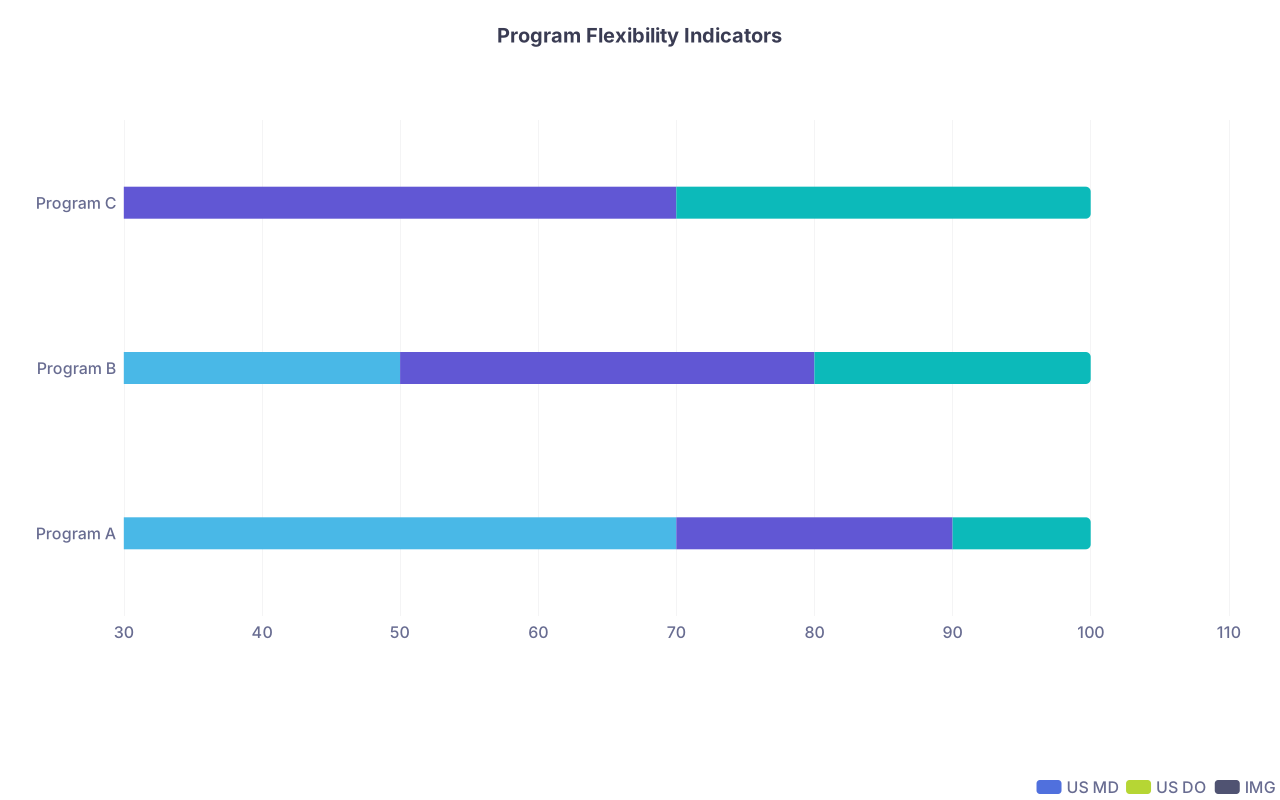
2. Watch the IMG % and DO %
Programs that already have:
- DO residents
- IMGs
- Non-traditional grads
…are visibly more flexible. They are telling you: “We do not worship pure Step scores above all.”
Programs with 0% DO and 0% IMG for five years? You are an outlier unless you are US MD with strong other metrics.
| Category | US MD | US DO | IMG |
|---|---|---|---|
| Program A | 70 | 20 | 10 |
| Program B | 50 | 30 | 20 |
| Program C | 30 | 40 | 30 |
Program C is clearly more flexible than Program A.
Step 9: Align Letters, Rotations, and Signals With Your List
Your program list is not a static document. You can shape its effectiveness with where you rotate, who writes for you, and where you signal interest.
1. Targeted away rotations (if timing allows)
If you have time before ERAS submission:
- Do aways at realistic or safety programs where you would genuinely be happy.
- Do not waste aways on extreme reaches when your score is far below their norm unless your home mentors directly recommend it.
A strong rotation and letter can sometimes drag you above the Step line at that single program. Do not scatter that leverage randomly.
2. Letters that match your list
For each specialty:
- Get at least 2–3 letters from attendings in that field.
- Prioritize writers with:
- Known connections to programs on your list
- Titles (PD, APD, Chair) if you earned their strong support
- Reputation for strong advocacy, not just titles
Then actually use this intel. If your medicine PD trained at Midwest University, and you have that program as “realistic,” bump it up within that tier.
Step 10: Build a Micro-Strategy for Reach Programs
Do not just pray on your reach programs. Give them a little more oxygen.
For each reach program you keep:
- Identify any geographic or personal hook
(even mild, like “I went to undergrad two hours away.”) - Read PD letter, resident bios, rotation structure
- Tailor any communications (signals, supplemental ERAS essays) specifically:
- Mention patient populations they serve
- Reference rotation structure if it aligns with your interests
- Connect your background to something they actually do
You will not do this for 40 programs. You can do it for 10–15 strategic reaches.

| Step | Description |
|---|---|
| Step 1 | Build Full Program List |
| Step 2 | Filter Hard Stops |
| Step 3 | Tier Programs |
| Step 4 | Select Reach Programs |
| Step 5 | Research Each Reach |
| Step 6 | Identify Hooks |
| Step 7 | Customize Signals or Essays |
| Step 8 | Submit Tailored Application |
Step 11: Design a Backup Path That Is Actually Viable
If your Step score is very low for your target field and you refuse to consider a backup, then be honest: you are choosing higher risk of not matching. Your choice. But own it.
If you decide to plan a backup:
- Pick a real backup specialty (FM, IM categorical, Peds, Psych are common).
- Build a full list there too, not 8 programs “just in case.”
- Make your ERAS application coherent:
- Slightly different personal statements for primary and backup
- Letters appropriate for each specialty (or at least generic and flexible)
- Do not pretend to both that they are “your one and only dream.”
This is chess, not a dating app. Programs understand that applicants may have applied broadly.
Step 12: Check for Common Self-Sabotage Patterns
Before you lock the list, do a sanity review. I see the same mistakes every year.
Run through this checklist:
- Are >30% of your programs in the top 25 metro areas (NYC, Boston, SF, LA, Chicago, etc.)?
- Are >35–40% of programs academic powerhouses with NIH money, big-name reputations, and high Step averages?
- Are <20–25% of your programs community or hybrid community-university?
- Does your list ignore whole regions of the country without any rational reason?
- Are you applying to < recommended total number of programs for your score range?
If you answered “yes” to any of those in a concerning direction, fix it.

A Compact Workflow Summary
If you like checklists more than essays, here is the condensed workflow:
- Benchmark your Step score vs your specialty’s matched averages.
- Define your application intensity: total number of programs (and whether you need a backup specialty).
- Build a raw universe list using FREIDA, Residency Explorer, and word-of-mouth.
- Hard-filter programs:
- Published cutoffs above your score
- Non-DO / non-IMG if relevant
- Visa or exam-failure exclusions
- Score and tier each remaining program (Reach / Realistic / Safety).
- Balance your final list by tier using target percentages (15–25% reach, 45–60% realistic, 25–35% safety).
- Layer on geography, emphasizing real hooks and spreading risk across regions.
- Use letters, aways, and signals strategically toward realistic and selected reach programs.
- Create a genuine backup strategy if your primary specialty is extremely competitive relative to your score.
- Sanity-check the list for overconcentration in prestige programs or popular locations.
- Lock it, then stop tinkering every 48 hours based on rumor and Reddit threads.

FAQs
1. How many “dream” or top-tier programs should I include with a low Step score?
Limit them to about 15–20% of your total applications, maximum. If you are applying to 80 programs, that means roughly 10–15 true reaches. More than that and you are donating money to low-yield applications. Keep some dreams in, but not at the cost of realistic options.
2. Can strong letters or aways “erase” a low Step score at competitive programs?
They cannot erase it, but they can sometimes override it locally at specific programs, especially if:
- The letter is from someone the PD knows or respects.
- You rotated there and clearly impressed people clinically.
- The program already has a culture of holistic review.
However, this is the exception, not the rule. Use this leverage surgically on a small number of reach or realistic programs, not as an excuse to ignore your score when designing your list.
3. Should I delay applying a year to improve my Step 2 score or do more research instead of applying with a low score?
If you already have a low Step 2 reported, a delay does not change that number. What matters is:
- Whether another year gives you a substantial upgrade (high-impact research, a new degree, stellar clinical work) that will realistically open doors in your target specialty.
- Your financial and personal tolerance for another year of uncertainty.
For most core specialties (IM, FM, Peds, Psych, Neuro), it is usually better to apply now with a maximally strategic list than to wait a year hoping to transform your competitiveness. For very competitive fields with no backup plan and very low odds, a planned gap year with a genuine strengthening project can make sense, but only if it is deliberate and well-structured, not just “waiting and hoping.”
Open your spreadsheet (or start one) right now and list 10 programs: 3 you consider reach, 4 realistic, 3 safety. Then, for each, write one sentence on why it belongs in that category. If you cannot justify it beyond “sounds good,” you have work to do.