
The ERAS application alone will not save you from a low Step score. A smart, targeted supplemental packet might.
You are not going to “hide” a low Step 1 or Step 2 CK. Programs see it in the first 5 seconds. Your move is not concealment. Your move is to overwhelm that single data point with organized, credible evidence that you are a lower-risk, higher-upside applicant than your score suggests.
This is what a good supplemental application packet does when you have low scores:
It reframes risk. It supplies context. It demonstrates growth. And it hands busy PDs exactly what they need to justify putting you on the interview list.
Let me walk you through exactly how to build that packet and how to use it without looking desperate.
1. First, Be Honest About What “Low Score” Means
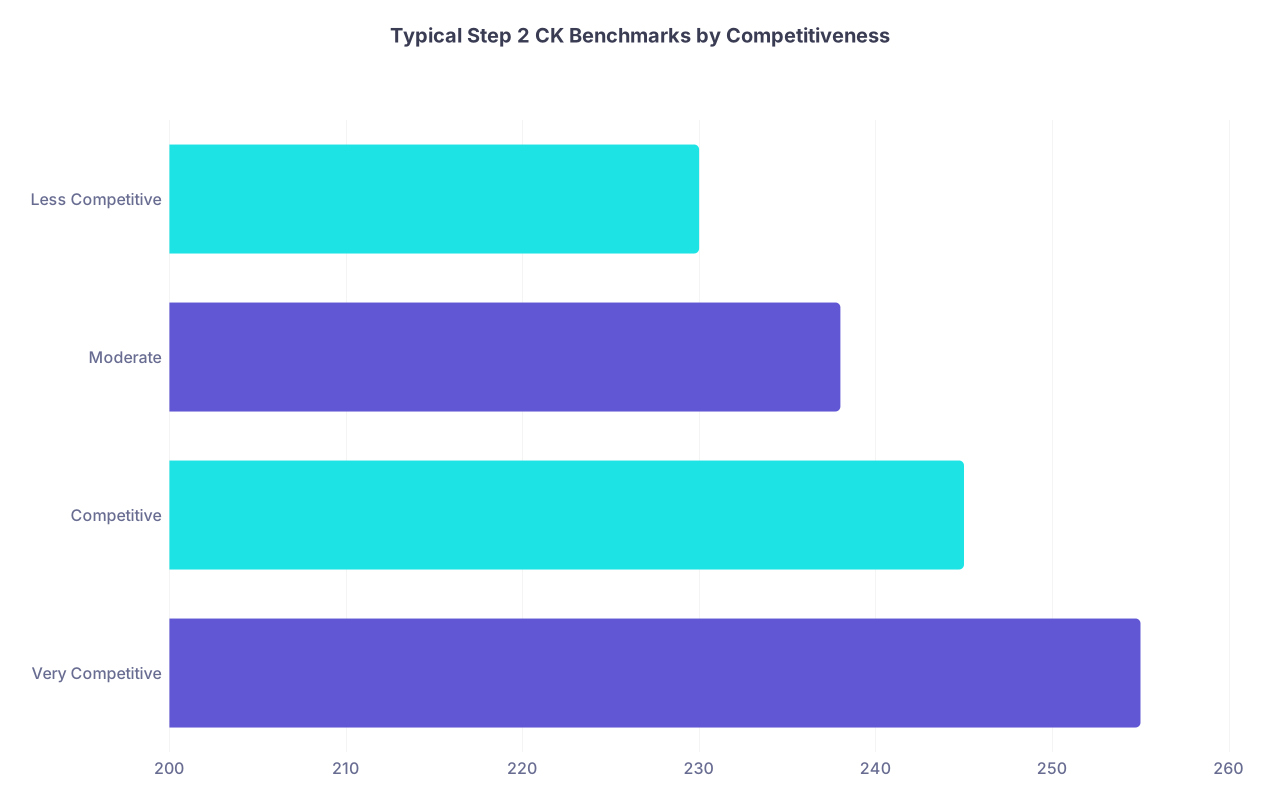
You cannot fix what you refuse to quantify. So start with hard numbers.
| Category | Value |
|---|---|
| Very Competitive | 255 |
| Competitive | 245 |
| Moderate | 238 |
| Less Competitive | 230 |
Rough (non-official) landscape:
- Very competitive fields (Derm, Ortho, ENT, Plastics, NSG):
Many successful applicants: Step 2 CK in the mid‑250s and up. - Competitive (Radiology, EM, Anesthesia, some IM programs):
Strong range: ~245–255. - Moderate (IM, General Surgery, OB/GYN):
Common match range: ~235–245. - Less competitive (FM, Psych, Peds, Path, Neuro in many places):
Solid range: ~225–235.
“Low” is relative to:
- Your specialty
- Your region / program type
- The rest of your file
For the purpose of this article, I will define “low” as:
- Failing Step 1 or Step 2 CK on first attempt, or
- Passing but clearly below your specialty’s usual matched range (e.g., applying categorical surgery with 218 Step 2 CK), or
- Multiple attempts (pass on second or third attempt).
If that is you, your supplemental packet is not optional. It is mandatory.
2. Understand What Your Packet Must Prove
Programs use Step scores as a risk filter. A low score triggers three questions in their heads:
- Will this applicant pass my in‑training exams and boards?
- Can this applicant handle the cognitive load and pace of residency?
- Is this score a one-off event or part of a pattern of underperformance and poor judgment?
Your supplemental packet has one job:
Answer those three questions with concrete, verifiable evidence.
So everything you include should support at least one of these messages:
- “I am academically safe now” (evidence: upward trend, remediation, recent performance)
- “I am reliable and coachable” (evidence: letters, concrete examples of following feedback)
- “I have a clear reason for the score and a credible fix” (evidence: structured plan, timeline, outcomes)
If a document does not serve one of those, drop it. This is not a scrapbook.
3. Core Components of a Strong Supplemental Packet
Here is what I recommend as the backbone of a “fix-my-low-score” packet.
| Component | Purpose |
|---|---|
| Targeted cover letter | Frame the narrative, reduce risk concern |
| Step score explanation addendum | Brief context without excuses |
| Evidence of academic improvement | Show trend and recent success |
| Focused CV (PDF) | Highlight strengths beyond scores |
| Strategic letters of recommendation | Validate your growth and reliability |
You may not need every piece for every program, but these are your main tools.
4. The Targeted Cover Letter: Your Front Door
Think of the cover letter as a one‑page “Why you should not auto-screen me out.”
Length: 3–5 short paragraphs, one page max.
Tone: Professional, concise, forward-looking.
Structure that works
Opening: Direct and respectful
- Who you are
- What you are applying for
- Why you are sending this packet
Scores: Acknowledge and reframe
- Direct reference to low/failed score without drama
- One line of context (if necessary)
- Quick pivot to what has changed
Evidence: Concrete, recent performance
- Shelf scores, sub‑I evaluations, Step retake, research, Qbank stats
- Brief bullets if you have multiple pieces of data
Fit: Why this specialty / this program
- One paragraph connecting your experience to their strengths
Close: Clear ask
- Explicit but polite ask for consideration for interview
Example skeleton
Dear Dr. [PD Last Name] and the [Program Name] Selection Committee,
I am a fourth‑year medical student at [School] applying to [Specialty] and am writing to express my strong interest in [Program]. I am including a brief supplemental packet to provide additional context and updated academic information beyond what appears in ERAS.
My Step 1 score of 201 is below your program’s historical average. This result reflected weaknesses in my early approach to independent study, not my current capabilities. Since that time, I have overhauled my study methods and performance has improved significantly:
- Step 2 CK: 234 (first attempt)
- Medicine clerkship: Honors, final exam 1.3 SD above mean
- Surgery sub‑internship at [Hospital]: Outstanding evaluations, “top 5% of students this year”
These results more accurately represent my current readiness for residency. They reflect not only improved test‑taking, but consistent, reliable clinical performance in demanding settings.
I am particularly drawn to [Program] because of your [specific features: county hospital exposure, emphasis on teaching, strong board pass rates, etc.]. I would be grateful for consideration for an interview so I can further demonstrate my fit and commitment to [Specialty].
Sincerely,
[Name, AAMC ID, Phone, Email]
Polite. Direct. No drama. No three-page autobiography.
That is your standard.
5. Step Score Addendum: Explain Without Whining
This is where many applicants wreck themselves. They either:
- Say nothing and leave PDs to assume the worst, or
- Write a 2‑page trauma narrative that reads like an excuse factory.
You need a half‑page, maximum one page addendum that does 3 things:
- Factually states the problem.
- Briefly outlines the cause in adult language.
- Emphasizes measurable changes and outcomes.
Good causes (when real, not invented)
These are credible if documented or clearly connected to performance:
- Poor early study strategy / inefficient approach
- Undiagnosed or poorly managed health issue (physical or mental)
- Major acute life event (death in immediate family, significant illness, etc.)
- Overcommitment (working too many hours, excessive extracurriculars) with a clear change in behavior afterwards
Bad causes (even if partly true)
Avoid framing your explanation like:
- “The exam was unfair / poorly written / not representative.”
- “USMLE changed the scoring / content.”
- “My school did not prepare us well.”
- “I am just a bad standardized test taker” (without showing you fixed it).
Example paragraph set
My Step 2 CK result of 222 does not reflect my true capabilities. During preparation, I attempted to balance a full‑time clinical schedule, part‑time employment, and exam study. This led to fatigue, inconsistent practice, and poor exam‑day performance.
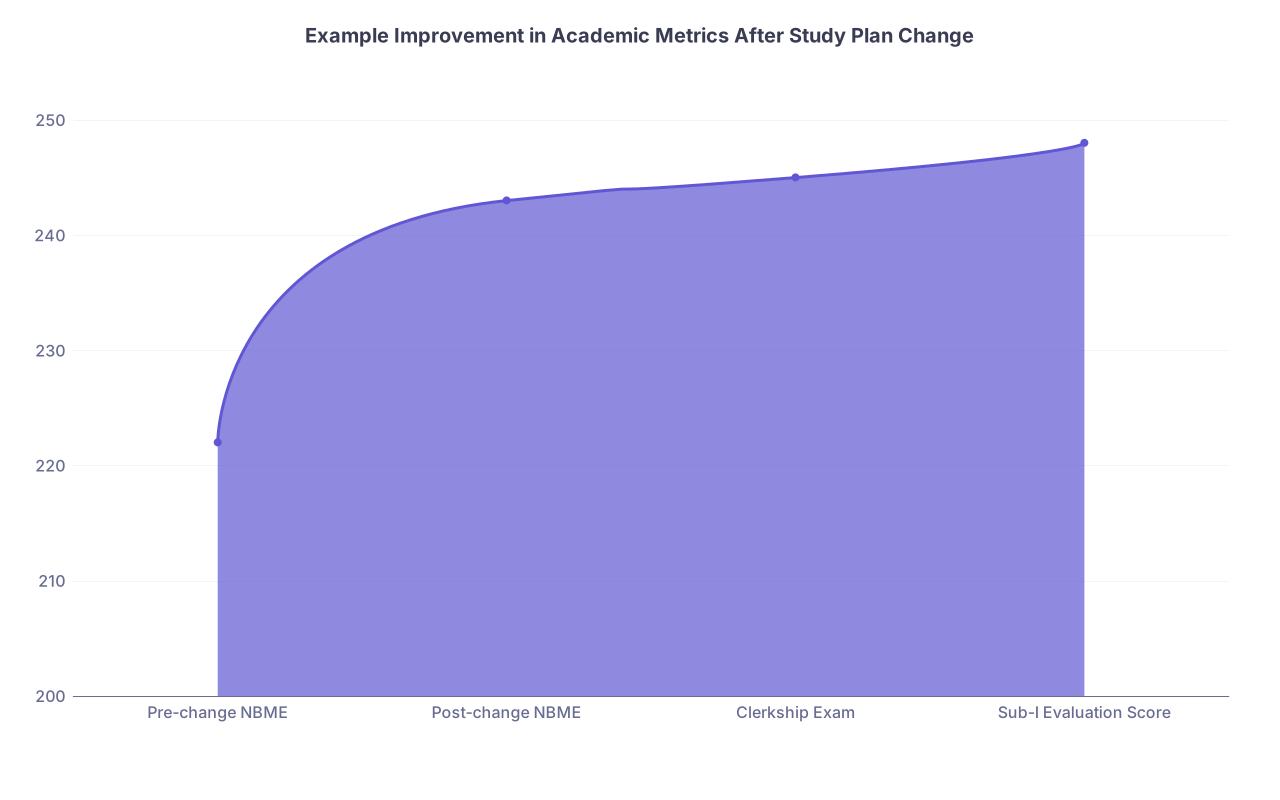
After receiving this score, I met with our academic dean and developed a structured study plan that reduced work hours, prioritized rest, and built a daily schedule of UWorld (40–80 questions), spaced repetition, and weekly NBME self‑assessments. Using this plan, my NBME practice exams improved from the low 220s to the 240s. I have applied this same systematic approach to my sub‑internships, where I have consistently received strong evaluations and exam scores.
While I cannot change the past result, I have changed the underlying behaviors that led to it. My recent performance is the best indicator of how I will approach residency education.
Notice:
- No melodrama.
- Clear cause.
- Clear corrective action.
- Clear improvement metrics.
That is what program directors are looking for.
6. Academic Evidence: Prove You Are Safe Now
Words are cheap. Data is not.
You want at least 3–5 recent indicators of solid academic and clinical performance.
| Category | Value |
|---|---|
| Pre-change NBME | 222 |
| Post-change NBME | 243 |
| Clerkship Exam | 245 |
| Sub-I Evaluation Score | 248 |
High-yield evidence to include
Improved exam scores
- Step 2 CK > Step 1 by a visible margin
- Shelf exams above mean, especially in your specialty
- In‑house exams with percentile or SD above mean (if school provides)
Sub‑internship / acting internship evaluations
- Narrative comments that explicitly mention independence, reliability, or “would take as resident”
- Any “top X% of students” language
Performance in rigorous settings
- Busy county or VA rotations, trauma services, ICU, night float rotations with strong evals
Formal academic remediation and completion
- Documented participation in academic support programs
- Completion certificates for institutional board prep courses, if any
How to present it
Make a 1‑page “Academic Progress Summary” PDF with:
- Short intro: 2–3 sentences
- 4–7 bullet points with concrete metrics, for example:
- Step 1: 205 → Step 2 CK: 233 (28‑point improvement)
- Medicine shelf: 84th percentile; Surgery shelf: 79th percentile
- Sub‑I Internal Medicine, [Hospital]: Final evaluation summary “excellent preparation, independent, ready to start residency tomorrow”
- Required remediation in M2 year (cardiology module) completed with final exam score 90% after retake; no further remediation needed.
Do not drown them in tables. They are skimming.
7. Letters of Recommendation: Use Them Strategically
With low scores, you cannot afford generic letters. “Hard‑working and pleasant” is not enough. You need letters that explicitly address your readiness and reliability.

Who you want letters from
Priority:
Sub‑I / Acting Intern supervisors in your chosen specialty
Especially from well‑known or rigorous programs.Clerkship directors
They can speak to your performance relative to the class.Research supervisor (only if they know you very well and can speak to reliability, not just data analysis).
What they should say (yes, you can guide them)
You cannot write their letter, but you can absolutely say:
“I am applying with a Step 2 score that is lower than I would like. It would help me a lot if you could comment specifically on my clinical reasoning, reliability, and how you believe I will perform as a resident in spite of that score.”
Ideal phrases you want to see in at least one letter:
- “I am aware of [Applicant’s] Step score and do not believe it reflects their capabilities.”
- “Performance on our service was in the top [x]% of students this year.”
- “I would rank [Applicant] among the best students I have worked with over the past [x] years.”
- “I have no concerns about [Applicant’s] ability to pass boards or handle our residency.”
If you have a PD, APD, or clerkship director willing to explicitly vouch for you over the score, that is gold. That belongs in your supplemental packet.
8. The CV: Trim the Fat, Highlight the Right
Your ERAS CV is bloated by design. Your supplemental CV should be curated.

What to emphasize:
- Leadership roles with accountability (chief, coordinator, lead tutor)
- Long-term commitments (3‑4 years somewhere) that signal reliability
- Teaching or tutoring roles (especially if you tutored USMLE or pre‑clinical courses)
- Research with deliverables: publications, posters, presentations
What to minimize:
- One‑off volunteering events
- High school achievements
- Laundry list of unrelated hobbies
You are building a case: “I follow through. I handle responsibility. I improve over time.” That is the lens.
9. Supporting Documents: Use Sparingly and Intelligently
Optional items that can help if done correctly:
1. Structured Study Plan (especially for future boards)
If you have not yet taken Step 3 or specialty boards, PDs want reassurance you will not fail.
Create a one‑page “Board Success Plan”:
- Timeline for future exam
- Weekly schedule structure (not minute‑by‑minute)
- Resources you will use (UWorld, NBME, Anki, etc.)
- How you will track progress (practice scores, spaced repetition metrics)
Keep it factual, not aspirational.
2. Selected Evaluation Comments Page
One-page collage of 6–10 of the strongest quotes from evaluations. Attribute each clearly:
- “Outstanding fund of knowledge, handled complex patients independently.” – Sub‑I Internal Medicine, [Hospital]
- “Top 10% of students I have worked with in 10 years.” – Surgery Clerkship Director
- “Reliable, calm under pressure, good judgment on nights.” – ICU Attending
This lets PDs see the pattern at a glance.
3. Transcript or MSPE Excerpts
If your transcript shows a strong upward trend (M1 average: Pass / B; M3: mostly Honors), highlight that visually. Same with MSPE summary language that contradicts concerns about your score.
10. How to Organize the Packet So People Actually Read It
You are sending this to overworked humans with 80 tabs open. If it looks messy or long, it goes in the trash.

| Step | Description |
|---|---|
| Step 1 | List weaknesses |
| Step 2 | Gather academic data |
| Step 3 | Draft cover letter |
| Step 4 | Write score addendum |
| Step 5 | Select key evidence |
| Step 6 | Assemble into single PDF |
| Step 7 | Program specific email |
| Step 8 | Track responses |
File structure
Create a single, clean PDF named like:
Lastname_Firstname_SupplementalPacket_InternalMedicine.pdf
Content order (with clear headings inside):
- Cover letter (1 page)
- Step score addendum (0.5–1 page)
- Academic progress summary (1 page)
- Selected evaluation comments (1 page)
- Focused CV (2–3 pages)
- Optional: Board success plan (1 page)
Total: ideally 5–7 pages. Not 20.
11. When and How to Send the Packet
Timing and delivery matter.

Best use cases
Immediately after ERAS submission
To programs where your score is clearly below typical range but you have a compelling story and good fit.After taking Step 2 CK if Step 1 was low or failed
Send once you have a stronger Step 2 score and updated metrics.Post‑interview
Less about getting an interview, more about reinforcing your growth story for rank list discussions.
Who to send it to
- Program Coordinator (PC) – often your best route; subject: “Supplemental Application Materials – [Name], [AAMC ID]”
- Program Director and/or Associate Program Director – especially in smaller programs
Sample email
Subject: Supplemental Application Materials – [Your Full Name], [Specialty Applicant]
Dear [Coordinator / Dr. Last Name],
My name is [Name], a fourth‑year medical student at [School], applying to [Specialty] at [Program]. I have submitted my ERAS application and wanted to provide a brief supplemental packet that offers additional context for my USMLE scores and highlights my recent academic and clinical performance.
I understand how busy this season is and kept the packet concise (6 pages). I hope it is helpful for the selection committee as they review my application.
Thank you very much for your time and consideration.
Sincerely,
[Full Name]
[AAMC ID]
[Phone]
[Email]
Attach the PDF. That is it. Stop. No weekly follow‑ups.
12. Common Mistakes That Make You Look Worse
Let me be blunt about the errors I see repeatedly:
Over‑explaining
A 3‑page score essay screams poor judgment. Keep it tight.Blaming everyone else
The moment you attack your school, exam, system, or pandemic for your score, you look risky.Emotional oversharing
“I cried for weeks after I failed.” Not helping your case as a future resident handling real emergencies.Random attachments
Certificates from random online courses, multiple workshop attendance certificates, pre‑med awards—clutter, not signal.Sending packets to 100 programs
Be selective. Target programs where:- Your score is low but not absurdly off range.
- You have a geographic or mission‑fit angle.
- You did an away rotation or have some connection.
Ignoring program instructions
If they explicitly say “Do not send supplemental material,” then you do not send it. Period.
13. Who Should Definitely Use a Supplemental Packet
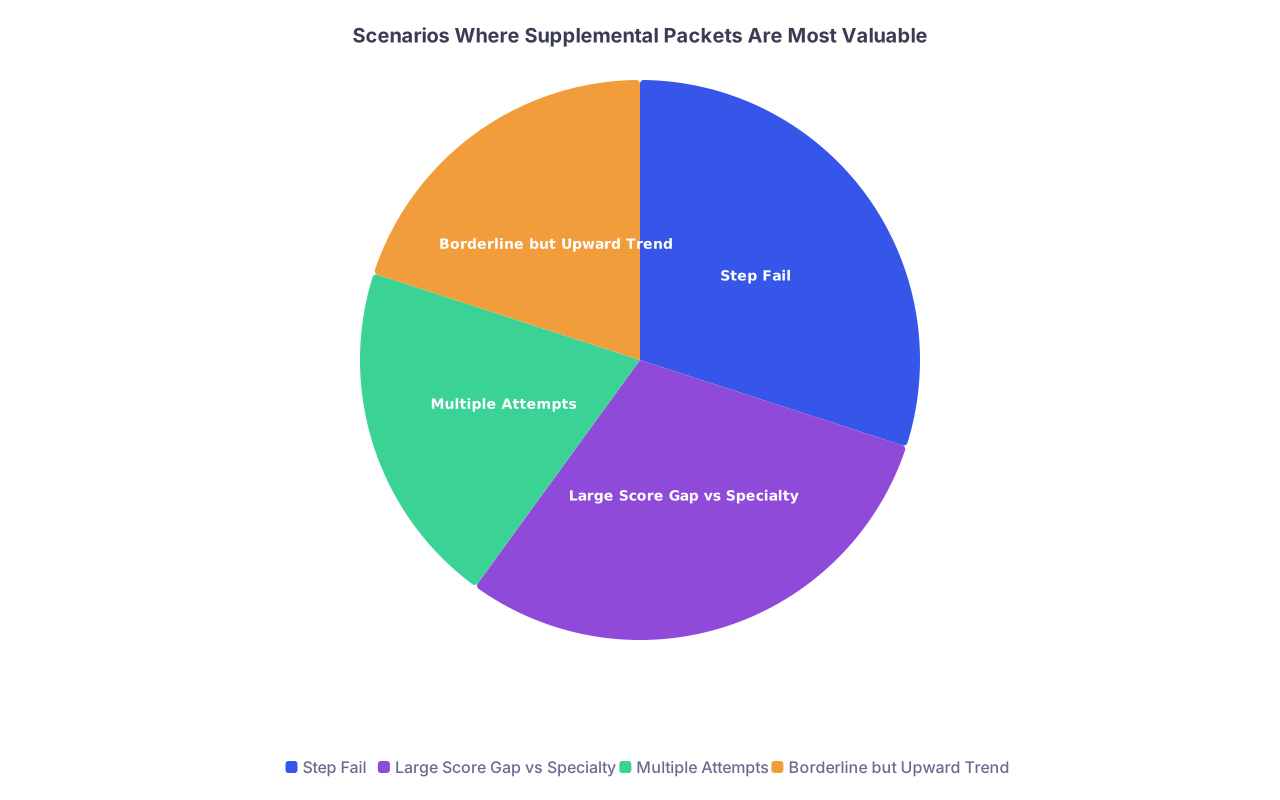
If any of these apply, you should build one:
| Category | Value |
|---|---|
| Step Fail | 30 |
| Large Score Gap vs Specialty | 30 |
| Multiple Attempts | 20 |
| Borderline but Upward Trend | 20 |
- Failed Step 1 or Step 2 CK at least once
- Step 2 CK significantly below typical matched range in your specialty
- Multiple exam attempts even if passed
- Large discrepancy between strong clinical performance and poor exam
- Major life event clearly overlapping with exam performance, now resolved
If you just have a slightly below‑average score but good everything else, you might not need this. Do not create drama where there is none.
14. Final Reality Check
A supplemental packet is not magic. It will not open doors at programs that hard‑filter at your score. It will not drag you into Derm with a 210.
What it can do:
- Push you from “auto-reject” to “maybe” at realistic programs
- Convert a cautious PD into a “let us interview and see”
- Give your advocates inside a program (alumni, faculty connections) ammunition to argue for you
You are trying to convert some no’s into yes’s. You only need enough yes’s to match once.
FAQ (Exactly 3 Questions)
1. Should I mention my low score in my personal statement or only in the supplemental packet?
Keep your personal statement primarily about your motivation, experiences, and fit for the specialty. If your score issue is significant (fail, huge gap) and you do not plan to send a supplemental packet widely, a brief, single paragraph in the personal statement is acceptable. But do not let your entire statement become a remediation essay. Ideally, you use the supplemental packet for detailed explanation and keep the personal statement forward‑looking.
2. Is it better to wait for a stronger Step 2 score before applying or apply on time with a weak score and supplemental packet?
If Step 1 is low and Step 2 is your chance to prove improvement, delaying until you have a clearly stronger Step 2 score usually helps more than an on‑time but weak application plus packet. Programs value an upward trend. A rushed, mediocre Step 2 followed by a packet full of “plans to do better” is less compelling than a solid Step 2 in hand on submission.
3. Can I re‑use the same supplemental packet for all programs, or should I customize each one?
You can absolutely use a core packet template for all programs—same score addendum, academic summary, CV, evaluation excerpts. What you should customize is the cover letter paragraph about program fit and the email itself. A 10–15% customization to show you understand that program’s strengths is enough. Do not waste time fully rewriting the packet 40 times.
Open a blank document right now and draft your one‑page cover letter using the structure above. Then list three concrete pieces of recent evidence (scores, evals, comments) that prove you are stronger than your Step score. Those two actions are the foundation of a supplemental packet that actually softens low scores instead of drawing more attention to them.