
It is late October. Your email is quiet, ERAS is submitted, and your Step score looks like a bruise in the middle of your application. You keep refreshing your inbox anyway. Meanwhile, your classmates with 250+ are complaining about having “too many interviews.” You are not amused.
Here is the truth: you cannot change that score. But you can absolutely change what it means in your file.
That is narrative repair. And if you do it properly, your low Step becomes a data point inside a coherent, credible story that actually strengthens your application instead of sinking it.
Let me walk you through how to do this like a professional, step-by-step.
Step 1: Get Clinically Honest About Your Score
Before you repair the narrative, you need to stop flinching away from the number.
1. Classify where you actually stand
Do not use vibes. Use data.
| Category | Step 2 CK Range | Typical Impact |
|---|---|---|
| Very Competitive (Derm, Ortho, ENT, Plastics) | 260+ | Strength |
| Above Average | 245–259 | Solid for most fields |
| Middle | 230–244 | Fine for many IM/FM/Peds/Neuro/OB programs |
| Below Average | 220–229 | Needs context + repair |
| Low / High Risk | < 220 or Fail | Requires explicit narrative strategy |
For Step 1 (now Pass/Fail), the main red flags are:
- A fail attempt
- Delayed exam date without a good reason
- Huge mismatch with clerkship performance
2. Identify if your score is a pattern or an outlier
Look at:
- Preclinical grades
- Clerkship grades (especially core rotations)
- COMLEX if you are DO
- Shelf scores
- Practice exam trajectory
Ask yourself bluntly:
- “Does this score fit my academic pattern?”
- “Or is it the weird outlier in an otherwise solid record?”
If:
- Score is low and preclinical/clerkship grades are mediocre → this is a pattern problem.
- Score is low, but grades, shelves, and evaluations are strong → this is an outlier problem.
You repair those two situations very differently. We will come back to this.
Step 2: Decide Your Strategic Angle (Outlier vs Pattern)
This is where most people screw up. They either:
- Over-explain and sound defensive, or
- Pretend the score does not exist, which just makes PDs write their own (usually harsh) interpretation.
You are going to pick a deliberate angle and commit to it.
A. If your Step score is an outlier
Your message:
“This score does not reflect my usual performance, and here is concrete evidence.”
Your supporting data:
- Strong clinical grades (Honors/High Pass in core rotations)
- Solid or high Step 2 vs Step 1 improvement (≥ 15–20 points jump if numeric; or pass after fail)
- Consistent COMLEX if DO
- Strong narrative feedback on evaluations (“excellent knowledge base,” “prepares thoroughly”)
Your job is to normalize the concern:
- Acknowledge the score briefly.
- Anchor attention to better metrics.
- Show the “trajectory” is upward.
B. If your Step score is part of a pattern
Your message:
“I used to have weaknesses in standardized testing / study approach / time management. I changed specific things, and here is the proof that it worked.”
Your supporting data:
- Later improvements (Step 2 better than Step 1, improved shelves toward the end of third year)
- Concrete changes in study strategy (not just “worked harder”)
- Better performance in environments that mimic residency: sub-I’s, acting internships, away rotations
- Evidence of reliability and work ethic (letters, narratives)
You are not trying to pretend you never struggled. You are proving that the version of you that had those struggles is not the one they will hire as a resident.
Step 3: Build a Clear Narrative Spine
Before you touch ERAS text boxes, you need one clean, internal script. One sentence that explains your Step situation without drama.
Examples:
Outlier, Step 2 much better:
“My Step 1 fail was a turning point; I rebuilt my study system from the ground up, and my Step 2 performance and clerkship grades are the more accurate reflection of where I am now.”
Pattern, but improving:
“Standardized exams have historically been a challenge, but over the last year I systematically changed how I learn and test; you can see the impact in my improving shelf scores and clinical evaluations.”
US-IMG with low score:
“My Step 1 score does not showcase my current capabilities; my US clinical rotations, strong letters, and Step 2 improvement are what I want you to judge me on.”
You will adapt that core line, with variations, in:
- Personal statement
- ERAS “Education / Experiences” descriptions (subtly)
- Interview answers
- Dean’s letter addendum (sometimes)
But the spine is the same. Consistent = credible.
Step 4: Decide Where to Address the Score (And Where Not To)
Residents and PDs read thousands of applications. They have limited patience for long-winded explanations about test anxiety.
You must be precise about where you spend “narrative capital.”
Places you can address it
- Personal statement – short, surgical paragraph only
- MSPE addendum or advisor letter – if your school offers this
- Interview answers – when asked directly or when discussing growth
- Occasionally, a brief ERAS “additional info” blurb (if truly needed)
Places you should not over-explain
- Every experience box on ERAS
- Every email to programs
- Every answer in interviews
The rule:
One clear written explanation in your application. Then you defend and expand in the interview.
Step 5: Write the “Narrative Repair” Paragraph
This is the part you probably care about most. Let us build it.
You want 3 elements:
- Brief acknowledgement (no excuses)
- Concrete change(s) you made
- Evidence that the change worked
Template you can adapt
“My [Step 1 / Step 2 CK] score is below my own expectations and does not fully reflect my capabilities. After that exam, I [specific, concrete changes you made – e.g., restructured my study approach, sought coaching for test-taking, integrated more active practice under timed conditions]. These changes are reflected in [better Step 2 score, improved shelf scores, strong clerkship performance, and feedback on my ability to apply knowledge clinically]. This experience forced me to become more deliberate and disciplined in how I learn, which has directly improved how I prepare for patient care.”
Now let us plug in some real versions.
Example: Step 1 fail, passed on second attempt, strong Step 2
“I failed Step 1 on my first attempt. That result was a shock and a clear signal that my study habits were not working. I met weekly with our academic support team, changed from passive re-reading to timed practice questions, and built a structured schedule that I followed consistently. I passed Step 1 on my second attempt and later scored a 238 on Step 2. My clerkship evaluations consistently highlight my preparation and growing fund of knowledge. The process was humbling, but it led me to a much more deliberate, sustainable approach to learning that I will carry into residency.”
Example: Low Step 2 (e.g., 218), but strong clinical record
“My Step 2 CK score of 218 is below where I aim to be. It reflects difficulty managing fatigue and timing during that specific testing period more than my day-to-day performance. Throughout my third year, I have consistently earned High Pass/Honors on core clerkships, with feedback emphasizing my solid clinical reasoning and preparation. Since Step 2, I have continued to refine my approach, using targeted question blocks and scheduled review, which has translated into stronger performance on subsequent shelf exams and my sub-internship.”
Example: DO student with modest COMLEX and Step 2, strong clinical work
“My COMLEX and Step 2 scores are not as strong as other aspects of my application. Standardized, single-day exams have often lagged behind my clinical and longitudinal performance. Over the last year I have worked closely with faculty mentors to refine how I study and how I test, shifting to higher-yield, case-based practice. This is reflected in my recent Honors in Internal Medicine and Family Medicine and the specific comments in my evaluations regarding clinical reasoning and patient ownership. I expect my performance as a resident, with continuous learning rather than single test days, to better match these strengths.”
Notice what these do not contain:
- Long trauma narratives
- Vague “test anxiety” with no corrective action
- Blame (COVID, Prometric, neighbor’s dog)
Programs are not interested in your excuses. They are interested in your adaptations.
Step 6: Back Your Story With Data (Receipts Matter)
Your narrative is only as strong as the objective evidence behind it.
1. Strengthen the academic trajectory
Where you can still move the needle:
- Sub-internships / acting internships
- Remaining shelf exams
- Step 2 (if not taken yet)
- COMLEX Level 2 (for DO)
If Step 2 is still ahead:
- Treat it as your primary “redemption” exam.
- Push it earlier if your practice scores are strong enough; delay if they are weak. Do not take it “just to get it done” and then explain another poor result.
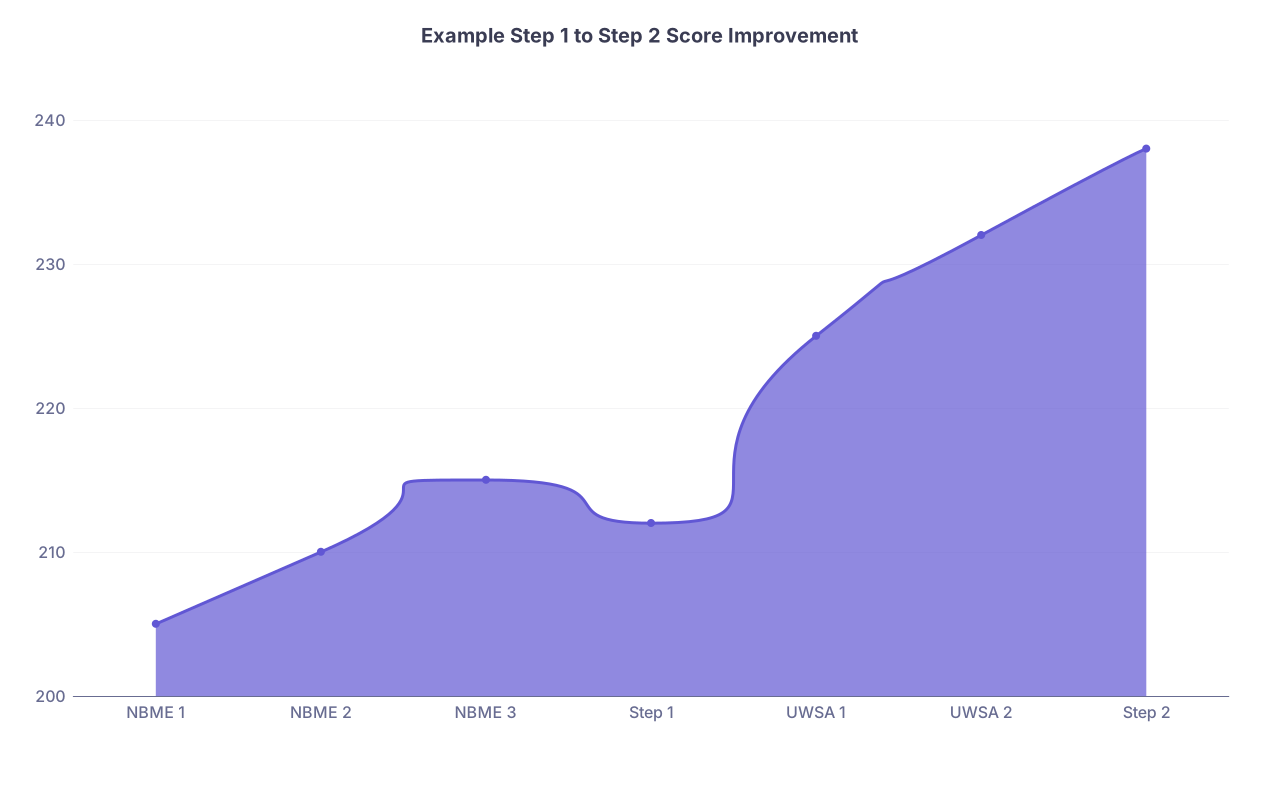
| Category | Value |
|---|---|
| NBME 1 | 205 |
| NBME 2 | 210 |
| NBME 3 | 215 |
| Step 1 | 212 |
| UWSA 1 | 225 |
| UWSA 2 | 232 |
| Step 2 | 238 |
This is the kind of curve PDs are happy to see. Modest Step 1, stronger Step 2, practice scores trending up. It tells a story of growth, not stagnation.
2. Mine your evaluations and letters
Ask your letter writers (politely) to:
- Comment directly on your fund of knowledge and clinical reasoning.
- Address reliability, work ethic, and ability to learn from feedback.
- If appropriate, briefly acknowledge that exams have not fully reflected your clinical performance and that you are safe and competent.
A strong letter that says:
“I would rank this student in the top 10% of those I have worked with over the last five years”
is far more powerful than another paragraph from you explaining your test anxiety.
Step 7: Align Your Application List With Reality
Here is where people sabotage themselves. They repair the narrative nicely, then apply like they scored a 260.
You need a list strategy that matches your numbers and your story.
1. Understand your competitiveness band
Rough guidance for Step 2 if Step 1 is pass/fail or weak (US-MD/DO):
- 245+ → competitive for most IM, EM, Neuro, OB, Peds at a wide range of places
- 230–244 → fine for many community and mid-tier academic IM/FM/Peds/Neuro
- 220–229 → needs a broad list, more community and regionally focused
- < 220 or fail → heavy emphasis on community, safety programs, sometimes transitional years
For surgical subspecialties with a low score, your realistic options narrow rapidly. You either:
- Commit to a Plan B specialty you also genuinely like, or
- Consider a research year at a strong home institution before a re-application.
2. Skew your list intelligently
If you have a low score:
- Apply broadly. 60–80+ programs in competitive specialties is normal, 80–120+ for IMGs or significant red flags.
- Favor:
- Community and hybrid community-academic programs
- Programs with a history of interviewing lower-score applicants
- Regions with less applicant pressure (Midwest, some South, smaller cities)
| Program Type | Friendly for Lower Scores? | Notes |
|---|---|---|
| Big-name academic | Low | Need very strong other factors |
| Mid-tier university | Moderate | Depends on region and specialty |
| Hybrid community-academic | Good | Often more flexible on scores |
| Pure community | Best | Look hardest at holistic fit |
| New programs | Variable | Less data, sometimes flexible |
Line up your expectations with this reality. That is not pessimism. It is strategy.
Step 8: Prepare Scripted, Non-Defensive Interview Answers
Programs will ask. You need a crisp, rehearsed answer that:
- Takes responsibility
- Shows growth
- Ends on your current readiness
Core structure to use in answers
- Acknowledge, no avoidance
- One clear cause (not ten)
- Two or three specific corrective actions
- Current evidence of improvement
- Short closing line linking to residency readiness
Example answer:
“You are right that my Step 1 performance was not where I wanted it to be. At the time, I relied heavily on passive review and underestimated how important timed questions were for me. After that, I met with our academic support office, shifted to a question-first strategy with daily UWorld blocks, and used weekly self-assessment exams to guide my review. Those changes led to a 25-point improvement on my Step 2 score, and I have consistently performed well on my shelves and sub-internships. The experience forced me to be much more systematic and honest about how I learn, which has made me more reliable in clinical settings.”
Practice this out loud. Not once. Ten times. In front of a mirror or recorded on your phone. You want it to sound natural but not improvised.
Step 9: Stop Doing the Three Things That Make Low Scores Worse
There are a few moves that reliably make PDs nervous. Avoid them.
Over-disclosure of personal drama
You do not need a full psychological autobiography in your personal statement. If there was:- Death in the family
- Major illness
- Serious mental health crisis
You can reference it briefly. One or two lines, max. Then pivot to changes and current stability.
Inconsistency between documents
If your personal statement says you struggled with mental health, but your Dean’s letter says nothing, and your interview answer gives a different reason (test strategy), PDs start to distrust the story. Keep the core explanation consistent.Victim framing
Anything that sounds like:- “The exam is unfair.”
- “My school did not support me.”
- “The pandemic ruined everything and that is why I scored low.”
Makes you look externally focused and not ready for residency reality.
You are allowed to be frustrated. Just do not put it in your application.
Step 10: Parallel Track – Improve the Rest of Your Application
Narrative repair is not just words. It is upgrading everything else around the weak spot.
Focus especially on:
1. Clinical strength
- Crush your sub-I’s. Be the person residents want to work with at 3 a.m.
- Get letters from people who saw you on busy, real services.
- Ask explicitly: “Can you speak to my clinical reasoning and readiness for intern year?”
2. Professionalism and reliability
Residents and PDs will forgive low scores faster than they forgive:
- Being late
- Poor follow-through
- Sloppy notes
- Complaining
Your day-to-day behavior on rotations is part of your narrative repair. Word travels.
3. Clear, believable specialty choice
If you have a low score and a wobbly specialty story, PDs assume:
- “They could not get into their first choice and defaulted here.”
Fix that by:
- Connecting your experiences to the specialty in a very grounded way.
- Showing longitudinal interest (not “I decided last month”).
Putting It All Together: A Mini-Case
You: US-MD, Step 1 pass, Step 2 = 221, aiming IM.
Clerkships: High Pass mostly, a couple of Honors.
No research. No fail attempts.
Narrative repair plan:
Internal spine:
“My Step 2 score is not where I want it, but my clerkship performance and evaluations reflect my actual capabilities, and I have systematically improved my study and test approach.”
Application strategy:
- Personal statement: 1 short paragraph as above.
- LORs: Request from inpatient IM attendings who can speak strongly about your clinical skills.
- Program list: 70–90 IM programs, heavy on community and hybrid, multiple regions, fewer big-name academic centers.
Interview answer prepared:
- Acknowledge 221
- One main cause (study approach, not 12 life crises)
- 2–3 specific changes
- Evidence: strong shelves, strong IM rotations, good feedback
Behavior:
- Be excellent on your IM sub-I. Show up early. Carry 4–6 patients well.
- Double-check orders and notes. Residents notice.
- Low-ish score, yes.
- But also: consistent clinical strength, reliable behavior, humble insight, and a realistic program list.
That applicant matches. Every year.

| Step | Description |
|---|---|
| Step 1 | Low Step Score Identified |
| Step 2 | Classify Outlier or Pattern |
| Step 3 | Build Core Explanation Line |
| Step 4 | Write Repair Paragraph |
| Step 5 | Back With Data and Letters |
| Step 6 | Adjust Program List |
| Step 7 | Prepare Interview Scripts |
| Step 8 | Strengthen Clinical Performance |
| Step 9 | Consistent, Coherent Application |
FAQ (Exactly 3 Questions)
1. Should I delay my application a year to “fix” a low Step score?
Maybe, but only if you can create new, strong objective data. If you already took Step 2 and it is also low, simply sitting out a year without a clear plan (research at a strong institution, additional degree, robust US clinical experience for IMGs) will not magically make programs ignore past scores. If you have not yet taken Step 2 and your practice scores are far below where they need to be, a planned delay to improve that performance can be justified. The key question: “Will I look substantially different on paper if I wait one year?” If the answer is no, apply now with narrative repair and a realistic list.
2. Should my personal statement always mention my low Step score?
No. If your Step is mildly below average but the rest of your application is strong and there are no fails, you can let your trajectory and letters speak for themselves. I advise explicit narrative repair if you have: a fail attempt, a very low score (< 220 for most US-MD/DO in competitive specialties), or a large mismatch between scores and other performance that will raise questions. If you do address it, keep it to one tight paragraph and spend the rest of the statement on who you are as a future resident.
3. Can a strong Step 2 completely erase a bad Step 1?
It does not erase it, but it changes the interpretation. A Step 1 fail followed by a solid Step 2 (for example, 235+) tells PDs you corrected course and can handle complex material. It will not reopen doors to the most competitive programs and specialties, but it will make many mid-tier and community programs comfortable moving you to the interview pile, especially if your clinical performance and letters are aligned with the improved score. The combination of upward trajectory, coherent narrative, and strong clinical evidence is what turns that low Step into a survivable – and sometimes even strength-building – part of your story.
Key Takeaways
- You cannot hide a low Step, but you can control the story around it: one clear explanation, concrete changes, and hard evidence of growth.
- Narrative repair only works if your behavior and trajectory back it up: stronger clinical performance, solid letters, and a realistic program list.
- Programs forgive scores more easily than they forgive denial, excuses, or inconsistency. Own the number, show how you changed, and make it obvious that the resident they will get is not defined by that one test day.