
It’s late October. You finally hit submit on ERAS, you know your Step score is below the comfort zone, and now you’re imagining a program director opening your file. You hope they read your personal statement. You hope they see your letters.
Let me tell you what really happens in those first 60 seconds.
In most programs, that initial review is brutal, fast, and unforgiving. And low Step scores get handled in a very specific, very algorithmic way long before anyone starts waxing poetic about “holistic review.”
I’ve sat in the rooms. I’ve watched PDs and associate PDs blow through 200 applications in a single afternoon, commenting out loud as they go. You’re not invisible. But you are getting judged hard and fast.
You want to know how low Step score applications get triaged, and more importantly, how you can survive that first 60-second purge. Let’s walk through what actually happens on their side of the screen.
The Real First Filter: The Spreadsheet, Not Your Story
Before anyone “reviews” your application, something else usually happens: a spreadsheet gets built.
Sometimes it’s exported directly from ERAS, sometimes a coordinator or chief resident puts it together. Either way, it’s cold and simple:
Name. School. Step 1/Comlex 1. Step 2. Home/away rotation. Visa. Red flags.
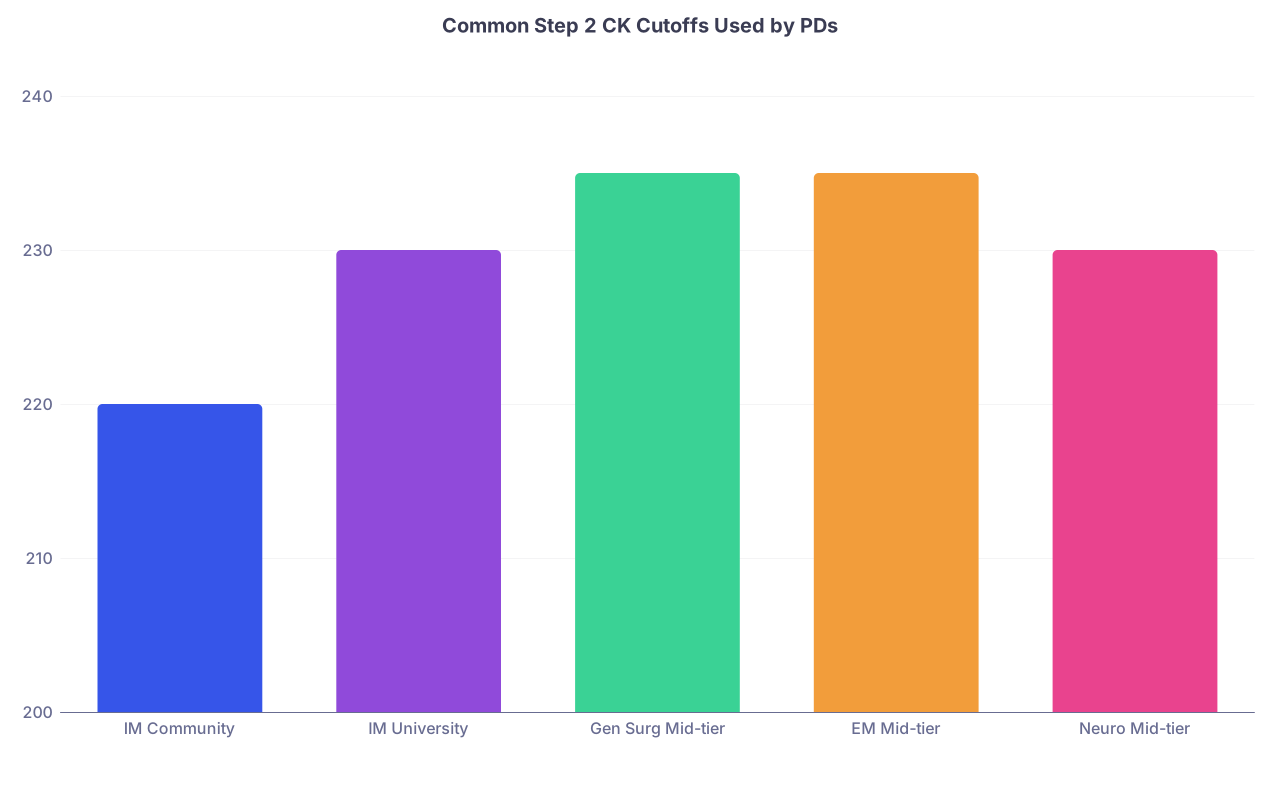
| Category | Value |
|---|---|
| IM Community | 220 |
| IM University | 230 |
| Gen Surg Mid-tier | 235 |
| EM Mid-tier | 235 |
| Neuro Mid-tier | 230 |
Programs will never publish this chart, but I’ve seen versions of it, often in an ugly Excel file titled “Screening Criteria 24-25.”
Here’s how it really goes behind closed doors:
- PD: “We got 2,100 applications again this year?”
- Coordinator: “Yes. Same as last year.”
- PD, to chiefs: “Okay, what are we setting for Step 2 this cycle so we don’t drown?”
They pick a number. That number is your first enemy.
Sometimes they’ll say:
- “Below 210 – auto reject unless special circumstance.”
- “220 and above gets full review, 210–219 maybe if they’re from X schools or did a rotation here.”
You? You’re a line in that spreadsheet. And they sort it by Step score in descending order.
Low scores don’t get “holistically reviewed” at first pass. They get bucketed.
The 60-Second Triage Script PDs Actually Use
Now imagine the PD has filtered some of the spreadsheet. You’ve squeaked by the absolute cutoff (or the coordinator pulled you into a “maybe” pool). Now comes the 60-second triage.
I’ve watched this play out enough times that I can basically narrate it.
Here’s the rough internal script, in order:
- Step Scores & Trend
- School & Context
- Rotations / Home / Away
- Red Flags
- Signals (if applicable)
- Quick glance at experiences / letters / personal statement only if you got past the above
Let’s break down what happens to low score apps in each of those stages.
Step 1 vs Step 2: How They Actually Read “Low”
Forget what you think “low” means. Programs define it for themselves, and it’s different by specialty and tier.
| Specialty Tier | Approx 'Low' Step 2 CK | Reaction in 60-Second Triage |
|---|---|---|
| Top Academic Derm/Plastics | < 250 | Hard pass unless massive hook |
| University Gen Surg | < 235 | Auto-triage down unless strong offset |
| University IM | < 225 | Careful look for home/away/letters |
| Community IM / FM | < 210 | Hesitation but not fatal |
| Psych / Peds (mid-tier) | < 215 | Needs a clear upside or explanation |
Step 1 is pass/fail now for most, but old habits die hard. PDs still look for a trajectory:
- Pass Step 1, Step 2 = 206 → they say: “Weak test taker, question readiness.”
- Pass Step 1, Step 2 = 220 → “Borderline but might be okay if the rest looks good.”
- Pass Step 1, Step 2 = 235 after a failed attempt → “Improved. Still a risk, but maybe.”
Here’s the brutal truth: low but rising is much more forgivable than low and flat. If Step 1 was marginal and Step 2 is the same or worse, that triggers concern instantly.
What I have heard PDs say out loud:
- “We don’t have time to remediate test takers.”
- “If they barely passed boards, how are they going to handle our in-service exams?”
The test score is not just a number. It’s a proxy for how much supervision and rescue you’ll need.
The Context Check: School Name and Training Environment
Once they clock your score, the next 10–15 seconds are about context.
They glance at:
- Your med school (US MD, US DO, Caribbean, other IMG)
- Reputation of that school in their mind, not on some ranking website
- Whether they know or trust your school’s grading and exam rigor
Let me be blunt:
- US MD with low Step 2 → They’ll often say, “Huh, what happened?” and look for explanations and strengths.
- US DO with low Step 2 → Much more variable. Some IM/FM programs are absolutely fine. Competitive fields, less forgiving.
- Caribbean / IMG with low Step 2 → This is where the axe falls fastest. If Step 2 is low, 60 seconds becomes 15.
I’ve watched PDs literally scroll: “School… score… IMG + 208… no. Next.”
That’s it. That was your application review.
Is that fair? No. Is that real? Yes.
The “Anchor Hooks” That Can Override a Low Score
Here’s where it gets interesting. There are specific things that make a PD stop and say, “Hold up, this might be worth more time.”
These are your survival tools.
Common hooks that actually make them pause:
Home student
If you’re at their own med school, your low score gets more slack. They trust their own faculty’s judgment more than a number. I’ve seen PDs say, “Okay, but Dr. X says they’re solid clinically. Invite.”Strong away rotation at that program
A mediocre score plus “worked with us, strong evaluation from Dr. Y” can absolutely rescue you. Many PDs will prioritize someone they’ve seen on their own wards over a random 240 they’ve never met.Known letter writer
If your low score is paired with, say, “outstanding” letter from someone the PD personally knows or respects, you get a second chance. They’ll actually click into the letter. That’s rare.Research / niche interest aligned with that program
This matters less than students think. But when it hits just right—your work is exactly in the PD’s niche—they’ll sometimes overlook a softer score because they want “their people.”URiM / diversity / special pathway candidate
Many academic programs consciously make room for applicants who bring underrepresented backgrounds or unique life stories, even with lower scores. It’s not a magic wand, but it changes the threshold.
Those are not theoretical. I’ve watched low-score applicants get flagged as “Invite” purely on those anchors.
How Programs Use Hard Cutoffs vs Soft Screens
Not all programs use the same level of ruthlessness. But almost everyone uses some version of this.
Think of it in three buckets:
Hard cutoff programs
“Below 220 → auto reject, no human eyes.”
This is common in competitive specialties and big-name university programs with insane volume.Soft screen programs
They set tiers: 230+ = high-priority review, 215–229 = secondary review, below 215 only reviewed if there’s a hook (home student, signal, away rotation, etc.)Truly holistic (but still busy) programs
These are mostly community or mid-tier academic programs. They’ll say, “We consider all apps,” but then chiefs and APDs quickly triage anyway. They don’t use a single number, but low scores still push you to the bottom of the pile unless something stands out.
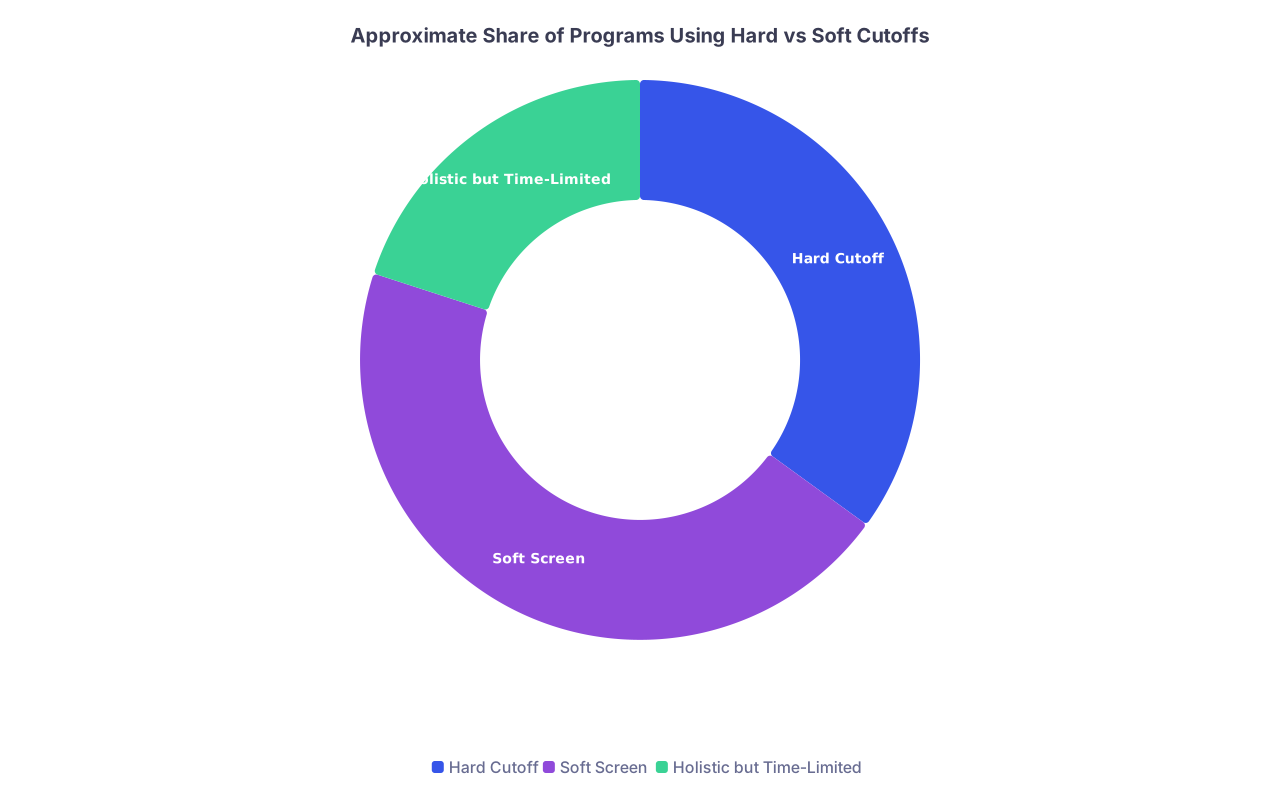
| Category | Value |
|---|---|
| Hard Cutoff | 35 |
| Soft Screen | 45 |
| Holistic but Time-Limited | 20 |
That doughnut? That’s closer to reality than what you’ll hear on any official webinar.
What Happens in the “Maybe” Pile for Low Scores
So let’s say you survived:
- You’re below their ideal, but above their absolute.
- You’re not an obvious yes.
- They’re not ready to flush you.
Welcome to the purgatory pile.
Here, the 60-second review becomes more like 90–120 seconds, but still fast.
What they look at now:
1. Trend and timing
- Did you take Step 2 late? They’ll side-eye that.
- Did you improve from a low Step 1 practice trajectory? Sometimes mentioned in your personal statement? If it’s clearly explained, it helps.
2. Transcript and clinical grades
Big oversight from a lot of applicants: if your Step score is low, your clinical evals need to scream “strong resident.”
I’ve heard:
- “Shelf scores meh, but all honors in medicine and surgery. So they can function on the floor.”
- “Low board but strong comments, they work hard. We can probably train them.”
If your transcript shows:
- Mediocre Step
- Average or below clinical grades
- No strong comments like “hardest-working student on the team”
You slide down the list very fast.
3. Personal statement: only now, and only lightly
Let me be frank. PDs do not read 2,000 personal statements word-for-word.
But in the maybe pile, they’ll sometimes:
- Skim the first half
- Look for an explanation of the score that doesn’t sound like an excuse
- Look for coherence: does your story, interest in specialty, and past experiences feel consistent?
If your PS starts with trauma, drama, or vague philosophy instead of getting to the point, they’ll bail out quickly. If you’re low score, you don’t have the luxury of a slow open.
Signals, Emails, and “I’m Really Interested” From Low Score Applicants
In the era of preference signals and overstuffed inboxes, programs are seeing desperate outreach from low-score applicants constantly.
Here’s the unfiltered truth on how that lands:
Signals matter more than your email.
If a low-score applicant signals a program and has some connection (region, rotation, known letter writer), the PD may say, “Okay, at least look at them.”Cold emails almost never override a low score.
I’ve seen inboxes with 400+ emails in October from applicants. PDs don’t have time to rescue everyone.Meaningful contact before application season can help.
If you did research with them, attended their virtual events consistently, or met them through a mentor they trust, then your name rings a bell and you buy yourself 10–20 more seconds.
But no one is saying, “This 205 is a must-interview because their email was really heartfelt.”
How Different Program Types Treat Low Scores
This is the part no one tells you: where you apply drastically changes how your score is interpreted.
| Program Type | Tolerance for Low Scores | What Helps Most |
|---|---|---|
| Big-name academic | Very low | Research, known mentor, rotation there |
| Mid-tier university | Moderate | Strong clinicals, away rotation |
| Community (busy) | Moderate to high | Work ethic, solid letters |
| New/small program | High (but cautious) | Genuine interest, decent Step 2 |
I’ve sat with mid-tier university IM PDs who say: “We’ll take a 215 with great clinicals over a 245 with garbage evaluations any day.”
I’ve also heard a big-name program say, flat out: “Below 230? Unlikely, we just don’t need to.”
You need to be brutally honest with yourself: are you spraying applications at places that will never meaningfully review you, or are you targeting programs whose cutoff tolerance fits your reality?
What You Can Actually Do If Your Score Is Already Low
Let me shift from surveillance mode to strategy, because voyeurism doesn’t help you match.
If your Step score is already low and you’re in or near the application phase, here’s what moves the needle inside that 60-second triage window.
1. Make Step 2 Your Redemption (if there’s time)
If Step 1 was weak or failed and Step 2 is pending:
You do not have the luxury of mediocrity. Programs look for a clear jump.
I’ve literally seen PDs say:
- “Step 1 fail but Step 2 235. Okay, they figured it out. Invite.”
- “Step 1 borderline, Step 2 215. That’s who they are.”
If Step 2 is already low, you can't fix the number, but you can fix context and everything else.
2. Exploit every possible anchor
You want to force the PD to say, “Hang on, let me actually look.”
That means:
- Doing or highlighting a home or away rotation at realistic programs.
- Making sure your best letters come from people who are known and respected in your specialty, not just big department names with generic praise.
- Getting your clerkship directors to explicitly address your work ethic, growth, and reliability. PDs eat that up when the score is shaky.
3. Explain the score once, clearly, and then move on
If there is a real, documentable reason for your score tanking (illness, major family crisis, tested too early because of admin pressure), then a short, direct explanation in your personal statement or an addendum can help.
The key:
- No self-pity.
- No long drama arc.
- One to two sentences: “I underperformed on Step 1 due to X, addressed Y, and my subsequent performance (Step 2, clerkships) better reflects my capabilities.”
If there’s no clean explanation, do not manufacture one. Own it and lean on your strengths. Fake or weak explanations are worse than silence.
Mental Model: How PDs Rank You in Their Head
Let me give you a simple framework that reflects how many PDs are actually thinking during rapid triage.
Imagine an internal score made of four pieces:
- Test performance (Step)
- Clinical performance (evals, grades)
- Fit/connection (home, region, rotation, signal, letters)
- Risk/red flags (fails, professionalism issues, big gaps)
If your test performance is low, you must overcompensate on at least one, ideally two, of the other categories.
I’ve seen low-score applicants get interviews because:
- Low test, outstanding clinical evals, home program, no red flags.
- Low test, strong research with the PD’s friend, clear alignment with the program’s niche, good letters.
I almost never see:
- Low test, average everything else, no connection.
Those get silently flushed in under 30 seconds.
A Quick Visual: What Actually Happens to Low Score Apps Over Time

| Step | Description |
|---|---|
| Step 1 | Application Submitted |
| Step 2 | Spreadsheet Export |
| Step 3 | Auto Rejection Pool |
| Step 4 | Initial 60 Second Triage |
| Step 5 | Maybe or Low Priority Pool |
| Step 6 | Shortlist for Interview |
| Step 7 | Silent Rejection |
| Step 8 | Occasional Late Invite |
| Step 9 | Interview Invite Sent |
| Step 10 | Below Hard Cutoff |
| Step 11 | Any Anchor Hook |
| Step 12 | Interview Slots Still Open |
That’s it. That’s the machine you’re up against.
FAQs
1. Should I address my low Step score directly in my personal statement?
If there’s a clear, legitimate, and briefly explainable reason—yes, in 1–2 concise sentences, then pivot to what you did about it and how your later performance improved. If your score is low because you just underperformed without a clean story, don’t contort yourself. Focus the statement on your clinical strengths, growth, and why you fit that specialty. PDs hate long-winded excuses more than low numbers.
2. Can a strong away rotation really overcome a low Step score?
At some programs, absolutely. I’ve watched PDs move low-score students from “maybe” to “definite invite” after a glowing evaluation from a trusted faculty member on their own service. The key is that your rotation performance has to be obviously strong, and the attending has to actually document that in a way the PD believes. A lukewarm eval does nothing for you.
3. Do preference signals help low-score applicants more than others?
Signals don’t magically erase a low score, but they can push a PD to actually open and look at your file instead of discarding it off the spreadsheet. Low-score + signal + some anchor (regional tie, school connection, rotation, or strong letters) can absolutely be the difference between “never reviewed” and “interviewed.” Low-score + signal alone, with no other strengths, usually isn’t enough.
4. Is it even worth applying to “reach” programs with a low Step score?
One or two true reaches are fine, especially if you have a meaningful connection (research, mentor, region, URiM status, or niche fit). But blanketing a tier that has no history of interviewing applicants with your profile is self-sabotage. Look up past match lists at your school, talk to recent grads with similar scores, and build a list where at least half the programs are places that actually take applicants like you. You need volume, yes—but you also need realism.
Key Takeaways
First: your application is often reduced to a few cells in a spreadsheet before a human ever looks at your story. Low scores get you screened; they don’t have to get you deleted, but you need anchors.
Second: PDs will forgive a low score when there’s a clear counterweight—strong clinical performance, a real connection to the program, trusted letters, or a meaningful upward trajectory.
Third: your job isn’t to magically fix the number; it’s to stack enough obvious strengths that when your file hits that 60-second window, the PD’s instinct is, “They’re a risk on paper, but I don’t want to lose this one.”