The way you email and call programs can hurt you more than your Step score ever will.
I’ve watched applicants with 250+ tank goodwill with one desperate voicemail. I’ve also seen 210–215 Step applicants quietly pull interviews because they handled communication like professionals while their peers spammed coordinators into oblivion.
If your Step score is low, your margin for error is already thin. You cannot afford to be “that person” in anyone’s inbox or voicemail.
This is the stuff people regret later. “I wish I hadn’t sent that email.” “I think I annoyed that coordinator.” “I probably shouldn’t have called that PD’s cell.” Let’s make sure those are not your lines.
The Single Biggest Communication Mistake: Acting Entitled Because You’re Anxious
Here’s the hard truth: feeling desperate doesn’t give you permission to be demanding.
Low Step applicants often slide into this pattern:
- Score anxiety →
- Fear of not matching →
- “I need to DO something” →
- Over-emailing / over-calling →
- Becoming a problem instead of a person they want to help
You’re not trying to be rude. You’re scared. But programs don’t see “fear,” they see:
- Neediness
- Poor judgment
- Boundary issues
- Lack of professionalism under stress
I’ve heard coordinators say, word for word:
“He’s emailed me six times in two weeks. If he can’t handle waiting for an interview invite, how’s he going to handle cross-cover on nights?”
Do not become the applicant who converts empathy (“that Step score is tough, maybe we can help”) into avoidance (“we do not want that drama”).
Email Missteps That Quietly Kill Your Chances
Let’s start with email, because that’s where most of the damage happens.
1. The “Spray and Pray” Mass Email
You know the one:
- Same generic paragraph
- Sent to 40+ programs
- Subject line like: “Passionate applicant with unique story”
- No program-specific content
Programs can smell a mass email from three screens away. And they hate it.
Why it hurts you (especially with a low Step):
- Confirms their bias: “Low Step and not selective or thoughtful”
- Signals you’re not really interested in them
- Wastes their time—so they remember you for the wrong reason
Avoid this by:
- Only emailing programs where:
- You have a real connection (school, region, rotation, mentor, spouse’s job)
- You would genuinely attend if matched
- Writing each email from scratch or from a tight template that you heavily customize
Bad example:
Dear Program Director,
I am writing to express my strong interest in your Internal Medicine residency program. I am a hardworking and dedicated applicant with a passion for patient care and lifelong learning…
I’ve seen that exact paragraph in 15 different inboxes, from different people. Nobody’s impressed.
Better skeleton (you customize heavily):
- Subject: “Application update – [Your Name], [School], [Specialty]”
- 4–6 sentences max
- Specific tie to the program
- One concrete update or clarification
- Clear, respectful closing
We’ll get to good templates later. For now: if you can send it to 20 programs with only the name changed, it’s a bad email.
2. The Over-Frequent “Just Checking In” Email
This one damages you fast.
Here’s the pattern I see:
- Applicant emails in September: “Just wanted to express my interest.”
- Emails again in October: “Checking if my application was reviewed.”
- Again in November: “Just following up on my previous email.”
- Then again in December “Reaffirming my strong interest.”
From the applicant’s side: “I’m being persistent and showing enthusiasm.”
From the program’s side: “This person doesn’t understand boundaries.”
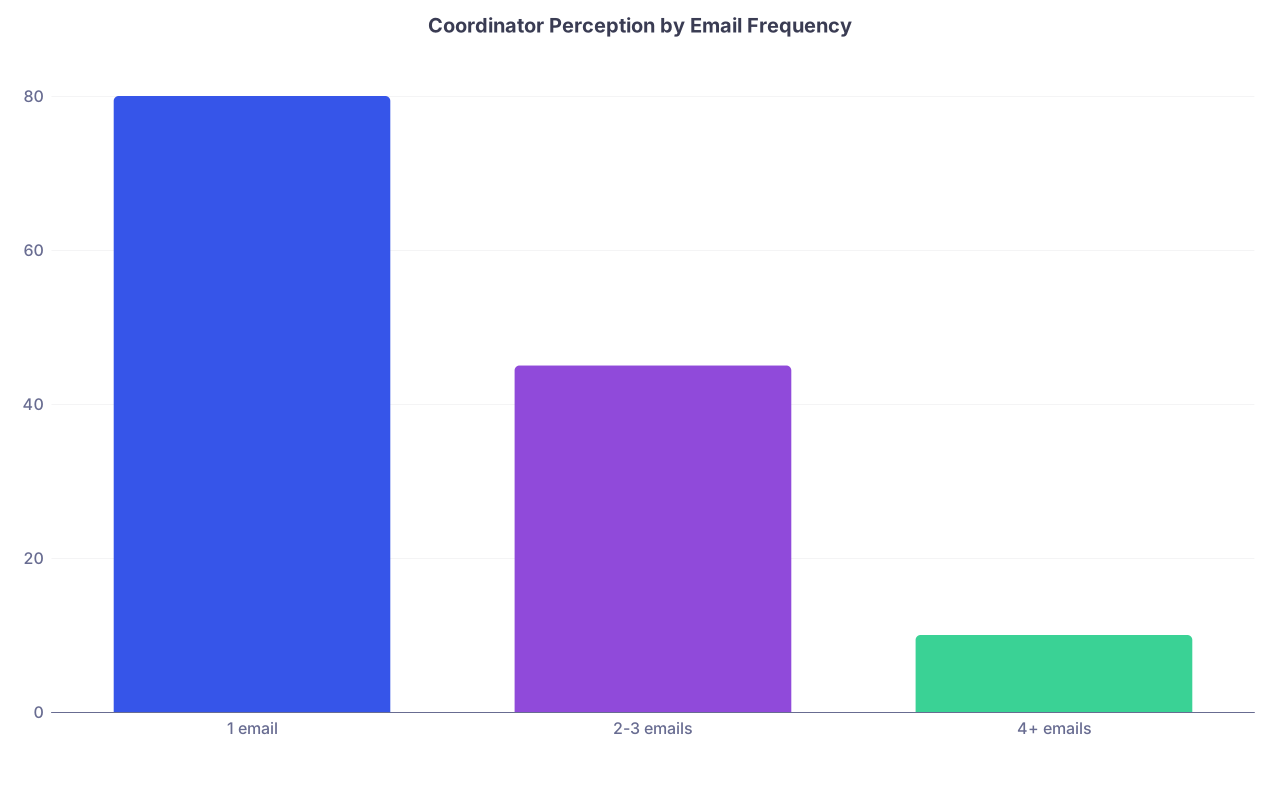
| Category | Value |
|---|---|
| 1 email | 80 |
| 2-3 emails | 45 |
| 4+ emails | 10 |
(Approximate reality: one thoughtful email is usually fine. Four is a problem.)
Safe rule of thumb:
- 0–1 interest email before interview season ramps up
- 1 TRUE update email if something major changes (new Step 2 score, publication, visa status resolved, major honor)
- That’s it. Unless a program asks you a question or invites updates.
If you’re writing, “Just wanted to follow up” for the third time? Stop. You’re not following up, you’re eroding your image.
3. The “Step Score Essay” Email
Common low Step mistake: sending a long autobiographical justification:
- 3–5 paragraphs explaining why you scored low
- Every family tragedy, every COVID disruption, every sleep issue
- Sometimes even screenshots of practice scores
Programs do not want a confessional email.
If they’re interested enough to wonder about your score, they’ll ask in an interview or read your personal statement/MSPE. Your explanation is not going to trigger an invite on its own.
Why this backfires:
- You center your weakness instead of your strengths
- You look defensive
- You force them to emotionally process your story in their already overloaded inbox
- You sometimes reveal more than is wise about mental health, professionalism, or boundaries
Exception (narrow, but real):
- Brief mention (1–2 sentences) if:
- There was a single, clear, time-limited issue
- You’ve since demonstrated improvement (Step 2, shelf exams)
- You tie it to data, not drama
Example of acceptable micro-explanation inside an update email:
I also wanted to share that while my Step 1 score does not fully reflect my capabilities, my subsequent Step 2 CK score of 238 and strong clinical evaluations better represent my current level of performance.
That’s enough. You’re not writing a memoir.
4. Writing Like a Text, Not a Professional Email
You’d think this is obvious. It isn’t.
Real things I’ve seen:
- “hey doc, just wanted to see if my app came thru”
- No capitalization, no greeting, no signature
- Emojis in emails to PDs
- Subject lines like “YO” or “Quick question”
With a low Step, you must overcompensate on professionalism. Not undercut it.
Basic sanity checks before you hit send:
- Subject line is clear: “Application update – [Your Name]”
- Greeting: “Dear Dr [Last Name]” or “Dear [Program Name] Residency Program”
- One screen of text or less
- Full signature:
- Name
- Medical school / year / grad year
- AAMC ID
- Contact info
If you wouldn’t send it to your dean, don’t send it to a program.
Call Missteps That Make Programs Avoid You
Calls are worse. One bad call carries more emotional weight than five bad emails.
Coordinators talk. PDs remember the names of “that caller.”
5. Calling When Email Was Clearly the Right Channel
Rule: If it’s not time-sensitive and life-or-death for your application, do not call.
Bad reasons I’ve heard applicants calling:
- “I just wanted to make sure you got my application.”
- “I wanted to know where I am on your list for interviews.”
- “I’m checking if my USMLE score is too low for your program.”
- “Have you reviewed my application yet?”
- “I sent an email yesterday and haven’t heard back.”
Those calls don’t get you clarity. They get you labeled.
Programs are drowning during application season. A phone call is an interruption that demands immediate attention. If the content isn’t urgent, you’re basically saying, “My anxiety matters more than your workday.”
Reasonable call scenarios:
- You’re having a problem with ERAS that affects their ability to see your file right now
- Time-sensitive logistics after an interview (travel disaster, illness, urgent reschedule)
- They specifically ask you to call
Everything else? Email.
6. Calling Personal or Off-Hours Numbers
Another career-limiting move: calling cell numbers you found on Google, Doximity, or some random resident contact list from years ago.
Red flags:
- Calling a PD’s office outside business hours
- Calling on weekends “because I knew you’d be less busy”
- Calling a resident on their personal cell to ask about your application status
- Calling main hospital numbers asking to be transferred to PDs or coordinators
You think you’re being “proactive.” You’re actually showing:
- Poor respect for boundaries
- Lack of awareness of hierarchy and professionalism
- Potential to be a high-maintenance resident
One program coordinator’s exact line to me about a caller:
“If he’s this intrusive before we even interview him, imagine him as a PGY-1.”
You don’t want to be the story coordinators tell each other at lunch.
7. Voicemails That Should Never Exist
If you’re forced to leave a voicemail (e.g., you had to call about a same-day emergency), most people still screw it up.
Common mistakes:
- Rambling for 2–3 minutes
- Sounding panicked or annoyed
- Including your entire Step story in the message
- Asking them to call you back “to discuss my application” with no specific reason
What a voicemail should be:
- 20–30 seconds
- Calm
- Specific
- Easy to act on
Bad voicemail example:
Hi Dr. Smith, this is Alex Johnson. I applied to your program and I have a low Step score but I’ve really grown as a student and I have a lot of clinical experience and I just wanted to talk more about my application and see if there’s anything else you need from me and I really love your program and it’s my top choice so please call me back…
They’re not calling you back. You just created an awkward situation.
Acceptable voicemail (only for true logistics/urgency):
Hello, this is Alex Johnson, an applicant to your Internal Medicine residency. I’m calling because I have an urgent issue with my interview scheduled for tomorrow, January 12. My flight was canceled and I won’t be able to arrive on time. My call-back number is 555-123-4567. Thank you.
Notice what’s missing: emotional oversharing, details about your scores, attempts to sell yourself.
The “Signals of Desperation” That Programs Notice
Low Step applicants often underestimate how pattern-based program judgments are.
It’s not just one email. It’s the pattern:
- Over-contact
- Over-explaining
- Over-apologizing
- Over-selling
Put bluntly: desperation is unattractive in residency applications.

8. Emailing Multiple People in the Same Program Separately
I’ve watched applicants do this:
- Email PD
- Then email APD
- Then email coordinator
- Then DM a resident on Instagram
- All with slightly different versions of the same “I’m very interested” message
They think they’re increasing their odds.
What they’re really doing is:
- Creating internal confusion (“Did you respond to this person already?”)
- Making themselves look pushy
- Signaling they don’t understand professional lines
Safer approach:
- Use the primary listed contact channel for applicants (usually program email or coordinator)
- Don’t double-email PD + APD unless:
- There’s a pre-existing relationship with one of them (e.g., mentor from your school), or
- You’re replying to something they started
If a resident explicitly tells you, “Email our coordinator and mention that we talked,” that’s fine. But one coordinated email, not four scattered ones.
9. Asking for Things Programs Can’t or Won’t Give
Another category of regret: emails or calls that put programs in impossible positions.
Examples:
- “Can you tell me where I am on your rank list?”
- “Can you tell me my chances of getting an interview?”
- “Can you guarantee I’ll be ranked if I come here?”
- “If I signal that you’re my number one, will you give me an interview?”
These questions don’t just go unanswered. They sour how people feel about you.
Programs are chained to policies and match rules. You asking them to break, bend, or disclose what they can’t shows:
- Poor understanding of the Match
- Self-focus over system rules
- Impaired judgment
If your question forces them into an awkward “we’re not allowed to say” response, you asked a bad question.
When You Should Reach Out – And How Not to Screw It Up
All this doesn’t mean you should never contact programs. Silence can also hurt you if you have important updates or real connections.
The trick is: be strategic and surgical.

| Step | Description |
|---|---|
| Step 1 | Want to contact program |
| Step 2 | Call once |
| Step 3 | Do not contact |
| Step 4 | Send 1 concise email |
| Step 5 | Wait at least 3-4 weeks |
| Step 6 | Send 1 more update |
| Step 7 | Is it urgent logistics? |
| Step 8 | Do you have a real update or tie? |
| Step 9 | Program invites updates? |
Good Reasons to Email (Especially With a Low Step)
You’re a low Step applicant. You actually have more reason than a 260-scorer to send a thoughtful email in these specific circumstances:
- New, stronger Step 2 score available
- Step 1: 207, Step 2: 236? That’s worth an update.
- You rotated there / strong geographic tie
- You did an away rotation
- It’s your home program
- Your family/spouse is firmly rooted there
- Programs that explicitly invite updates
- Many will say in their website or emails: “Feel free to send us updates.”
For each of those, one clean email is fine.
A Clean, Non-Cringe Email Template
Use this as a starting point, not a script.
Subject: Application update – [Your Name], [Med School], [Specialty]
Dear Dr [Last Name] and [Program Name] Residency Team,
My name is [Name], a [MS4 / recent graduate] from [School], and I recently applied to your [Specialty] residency program. I wanted to briefly share an update to my application.
I received my Step 2 CK score of [###], which I hope provides a more accurate reflection of my current clinical knowledge and preparation than my Step 1 result. I have also [very brief second update if truly meaningful – e.g., “had a manuscript accepted in X journal on Y topic” or “completed a sub-internship in Z with strong evaluations”].
I remain genuinely interested in your program, particularly because of [1–2 specific reasons tied to curriculum/structure/location you can prove are real].
Thank you for your time and consideration.
Sincerely,
[Full Name]
[Med school, class year]
AAMC ID: [#######]
[Phone] | [Email]
Notice what’s not here:
- No begging
- No multi-paragraph Step trauma dump
- No demand for a response
- No “I will rank you #1 if you interview me” nonsense
Red Flag Phrases to Purge From Your Emails and Calls
Here’s your quick “don’t say this” list. I’ve seen all of these hurt applicants.
| Red Flag Phrase | Better Alternative |
|---|---|
| "Just following up again..." | "I wanted to share one brief update..." |
| "I know my Step is low but..." | "I hope my recent Step 2 and clinical evaluations better represent my abilities." |
| "You are my top choice and I will rank you #1 if interviewed." | "Your program is one of the few where I can clearly see myself thriving." |
| "Please let me know where I stand on your list." | [Delete. Do not ask this.] |
| "I really need an interview from your program." | "I would be grateful for any consideration of my application." |
If your message sounds like pleading when you read it out loud, rewrite it.
The Silent Killer: CC’ing or Forwarding the Wrong People
Last one, but I’ve seen it blow up careers.
- Forwarding a PD’s email to another program and leaving the original thread visible
- CC’ing multiple programs in the same “I’m very interested” email
- Accidentally hitting “Reply all” on a mass applicant email and oversharing
- Copy-pasting content and forgetting to change the program name
You will not recover easily from, “I’m very excited about your surgery program at [Wrong Hospital Name].”
Two simple protections:
- Always address programs by name twice in your email
- Once in the greeting
- Once in the body
Then read both before sending.
- Send interest/update emails one by one, never with multiple programs on the same thread.
You do not want your name remembered because of a careless CC.
Key Takeaways – So You Don’t Become a Cautionary Tale
You don’t need perfect communication to overcome a low Step score. You just need to avoid the big, unnecessary screwups.
Remember these:
One or two targeted, professional emails can help you.
Repeated, generic, or emotional emails will hurt you. Especially if your score already makes them cautious.Calls are for true logistics emergencies only.
Not for fishing, reassurance, or “just checking.” Every non-essential call moves you closer to the “high-maintenance” box.Desperation is louder than your Step score.
If your messages scream anxiety, poor boundaries, or neediness, that’s what they’ll remember—not the 215 vs 225.
Protect your professionalism like your match depends on it.
Because with a low Step score, it just might.