
The “shotgun” residency application strategy is a trap that drains your money and still does not fix a low Step score.
Let me be blunt: if your Step 1/Step 2 numbers are weak, flinging 100+ applications into the void is one of the fastest ways to burn thousands of dollars and still end up unmatched. I’ve watched too many students do it, then sit in my office March 15th asking, “But I applied to 120 programs…how did I not match?”
Because volume does not fix strategy. And it definitely does not fix red flags.
You’re in the danger zone if you’re thinking: “My Step score is low; I’ll just apply everywhere.” That’s exactly how people end up broke, exhausted, and unmatched.
Let’s walk through the mistakes you’re about to make—and how to avoid them.
The Core Lie Behind Shotgun Applications
The core lie is simple:
“More applications = more interviews = higher chance to match.”
Sounds logical. It’s also wrong when you have a low Step score.
Programs are not drawing from a lottery bowl of ERAS applications. They’re filtering. Hard.
Here’s what actually happens at many programs (yes, even “low-tier” ones):
- They set a Step 1 or Step 2 cutoff (even if they claim “holistic review” publicly).
- They auto-screen anyone below that number.
- Only then do humans read.
If you’re under the cutoff, it doesn’t matter whether you applied to 40 programs or 140. You’re getting filtered out at scale—quietly, instantly, and without mercy.
You think you’re buying opportunity.
You’re actually buying more automated rejections.
The Financial Hit You’re Underestimating
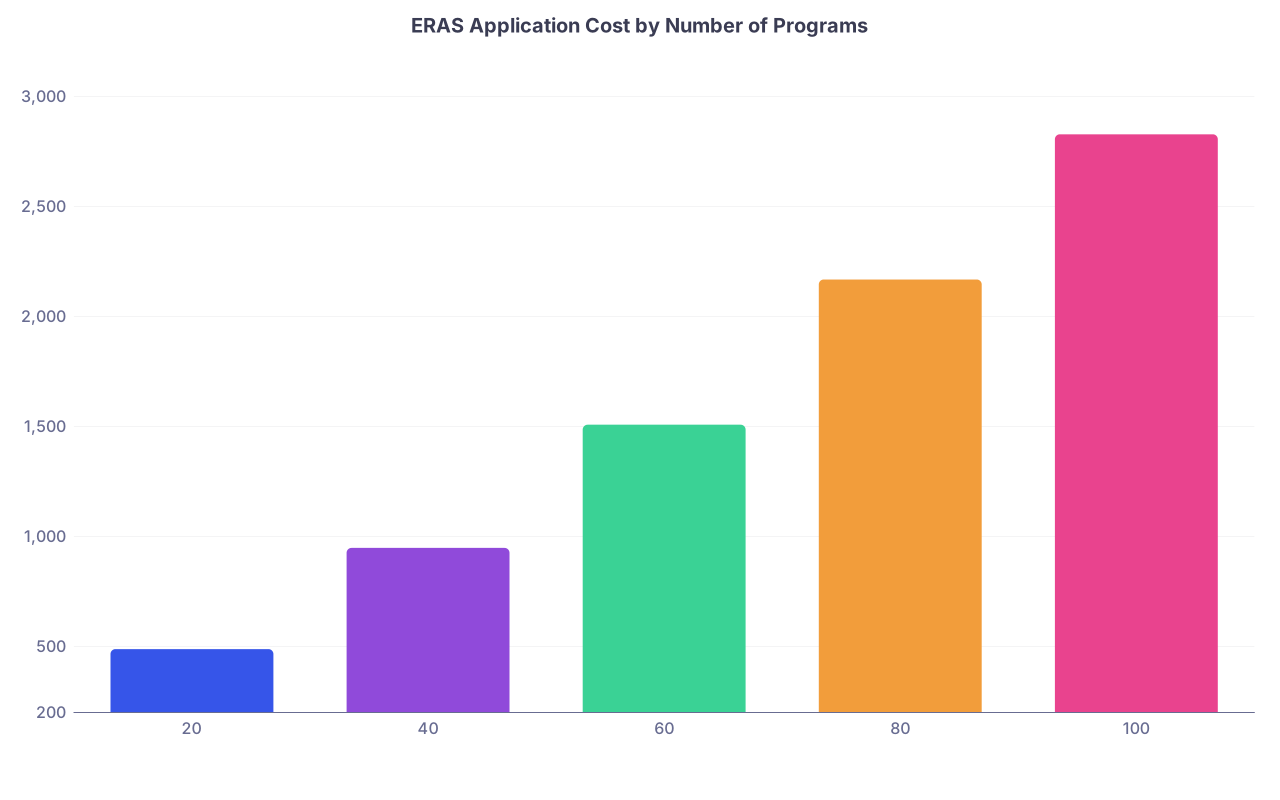
The money bleed is not theoretical. It’s very, very real.
| Category | Value |
|---|---|
| 20 | 486 |
| 40 | 946 |
| 60 | 1506 |
| 80 | 2166 |
| 100 | 2826 |
Those numbers are ballpark based on recent ERAS fee tiers for a single specialty. And they’re only the application fees:
You still haven’t paid for:
- NRMP registration
- Extra transcript/score report fees
- Interview travel (if in-person) or time off work
- VSLO/away rotations earlier in the year
- Rank list submissions
I’ve seen students:
- Put $3,000–$5,000 on credit cards for a single Match cycle
- Apply “shotgun” style two years in a row
- End up with less than 5 interviews total across both cycles
They didn’t have a strategy problem. They had a denial problem. They refused to accept what their scores realistically allowed—and paid for magical thinking with interest.
How Programs Actually View Low Step Scores
Do not romanticize “holistic review.” Programs are under time pressure and application overload. They default to shortcuts. Your Step scores are one of the fastest ones.
Here’s how typical reactions look:
Step 1: 195–205 or Step 2: 205–215
- Many competitive programs: hard no
- Mid-tier: maybe if strong story + home program + connections
- Community: mixed; depends on applicant volume
Step 1: pass with multiple failures or Step 2 fail
- Major red flag
- Needs active explanation + strong remediation
Step 2 in the 220s with an earlier Step 1 issue
- Better, but still not “fixed”
- Some doors reopen; many stay shut
| Category | Min | Q1 | Median | Q3 | Max |
|---|---|---|---|---|---|
| <215 | 0 | 2 | 4 | 6 | 8 |
| 215-229 | 5 | 10 | 15 | 20 | 25 |
| 230-239 | 15 | 25 | 30 | 40 | 50 |
| 240+ | 25 | 35 | 45 | 55 | 65 |
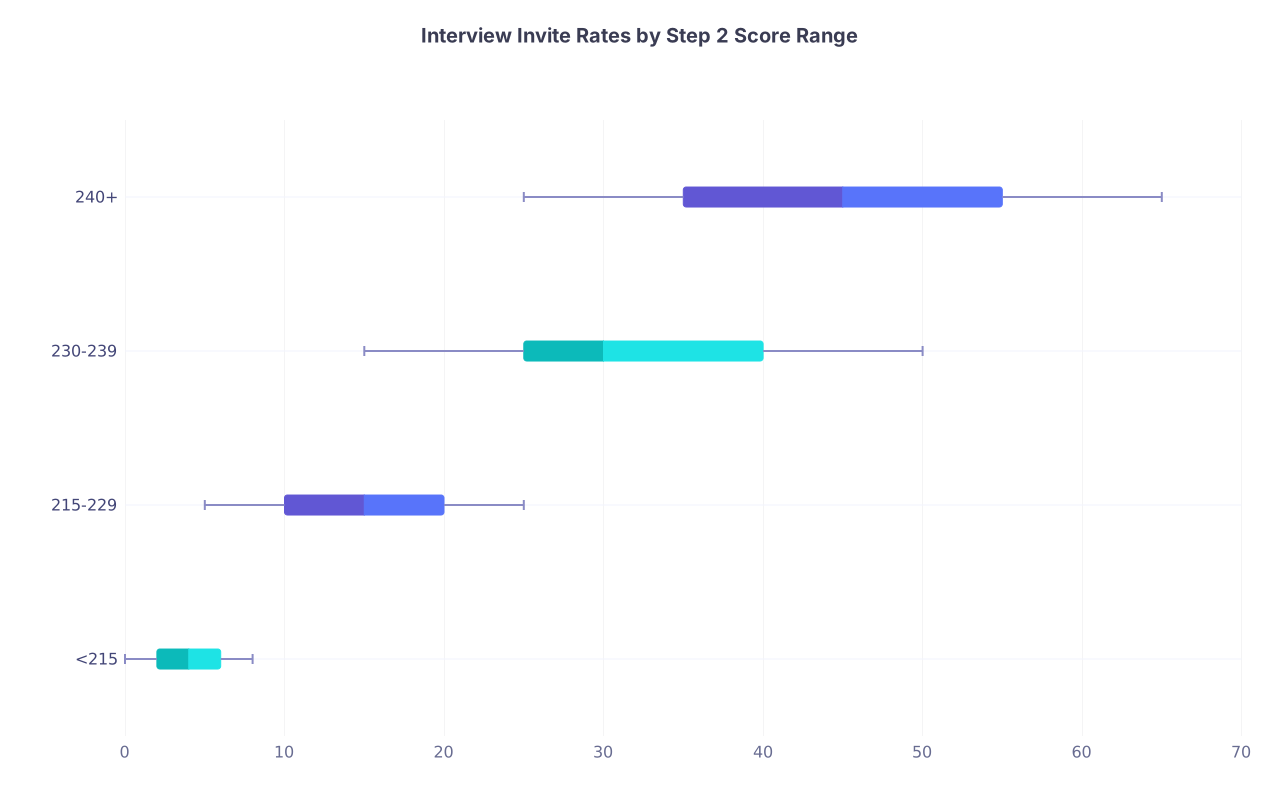
Point is: your Step score doesn’t just “hurt a little.” It defines which programs will even see you, and which ones never will—no matter how many you apply to.
The 5 Classic Shotgun Mistakes (You’re Probably Planning at Least 3)
1. Applying too broad and too random
“I’ll just apply to all Internal Medicine programs in the country.”
No you won’t. You’ll apply to:
- Places that will hard-filter you out on Step
- Places that never take IMGs (if applicable)
- Programs that have never interviewed anyone from your school
- Cities you’d be miserable living in—but you didn’t check because “I just need to match”
You don’t need “all programs.” You need:
- Programs that:
- Have taken applicants with scores like yours
- Accept your degree background (MD vs DO vs IMG)
- Match your visa needs (if any)
- Are realistically reachable given your clinical and research record
Everything else is just a paid rejection.
2. Ignoring historical match data
This one drives me crazy.
Your school has match data. NRMP has data. Many programs have alumni known by your advisors. If you’re not asking:
- “Where did students with Step 2 scores like mine match in the last 3–5 years?”
- “Did anyone with a 208 in Step 2 from our school match into radiology? Where?”
- “Which community programs routinely take our grads?”
…you’re flying blind.
Students with low scores often:
- Over-apply to aspirational programs with no history of taking similar applicants
- Under-apply to realistic safety programs that actually have taken people like them
That’s the exact opposite of what you should be doing.
3. Chasing prestige you cannot afford
With a 209 Step 2 and no strong connections, you’re not matching academic neurosurgery at a top-20 program. I don’t care how many publications you have. There are exceptions, yes—those are called “exceptions” for a reason.
What I see too often:
- 50% of applications go to “name-brand” university programs
- 40% go to mid-tier university/community hybrids
- 10% go to true safety programs
And then: 2–3 interview invites. All from the safety tier they reluctantly added.
If your Step scores are low, your application list should be:
- Heavy on community programs
- Heavy on programs with prior low-score or non-traditional matches
- Light—very light—on prestige vanity shots
You are not in a position to waste half your list on fantasy.
4. Underestimating how badly a low Step score narrows competitive specialties
Some specialties are brutally numbers-driven:
- Dermatology
- Plastic surgery
- Orthopedic surgery
- ENT
- Neurosurgery
- Radiation oncology
- Some radiology and anesthesiology programs, especially academic
If you’re sitting on a Step 2 CK of 216 and telling yourself, “But I really love ortho, so I’ll just apply widely,” you’re not being “determined.” You’re ignoring risk-reality.
Could you still match? Rarely, in extremely specific situations:
- Strong home program that loves you and advocates hard
- Research monster with multiple first-author publications with their faculty
- Red flag explained and completely remediated
Everyone else just spends $3,000 for a specialty that will screen them out before a human ever sees their name.
5. Not adjusting for IMG/DO reality
If you’re an IMG or a DO targeting an MD-heavy specialty or region, the shotgun instinct is even more dangerous.
Common pattern:
- IMG with 217 on Step 2
- Applies to 150 Internal Medicine programs, including tons of academic Northeast programs that rarely touch IMGs
- Ends up with 2–3 community interviews in the Midwest and South
That applicant could have:
- Saved money
- Focused on 70–90 more IMG-friendly programs
- Done more targeted networking and audition rotations
Instead, they distributed their effort evenly across programs that never seriously considered them.
What a Smart, Low-Score Strategy Actually Looks Like
Let me show you the opposite of shotgun: targeted, data-driven, and brutally honest.
| Aspect | Shotgun Approach | Targeted Strategy |
|---|---|---|
| Program count | 100–150+ | 40–80 (usually) |
| Research used? | Rarely | Heavily (filter by real trends) |
| Cost focus | Ignored | Explicit budget upfront |
| Specialty mix | Often one unrealistic | Realistic + backup options |
| Outcome quality | Few interviews, scattered | Focused interviews, better fit |
Step 1: Define reality, not fantasy
You must start here:
- What are your exact Step scores and any failures?
- Are you MD, DO, or IMG? Need a visa?
- Class rank? Any repeats, professionalism issues?
- Research output (not just “I helped in a lab”)?
- Any strong home program support?
Write it down. All of it. Then get a frank read from:
- A trusted advisor who actually handles match advising
- A resident or faculty member in your target specialty
- Not your optimistic friend who “believes in you”
Step 2: Choose realistic specialties (including a backup)
This is where pride kills people.
If your numbers are low and your specialty is competitive, you need to make some hard calls:
- Primary goal: choose something you’d be willing to do as a career
- Secondary goal: pick something that accepts people with your scores
Sometimes that means:
- Switching from derm → internal medicine
- From ortho → family med or PM&R
- From radiology → internal medicine with possible later subspecialty
No, it’s not fun. Yes, it may be necessary if your goal is to match this cycle and not become a permanent re-applicant.
Step 3: Build a filtered program list
This is where you avoid the shotgun trap.
Filter using:
- Score cutoffs (if stated or found via advisors)
- Historical match data from your school
- IMG/DO friendliness (for many specialties this is well-known)
- Geographic reality (some regions are massively more competitive)
You want something like:
- 10–20 “reach” programs (realistic stretch, not delusions)
- 20–40 “target” programs
- 10–20 “safety” programs where your stats are comfortably within range
Not 90% reach and 10% “I guess I’ll add a few community places.”
The Hidden Time Trap of Shotgun Applications
Money isn’t the only thing you’ll burn. You will torch time and mental energy that should be going somewhere else:
- Personalized emails to PDs
- Strategic away rotations
- Crafting tailored personal statements for specific types of programs
- Fixing weak letters of recommendation by finding better mentors
- Doing real interview prep
If you’re applying to 130 programs in one specialty and maybe another 40 in a backup:
- Your personal statement becomes generic
- Your program-specific communication becomes non-existent
- Your interview prep is chaotic because you don’t know what kind of programs will respond
You’re trying to brute-force a process that rewards focus.
Red Flags That You’re Already Falling Into the Trap
If any of these sound like you, stop and reassess now:
- “I’ll just apply to every program in the specialty and see who bites.”
- “I don’t really want to do family medicine but I’ll throw in 20 apps there just in case.”
- “I haven’t talked to an advisor yet, but I know people with lower scores who matched.”
- “My backup plan is to reapply next year if I don’t match.”
- “I don’t want to rule anything out, so I’ll apply broad and decide after interviews.”
Translation: “I don’t have a strategy; I’m outsourcing my fate to ERAS and luck.”
That’s not a plan. That’s gambling.
What To Do Instead – A Concrete, Safer Plan
Here’s a better way to approach residency applications with low Step scores.
1. Set a hard budget first
Yes, first. Before you even build your list.
- Decide exactly how much you can spend this cycle
- Include: ERAS fees, NRMP, travel or tech, and some cushion
- If possible, cap your total number of programs per specialty
This forces you to prioritize. It also makes you think in terms of return on investment, not panic.
2. Use data and humans, not vibes
- Pull NRMP Charting Outcomes and program websites
- Talk to:
- Your dean’s office or advising office
- A recent grad with similar stats who matched
- At least one faculty member in your target field
Ask them explicitly:
“What range of programs have historically taken people like me?”
3. Trim relentlessly
If you’re planning to apply to 100+ programs in one specialty, ask:
- How many of these:
- Have taken someone with my score range?
- Take my school’s grads?
- Are in a region where I’d realistically live?
If the answer is “I don’t know” for most of them, that’s where you start cutting.
4. Decide on a true backup pathway
Not “we’ll see.” Not “maybe prelim.” A real backup plan.
Examples:
- Internal medicine + family medicine as backup
- Categorical general surgery + 1-year prelim surgery + IM backup
- Psychiatry + internal medicine
Then allocate your money accordingly. Don’t throw 90% of your budget at a specialty where your chances are objectively tiny.
The Mental Game: Accepting Limits Without Giving Up
Here’s the part nobody wants to talk about.
If your scores are low, you are playing on hard mode. That doesn’t mean you’re doomed. It does mean:
- You can’t afford ego in your specialty choice
- You can’t afford magical thinking in your program list
- You definitely can’t afford a $4,000 shotgun experiment that gives you five auto-rejects per hour from filters during selection season
You’re allowed to be disappointed. You are not allowed—if you want to protect your future—to pretend the numbers don’t matter.
A realistic, targeted strategy isn’t “settling.” It’s triage. It’s survival. It’s you saying, “I will not add financial disaster to an already stressful situation.”
FAQ (Exactly 3 Questions)
1. I have a low Step score but strong research and great letters. Doesn’t that justify applying broadly?
Strong research and letters help—especially at academic programs—but they do not override hard electronic filters at many institutions. If your score is below a program’s cutoff, your Nobel Prize mentor letter won’t matter if no human ever opens your file. Use your strengths to target specific programs that actually value them (home program, places where your letter writers are known, research-heavy but historically flexible on scores), not to justify a random 150-program blast.
2. How many programs should I apply to with a low Step score?
There’s no magic number, but I start to get suspicious once I see >80 programs in a single specialty. That’s usually panic, not strategy. A lot of well-advised, low-score applicants match with 40–80 carefully chosen programs plus a real backup specialty. The key is not “how many” but which ones: IMG-friendly, historically low-score-friendly, community-heavy, and aligned with your actual background.
3. What if I already submitted a shotgun list this year?
Then your mistake has already been paid for; don’t double down emotionally. Focus now on what you can control:
- Aggressively prepare for every interview you do get
- Reach out respectfully to a small number of programs where you have a realistic shot and some connection
- Start planning a serious, structured backup (research year, prelim-to-categorical strategy, or a different specialty) now, not after an unmatched result
Your next move: open your current program list today and mark each program as “realistic,” “long shot,” or “fantasy” based on your scores and background. If “fantasy” takes up more than 20–25% of the list, you’re already in the shotgun danger zone—start trimming and rebalancing immediately.