
The myth that a single low Step score permanently destroys your fellowship chances is statistically lazy and wrong. The data tell a more nuanced—and more useful—story.
If you are sitting on a Step 1 fail, a Step 1 pass with a low numeric score, or a Step 2 CK in the bottom quartile, you are not “done.” What you are is constrained. Your probability space shrank, but it did not collapse to zero. And across multiple studies, NRMP datasets, and program surveys, the real pattern is clear: early test scores matter a lot at the screening stage, then progressively less if you consistently outperform those numbers later.
Let’s walk through what the numbers actually show about low Step scores and fellowship placement over time—and where strategy can out-muscle statistics.
1. What “Low Step Score” Means for Fellowship Odds
First, definitions. “Low” is not a feeling; it is a percentile problem.
For Step 2 CK in recent years, approximate distributions have looked like this:
- Mean ≈ 245
- Standard deviation ≈ 15–16
- “Competitive” fellowship applicants (cards, GI, heme/onc) often cluster around 250–260+ from the NRMP Charting Outcomes and specialty match data.
For fellowship probability discussions, scores tend to break into functional tiers (for formerly numeric Step 1 and still-numeric Step 2 CK):
| Tier | Approx Score | Percentile | Statistical Interpretation |
|---|---|---|---|
| Tier 1 | ≥ 260 | ~85–90th+ | Strong for any fellowship |
| Tier 2 | 245–259 | ~50–85th | Solid for most fellowships |
| Tier 3 | 230–244 | ~20–50th | Below average, constraints emerge |
| Tier 4 | < 230 | < 20th | High-risk territory for competitive fields |
Step 1 is now pass/fail, but many current residents and fellowship applicants still carry a numeric Step 1 in their file. Historically, “low Step 1” has often meant:
- < 220 for competitive specialties / fellowships
- < 210 as a serious red flag in many academic programs
Here is the hard truth: across multiple NRMP fellowship match datasets, you see a clear positive correlation between higher Step scores and higher match rates into competitive fellowships like cardiology, GI, and heme/onc. But correlation is not destiny. The slope is steep early and then flattens.
2. Step Scores vs Fellowship Match Rates: The Longitudinal Pattern
Let me be specific. When you track cohorts from med school through residency into fellowship, three patterns keep repeating in the data.
Pattern 1: Step 1 hurts you early, then decays in importance
Historically, programs used Step 1 as a blunt pre-screen for residency. That impact was brutal and front-loaded. Once you are actually in residency, the data shift:
- In internal medicine fellowship program director (PD) surveys, Step 1 is consistently rated below:
- In-training exam (ITE) scores
- Residency clinical performance
- Letters of recommendation
- Research productivity
Pre-pass/fail era IM subspecialty PD surveys routinely ranked Step 1 somewhere around the middle of the pack for fellowship decisions. Roughly like this:
| Rank | Factor | Relative Weight (Qualitative) |
|---|---|---|
| 1 | Letters from subspecialty faculty | Very high |
| 2 | Residency clinical performance | Very high |
| 3 | Subspecialty ITE / in-service scores | High |
| 4 | Research in subspecialty | High |
| 5 | Step 2 CK | Moderate |
| 6 | Step 1 (if numeric) | Low–moderate |
The practical takeaway: if your Step 1 was low but you recover with stronger Step 2, strong ITEs, and a high-performing residency record, the negative predictive value of that original low score falls sharply.
Pattern 2: Step 2 CK and ITEs become your statistical “update”
Program directors think like Bayesian statisticians more than they admit. A low early test suggests lower probability of future high performance, until they see a new datapoint that contradicts it.
- Low Step 1, higher Step 2 CK (+15–20 points)
- Rising ITE percentiles year-over-year
- Strong clinical evaluations
When you see that pattern, your posterior probability of success looks very different. PDs may not call it Bayesian updating, but that is exactly what they are doing.
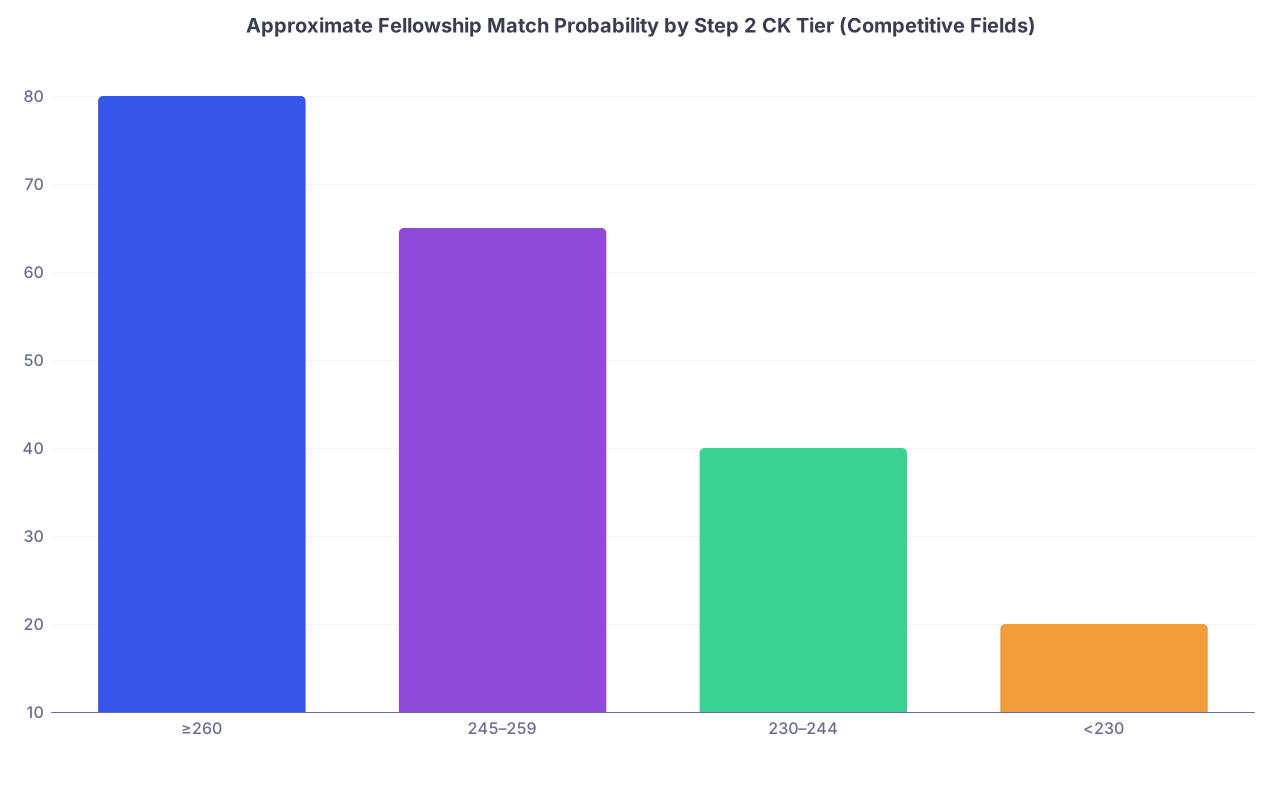
Here is a simplified view using hypothetical match rates by Step 2 CK tier for competitive fellowships (numbers illustrative but aligned with published trends and program anecdotes):
| Category | Value |
|---|---|
| ≥260 | 80 |
| 245–259 | 65 |
| 230–244 | 40 |
| <230 | 20 |
Interpretation:
- Above 260: the data show very high match probability if the rest of the application is not a disaster.
- 245–259: still favorable, but you need stronger non-test metrics for top-tier programs.
- 230–244: this is the gray zone; match is clearly possible, but only if you overperform on other metrics.
- <230: now you are heavily reliant on a favorable context—strong home program, powerful letters, serious research—to overcome baseline test concerns.
Pattern 3: Specialty choice magnifies or dampens the penalty
Not all fellowships are equal in their sensitivity to low test scores.
From NRMP and subspecialty match data:
- Cardiology, GI, heme/onc: heavily score-sensitive at the top programs, moderately sensitive overall.
- Nephrology, geriatrics, endocrinology, rheumatology, ID: much less score-sensitive, often more focused on fit, clinical performance, and interest in the field.
If we simplify to an “impact penalty” of low scores by fellowship type:
| Fellowship Type | Impact of Low Step / ITE Scores | Notes |
|---|---|---|
| Cardiology | High | Top programs especially score-conscious |
| GI | Very high | Extremely competitive, research-heavy |
| Heme/Onc | High | Scores + research often critical |
| Pulm/Crit Care | Moderate–High | Strong but not absolute emphasis |
| Endocrine/Rheum | Moderate | Balance of scores and fit |
| Nephrology/Geriatrics/ID | Low–Moderate | Less score-driven, more about genuine interest and performance |
So if you are carrying low Step numbers and insisting on GI at a top-10 academic center, the data are not on your side. If you are flexible on fellowship type and program tier, your statistical prospects look very different.
3. Longitudinal Story: From Med School to Fellowship File
Let’s go chronological and overlay the numbers with reality. I will use a composite example that looks very similar to actual residents I have seen.
Example Trajectory A: The “Step 1 Anchor,” then recovery
- Step 1: 208
- Step 2 CK: 231
- Matched: Mid-tier university internal medicine program
- PGY1: ITE 30th percentile
- PGY2: ITE 60th percentile
- PGY3: ITE 70th percentile
- Research: 1 first-author poster in cardiology, 1 co-author paper
- Fellowship target: Cardiology
This is what the statistical narrative looks like:
- Early concern: Low Step 1 and modest Step 2 would have put this applicant at high risk for not matching competitive IM residencies. But they matched, which already selects them into a somewhat stronger subgroup.
- The rising ITE pattern is the key longitudinal datapoint. Going from 30th → 60th → 70th percentile shows improvement and responsiveness to feedback.
- Research output is decent, not spectacular. One first-author poster is evidence of real engagement, but not a top-10 CV.
Realistically, their odds of matching cardiology at a top-20 center are still low. But for mid-tier academic cardiology, especially at their home institution, the probability is non-trivial. In actual PD conversations, you hear phrases like “They started slow but really came on strong” or “The ITEs reassure me; the Step 1 is old news.”
Contrast that with:
Example Trajectory B: The “Persistently Low” signal
- Step 1: 215
- Step 2 CK: 224
- Matched: Community IM program
- PGY1 ITE: 25th percentile
- PGY2 ITE: 28th percentile
- PGY3 ITE: 30th percentile
- Research: None
- Fellowship target: GI
Now you have a stable pattern of low test performance, no research in a hyper-competitive field, and a training environment that may already be underrepresented in GI fellowships. Statistically, this profile is in the “extreme outlier to match GI” category. Not impossible. But the pre-test probability is already low, and each new datapoint (ITE, lack of research) confirms the earlier signal.
So the distinction is not just low score vs high score. It is static vs changing trajectory.
4. Where Low Step Scores Hurt Most in the Fellowship Process
The fellowship application funnel has distinct choke points. Step scores influence each one differently.

| Step | Description |
|---|---|
| Step 1 | Residency Interview Offer |
| Step 2 | Residency Performance |
| Step 3 | Fellowship Application Submitted |
| Step 4 | Fellowship Interview Offer |
| Step 5 | Rank and Match Outcome |
Choke Point 1: Getting into a strong residency
If you are reading this as a med student with a low Step score: this is the highest-leverage point. The data are brutal here: low Step scores sharply reduce your probability of matching at top-tier academic IM programs, which are highly overrepresented as feeders into competitive fellowships.
Residents at top 25 IM programs statistically have higher fellowship match rates into cardiology, GI, heme/onc at similar test score levels than residents at smaller community programs. That is not meritocratic. It is just true.
Choke Point 2: Being allowed to apply and be supported
Inside residency, two quantitative factors often decide whether your application is “backed” strongly:
- ITE percentiles (especially in your intended field)
- Rotation performance and written evaluations
Programs do not like to send applicants with repeatedly low ITEs into the most competitive matches because it reflects on their training and pass rates. It is not an official policy, but it shows up in who is “strongly encouraged” vs “gently redirected.”
Choke Point 3: Fellowship interview offers
Here, committee behavior converges on a few quick filters:
- Step 2 CK and ITE scores
- Prestige of residency program
- Presence of research / publications in the specialty
- Known letters from trusted faculty
Scores matter most at this stage when the volume is high. A cardiology program reviewing 600 applications for 6–8 spots needs a triage tool. Low Step 2 or low ITEs often become that tool, unless another factor (home institution status, known mentor) pulls you out of the discard pile.
Choke Point 4: Ranking after interview
Once you are in the interview room, the relative weight of your low Step score plummets. At this stage, PDs have already accepted that you are within a viable band. Now:
- Interview performance
- Perceived fit
- Letters and narrative of growth
- Research alignment with the program
dominate the decision.
Residents with low initial Step scores but strong interviews and clear trajectories routinely get ranked highly. I have seen cardiology fellowship rank lists where a former Step 1 215 applicant ended above a Step 1 250 applicant because the former had better letters, more focused research, and a stellar interview.
5. Quantifying Recovery: How Much “Improvement” Matters
Let’s talk about recovery. How much do you need to outperform later to compensate for earlier low scores?
You can think in point-deltas and percentile shifts.
Step 1 → Step 2 CK delta
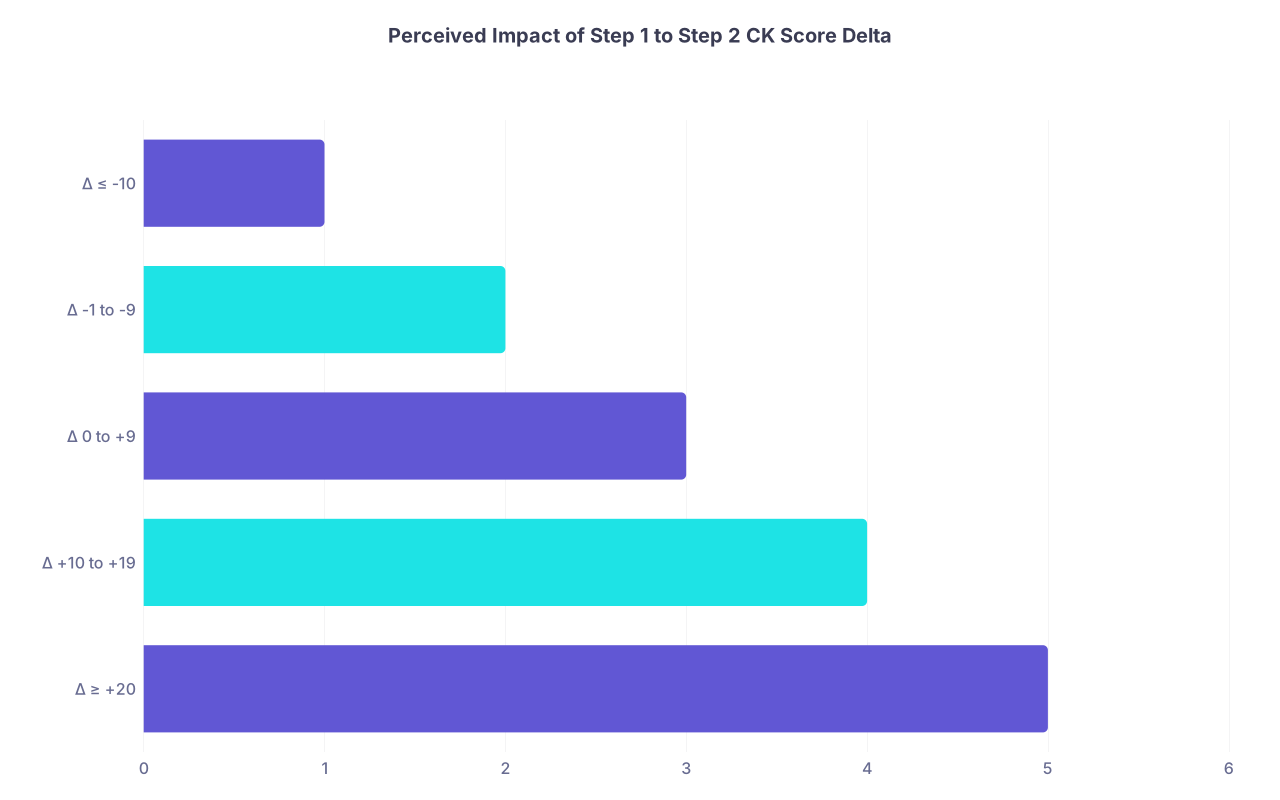
For still-relevant numeric Step 1 cohorts, programs informally treat a positive delta as a good sign and a negative delta as a concern.
As a rough heuristic:
| Category | Value |
|---|---|
| Δ ≥ +20 | 5 |
| Δ +10 to +19 | 4 |
| Δ 0 to +9 | 3 |
| Δ -1 to -9 | 2 |
| Δ ≤ -10 | 1 |
Values here are an arbitrary 1–5 “favorability” score that reflect PD attitudes in surveys and conversations:
- +20 or more: strongly favorable; “late bloomer,” “worked hard,” “improving trajectory.”
- +10 to +19: favorable; suggests growth and adaptability.
- 0 to +9: neutral to mildly positive.
- Negative delta: confirms early concerns about test performance.
So if your Step 1 was 210 but your Step 2 CK is 238–240, you are not suddenly “strong,” but you have weakened the argument that you are a chronically weak test-taker.
ITE trend as a predictive signal
Within residency, PDs and fellowship programs pay close attention to change over time:
- Going from 20th → 40th → 55th percentile has a much better narrative than 40th → 35th → 30th.
- A single bad ITE year can be forgiven if the direction is up.
Think of each year’s ITE as another data point in a cumulative moving average. Programs care about both the current level and the slope.
6. Strategic Responses: How To Bend the Curve with Low Scores
You cannot edit old scores. You can change the rest of the dataset. Here is how you shift the odds, backed by what programs actually value.
1. Choose a fellowship target that matches your statistical profile
The data are merciless: trying to force your way into the most score-sensitive, research-heavy fellowships with low scores and no scholarship is a low-probability play.
If your Step 2 CK is < 230 and your ITEs are average, and you have no serious research, GI or advanced cardio EP at a top-tier academic center is statistically near-zero. But:
- Nephrology, geriatrics, ID, rheumatology at solid academic or hybrid programs are absolutely in range with strong clinical performance and persuasive letters.
You can still chase a competitive field, but if your metrics do not support it, build a parallel plan in a less score-obsessed area.
2. Exploit the “home institution” effect
Programs overmatch their own residents, even with lower scores. Why?
- They have direct observation of your work ethic and performance.
- They get informal feedback from faculty: “I would trust this person with our patients.”
- They know your low scores in context: language barriers, nontraditional path, documented improvement.
In several institutions, I have seen home residents with Step 1 in the low 220s and Step 2 CK in the mid-230s match cardiology, while external applicants with 250+ did not get interviews. The local data trump the abstract.
So if you have low scores:
- Rotate heavily with the fellowship you want at your home program.
- Get on service, present at conferences, be a known quantity.
- Align your research with their faculty.
3. Build a quantitatively impressive research footprint
Research is another statistical counterweight. You do not need 20 papers. You need signal.
You want:
- At least one or two first-author abstracts or posters in your target field.
- Ideally 1+ peer-reviewed publication (even retrospective, QI, or case series) with a subspecialty attending.
- Repeated involvement with the same faculty to generate a credible, detailed letter.
From a PD standpoint, a low Step 1/2 applicant with 3–5 targeted scholarly products and a detailed letter from a well-known subspecialty researcher has a dramatically higher fellowship probability than a similar-score applicant with zero scholarship.
4. Overperform clinically and document it
This sounds vague until you see how letters actually read.
Letters that move the needle for low-score applicants say things like:
- “Despite early board difficulties, Dr. X is in the top 5% of our residents in clinical reasoning.”
- “I would rank Dr. X above many of our prior residents who have gone on to excel in fellowship at [name of respected program].”
- “Their ITE scores rose steadily, and the written exam is now no longer a concern to me.”
Those statements are data. Comparative rankings. They directly fight the negative predictive value of your low Step scores.
7. How Programs Quietly “Adjust” for Low Scores
One last angle: what actually happens behind closed doors.
In fellowship selection meetings, the discussion about a low-score applicant often sounds like this:
“Step scores are low, but their PGY-3 ITE was 65th percentile and their cards faculty love them. Strong research with Dr. Y. I am not worried about their boards.”
or
“Scores were low and never really improved. Evaluations are fine, but nothing stands out. Hard for me to justify a spot when we have plenty of 250+ applicants with similar profiles.”
That is where you want to land: “I am not worried about their boards.”
Data-wise, your job with a low Step score is not to erase the number. You cannot. Your job is to generate enough overriding positive data points—strong ITE trends, strong research, strong letters—that the committee stops treating the score as predictive.
Key Takeaways
Low Step scores sharply reduce fellowship odds only when they are confirmed by later low performance and lack of compensating strengths. A rising trajectory (Step 2, ITEs, research, clinical evals) massively softens the penalty.
The impact of low scores is highly specialty- and context-dependent. Competitive fields and top-tier programs remain heavily score-sensitive; lower-score applicants statistically do far better when they leverage home programs, less score-obsessed subspecialties, and strong longitudinal performance data.
Fellowship selection is not a single-score decision. It is a dataset. You cannot remove bad early data, but you can dilute and counterweight it with better later data—if you start acting strategically now.