
The myth that “a high Step 2 CK erases a bad Step 1” is wrong. The data show something more nuanced: Step 2 CK can partially offset Step 1, but it does not reset the game board.
You want numbers, not platitudes. So let’s quantify how much a stronger Step 2 CK actually helps you when Step 1 is a liability.
1. The Baseline: How Programs Actually Use Step Scores
Program behavior is surprisingly consistent once you strip out the noise. When I look at NRMP program director surveys, Step-related filters show up again and again as the first gate.
From the most recent NRMP Program Director Survey (pre–Step 1 pass/fail but still informative for behavior):
- Around 75–85% of programs reported “USMLE Step 1 score” as a factor in offering interviews.
- Around 80–90% reported “USMLE Step 2 CK score” as a factor.
- A large fraction—often 50–70% depending on specialty—reported using a Step cutoff for interview screening.
Even though Step 1 is now pass/fail for current cohorts, behavior from the “numeric Step 1 era” still applies if you have a numeric score. Many programs still have those cutoffs baked into their spreadsheet filters and institutional culture.
The mental model most PDs use is simple:
- Run a filter on Step scores to reduce volume.
- Then weigh the rest: letters, school, research, personal statement, etc.
If your Step 1 is low, you are starting below the median. The question is whether a higher Step 2 lifts your combined “Step profile” back into the competitive zone.
2. Benchmarks: What Counts as Low, Average, and High?
You cannot talk about “low” or “high” without distribution.
Using typical score distributions from the last several numeric Step 1 cohorts and recent Step 2 CK data, you can approximate:
| Score Type | Low (≈25th) | Median (≈50th) | Strong (≈75th) | Top (≈90th) |
|---|---|---|---|---|
| Step 1 | 220 | 230–232 | 240–245 | 250+ |
| Step 2 CK | 235–240 | 245–247 | 255 | 260+ |
Translate that to language PDs actually use:
Step 1:
- Below ~225 → clearly below average
- 225–235 → soft spot, but not fatal in many fields
- 240+ → positive signal; 250+ → strong asset
Step 2 CK:
- Below ~240 → weak for competitive fields
- 245–250 → solid, “fine”
- 255–260 → strong
- 260+ → clearly strong outlier upward
Programs do not look at single numbers in isolation. They look at patterns:
- Low Step 1 + high Step 2 = improvement story, potential redemption
- High Step 1 + low Step 2 = concern for plateau or burnout
- Both low = real problem
- Both high = green light
Your leverage comes from the delta between Step 1 and Step 2 CK.
3. Quantifying “Redemption”: How Much Does Step 2 CK Offset Step 1?
Let me be blunt: going from a Step 1 of 210 to a Step 2 CK of 265 does not make programs forget the 210. But it does change how many doors are open and how you are perceived inside the file review.
Think of it as a weighted combination, not a replacement.
A reasonable approximation of how many programs think (based on PD interviews, survey emphasis, and match outcome patterns) is:
- For many core fields (IM, FM, Peds, Psych):
Step 1 weight ~30–40%; Step 2 CK weight ~60–70% - For competitive surgical subs (Ortho, Plastics, ENT):
Historically Step 1 was heavier, but as Step 1 moved to pass/fail, Step 2 CK took over. For old numeric cohorts, it was closer to 50/50.
If you want a crude composite score:
Composite ≈ 0.35 × Step 1 + 0.65 × Step 2 CK
Is that exact? No. But it tracks how PDs talk: “We care more about Step 2 now, but Step 1 still matters.”
Example: Concrete Score Pairs
Let’s run numbers.
Scenario A: Step 1 = 220, Step 2 CK = 250
Composite ≈ 0.35 × 220 + 0.65 × 250
= 77 + 162.5 = 239.5
So in a rough blended view, you now “look like” an applicant with a ~240 combined Step profile. That is just below the old 75th percentile Step 1, but clearly above average.
Scenario B: Step 1 = 215, Step 2 CK = 260
Composite ≈ 0.35 × 215 + 0.65 × 260
= 75.25 + 169 = 244.25
That looks very close to a 244 on Step 1 alone—strong in many fields. Programs will see the low Step 1, yes. But the aggregate signal is now in the competitive range for many specialties outside the ultra-competitive ones.
Scenario C: Step 1 = 225, Step 2 CK = 245
Composite ≈ 0.35 × 225 + 0.65 × 245
= 78.75 + 159.25 = 238
Translation: you basically stayed around “slightly below median” territory. No huge redemption; you did not hurt yourself, but you did not radically change the story.
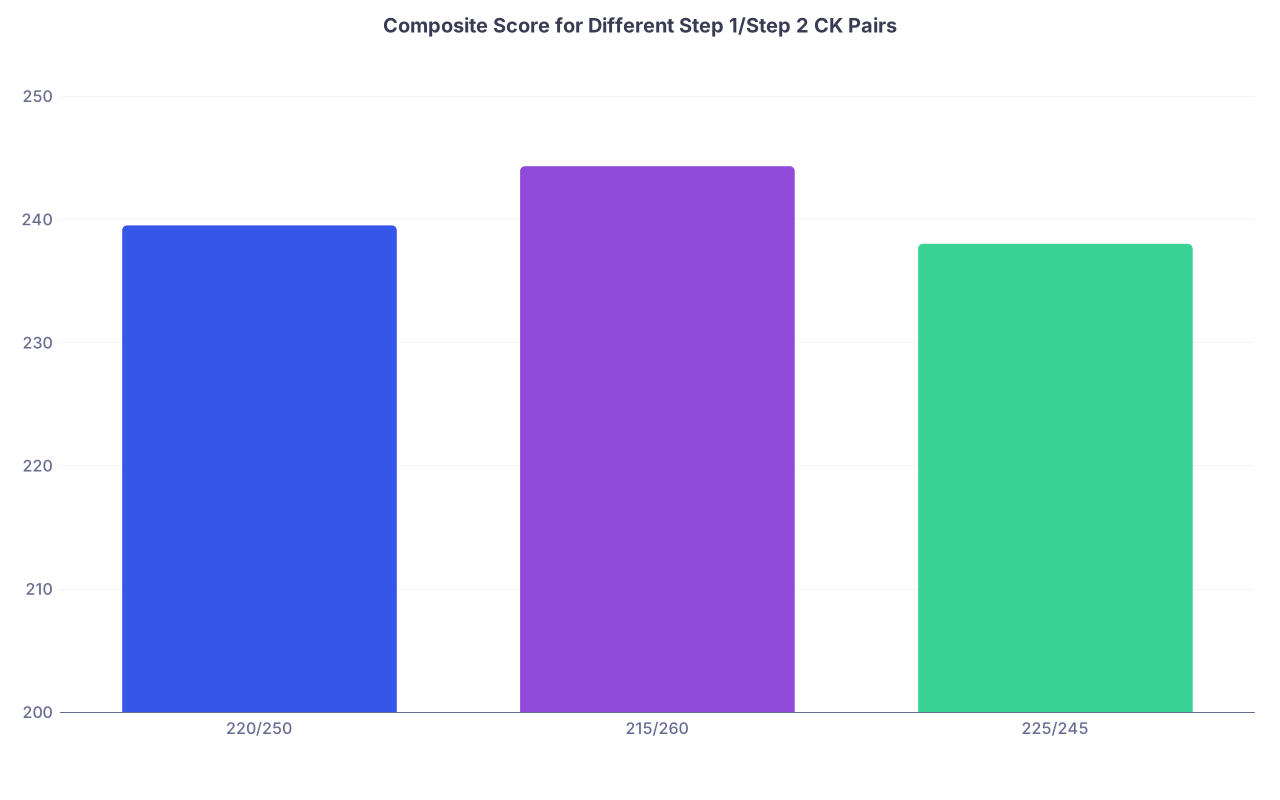
| Category | Value |
|---|---|
| 220/250 | 239.5 |
| 215/260 | 244.3 |
| 225/245 | 238 |
The pattern is consistent:
You need Step 2 CK ≥15–20 points above Step 1 to meaningfully reposition your academic profile.
4. Specialty-Specific Sensitivity: Where Step 2 CK Helps More (or Less)
Different specialties react differently to a “low Step 1, higher Step 2 CK” pattern.
Rough Competitiveness and Score Sensitivity
Here is a simplified view of how forgiving each specialty tends to be about a low Step 1 if Step 2 CK is strong, assuming U.S. MD with no red flags.
| Specialty Tier | Example Fields | Step 2 Redemption Potential |
|---|---|---|
| Ultra-competitive | Derm, Plastics, ENT | Low |
| Competitive surgical | Ortho, Neurosurgery | Low–Moderate |
| Competitive but broader | Anesthesia, EM, Rad Onc | Moderate |
| Core medicine / less competitive | IM, FM, Peds, Psych | High |
| Lifestyle-focused, moderate | PM&R, Pathology | High |
Interpretation:
Dermatology / Plastics / ENT / Neurosurgery:
Programs are drowning in applicants with high Step 1 and high Step 2. A 210–220 Step 1 is often filtered out before anyone admires your 260 Step 2. You can overcome this at some programs with strong Step 2 + serious research + connections, but at a population level, redemption is limited.Orthopedics / competitive surgical:
Step 2 CK can help, especially with a ≥20-point jump. But if your Step 1 is in the low 220s or below, your target list needs to lean toward mid-tier and community programs that look at the full file instead of strict numerical screens.Internal Medicine / Pediatrics / Psychiatry / Family Medicine:
These fields are much more responsive to a strong Step 2 CK. A 220 Step 1 + 255 Step 2 in IM can absolutely “feel” like a competitive academic applicant, especially if the rest of the file is solid.EM and Anesthesia:
Historically very Step-sensitive, but both fields have large enough ranges of programs that a strong Step 2 CK can still open many doors.
5. Filters, Thresholds, and Where a High Step 2 Actually Changes Outcomes
The ugly part: many programs set hard Step 1 cutoffs in their ERAS filters. If you do not meet the threshold, you never get human eyes.
From PD survey data and anecdotal program statements, typical filter cutoffs for Step 1 were:
- Less competitive fields: often 210–220
- Mid-range: often 220–230
- Competitive: 230–240+
- Ultra-competitive: often 240–245+
Now, how do they treat Step 2 CK?
- Some programs require Step 2 CK by ranking, not by interview.
- Many are now shifting to Step 2-based filters (for current cohorts) around:
- 230–235 for less competitive programs
- 240–245 for mid-range
- 250+ for top/competitive
If your Step 1 is low but above the hard cutoff, a strong Step 2 CK can:
- Move your application from “meh” to “interesting”.
- Reduce the concern column in the committee room.
- Make your improvement narrative credible.
If your Step 1 is below the hard cutoff, you have a different game:
- A high Step 2 CK sometimes triggers a manual override (if the program actually looks), especially in smaller or more holistic programs.
- But for many large, competitive programs, the filter kills you before your 260 Step 2 ever matters.
The strategy shifts from “Can I neutralize my Step 1?” to “Where will anyone actually see my Step 2?”
6. Score Gaps: What Kind of Improvement Actually Moves the Needle?
Size of the jump matters. PDs are not impressed by noise-level shifts.
Here is a rough grading of Step 1 → Step 2 CK improvements, assuming Step 1 is low or mediocre:
0–5 points up:
Statistically meaningless. Looks like regression to the mean or just random performance variation.5–10 points up:
Mild improvement. Better than nothing, but it will not reframe you from “weak” to “strong.”10–15 points up:
Noticeable improvement. PDs will see this as some combination of growth, better test prep, and stronger clinical knowledge.15–20+ points up:
Significant improvement. Now you have an actual talking point and a defensible story: “I adjusted my study approach; my Step 2 reflects my true capabilities.”25–30+ points up:
Outlier positive jump. Particularly compelling when combined with good clerkship grades and strong clinical evaluations.
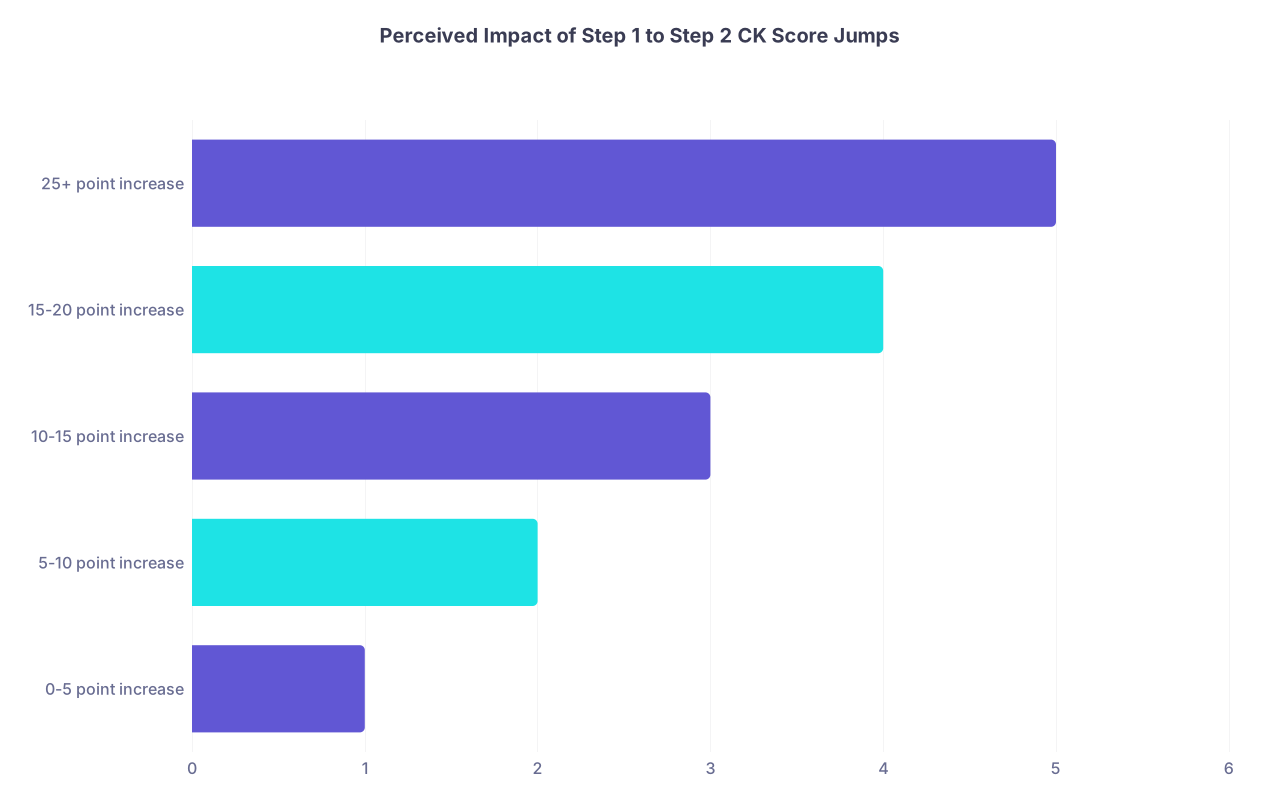
| Category | Value |
|---|---|
| 0-5 point increase | 1 |
| 5-10 point increase | 2 |
| 10-15 point increase | 3 |
| 15-20 point increase | 4 |
| 25+ point increase | 5 |
(Scale 1–5: 1 = negligible impact, 5 = major positive reframe.)
Where does “neutralization” start to feel real? Typically once you hit 15+ points above Step 1 and cross into at least the median Step 2 CK range for your desired specialty.
7. Realistic Scenarios: What Changes, Specialty by Specialty
Let’s walk through a few archetypes. These are not hypothetical; they are composites of real outcomes I have seen.
Scenario 1: Step 1 = 215, Step 2 CK = 255, Aiming for Internal Medicine
Distribution check:
215 → bottom quartile Step 1
255 → top quartile Step 2 CKComposite ≈ 244 (from earlier math).
Effect:
- At many academic IM programs, you move from “probably screened out or low priority” to “viable candidate with an improvement story.”
- At community and mid-tier university programs, your Step 2 will be a strong positive.
- Does it fully erase Step 1? No. But for IM, this is close to “functional neutralization.” You will get interviews if you apply broadly and your other metrics (clerkships, letters) are aligned.
Scenario 2: Step 1 = 220, Step 2 CK = 260, Aiming for Orthopedics
- Distribution:
220 → below average for Ortho applicants (many sit 240+)
260 → strong for Ortho, above many applicant medians.
Effect:
- Many top Ortho programs historically ran Step 1 filters around 235–240+. So you may never be seen at those places.
- However, your Step 2 will stand out at less brand-name Ortho programs that genuinely review files.
- Redemption is partial: you are now competitive at a subset of programs. But the original low Step 1 still shuts some doors permanently.
Scenario 3: Step 1 = 205, Step 2 CK = 250, Aiming for EM
- 205 is very low. In many programs, that is below the historical filter.
- 250 Step 2 CK is strong, but the question is: do they see it?
Effect:
- You will be screened out at a non-trivial number of EM programs that still use Step 1 ISO filters.
- Where they do see it (more holistic or less crowded programs), you become an interesting “late bloomer” applicant.
- This is not neutralization. It is selective rescue. You must apply very broadly and be realistic about program tier.
8. Strategic Moves: How to Maximize the “Neutralizing” Effect
You cannot change your Step 1. But you can optimize the signal around your Step 2 CK and clinical performance.
1. Time the Step 2 CK Right
For anyone with a low Step 1, the data-driven strategy is clear:
- Take Step 2 CK early enough that:
- You have the score in ERAS at the time of application.
- Programs see your upward trajectory before sending interview invites.
Waiting and hoping Step 1 alone does not hurt you is magical thinking.
2. Build Coherent Evidence Around Step 2
Programs do not just compare two numbers. They look for consistency.
If you want Step 2 CK to “neutralize” Step 1, align the rest:
- Strong clerkship grades (especially in core rotations relevant to your specialty).
- Shelf exam scores trending upwards.
- Letters that explicitly mention your clinical reasoning, fund of knowledge, and improvement.
That way, the narrative is:
“Yes, Step 1 was a soft spot. But from the clinical phase onward, this applicant is clearly high-functioning.”
Not:
“Big Step 2 score, but mediocre clinical feedback and weak letters.”
3. Use Your Personal Statement and MSPE Wisely
Do not write a sob story. PDs are not interested in excuses. Instead:
- Briefly acknowledge the Step 1 underperformance (if your advisor agrees).
- Then pivot quickly: specific changes in study strategy, increased use of question banks, better time management on rotations, etc.
- Point directly to Step 2 CK and clinical evaluations as evidence.
Data-backed narrative, not emotional pleading.
4. Target Programs That Actually Read Files
If you have a low Step 1 and strong Step 2 CK, your return on investment is higher at:
- Medium and smaller programs
- Programs with reputations for holistic review
- Regions less flooded with top-of-the-pile applicants
How do you identify them?
- Look at their published minimum requirements on their websites.
- Talk to recent grads or residents about culture: do they brag about “cutoff scores” or “we look at the whole person”?
- Check whether they historically take a mix of Step profiles, or only ultra-high scorers.
9. Visual Summary: Which Profiles Get “Neutralized”?
Here is a simplified matrix for U.S. MDs applying to a core field (IM / Peds / Psych / FM). Green = effectively neutralized; Yellow = partial; Red = not neutralized.
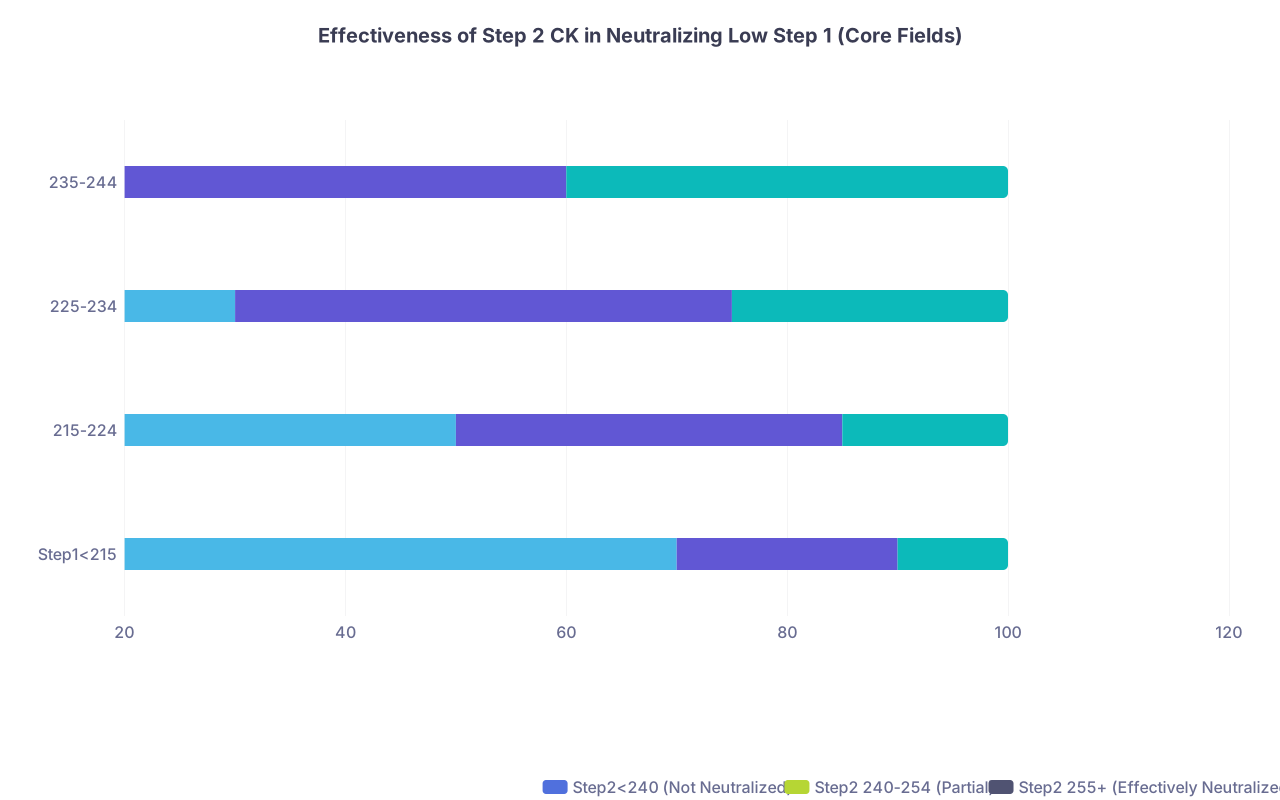
| Category | Step2<240 (Not Neutralized) | Step2 240-254 (Partial) | Step2 255+ (Effectively Neutralized) |
|---|---|---|---|
| Step1<215 | 70 | 20 | 10 |
| 215-224 | 50 | 35 | 15 |
| 225-234 | 30 | 45 | 25 |
| 235-244 | 20 | 40 | 40 |
Interpretation (approximate, but directionally accurate):
- Very low Step 1 (<215) needs a very strong Step 2 (255+) just to reach “partial to effective neutralization” for core fields.
- 215–224 Step 1 with 255+ Step 2 is often perceived as essentially neutralized in many core specialties.
- 225–234 Step 1 with 250+ Step 2 is usually viewed as a solid academic profile.
- Once your Step 1 is ≥235, Step 2 CK mainly affects how strong you look, not whether you are “rescued.”
For competitive surgery and ultra-competitive fields, shift that whole bar to the right by about 10–15 points in expectation.
FAQ (5 Questions)
1. Is there a specific Step 2 CK score that “automatically” neutralizes a low Step 1?
No single number flips a switch. But for many core specialties, a Step 2 CK ≥255 starts to neutralize a Step 1 in the low 220s, assuming the rest of your application is aligned. For very competitive fields, even a 260+ Step 2 may not fully compensate for a sub-225 Step 1 at top programs.
2. If my Step 1 is low, should I delay Step 2 CK to study longer, even if it means scores arrive late?
Usually no. For a weak Step 1, having a strong Step 2 CK available at the time of application is far more important than eking out a few extra points but sending it late. A delay can cost you interviews because many programs will not take a chance based solely on a low Step 1 and “pending” Step 2.
3. Does a big Step 1 → Step 2 jump help for away rotations and SLOEs (for EM, Ortho, etc.)?
Indirectly, yes. Strong Step 2 CK usually correlates with sharper clinical reasoning and better shelf performance, which can improve how attendings rank you. But away rotations themselves are more impacted by in-person performance, work ethic, and personality than by the exact Step 2 number.
4. How do international medical graduates (IMGs) fit into this Step 1 / Step 2 CK story?
For IMGs, Step scores are often treated as even more critical screening tools. A low Step 1 can be brutal. A very high Step 2 CK (260+) helps substantially, but you still face steeper competition and more rigid cutoffs. In practice, a strong Step 2 for an IMG “rescues” fewer situations than for a U.S. MD, especially in competitive specialties.
5. Should I address my low Step 1 directly in my personal statement?
Only if you have a clear, concise, data-backed improvement narrative. One or two sentences acknowledging the issue and pointing to your Step 2 CK + clinical performance can be effective. Long explanations or emotional justifications tend to hurt you. Programs care less about your feelings about Step 1 and more about evidence that you can now perform at the necessary level.
Two key points to walk away with:
- A higher Step 2 CK can partially neutralize a low Step 1, but only when the jump is large enough (≈15–20+ points) and brings you into at least the median or above range for your target specialty.
- Your strategy should not be “erase Step 1.” It should be “build a consistent, data-backed story of improvement and current competence”—and then apply smartly to programs that actually bother to read that story.