18% of applicants with below-median Step 2 scores end up submitting 60+ applications to get just 5–7 interviews.
That is the real problem you are trying to solve: not “Can I match?” but “How many programs do I need to apply to in order to get enough interviews to have a realistic match probability… with my scores?”
This is a numbers question. So let’s treat it like one.
1. The Core Math: From Applications → Interviews → Match
For residency, the sequence is brutally simple:
Applications → Interview Offers → Rank List Length → Match Probability.
NRMP outcome data make one thing very clear:
- For U.S. MD seniors in non-ultra-competitive specialties, the “safe zone” starts around 10–12 interviews.
- For DO and IMGs, or for lower Step applicants, that “safe” zone usually means 12–15+ interviews.
Most low Step applicants do not have a “competitiveness problem” in theory. They have a yield problem. Their:
- Application-to-interview rate is lower
- Interview count per 100 applications is lower
- Match probability at the same interview count is often similar once they get those interviews
So the critical strategic lever is volume + targeting, not magical phrasing in your personal statement.
To make this concrete, we need yield curves.
2. What “Yield Curve” Actually Means Here
I am using “yield curve” in a practical sense: interviews per 10 applications as your application volume rises, stratified by Step performance and applicant type.
The pattern I have seen over and over:
- High Step applicants: early saturation. Once they hit 40–50 applications, their marginal yield drops because they already got most of the interviews they were going to get.
- Low Step applicants: slow start, long tail. They need more total applications to reach the same interview count. Yield improves only slightly with better targeting but never matches high Step peers.
Let’s define simple categories to keep the math clean:
- “Low Step”: Step 2 CK < ~230 (or COMLEX Level 2 < ~520) for noncompetitive fields. For more competitive fields, “low” starts higher.
- Applicant types: US MD, US DO, AMG-IMG (Carib etc.), non-US IMG.
Now, rough but realistic baseline interview yields I have seen from advising and from cross-referencing with NRMP/ERAS trend data:
| Applicant Type | Step Profile | Interviews per 10 Apps (broad, mixed list) |
|---|---|---|
| US MD | Strong | 3.5–4.5 |
| US MD | Low | 1.5–2.3 |
| US DO | Strong | 2.5–3.5 |
| US DO | Low | 1.2–2.0 |
| AMG-IMG | Strong | 1.8–2.5 |
| AMG-IMG | Low | 0.8–1.5 |
| non-US IMG | Strong | 1.2–2.0 |
| non-US IMG | Low | 0.4–1.0 |
These are averages. There are outliers. But they are decent planning numbers.
Now put that against the match numbers:
- US MDs in IM/FM with 10–12 interviews: usually >90% match
- DOs and IMGs: safer in the 12–15+ range
So, the math question becomes: given your approximate yield per 10 applications, how many total applications do you need to hit, say, 12 interviews?
We will do that next, specialty by specialty.
3. Baseline Curves by Specialty for Low Step Applicants
I am going to group specialties into three buckets because the yield curves are radically different:
- Relatively forgiving: FM, IM (community-heavy), Psych, Peds, Path
- Middle tier: OB/GYN, Neurology, EM (post-SLOE/Step filters), Anesthesia
- High-risk for low scores: Radiology, Derm, Ortho, ENT, Plastics, Neurosurgery, Urology
If you are low Step and trying to break into group 3 without a truly exceptional hook (national-level research, home-advocacy powerhouse, etc.), that is a whole different conversation and your yield curve is often effectively zero at many programs.
3.1 FM, IM, Psych, Peds, Path – Where Low Step Can Still Work
For these fields, program directors consistently report that they will interview applicants with lower Step scores, but they are more likely to be:
- Community programs
- Less “brand name”
- Away from coastal big-name cities
Let us put numbers to it. For low Step applicants (as defined above), applying strategically (not sending 200 apps to university programs in Boston and San Diego):
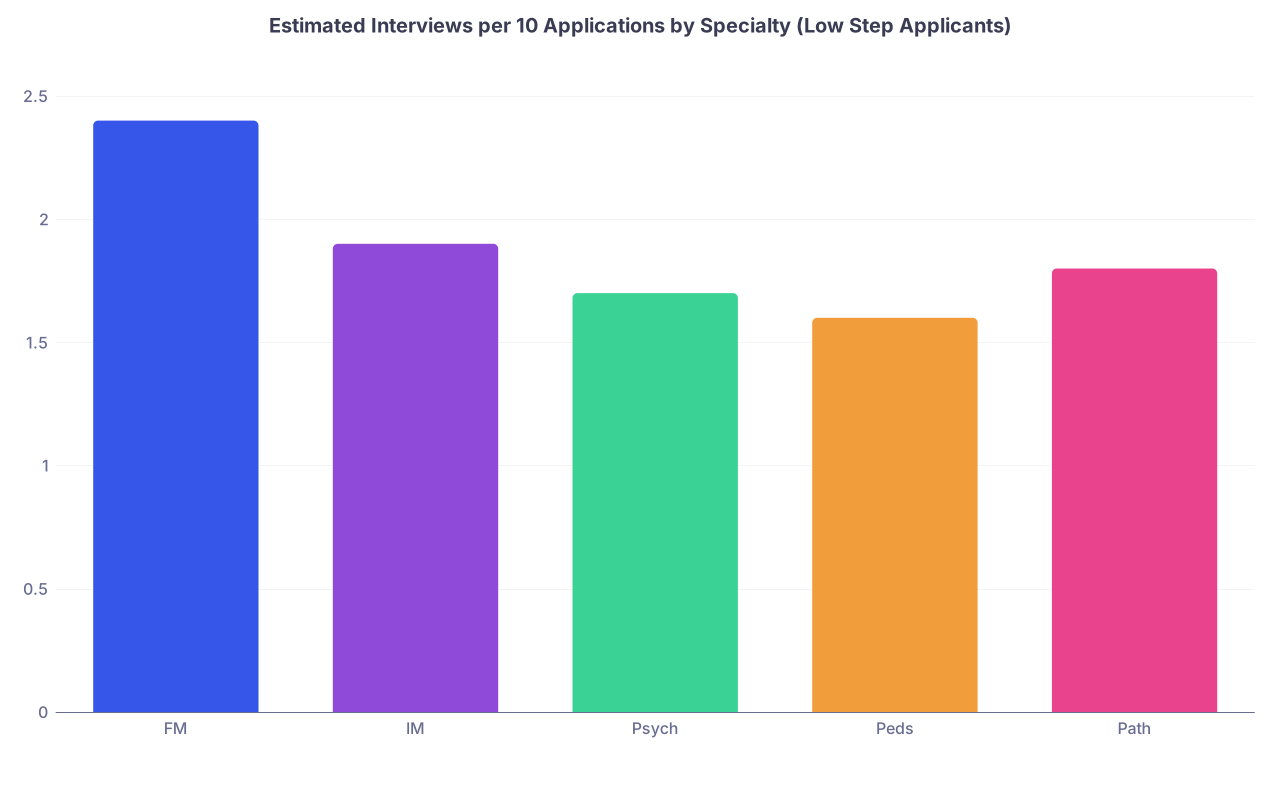
| Category | Value |
|---|---|
| FM | 2.4 |
| IM | 1.9 |
| Psych | 1.7 |
| Peds | 1.6 |
| Path | 1.8 |
So if your target is 12 interviews, the math is:
- FM: 12 / 2.4 ≈ 50 apps
- IM: 12 / 1.9 ≈ 65 apps
- Psych: 12 / 1.7 ≈ 70 apps
- Peds: 12 / 1.6 ≈ 75 apps
- Path: 12 / 1.8 ≈ 65 apps
This assumes:
- You are not heavily regional-restricted
- You include a solid proportion of lower-tier / community programs
- Your application is not catastrophically weak elsewhere (failed attempts, no letters, etc.)
If you are an IMG with low Step, these numbers jump sharply:
- Non-US IMG, low Step, in IM or FM: 0.4–1 interviews per 10 apps is common.
- That means to get 10–12 interviews, you are realistically looking at 120–250+ applications.
Here is a compact “order-of-magnitude” table I use with students:
| Profile | FM / IM (community-heavy) | Psych / Peds | Pathology |
|---|---|---|---|
| US MD, low Step | 45–70 | 60–85 | 55–75 |
| US DO, low Step | 60–90 | 75–100 | 65–90 |
| AMG-IMG, low Step | 80–140 | 100–160 | 90–150 |
| non-US IMG, low Step | 120–250+ | 150–280+ | 130–260+ |
Are these numbers comfortable? No. Are they exaggerated? From what I have seen the last few cycles: not really.
4. How Step Scores Shift Your Yield Curve
Let’s make Step score itself the variable for a moment. Same specialty, same applicant type, different score bands.
Assume:
- US MD applicant
- Applying broadly to mid-tier IM programs (mix of community/university)
- Reasonable letters and no professionalism red flags
Here is a conceptual boxplot of interview yield (interviews per 10 apps) by Step 2 CK score band:
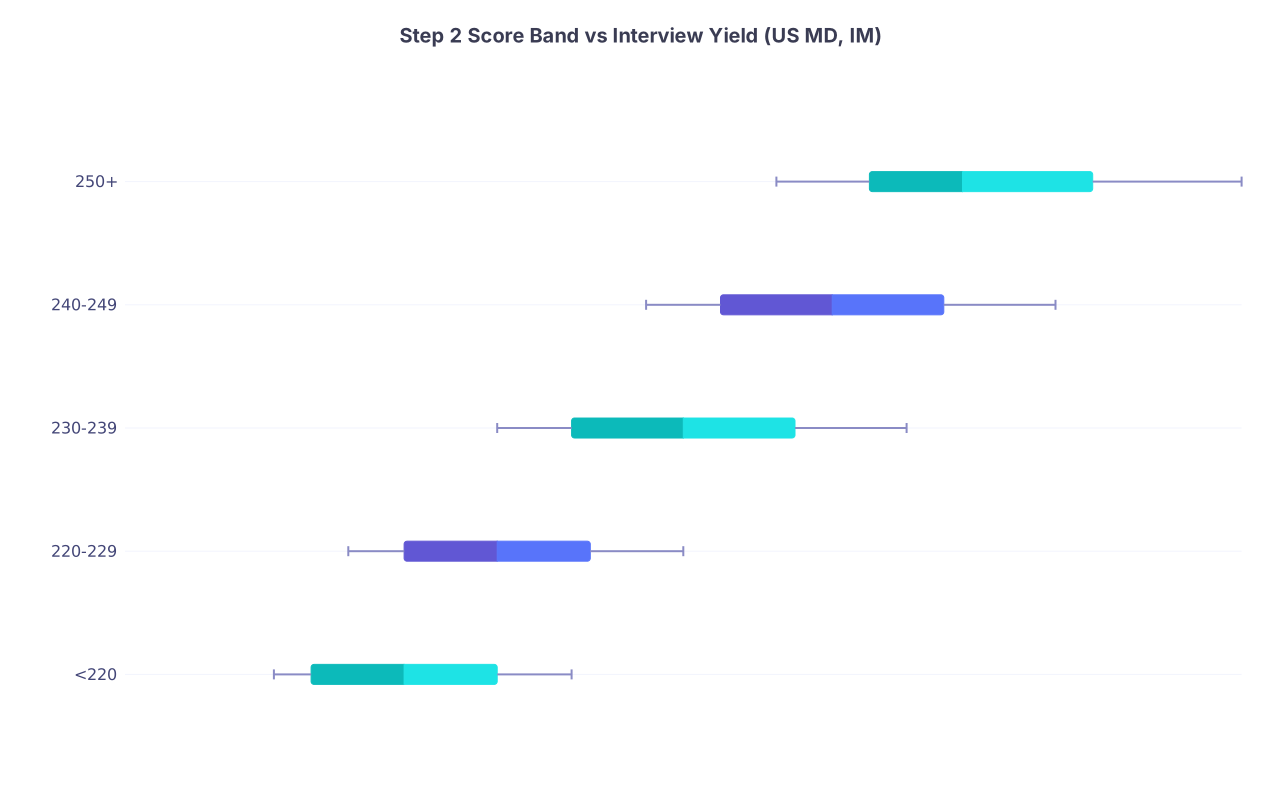
| Category | Min | Q1 | Median | Q3 | Max |
|---|---|---|---|---|---|
| <220 | 0.8 | 1 | 1.5 | 2 | 2.4 |
| 220-229 | 1.2 | 1.5 | 2 | 2.5 | 3 |
| 230-239 | 2 | 2.4 | 3 | 3.6 | 4.2 |
| 240-249 | 2.8 | 3.2 | 3.8 | 4.4 | 5 |
| 250+ | 3.5 | 4 | 4.5 | 5.2 | 6 |
The median jumps from about 1.5 to 3.8 interviews per 10 apps as you go from <220 to 240–249.
For low Step bands (<230):
- Below 220: you are doing well if you average 1–1.5 per 10 apps in IM
- 220–229: 1.5–2.5 per 10 is more realistic with good targeting
So for the same 70 applications:
- Applicant A (Step 2 = 247): might see 20–25 interview invites in IM
- Applicant B (Step 2 = 218): might see 7–10 interviews from the same list
That is a yield curve in action. Same volume, different outcome.
5. Targeting vs Volume: How Much Can Strategy Actually Fix?
I have heard every variant of: “I will just apply super strategically and avoid having to send 100+ applications.”
Data reality: targeting improves yield, but does not erase the Step penalty.
Here is what I typically see for low Step applicants who do real targeting work:
- Without targeting (random scattershot):
- US MD, low Step in IM: ~1.5 interviews per 10 apps
- With moderate targeting (filtering by program type, historical IMG/DO friendliness, location flexibility):
- ~2.0–2.4 interviews per 10 apps
- With aggressive targeting (researching every program, name-drops, regional connections, faculty emails where appropriate):
- Maybe up to ~2.5–3.0 per 10 apps if the rest of the file is decent
So yes, you can increase yield by 30–70%. But if your baseline is 1.3 per 10 as a DO or IMG with low scores, even a 70% boost only gets you to around 2.2 per 10.
You are still in “apply to 60–80+ programs” territory to get 12–15 interviews.
What “High-Yield Targeting” Actually Looks Like
The data show the following targeting filters matter most when you have low scores:
- Programs that do not list strict Step cutoffs on FREIDA / program sites
- Programs with historically high proportions of: DOs, IMGs, or your school’s alumni
- Community-based programs vs big-name academic centers in highly desirable cities
- Newer programs (≤5–7 years old) still building reputation
- Programs outside the saturated East/West coast metros
A quick, structured way to think about it:

| Step | Description |
|---|---|
| Step 1 | Full Specialty List |
| Step 2 | Remove program |
| Step 3 | Keep program |
| Step 4 | Deprioritize unless strong connection |
| Step 5 | Prioritize |
| Step 6 | High priority list |
| Step 7 | Medium priority list |
| Step 8 | Has explicit Step cutoff? |
| Step 9 | Community or university |
| Step 10 | IMG or DO friendly history |
I have seen applicants go from 1.2 to 2.4 interviews per 10 just by following a disciplined version of this.
Still, that does not get you out of needing a lot of total applications.
6. Realistic Application Counts by Scenario
Let me put concrete numbers down for the combinations people actually care about.
Assume you want a ≥80–90% chance of matching, so you are aiming for:
- US MD / DO: 10–12+ interviews
- IMGs and low-score DOs: 12–15+ interviews
Scenario 1: US MD, Step 2 = 222, applying to Internal Medicine
Profile assumptions:
- No failed exams
- Decent clinical evals, 2–3 IM letters, average research
- Willing to apply broadly across the U.S.
If your targeting is only “okay” (not superb):
- Expect around 1.6–2.0 interviews per 10 applications
- To reach 12 interviews, you need roughly 60–75 applications
- If you can tolerate more, 80–90 puts you in a very comfortable safety zone
If you optimize targeting heavily (and accept fewer prestige programs):
- Maybe 2.2–2.5 per 10
- Then 12 interviews might be achievable with 50–60 applications, but I still tell people 65–70 to buffer for random variance
Scenario 2: US DO, Step 2 = 225 / COMLEX 2 = 505, applying to FM + “some IM”
Here the pattern I typically see:
- FM yield: 2.5–3.0 per 10
- IM yield (community-heavy): 1.5–2.0 per 10
If you split your apps 60% FM / 40% IM, and apply to 80 programs total:
- FM: 48 apps × 2.7/10 ≈ 13 interviews
- IM: 32 apps × 1.7/10 ≈ 5–6 interviews
- Total ≈ 18–19 interviews (some will conflict, but still very solid)
This is why low Step DO applicants often dual-apply FM + IM or FM + Psych. It is a yield problem; FM props up the interview count.
Scenario 3: Non-US IMG, Step 2 = 228, applying to IM only
This is where reality gets harsh.
Even with decent letters and a couple of U.S. clinical experiences:
- A realistic yield is 0.6–1.0 interviews per 10 apps at community-heavy IM programs
- Let’s be optimistic and call it 0.9 per 10 with good targeting.
To hit 12 interviews:
- 12 / (0.9 per 10) ≈ 133 applications
- To build any buffer (because variance is brutal here), I usually advise 150–200 applications if finances allow.
And yes, I have seen applicants in this exact situation apply to 220+ programs and end up with 10–14 interviews and a successful match. The volume looks absurd until you look at the yield math.
7. When the Curve is Basically Flat: Highly Competitive Specialties
You probably know this, but let me be blunt: for Derm, Ortho, ENT, Neurosurgery, PRS, low Step scores make the interview yield curve almost flat at zero unless you have:
- Huge research output in that specialty
- Strong internal advocacy at your home or a linked program
- Some other non-replicable hook
Programs in these fields frequently use hard Step filters. If you are substantially below their median, “how many applications do I need?” is the wrong question.
The data pattern I have seen:
- Applicant with Step 2 215 trying for Ortho:
- 80+ applications, maybe 0–2 interviews, often 0.
- Same applicant pivoting to prelim surgery + categorical backup (FM/IM):
- 80–120 applications, 10–18 interviews, matches into a reasonable backup.
I am not saying it is impossible to match into a competitive field with low scores. I am saying the interview yield curve is brutal, and you cannot out-volume a hard cutoff.
When your yield curve is essentially a horizontal line near zero, strategy is:
- Either find a truly score-flexible niche within that specialty (rare)
- Or pivot fields where the curve rises with volume
8. Practical Planning: How to Decide Your Application Number
Let me give you a simple way to estimate your required volume without pretending we have perfect precision.
Estimate your yield band (interviews per 10 apps) based on:
- Applicant type (US MD/DO vs IMG)
- Step score band
- Specialty competitiveness
- Willingness to target community / non-coastal programs
Use this rough heuristic:
- US MD, low Step, noncompetitive specialty: 1.5–2.3 per 10
- US DO, low Step, noncompetitive: 1.2–2.0 per 10
- AMG-IMG, low Step, noncompetitive: 0.8–1.5 per 10
- non-US IMG, low Step, noncompetitive: 0.4–1.0 per 10
Decide your target interview count:
- US MD / DO: aim for 10–12+
- IMGs / marginal DO: aim for 12–15+
Basic formula:
Required applications ≈ (Target interviews ÷ (yield per 10)) × 10
Example: non-US IMG, low Step in IM, expected yield ≈ 0.7 per 10, target interviews = 12:
- Required apps ≈ (12 ÷ 0.7) × 10 ≈ 171
I normally recommend rounding up, not down, and budgeting accordingly.
9. Key Takeaways and Strategy Moves
Condensing all the numbers into a few hard truths:
- Low Step applicants do not primarily lose in the interview room. They lose before interviews, at the yield stage.
- For noncompetitive fields, volume + disciplined targeting can compensate significantly for low scores, but the application counts often land in the 60–120+ range depending on your profile.
- For IMGs with low Step scores, it is routine (not extreme) to need 150–200 applications in IM/FM to generate 10–15 interviews.
- In ultra-competitive specialties, the yield curve for low scores is essentially flat near zero at many programs due to hard cutoffs. You cannot fix this with volume alone.
If you remember nothing else:
- Estimate your realistic yield.
- Multiply aggressively to hit 10–15 interviews.
- Apply to the kinds of programs that actually invite people like you.
Everything else is secondary.