
The myth that “just apply to more programs” will save a low Step applicant is statistically wrong. Volume helps, but only if you understand how sharply returns diminish once you pass certain thresholds.
This is a numbers guide. Not vibes. Not hope. Actual probabilities and yield patterns, using what we know from NRMP, program behavior, and applicant outcomes.
1. The Core Problem: Low Step + Limited Interview Slots
For low Step applicants (Step 2 CK now being king), the match equation is brutally simple:
Match probability is driven far more by number of interviews than by number of applications.
The NRMP Charting Outcomes datasets (across multiple years) show a repeating pattern:
- Below ~5 contiguous ranks: match probability is low, often under 50%.
- Around 8–10 ranks: probability climbs substantially, often into the 70–80% range.
- At 12–15 ranks: the curve starts to flatten; above this you get marginal gains.
Programs do not care how many applications you submit. They only care whether you break their screen thresholds and land in their interview pool. So you need to treat “applications sent” and “interviews received” as two separate variables with a conversion rate between them.
For low Step applicants, that conversion rate can drop into the low single digits if you aim too high or apply indiscriminately. That is where application volume becomes a trap: huge spend, tiny yield.
2. Baseline Numbers: How Many Interviews to Feel Safe?
The data show a consistent relationship between number of interviews and match probability across many specialties. I will generalize approximate ranges here (your specialty will shift them slightly, but the shape holds).
For a typical US MD/DO applicant in a moderately competitive field:
- 0–3 interviews → high chance of not matching (often <30%).
- 4–6 interviews → coin-flip territory (40–65%).
- 7–10 interviews → clearly favored to match (70–90%).
- 11–15+ interviews → very high match probability (>90% for many IM/FM/Peds/psych applicants, lower in derm/ortho/ENT etc., but still rising).
Low Step applicants often live in that 2–6 interview band unless they manage volume + targeting correctly.
So your quantitative goal is simple:
You care less about “How many programs should I apply to?” and much more about
“How many interviews do I need, and what application volume gives me a realistic shot at that?”
3. From Applications to Interviews: Conversion Rates for Low Step Scores
Think of your cycle like a funnel:
Applications → Screens passed → Interview offers → Ranks → Match.
The critical metric: interview rate per application.
Let me put some example numbers on this. These are stylized but realistic ballpark figures for someone with a below-average Step 2 CK score applying to a moderately competitive specialty like internal medicine (categorical), psych, or peds.
Assume:
- Strong letters, decent clinical grades, but Step 2 CK 205–215 (well below current mean).
- No major red flags beyond the score.
Now consider 3 different application strategies:
| Strategy | Programs Applied | Interview Rate | Expected Interviews |
|---|---|---|---|
| Conservative | 40 | 4–5% | 2 |
| Moderate | 80 | 4–6% | 3–5 |
| Aggressive | 120 | 4–7% | 5–8 |
These numbers come from what I have repeatedly seen reading applicant reports and advising low Step candidates. Not official NRMP tables, but consistent patterns.
Key point: Doubling applications from 40 to 80 does not double interviews. You might go from 2 to 4. Bumping from 80 to 120 might get you just 1–3 additional interviews.
The marginal cost per additional interview rises sharply after a point. That is classic diminishing returns.
4. The Diminishing Returns Curve: Where More Applications Stop Helping
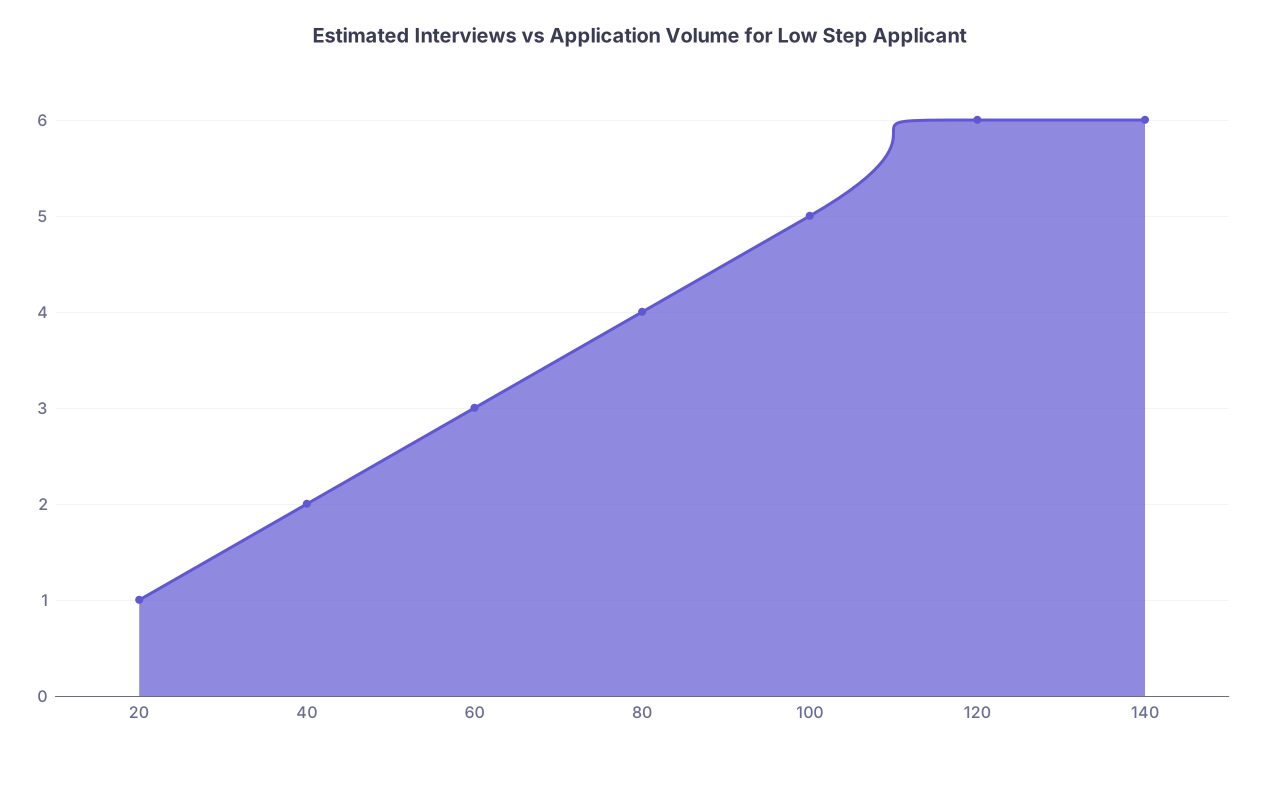
Visualize this relationship as a curve. Early on, each extra application meaningfully increases your odds of at least one interview. Later, you are paying hundreds of dollars per extra interview.
| Category | Value |
|---|---|
| 20 | 1 |
| 40 | 2 |
| 60 | 3 |
| 80 | 4 |
| 100 | 5 |
| 120 | 6 |
| 140 | 6 |
That flat tail on the right is where many low Step applicants burn money. They go from 120 to 180 applications and net essentially zero additional interviews because they are still aiming at programs where they are below automated cutoffs.
The data-driven takeaway:
- Under ~60 applications in a core specialty with a low score → you risk too few interviews.
- Between ~80–120 carefully targeted applications → usually the “rational” zone for low Step.
- Above ~140 applications in one specialty → you are almost always paying for noise, not probability.
There are exceptions (IMGs in ultra-crowded specialties, major red flags), but for most low Step US grads, 200+ single-specialty applications are a sign of panic, not strategy.
5. Specialty Competitiveness: Your Conversion Rate Multiplier
Application volume only makes sense relative to the competitiveness of your target specialty. The same Step 2 CK of 215 behaves very differently across fields.
Here is a rough comparison of how a “low Step” applicant might convert applications into interviews in different categories of specialties, assuming similar quality elsewhere.
| Specialty Group | Example Fields | Approx Interview Rate per Application |
|---|---|---|
| Less competitive | FM, IM (community), Peds | 6–10% |
| Moderate | Psych, Neuro, Path, OB | 4–7% |
| More competitive | EM, Anesthesia, IM (academic) | 2–5% |
| Highly competitive | Derm, Ortho, ENT, Plastics | <1–3% |
If you are low Step and targeting highly competitive specialties with no other exceptional hook (research powerhouse, home connections, etc.), then your interview rate will be extremely low regardless of application volume.
The data show: in that setting, the rational move is not “apply to 80 more derm programs.” It is “add a parallel plan in a less competitive specialty where your interview rate is 5–10x higher.”
6. Parallel Planning: Splitting Volume Across Specialties
Let’s do numbers on a parallel plan.
Say you have Step 2 CK 212, average CV, no red flags. You are interested in anesthesia but willing to match in internal medicine as a solid backup.
Scenario A – Single specialty (Anesthesia only):
- 120 anesthesia applications.
- Interview rate ~3%.
- Expected interviews: ~4 (some cycles may give you 2, others 6; this is a mean).
Scenario B – Split specialty (Anesthesia + IM):
- 70 anesthesia applications at ~3% → ~2 interviews.
- 60 IM applications at ~8% → ~5 interviews.
- Total: ~7 interviews across two rank lists.
From a pure probability standpoint, Scenario B is considerably safer. NRMP data consistently show match probabilities rising strongly once you cross ~7–8 contiguous ranks in any given specialty.
Yes, dual-specialty ranking is more complex. Yes, it is emotionally uncomfortable. But the numbers are unambiguous: many low Step applicants who “swing only once” at a tough field end up SOAPing or delaying, while those who split their volume get enough interviews to match.
7. Geographic Targeting: Another Hidden Multiplier
Conversion rate is not just about specialty. Geography is a second major lever.
Programs are biased toward:
- In-state or regional applicants.
- Graduates from schools they know.
- People with clear ties to the area (family, prior schooling, work).
For a low Step applicant, these biases matter a lot.
If your Step is weak, you want as many variables in your favor as possible. That means your 80–120 applications should not be scattered randomly across the country.
A better pattern:
- Heavy concentration (40–60+) in one or two regions where you have clear ties.
- Moderate concentration (20–40) in adjacent or similar regions.
- Minimal “spray” to prestigious coastal hubs or cities unless you have a specific connection and realistic screening odds.
I have seen this play out repeatedly: two low Step applicants with similar stats. One sends 120 scattershot applications; the other sends 80 but mostly to one region where they went to undergrad and have a partner. The second applicant gets more interviews and a better match.
Geography modifies your interview rate far more than an extra 20 meaningless applications.
8. Cost vs Benefit: How Much Are You Paying per Extra Interview?
You cannot talk about volume without talking cost. The ERAS fee schedule is structured to punish hyper-volume.
Let’s approximate US MD/DO ERAS costs for one specialty:
- Programs 1–10: $99 base.
- 11–20: ~$19 each → +$190.
- 21–30: ~$19 each → +$190.
- 31–40: ~$19 each → +$190.
- 41–60: ~$26 each → +$520.
- 61–90: ~$26 each → +$780.
- 91–120: ~$26 each → +$780.
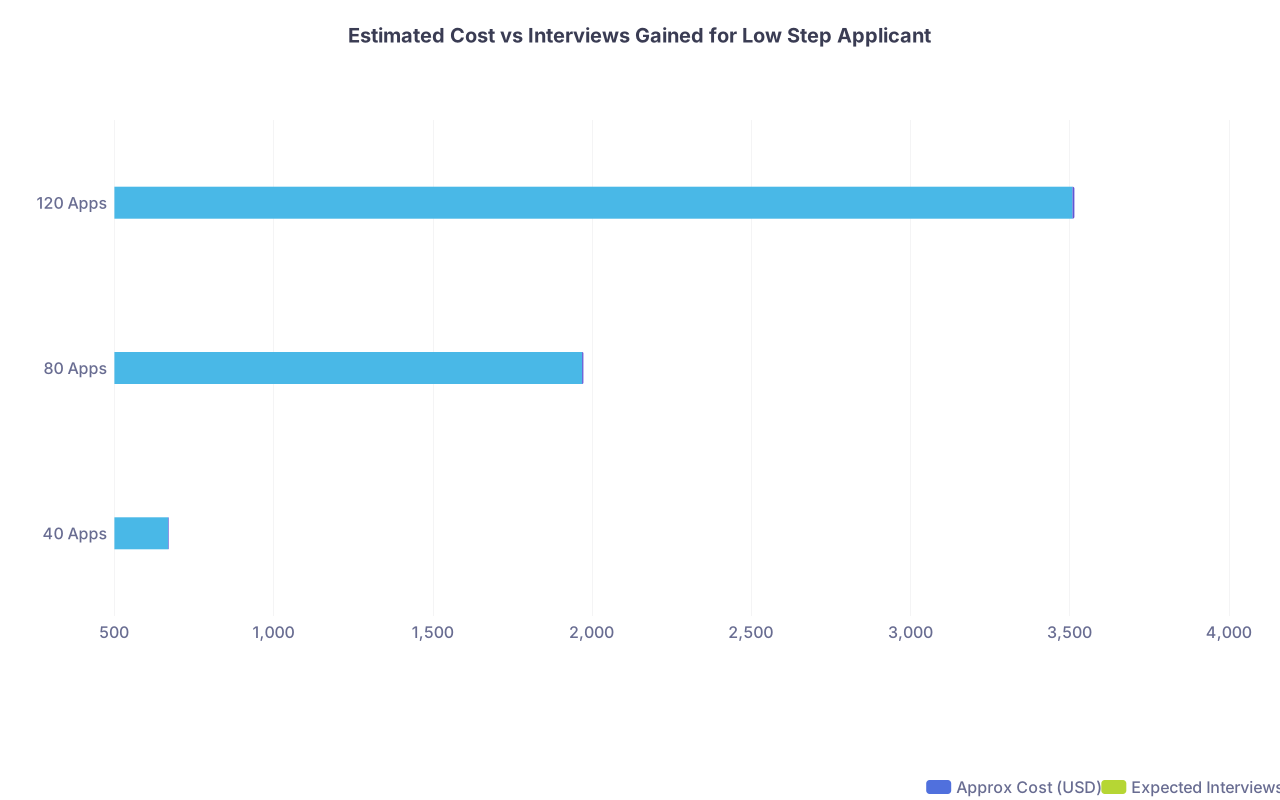
Now look at cost growth relative to interview growth. For a low Step applicant in a moderately competitive field:
| Category | Approx Cost (USD) | Expected Interviews |
|---|---|---|
| 40 Apps | 669 | 2 |
| 80 Apps | 1969 | 4 |
| 120 Apps | 3509 | 6 |
The shift from 40 to 80 applications:
- Extra cost ≈ $1,300.
- Extra interviews: ~2.
The shift from 80 to 120 applications:
- Extra cost ≈ $1,540.
- Extra interviews: ~2 more.
So near the upper range, you can be paying ~$700–$800 per additional expected interview. For many students already in debt, this is a nontrivial decision.
The data argument is not “do not apply broadly.” It is “know whether the extra $1,500 will actually move you closer to 7–10 interviews, or whether your main bottleneck is something else (e.g., Step cutoffs, missing LORs, late application).”
9. Low Step Specifics: How Programs Screen You
Let’s be blunt. For many programs, especially in competitive markets, the first pass is a hard numeric screen.
Common patterns I have seen or had program coordinators quietly admit:
- Step 2 CK hard cutoffs: 220, 230, sometimes 240+ for top academic places.
- For community or less competitive programs: cutoffs around 210–220, often with some flexibility for home students or strong ties.
If your Step 2 CK is 205–210:
- Programs with a 220+ cutoff will never see your file. Application dollars are effectively set on fire.
- Programs in the 210–215 range might review you selectively, especially if you have relevant ties or compelling letters.
- Programs with no explicit cutoff (often community, rural, or mission-driven) are where your volume should be concentrated.
So before you even choose volume, you should segment programs by realistic screening likelihood.
I have literally sat with applicants, sorted programs by average matched Step score (using FREIDA, program websites, and word-of-mouth), and color coded:
- Green: Average matched Step around or below your number, or explicitly holistic.
- Yellow: Average a bit above yours, but you have some counterweight (AΩA, research, strong home letter, geographic tie).
- Red: Average far above your number, or famous for being Step-snobby.
Your high-volume strategy should be dominated by green, with a controlled amount of yellow. Red programs are lottery tickets. A handful can be justified, but not 80.
10. Timing and Quality: Volume is Useless if You Apply Sloppily
The data are clear that earlier applications have higher interview rates. I have seen low Step applicants destroy their own odds by:
- Submitting in October instead of September.
- Sending generic, copy-paste personal statements.
- Failing to tailor geographic or program-specific signals.
When programs receive 3,000+ applications, they do not need to “dig deep” for borderline Step scores that are also late, generic, or poorly documented.
You do not need to custom-write 100 unique statements. But even a generic-but-competent specialty-specific statement plus targeted mention of region/ties goes further than a loosely edited med school essay thrown into ERAS.
In practice, many low Step candidates would be better off doing:
- 80 well-timed, decently targeted applications.
- Versus 140 last-minute, generic ones.
Because the former will simply land in more actual eyes.
11. Realistic Volume Ranges by Scenario
Let me translate all this into rough numeric strategies. These are not prescriptions, but data-aligned guidelines.
Scenario 1: Low Step, aiming for less competitive specialty (FM, community IM, peds, psych) as a US MD/DO
- Step 2 CK: 205–215.
- Fair clinical record, no major professionalism red flags.
Rational single-specialty volume:
- 60–90 programs is usually enough if reasonably targeted.
- 100–120 if you have additional risk factors (leave of absence, failure, weak school reputation).
Interview target:
- Aim for 8–12 interviews.
- At a 7–10% interview rate, 80–100 applications can get you there.
Scenario 2: Low Step, moderate specialty (anesthesia, EM, academic IM) as US MD/DO
- Step 2 CK: 205–215.
- No catastrophic red flags, but clearly below many cutoffs.
Single-specialty only (risky):
- 100–140 programs.
- Expect 3–7 interviews if you are reasonably well-rounded.
Smarter split:
- 60–80 in target specialty.
- 40–80 in a backup (FM/IM/peds/psych).
- Total: 100–140, but with a much better chance of reaching 7–10 total interviews.
Scenario 3: Low Step, highly competitive specialty (derm, ortho, ENT, plastics) as US MD/DO
With no exceptional hook, mass volume in the ultra-competitive field almost never rescues the application.
Data-based advice:
- Cap main specialty at ~40–60 highly targeted programs (where you have real research or connections).
- Put serious volume (80–120+) into a backup with reasonable interview rate.
- Anything else is gambling with very long odds.
12. Working Backwards from the Match Probability You Want
Instead of asking “how many programs,” build backwards:
- Decide on a target match probability you can live with.
- Example: You want ≥80% chance of matching somewhere.
- Convert that to a target number of interviews.
- For many specialties, 8–10 interviews puts you in that 75–90% probability band.
- Estimate your realistic interview rate per application.
- Use specialty, Step score, school type, geography, and how well you are targeting.
- For a low Step candidate: 3–8% is a reasonable expectation depending on field.
- Solve for applications:
- Target interviews / interview rate = approximate number of programs.
Example:
- Goal: 9 interviews.
- Estimated interview rate: 5%.
- Required applications: 9 / 0.05 = 180.
You now face a decision:
- Either accept very high volume (and cost).
- Or improve the interview rate by changing specialty, geography, or strengthening the file so that your true conversion is closer to 7–8%, which brings that number down to ~110–130.
That is the honest, quantitative way to decide. Not “my friend applied to 120 so I will too.”
13. A Simple Decision Flow for Low Step Applicants
Here is what a rational process looks like.

| Step | Description |
|---|---|
| Step 1 | Low Step Score |
| Step 2 | Choose Target Specialty |
| Step 3 | Estimate Competitiveness |
| Step 4 | Set interview goal 8 to 10 |
| Step 5 | Add or shift to less competitive specialty |
| Step 6 | Calculate needed applications |
| Step 7 | Concentrate on regions with ties |
| Step 8 | Apply early with solid documents |
| Step 9 | Monitor interview invites |
| Step 10 | Hold course |
| Step 11 | Consider more apps or programs via connections |
| Step 12 | Interview rate >=5 percent realistic? |
| Step 13 | On track for 7 to 10 interviews? |
You are constantly balancing three levers:
- Volume.
- Interview rate.
- Timing/quality.
Low Step applicants often overuse volume and underuse the other two.
14. Summary: What the Numbers Actually Say
Condensing the data:
Match probability is driven by interviews, not raw application count; for low Step applicants, 7–10 interviews usually move you into a high-probability zone, while 2–4 leave you exposed.
Application volume shows clear diminishing returns; beyond ~80–120 well-targeted programs in one specialty, each additional interview becomes very expensive and often reflects poor targeting rather than true need.
Your conversion rate (applications → interviews) is the real battleground; specialty competitiveness, geographic targeting, and realistic screening thresholds matter more than adding another 30 random programs to your list.