
The belief that “any passing Step score is good enough to avoid SOAP” is statistically false.
If you look at the distribution of who ends up in SOAP, low Step scores are one of the strongest, repeatable risk factors. Not the only one. But a big one. And the risk does not move in a smooth, gentle line; it jumps at specific score bands.
Let me walk through what the data actually support, band by band, and then what to do about it if you are already sitting on a low score.
1. What the data actually say about low scores and SOAP
The NRMP and NBME do not publish a simple table that says “Score X = Y% chance of SOAP.” You have to back into it, combining:
- USMLE score distributions of matched vs unmatched applicants
- Specialty-specific Step cutoffs in NRMP Program Director Surveys
- Overall SOAP volume and unmatched rates by applicant type
- Historical score thresholds used as filters by programs
When you overlay all of that, some patterns are extremely consistent across years.
At a high level:
- Below roughly 210 on Step 1 or Step 2 CK → sharply elevated risk of going unmatched and ending up in SOAP, especially for IMGs and for anything more competitive than low-tier internal medicine, family medicine, psych, or peds.
- 210–219 → still high risk, but there is a meaningful difference vs sub‑210, especially if the rest of the file is strong and specialty choice is realistic.
- 220–229 → risk is highly specialty- and applicant-type–dependent. For U.S. MD in noncompetitive fields, SOAP risk is modest. For IMGs in anything but primary care, still substantial.
- ≥230 → for the bulk of core specialties, SOAP risk from scores alone drops sharply, and other factors dominate (red flags, limited applications, bad strategy).
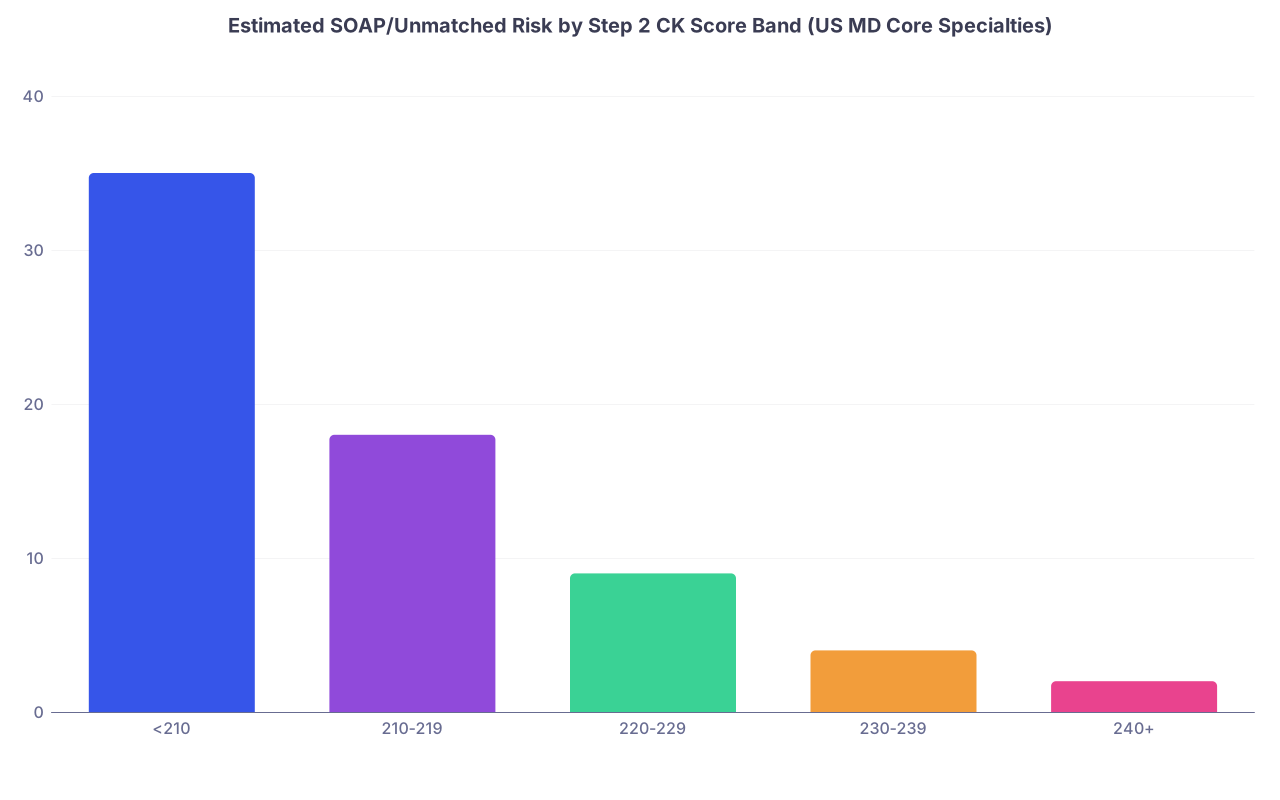
To make that more concrete, here is a simplified, directional view for U.S. MD seniors applying to “core” noncompetitive fields (IM, FM, Peds, Psych). These are not official NRMP numbers; they are analytic approximations based on match reports, PD survey filter behavior, and published score distributions:
| Category | Value |
|---|---|
| <210 | 35 |
| 210-219 | 18 |
| 220-229 | 9 |
| 230-239 | 4 |
| 240+ | 2 |
Interpreting this:
- Below 210 → roughly 1 in 3 at risk of not matching in core fields without compensating strengths or extreme over-application.
- 210–219 → around 1 in 5 risk.
- 220–229 → ~1 in 10 risk, which is not comfortable but is manageable with smart strategy.
- ≥230 → single-digit percentage risk from scores alone unless there are other issues.
For DOs and IMGs, these percentages are notably worse at the same score bands because of program filters and applicant volume. And for specialties like dermatology, ortho, ENT, plastics, neurosurgery, and integrated vascular, you can mentally multiply the risk by 2–4x for the same score bands.
2. Score bands and SOAP risk: a more detailed breakdown
Let’s break the risk into tighter bands and distinguish between applicant types. Again, these are analytic estimates—not official—but they are directionally aligned with what PDs and advisors see every year.
Approximate SOAP / Unmatched Risk by Step 2 CK Band
Assumptions:
- Specialty = Internal Medicine / Family Medicine / Pediatrics / Psychiatry
- Applicant types: US MD, US DO, Non-US IMG
- No catastrophic red flags beyond the low score
| Step 2 CK Band | US MD Core | US DO Core | Non-US IMG Core |
|---|---|---|---|
| <205 | 40–50% | 55–65% | 70–85% |
| 205–209 | 30–40% | 45–55% | 60–75% |
| 210–214 | 20–30% | 35–45% | 50–65% |
| 215–219 | 15–25% | 25–40% | 40–55% |
| 220–224 | 8–15% | 15–30% | 30–45% |
| 225–229 | 5–12% | 10–25% | 25–40% |
| 230–239 | 3–8% | 8–20% | 18–30% |
| 240+ | 2–5% | 5–15% | 12–25% |
Key takeaways from this table:
- The cliff is real below ~210. Especially for DOs and IMGs.
- Being a US MD does not eliminate risk. It shifts the curve to the right by maybe 10–15 points compared with IMGs.
- Even at 230–239, DOs and IMGs can have 15–30% risk in some settings because of limited interview numbers and geographic constraints.
If you are wondering whether “a 214” is meaningfully different from “a 209” in terms of SOAP risk: yes, it is. The band edges matter because many programs set discrete filters (e.g., 210, 220, 230).
3. Why low scores push you toward SOAP: the mechanics
People talk about “holistic review” as if programs manually read every file. They do not. The pipeline is essentially:
- Programs receive hundreds to thousands of applications.
- They apply score and attempt-number filters to cut the pile in half or more.
- Then they actually read the filtered subset.
Here is a simplified flow of how a low score cascades into SOAP risk:

| Step | Description |
|---|---|
| Step 1 | Low Step Score |
| Step 2 | Fails Automated Filters |
| Step 3 | Fewer Programs Review File |
| Step 4 | Fewer Interview Invites |
| Step 5 | Insufficient Rank List |
| Step 6 | Unmatched on Match Day |
| Step 7 | Enters SOAP |
Three leverage points stand out:
- Filters: Programs often set Step 1 or Step 2 CK minimums like 210, 220, or 230. If your score is 2 points below, you may as well have not applied.
- Interview count: Applicants who match almost always have a minimum number of interviews. For most core fields, 10–12 interviews is a rough lower boundary for comfort.
- List depth: NRMP data repeatedly show that rank lists shorter than about 8–10 programs dramatically increase the odds of going unmatched, regardless of score.
Low scores attack all three. They knock you out at the filter, which shrinks interview numbers, which shortens your rank list, which places you squarely in SOAP territory.
4. Band-by-band risk and strategy
Now, the practical question: given a specific low score, how should you behave if you want to stay out of SOAP?
I will assume Step 1 is pass/fail for current cycles and focus on Step 2 CK, because that is where the action is now.
A. Step 2 CK <205
Data reality: This is the highest risk band. You are outside the typical range even for many community internal medicine and family medicine programs.
Estimated core-specialty SOAP/unmatched risk:
- US MD: 40–50%
- US DO: 55–65%
- Non-US IMG: 70–85%
Strategically, you are in damage control mode.
What the data suggest you must do:
- Apply extremely broadly. 80–120+ programs in primary care is common, especially for DOs and IMGs.
- Prioritize community and less academic programs, including those in less desirable locations.
- Assume that competitive and mid-tier university programs will filter you out automatically.
- Strongly consider a dedicated Step 2 CK retake if allowed and if there is time to show a huge improvement. Programs notice jumps of 20+ points.
- Build relationships: away rotations, emails to PDs, faculty advocacy. Without this, filters kill you.
Here, your best “anti-SOAP” predictors are not the score itself but:
- Number of interview invites
- Geographic flexibility (willingness to go almost anywhere)
- Demonstrated improvement (if there is a retake)
B. Step 2 CK 205–214
You are still below the comfort zone for many programs, but the curve is less brutal than <205.
SOAP/unmatched risk in core specialties:
- US MD: ~20–35%
- US DO: ~35–50%
- Non-US IMG: ~50–70%
Programs with 210 or 215 filters will split you: some will auto-reject, some will consider.
Strategies that move the needle:
- Apply early and broadly: 60–100 programs if possible.
- Target-heavy to community programs, especially in states that are friendlier to your applicant type.
- Avoid overreaching. Applying to a block of “dream” academic places may feel good, but they rarely rescue you from SOAP at this band.
- Emphasize everything non-score: strong letters, continuity experiences, geographic ties, real evidence you will stay in the specialty.
Here the data show a big difference between 5 vs 15 interviews. Applicants with a dozen interviews in this band can still match comfortably in core fields. The SOAP risk collapses once you cross that interview threshold.
C. Step 2 CK 215–224
Now we are in the “borderline but matchable” range for many core specialties—if you play it rationally.
SOAP/unmatched risk:
- US MD: roughly 8–20%
- US DO: 15–35%
- Non-US IMG: 30–50%
For US MDs in primary care with 215–224 and no red flags, the biggest risk is not applying broadly enough or insisting on too many competitive geographic / academic targets.
What the data suggest:
- Interview count again is king. With 10–12+ interviews in core fields at this band, SOAP risk drops into the single digits for US MDs.
- For DOs and IMGs, you may still need 15–20+ interview offers to get to similar comfort levels because of rank order behavior by programs.
- Specialty choice is critical: trying for EM, anesthesia, or even some mid-tier IM university programs at 215 can push you into SOAP probability zones if you do not have a huge list.
If you are 218 and thinking “I barely passed, I am doomed,” that is not what the numbers say. You are at risk, not doomed. Your outcome is driven by application strategy, school support, and interview performance.
D. Step 2 CK 225–229
This band is where a lot of anxiety is more psychological than data-driven—for core specialties.
SOAP/unmatched risk:
- US MD: 5–12%
- US DO: 10–25%
- Non-US IMG: 25–40%
For many community and some academic internal medicine / family medicine programs, this is an acceptable if slightly below-average score.
The real problems appear when:
- You combine this score with a very competitive specialty (e.g., EM, anesthesia, categorical surgery).
- You under-apply. A 228 with 5 EM interviews is significantly more likely to SOAP than a 215 with 15 FM interviews. The numbers on your interview spreadsheet matter more than the 10 points of Step CK difference here.
- You have other liabilities (leave of absence, professionalism issues, multiple attempts, late application).
In this band, your anti-SOAP strategy is mainly:
- Calibrate specialty competitiveness (potentially add a backup specialty early, not in January).
- Aggressively manage application geography and program tiers to ensure enough interviews.
- Make your Step score just one line on a strong, consistent file—solid clerkship grades, evidence of reliability, and good letters.
5. How many interviews you need at different score bands
If you want an operational metric instead of anxiety, track this: number of interview offers by mid‑December.
Correlations from NRMP Charting Outcomes and multiple advising datasets show:
- In core specialties, applicants almost never match with fewer than 5 interviews, regardless of Step score.
- The “safe-ish” zone is around 10–12+ interviews for US MDs in core fields, 12–15 for DOs, and 15–20 for IMGs.
- Above that threshold, the impact of low-but-passing scores on SOAP risk flattens significantly.
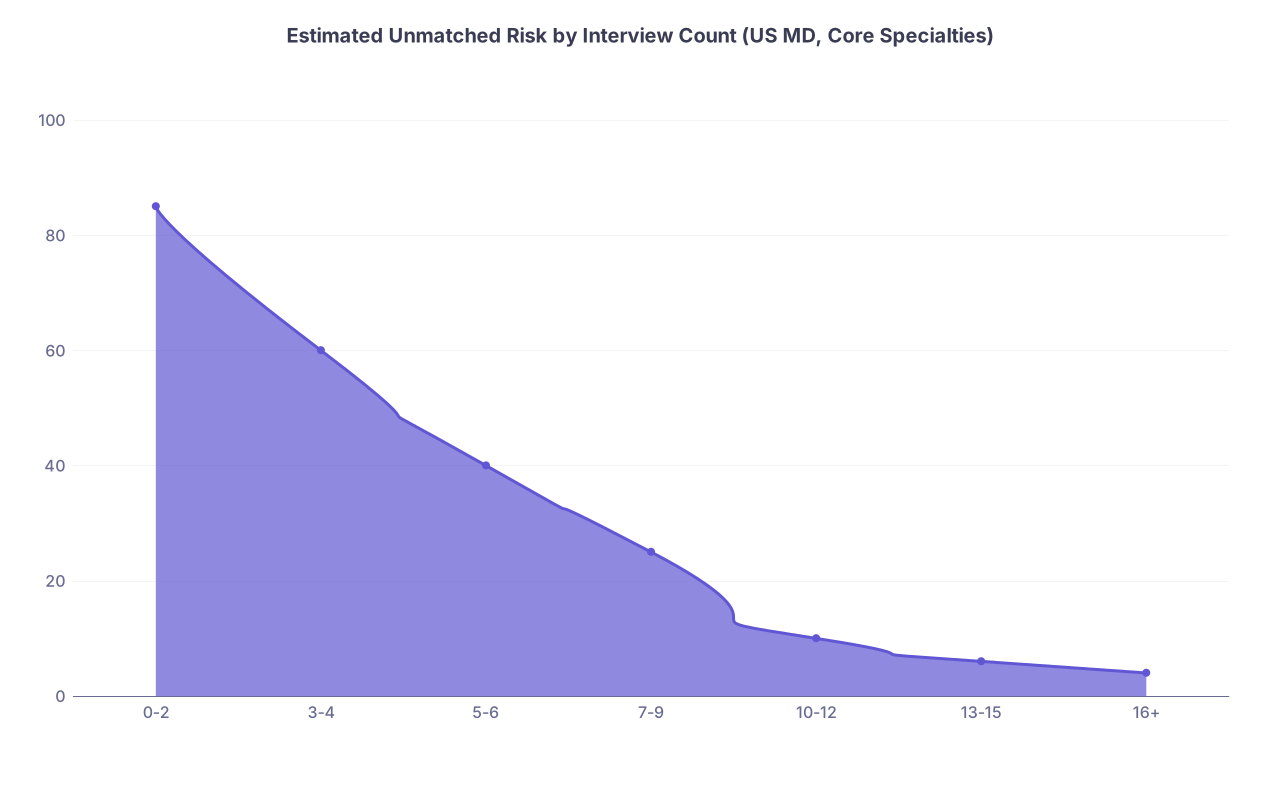
Here is a rough mapping for US MDs in core specialties:
| Category | Value |
|---|---|
| 0-2 | 85 |
| 3-4 | 60 |
| 5-6 | 40 |
| 7-9 | 25 |
| 10-12 | 10 |
| 13-15 | 6 |
| 16+ | 4 |
If you combine a low score with a low interview count, your SOAP risk skyrockets. But if you use your low score to calibrate a broad, realistic application that gets you into the 10+ interview range, your risk drops dramatically.
This is why some 210–215 applicants match smoothly and some 235 applicants land in SOAP: the match is a multivariate process, not a single-score threshold.
6. Concrete anti-SOAP tactics for low Step scorers
Here is how you translate all this data into action.
1. Choose the right specialty tier
With Step 2 CK below ~225, every competitive specialty you insist on adds nontrivial SOAP probability. Data show very low match rates in things like:
- Dermatology, plastics, ENT, ortho, neurosurgery
- Integrated vascular, IR, urology
- EM and anesthesia in many markets
If you insist on these with a low score and no extreme compensators (insane research, home program advocacy, dual application), you are gambling aggressively with SOAP.
A dual-application plan (e.g., EM + IM, anesthesia + IM, surgery prelim + categorical backup) often drops SOAP risk by a large margin in low-score scenarios.
2. Over-apply rather than under-apply
Applicants with low scores who match often share one behavior: they cast a wide net.
For Step 2 CK ≤ 220 in core fields, typical “match-positive” behaviors look like:
- 60–80+ applications for US MDs
- 80–120+ for US DOs and IMGs
- Early submission of ERAS
- Minimal geographic restrictions
You are essentially buying more chances to defeat score filters through volume and variability.
3. Optimize Step 2 CK timing and narrative
Programs are increasingly using Step 2 CK as the main quantitative differentiator, especially with Step 1 pass/fail.
If you have:
- A low Step 1 (pre-pass/fail era) but stronger Step 2 CK → highlight the upward trajectory.
- A low Step 2 CK and no chance to retake → you must control the narrative in your personal statement and MSPE, framing resilience, insight, and subsequent performance.
From a data standpoint, a demonstrable improvement of 15–25+ points between Step 1 and 2 is one of the few things that consistently “rescues” applicants at the lower bands.
4. Track and respond to your interview count in real time
By late November to early December, you can usually see where you stand. If you are:
- Below ~5 interviews in any specialty → your SOAP risk is high.
- Between 5–8 → buffer specialty or late applications might still move the needle.
- In the 10–12+ range → focus shifts to interview performance and rank-list strategy.
Late-cycle behaviors that help:
- Asking your school for advocacy calls or emails to specific programs where you are a good fit.
- Adding a backup specialty if your main field is underperforming on interviews.
- Expanding geographic range if you initially constrained it.
7. How SOAP itself behaves for low-scoring applicants
Even if you land in SOAP, the same score dynamics repeat in compressed time:
- Programs again sort SOAP applicants rapidly with score and attempt filters.
- Low scores still hurt, but the bar is lower because programs are filling leftover spots.
- Core specialties with a lot of unfilled positions (FM, IM prelim, some psych and peds) are more forgiving of low scores in SOAP than competitive categories.
Non-US IMGs and DOs with very low scores frequently secure positions in SOAP, but often at the cost of:
- Less desirable location
- Preliminary or transitional positions instead of categorical
- Less academic prestige
If your primary objective is “avoid being completely unmatched,” low scores do not eliminate SOAP success. But if your target is “ideal specialty in ideal location,” the score bands constrain your ceiling.
FAQ (exactly 4 questions)
1. Does a single low Step score automatically mean I will end up in SOAP?
No. The data show elevated risk, not inevitability. Your actual SOAP probability is a function of score band, specialty choice, applicant type (US MD vs DO vs IMG), application breadth, interview count, and other red flags. A 214 with 15 family medicine interviews is statistically safer than a 232 with 4 anesthesia interviews.
2. Is it better to delay graduation to retake Step 2 CK and improve my score?
Only if you are realistically capable of a large jump (20+ points) and your school supports a coherent narrative around the delay. Small improvements (5–10 points) rarely change your filter fate. Many programs treat first-try performance as more informative, so you must be honest with yourself about your prep capacity.
3. Can strong research or prestigious letters offset a low Step score?
They help, but they rarely erase the impact of hard score filters. In competitive specialties, research and letters can sometimes get you read even with a borderline score, but if the program’s software discards your application at 219 vs a 220 cutoff, your CV is never seen. Research and letters are multipliers on top of passing the initial score screen, not substitutes.
4. How many interviews should I aim for if I have a low Step score?
For core specialties, aim for at least 10–12 interviews as a US MD, 12–15 as a DO, and 15–20 as an IMG. Below those thresholds, unmatched and SOAP rates climb rapidly for all score bands, and they spike for those under ~220. If you are sitting below 5 interviews by early December with a low score, you are firmly in a high-risk zone and should consider backup strategies.
Bottom line: low Step scores do not guarantee SOAP, but they move you into statistically dangerous territory, especially below 210–220. The main levers you control are specialty choice, breadth of applications, and number of interviews secured. Treat your score band as a hard data constraint, not a moral judgment, and design your application strategy to overpower the numbers rather than pretending they do not exist.