
The belief that “a low Step score kills your residency chances everywhere” is factually wrong. The data show something more nuanced: where you apply matters almost as much as what you scored.
Residency matching in the low-score range is heavily geographic. Certain regions, states, and program types absorb a disproportionate share of applicants with below-median Step 1 (historically) or lower Step 2 CK scores. Others barely touch them unless there is an exceptional compensating factor. If you ignore these trends and spray applications evenly across the map, you are wasting money and time.
Let me walk through what the data, match reports, and program behavior actually show.
1. The Score Reality Check: Where You Stand Statistically
Before geography matters, the score does.
Even in a pass/fail Step 1 era, programs are still anchored to historical score behavior and Step 2 CK as a filter. From NRMP and NBME data (pre–Step 1 P/F, but the structure still holds):
- US MD seniors in less competitive specialties tend to match robustly with Step 2 CK in the 225–240 range.
- Below roughly 220, match rates drop sharply unless other factors (geography, connections, school reputation) tilt in your favor.
- DO and IMG applicants feel this drop-off even earlier and more steeply.
Programs rarely say this explicitly, but behavior shows it clearly: they filter on exam performance first, then location, then everything else.
So if you are, say, a 208–215 Step 2 CK US MD or DO, or an IMG with 220–230, geography is not optional strategy. It is core strategy.
2. Macro Geography: Regions That Tolerate Lower Scores
Some regions historically give more interview chances to lower-score applicants. That is not because they are “worse” programs. It is a function of supply–demand and applicant preferences.
Broadly:
- Coasts (Northeast major metros, West Coast): High demand, high applicant density, higher score expectations.
- Midwest, South, non-coastal West: Lower applicant density, more community programs, broader score ranges interviewed.
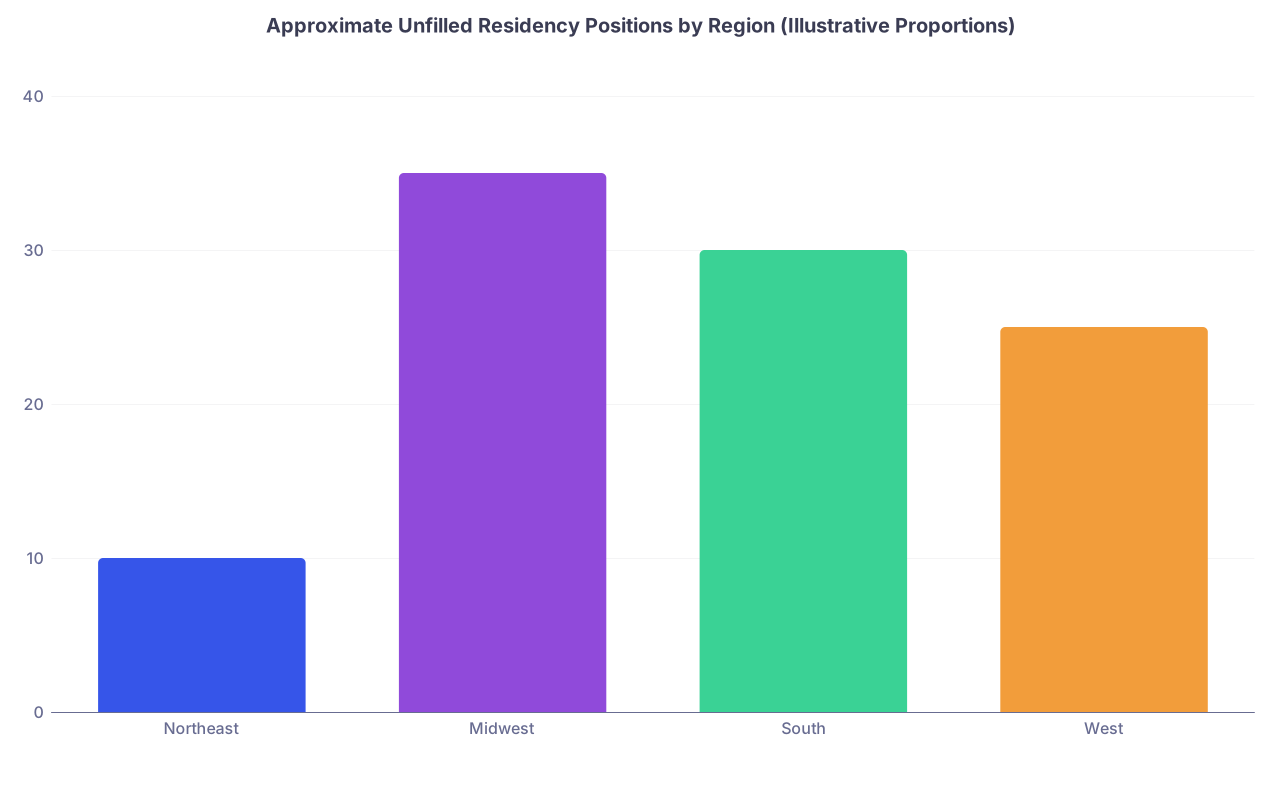
You can see this indirectly by looking at how many unfilled positions show up in SOAP by region and specialty. Programs that struggle to fill every year are, by definition, more flexible.
Where positions tend to go unfilled more often
Compare an illustrative pattern in primary care–heavy specialties (FM, IM, Psych) based on historical NRMP data patterns:
| Category | Value |
|---|---|
| Northeast | 10 |
| Midwest | 35 |
| South | 30 |
| West | 25 |
The pattern you see in real data is similar: the Midwest and some Southern and interior Western states consistently carry more unfilled spots per capita, especially in primary care and smaller cities. That is where lower-score applicants quietly match.
If your Step 2 CK is, say, 210–220 and you blast half your applications into Boston, NYC, DC, SF, LA, Seattle, you are playing a low-probability game. The same application list refocused to the Midwest and South shifts your odds dramatically.
3. State-Level Trends: Where Lower Scores Match More
The data do not publish a neat “average Step score by state,” but you can infer patterns by combining:
- Specialty competitiveness by state
- Percent of programs that fill with US MDs vs DOs vs IMGs
- Frequency of unfilled positions and SOAP activity
From that, several clusters emerge where lower Step scores match more frequently.
3.1 States that are relatively “friendly” to lower scores
You see a recurring pattern in:
- Midwest: Michigan (outside Ann Arbor and big academic centers), Ohio, Indiana, Iowa, Kansas, Missouri, Nebraska, Wisconsin, Minnesota (community programs rather than Mayo/UMN), Illinois (outside Chicago academic powerhouses).
- South: Alabama, Arkansas, Mississippi, Louisiana, Oklahoma, Kentucky, Tennessee (non-Nashville big-name systems), South Carolina.
- Interior West: Nevada, New Mexico, Utah (non–big name centers), Idaho, parts of Colorado (community programs), North Dakota, South Dakota, Montana, Wyoming (where programs exist).
These states have two common features:
- A higher proportion of community-based or hybrid academic–community programs.
- A higher proportion of non–US MD residents (DO + IMG), which usually corresponds with wider Step score distributions.
In practice, this means:
- A US MD with a 215 Step 2 CK has a non-trivial shot at IM/FM in these areas.
- A DO with a 210 Step 2 CK has a fighting chance at IM/FM, sometimes Psych, and even some prelim surgery.
- An IMG with 220–230 can match IM/FM, sometimes Psych, particularly in programs that already have many IMGs on the roster.
3.2 States that are mathematically harsher for low scores
Contrast that with:
- Northeast: Massachusetts, New York (especially NYC area), New Jersey, Connecticut, Pennsylvania (Philly/Pittsburgh centers), DC.
- West Coast: California, Washington, Oregon, large parts of Colorado, Arizona (Phoenix academic centers especially).
- Certain prestige magnets: Texas (Houston/Dallas academic centers), Florida (big-name systems, Miami, Tampa), North Carolina (Duke, UNC), Virginia (UVA, VCU, some Northern Virginia programs).
In these states you see:
- Higher proportion of US MD seniors.
- Higher percentage of categorical spots filling via main match with US MDs.
- Fewer SOAP openings relative to program count.
This translates into meaningfully higher filter thresholds.
4. Program Type: Academic vs Community vs Rural Tracks
Geography has layers. State is one. Program type is another.
Academic medical centers
Large university hospitals and brand-name systems usually:
- Receive thousands of applications for IM, 500–800 for FM, 800–1500+ for surgery, etc.
- Set hard Step 2 CK filters (often ≥ 230–240 for many specialties, sometimes higher).
- Prefer US MDs, then DOs, then selected IMGs with strong scores and research.
With a low Step score, you are essentially hoping to be the exception, not the rule. That can happen, but you do not build a strategy on it.
Community programs and hybrid programs
These are the workhorses of low-score matching.
They:
- Receive fewer applications, especially in less “desirable” cities or states.
- Use lower or more flexible score cutoffs, and often review more holistically if you express geographic interest.
- Tend to value continuity, clinical performance, and “fit” over pure test performance.
This is where a 205–215 applicant can still credibly match, especially in primary care or prelim years.
Rural and community-focused tracks
The most underexploited option for low-score applicants.
- Rural tracks in FM and IM and some Psych programs are frequently underapplied to.
- Some explicitly state: interest in rural/underserved practice heavily weighted in selection.
- Their score ranges are visibly wider, especially for DO and IMG applicants.
If you grew up in a small town, worked in FQHCs, or can make a credible rural-interest argument, that geographic alignment can offset 10–15 points of Step deficit compared with coastal academic programs.
5. Where US MD vs DO vs IMG with Low Scores Actually Match
Different applicant types interact with geography differently. The same Step score means something very different for an IMG compared with a US MD.
Comparative “friendliness” for low scores by applicant type
This is a simplified, conceptual picture derived from NRMP and program composition patterns:
| Applicant Type | Best Regions/States (Score-Friendlier) | Toughest Regions (Score-Heavy) |
|---|---|---|
| US MD | Midwest, South, interior West | Coastal metros, prestige hubs |
| DO | Midwest, South, DO-heavy states (MI, OH, PA, WV, MO) | CA, MA, NY academic centers |
| IMG | Midwest, South, some NY/NJ community programs | West Coast, elite academic centers |
Key points:
- US MD with low scores: Still favored compared with DO/IMG in many community programs. Geography expands your margin of error.
- DO with low scores: Does best in states with many DO schools and hospitals (Michigan, Ohio, Pennsylvania, West Virginia, Missouri, Oklahoma).
- IMG with low scores: Needs programs with a proven history of IMG-heavy rosters, usually in the Midwest and South, sometimes in NYC/NJ community hospitals that have long recruited IMGs.
If you are an IMG sitting at 220, focusing on California, Washington, and New England is almost mathematically irrational. Those slots are taken by 240+ US MDs and select DOs and IMGs. Your match wins are hiding in Ohio, Michigan, Illinois (outside Chicago core), Texas community programs, and Southern states.
6. Specialty plus Geography: Where Low Scores Still Move
You cannot talk geography without talking specialty. Certain specialties are score-sensitive everywhere (Derm, Plastics, Ortho, ENT, integrated CT, etc.). Others flex more by region.
More forgiving specialties
Within rational reach for low Step 2 CK (e.g., 205–220 US MD / 210–225 DO / 215–230 IMG), if you choose geography wisely:
- Family Medicine
- Internal Medicine (especially community-based, non-university programs)
- Psychiatry (outside coastal metros, and not the ultra-brand-name programs)
- Pediatrics (in some Midwestern/Southern community or hybrid programs)
- Prelim Medicine and Prelim Surgery (as a route to categorical later)
Almost always unforgiving specialties
Even in “softer” regions, low scores remain a major barrier:
- Dermatology
- Plastic Surgery
- Orthopedic Surgery
- Neurosurgery
- ENT
- Integrated Vascular and CT Surgery
- Often Emergency Medicine (though this has shifted slightly with changing market dynamics)
If you want a surgical or competitive specialty with low scores, your realistic geographic optimization is: choose prelim or transitional positions in score-friendlier states, then work up to a categorical spot via performance and networking. Matching straight into a competitive categorical spot from a 210 CK is a statistical outlier.
7. How Programs Use Geography as a Filter
Program directors do not only filter on scores. They filter on geography. This is where candidates with low scores often misread the game.
Three recurrent patterns:
“We prefer applicants with regional ties.”
Translation: Your 215 from a Midwest school applying to Midwest community IM is far more competitive than the same 215 applying to a California academic IM program.“We welcome applicants from X or Y schools.”
Programs often have pipelines from certain med schools in their region. Those pipelines are more forgiving about scores.“We like people who will actually stay here.”
A candidate with personal/family roots in a smaller state has a huge edge over someone with zero connection, across all score bands. At low scores, this can be the difference between filtered out and interviewed.
This is where you can turn a weak number into a workable file:
- Explicitly aligning your personal story with the region.
- Applying to a high volume of programs in one or two target regions rather than scattering across the country.
- Using away rotations or sub-Is strategically to establish “ties.”
8. Data-Driven Application Strategy for Low Scores
Let’s move from concepts to more concrete strategy. You do not control your score anymore; you do control where and how you apply.
Step 1: Honestly place yourself in a score tier
For Step 2 CK (or legacy Step 1 if still referenced in some data):
- Severe deficit: <205
- Moderate deficit: 205–215
- Mild deficit: 216–225
- Borderline: 226–235 (depends heavily on specialty and applicant type)
The more severe the deficit, the more you must lean on geography and specialty flexibility.
Step 2: Pick 1–2 primary geographic zones
You want concentration, not scatter.
For example, a DO with 210 CK targeting IM:
- Zone A: Midwest (Ohio, Michigan, Indiana, Illinois, Missouri)
- Zone B: South (Kentucky, Tennessee, Alabama, Arkansas, Oklahoma)
Then apply broadly to community and hybrid programs there, plus a limited number of reach programs elsewhere.
For an IMG with 225 targeting IM:
- Zone A: Midwest (OH, MI, IL, WI, MN, IA, KS, NE)
- Zone B: South (TX, FL, GA, LA, MS, AL, SC, NC – but focus on IMG-friendly programs)
Step 3: Bias strongly toward community and hybrid programs
If you have a low score and your application list is dominated by university- or university-affiliated flagship programs in major metros, you have constructed your own problem.
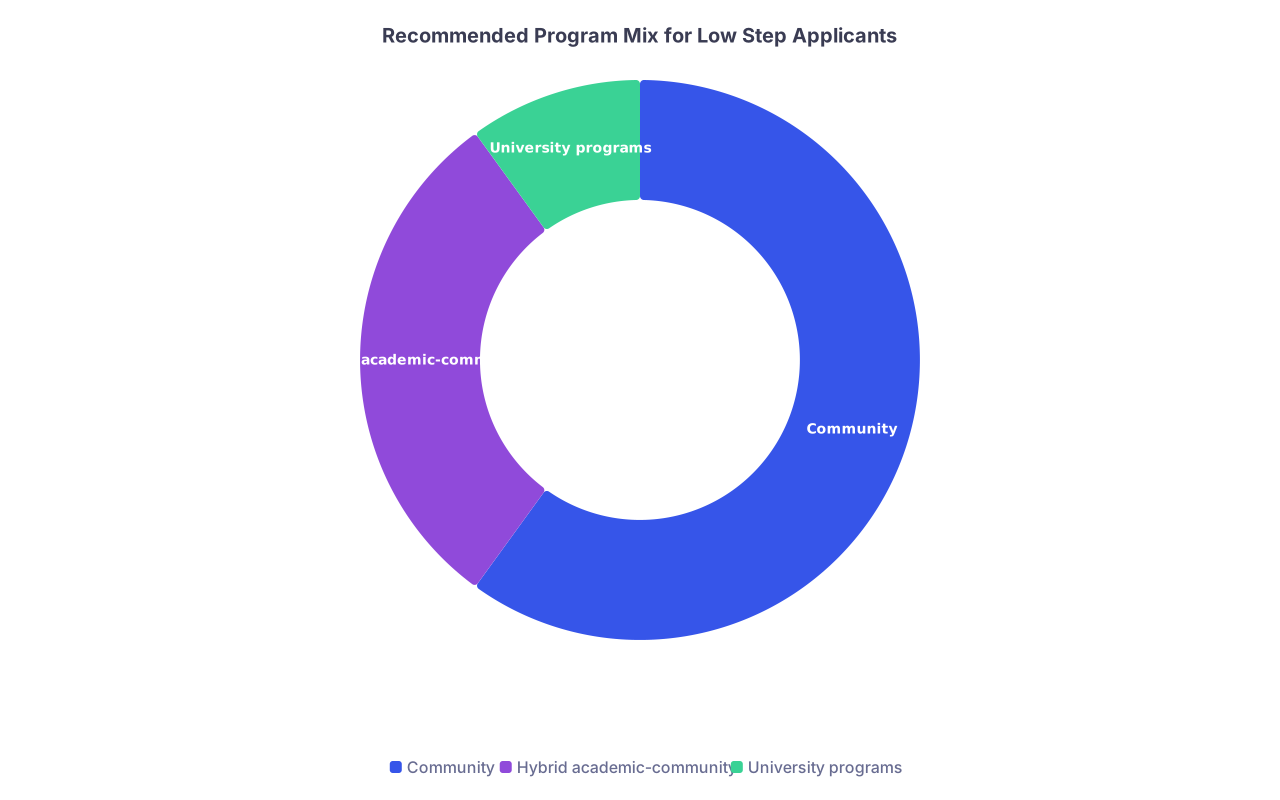
You want a program mix something like this (for a low-score primary-care applicant):
| Category | Value |
|---|---|
| Community | 60 |
| Hybrid academic-community | 30 |
| University programs | 10 |
The data show that unfilled positions and IMG/DO-heavy rosters cluster in the community/hybrid program categories. That is where your probability mass sits.
Step 4: Use program composition and board pass rates as proxies
Two quick data-driven checks before you apply:
- Resident composition: If a program has many DOs and IMGs, they are more likely to flex on scores. If they are nearly 100% US MD from top schools, assume high thresholds.
- Board pass rates: Some programs deliberately bring in a range of scores but have strong teaching and board prep. Those are gold for low-score applicants.
9. Misconceptions That Kill Low-Score Applicants
I have seen the same poor assumptions sabotage many candidates who actually had a path to matching.
Misconception 1: “I need to be on the coasts to get a good residency.”
Data do not support that. Many Midwestern and Southern community and hybrid programs have excellent board pass rates, fellowship placement, and procedural exposure. The prestige narrative is overblown, especially for IM/FM/Psych.
Misconception 2: “IMG-friendly = bad program.”
Incorrect. “IMG-friendly” in data often just means:
- Willing to consider high-performing IMGs.
- Located in less-saturated cities.
- Lower brand recognition with applicants, so they must compete less on test scores and more on environment.
There are very strong IMG-heavy IM programs in places most applicants never seriously consider.
Misconception 3: “I should still apply to a lot of academic coastal programs ‘just in case.’”
Sprinkling a handful of dream programs is fine. Making them half your list is statistical malpractice. With low scores, your realistic ROI comes from:
- Volume in score-friendlier geographies.
- The right program types.
- Programs with documented history of taking people like you.
10. A Simple Process Map: How to Align Geography with Your Score
You can structure this like an actual workflow.

| Step | Description |
|---|---|
| Step 1 | Know Your Step Tier |
| Step 2 | Choose Target Specialty |
| Step 3 | Select 2 Score Friendly Regions |
| Step 4 | Select Prelim Friendly Regions |
| Step 5 | Prioritize Community and Hybrid Programs |
| Step 6 | Check Program Resident Mix and IMG DO Rate |
| Step 7 | Build List Heavy in Friendly States |
| Step 8 | Emphasize Regional Ties in Application |
| Step 9 | Primary Care or Competitive |
Walk it once, deliberately. Your spreadsheet should mirror this logic, not your wishlist.
Key Takeaways
- Low Step scores do not kill your match chances everywhere, but they absolutely change where you are statistically competitive. The Midwest, South, and interior West, especially community and rural programs, absorb a disproportionate share of low-score matches.
- Region, program type, and applicant type interact. US MDs, DOs, and IMGs each have specific states and program profiles where their odds rise sharply even with weaker scores.
- A rational strategy concentrates applications in score-friendlier geographies and program types, instead of wasting volume on coastal academic centers that historically do not take applicants with your profile.