The usual “academic vs community” advice for low Step scores is lazy and wrong. The data show a far more nuanced picture: some academic programs are safer than certain community programs, and low scores do not automatically exile you to the community hospital wilderness.
Let me walk through what the numbers actually say.
1. The baseline: how much do low scores hurt?
Before we even touch academic vs community, you need a reference frame. Low Step scores behave differently by specialty and score band.
For simplicity, I will treat Step 1 as pass/fail era and focus on Step 2 CK (since that is now the main numeric filter). I will use rough but realistic bands:
- Very low: < 215
- Low: 215–225
- Borderline: 226–235
- Average: 236–245
- High: 246+
NRMP and program survey data give us a few hard truths:
- Most programs still use Step 2 CK cutoffs, even after Step 1 went pass/fail.
- Academic university programs report higher average scores and more frequent hard screens.
- Community programs show wider variance: some are forgiving, others quietly brutal.
The question is not “Can I match?” but “Where does a low score hurt least, and where does it kill you?”
2. Academic vs community: structural differences that affect low-score applicants
Let me define terms the way program directors actually use them, not the way Reddit does.
- Academic program = university-based or major university-affiliate, substantial research, fellowship-heavy, residents teaching students, often tertiary/quaternary referral centers.
- Community program = primarily hospital-based, less research, fewer or narrower fellowships, often service-heavy, may be university-affiliated but not university-owned.
These differences translate into observable patterns in who they interview and rank.
| Factor | Academic IM Program | Community IM Program |
|---|---|---|
| Avg Step 2 CK matched | ~245 | ~235–240 |
| Research per applicant | 4–6 entries | 1–3 entries |
| Home med school | Often same institution | Mix of DO, IMG, MD |
| Fellowship placement | High subspecialty rates | Variable, often moderate |
Notice what is not on that table: “Low scores = no chance” for academic. Because that is simply false.
Academic programs care a lot about:
- Score trends (upward vs flat vs downward)
- Class rank / AOA / clerkship performance
- Research fit, especially for competitive subspecialties
- “Signal” factors: home school, rotations, letters from known faculty
Community programs care more about:
- Can this applicant handle workload?
- Will they stay for primary care or hospitalist jobs?
- Are they likely to leave for a different program or specialty?
- Visa issues (for IMGs)
Low scores intersect with those priorities differently in each environment.
3. What the data suggest about match odds by score band
You will not find a neat NRMP table that says “Academic vs Community by Step 2 for low scores.” So you have to triangulate:
- Program director surveys (cutoff behavior, interview filters)
- Specialty reports (average matched scores, by program type where reported)
- Anecdotal but consistent patterns across hundreds of applicant outcomes
Let’s break it down by Step 2 CK band and broad-strokes specialties (non-primary competitive vs primary care-ish).
Band A: Step 2 CK < 215 (very low)
This is the danger zone.
Patterns I have seen:
- Academic university programs: many will auto-screen these out.
- Only exceptions: strong “institutional loyalty” (home student), major personal or educational adversity with clear recovery, or very strong prior academic record with an outlier bad test.
- Community programs: some will still interview, especially in family medicine, psych, IM at smaller hospitals, and certain regional centers that historically take more risk.
Realistically:
- If your Step 2 is below 215, community-heavy strategy is statistically rational.
- Academic programs go on your list only if you have: home affiliation, strong internal advocate, or clearly outstanding profile otherwise.
From a probability standpoint, the marginal interview gain per “additional academic application” in this band is extremely low compared with the same application placed at a community program.
Band B: Step 2 CK 215–225 (low but not catastrophic)
This is where most bad Step stories live. Not ideal, but not fatal.
For these applicants:
Academic programs: Many categorical spots in IM, peds, FM at mid-tier university programs will still look at you if:
- You are their med student
- You rotated there and impressed
- You have strong shelf scores and solid narrative evaluations
Community programs: These become your statistical backbone. For IM, FM, peds, psych, EM at some community sites, a 215–225 will not stand out badly if the rest of the file is coherent and strong.
Rough pattern from real cycles I have watched:
- Applicants in this band who match in IM/Peds/Fam/Psych often have:
- Application lists skewed ~60–80% community
- A few targeted academic programs with genuine ties (not random top-20s)
- Evidence of late improvement (good clerkship grades, strong Step 2 compared to Step 1 if Step 1 score existed)
This is not just about “more community apps.” It is about concentration of realistic targets where your score is not a deal-breaker.
Band C: Step 2 CK 226–235 (borderline / slightly below average)
Here is the messy truth: in many core specialties, this is close to the actual matched median in community programs and some academic ones.
For internal medicine, pediatrics, family medicine, and psychiatry:
Academic programs:
- Top tier: likely not enough unless paired with very strong research, top quartile rank, AOA, or home-student advantage.
- Mid-tier academics and university-affiliated community programs: very much in play, especially with strong clinical evaluations and targeted interest.
Community programs:
- Many will see this score as perfectly fine, not low.
- Your “low score” narrative should almost never lead here; instead, you lean into clinical strength and fit.
The data angle: if the program’s published mean Step 2 CK for matched residents is 238–242, then a 230–235 with strong other metrics is not an outlier. The gap is 5–10 points, not 20.
4. Where academic programs are actually better bets with low scores
This is the part nobody tells you: the variance within each category is huge. Some academic programs are more forgiving than some community programs, given the right kind of applicant.
Three scenarios where the data patterns favor academic over community, even with a low score:
4.1 The home-program advantage
Programs systematically over-select their own students. It is easy to see why: they know your clinical performance, your personality, your trend line. They do not need the same Step-based proxy.
Patterns:
- A home student with Step 2 CK 218 and strong medicine clerkship honors often matches at their own university IM or peds program over external applicants with 240+.
- Academic PD surveys consistently mention “clinical performance at our institution” as a top factor.
If you are a home student with strong clerkship performance, a low Step 2 at your academic program is statistically safer than the same score at a random community program that does not know you.
4.2 “Clinical workhorse” specialties at mid-tier university programs
Certain academic IM, peds, and FM programs do not live off NIH grants alone. They need residents who will run wards and clinics.
Patterns I have seen:
- University IM programs that are not research powerhouses but have huge underserved populations often take residents with 220–230s if the narrative screams reliability and work ethic.
- Community programs in “desirable” metro areas sometimes quietly raise score cutoffs above what you would expect because they are flooded with applicants.
Result:
A 225 at a service-heavy university IM program in the Midwest with strong third-year comments may be more competitive than a 225 at a small community program in a coastal city that receives 3000+ applications.
4.3 DO and IMG dynamics
This is politically sensitive, but the data show clear patterns.
For DOs/IMGs with low-ish Steps:
- University-affiliated academic programs that already take a good proportion of DOs/IMGs and have structured support often evaluate DO/IMG files more holistically.
- Some community programs with little DO/IMG history will use hard cutoffs as a simple filter.
So “community” does not automatically mean “IMG/DO-friendly” or “low-score-friendly.” You have to look at historical composition of each specific program.
5. Program filters: where low scores get you cut before anyone reads your file
Program type strongly influences how filters are used.
From PD surveys:
- A majority of programs use “some form” of Step cutoff to screen applications.
- Academic programs more frequently report formal filters.
- Community programs more often describe “soft” or manual review for borderline scores.
Translated to your situation:
- Academic: If the program uses ERAS auto-filters, a 215 in a program with a 220 cutoff never gets seen. Your only outs are home status or internal advocates who ask to override filters.
- Community: Some will run manual scans of all applications from certain schools or geographic regions, even if the score is low.
Here is how that shakes out by program type and your score:
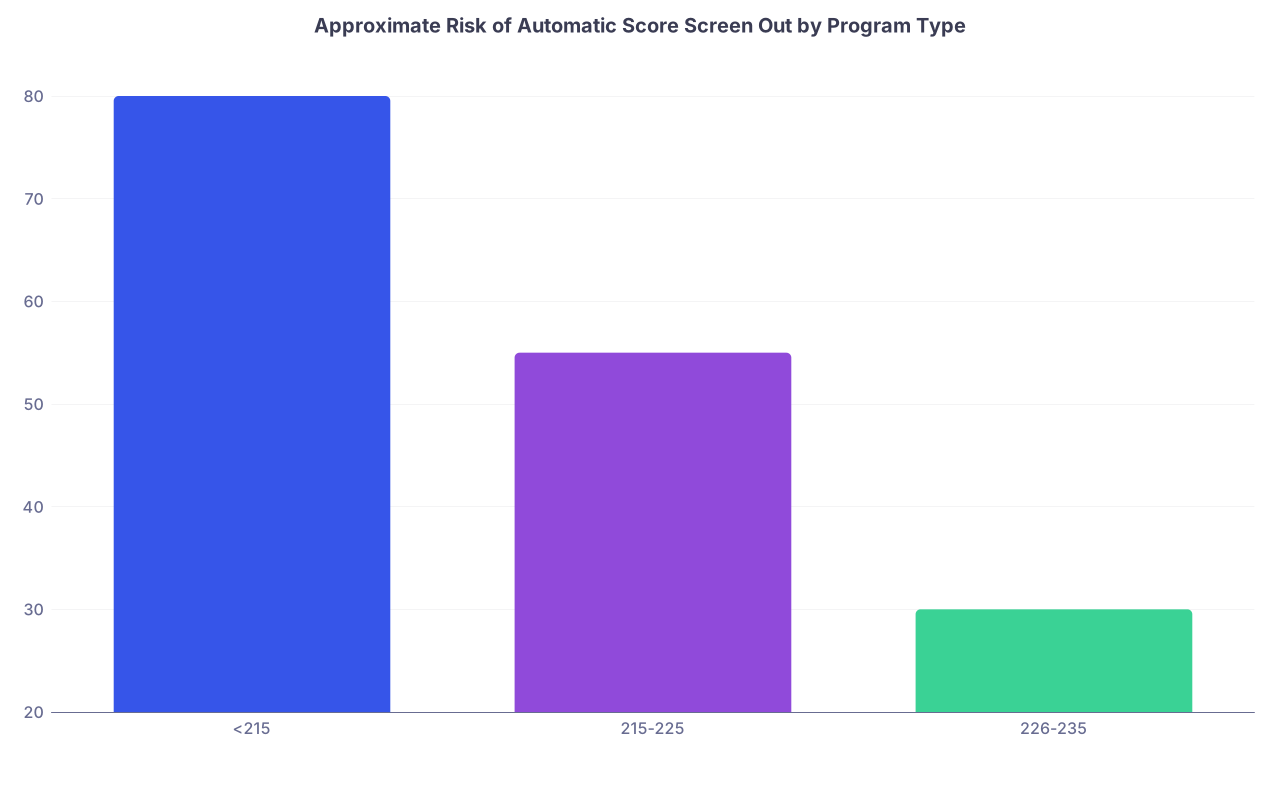
| Category | Value |
|---|---|
| <215 | 80 |
| 215-225 | 55 |
| 226-235 | 30 |
Interpretation for low scores:
- Below 215: assume ~70–80% of academic programs and maybe 50–60% of community programs will not see you.
- 215–225: the gap narrows; more community programs and some academic ones may still read the application.
- 226–235: auto-screen risk drops, particularly at community and mid-tier academic programs.
So the “program type breakdown” is less about philosophical attitude and more about how aggressively they filter at the front door.
6. Strategic application mix for low scores: what the numbers suggest
You want to convert low-score risk into match probability. That comes down to portfolio design: how you distribute applications across academic vs community, and within each group.
Broad template for core fields (IM, peds, FM, psych) if you have no massive red flags beyond a low Step 2:
If Step 2 CK < 215
Academic:
- Focus almost entirely on home program + any place where you have done a rotation and made an impression.
- Maybe 5–10 truly justifiable academic applications where you have strong ties or a clear narrative.
Community:
- 80–90% of your list.
- Prioritize:
- Programs historically accepting DOs/IMGs if that applies to you
- Less saturated geographic zones (Midwest, South, non-coastal)
- Hospitals with a track record of giving chances to applicants with imperfect metrics
If Step 2 CK 215–225
Academic:
- 20–40% of your list, but highly targeted:
- Home institution
- Programs where you rotated and have strong letters
- Academic centers with a reputation for strong clinical training but not insane research output
- 20–40% of your list, but highly targeted:
Community:
- 60–80% of your list. But not random.
- Look for:
- Resident cohorts with wide score distributions (visible via program social media or data if available)
- Programs that list “holistic review” and emphasize service, underserved care, or nontraditional paths
If Step 2 CK 226–235 (borderline)
The irony: at this range, the story becomes less about your Step score and more about the rest of your application.
Academic:
- 40–60% can be academic/university-affiliated if:
- You are realistic: not loading with top-10 IM or surgical subspecialties without compensating strengths
- You show alignment with their mission (e.g., primary care, underserved focus, community engagement)
- 40–60% can be academic/university-affiliated if:
Community:
- 40–60% community, again selected for:
- Fit with your future goals (hospitalist, fellowship, outpatient, etc.)
- Historical DO/IMG acceptance (if that matters)
- Geography where applicant volume is lower
- 40–60% community, again selected for:
7. Outcomes: where low-score applicants actually end up
Let us be blunt. For applicants with low Step 2 CK scores in core specialties:
- A substantial fraction match in community programs.
- A non-trivial minority match in academic programs, especially at home institutions or mid-tier schools.
- The ones who fail to match often made the same 3 mistakes:
- Overweighting prestige: Too many academic or “big name” community programs in popular cities.
- Ignoring signal strength: Applying to 80 programs where they are just a random low-score name with no ties.
- Not compensating: Weak letters, vague personal statement, no story of growth after the low score.
The angle I care about as a data analyst: marginal gain per application. Where does the next application meaningfully increase your odds of an interview?
For a 220-ish Step 2 CK applicant in internal medicine:
- The 51st academic application to some random East Coast university hospital rarely moves the needle.
- The 51st application to a solid but less glamorous community program in the Midwest or South often does.
You are not trying to maximize “number of academic logos on ERAS.” You are trying to maximize expected value: probability of match × program quality you are comfortable with.
8. Practical signals to decide if this academic or community program is viable for low scores
You do not have perfect data, but you have enough to make better decisions than most applicants who just rank by city and brand.
Look for these crude but surprisingly predictive signals:
Resident mix:
- Many DOs or IMGs in the current class → more likely to consider broader score ranges.
- All US MD, top schools → score threshold probably high.
Website/program materials:
- Heavy emphasis on NIH grants, research track, Physician-Scientist track → likely higher score expectations, especially for competitive fields.
- Emphasis on community service, underserved care, primary care → more room for low scores if your narrative fits.
Fellowship outcomes:
- For IM: if every graduate goes to cards/GI/onc at top centers, they probably select heavily on metrics.
- Mixed outcomes (hospitalist, primary care, some fellowships) → more variability, possibly more openness to lower scores.
Application volume and geography:
- Popular coastal cities and “brand name” places attract 3000+ applications for 10–15 IM spots. Filtering thresholds climb.
- Mid-size cities, less famous regions → fewer apps, more willingness to read a file with an outlier score.
Your ties:
- Any place where you did an audition rotation or have a strong letter writer advocating for you has a meaningfully higher probability of forgiving a low score, academic or community.
9. Tying it back to strategy: academic vs community with low scores
Let me distill the core point.
The “program type breakdown” for low scores is not:
- Low score → community only
- High score → academic only
The data and real outcomes say something closer to:
- Very low scores: community-heavy portfolio, plus targeted academic applications where you have leverage (home, rotations, advocates).
- Low/moderate scores: mixed portfolio; academic and community are both viable, but specific program characteristics matter more than the label.
- For any score: home academic programs frequently behave more forgivingly than random community programs with no prior relationship.
Your strategic levers:
- Use academic programs where relationships and narrative can override metrics.
- Use community programs as statistical workhorses in regions and environments where your score is not a glaring liability.
- Stop thinking “academic vs community” as a binary prestige choice; think in terms of match probability per application slot.
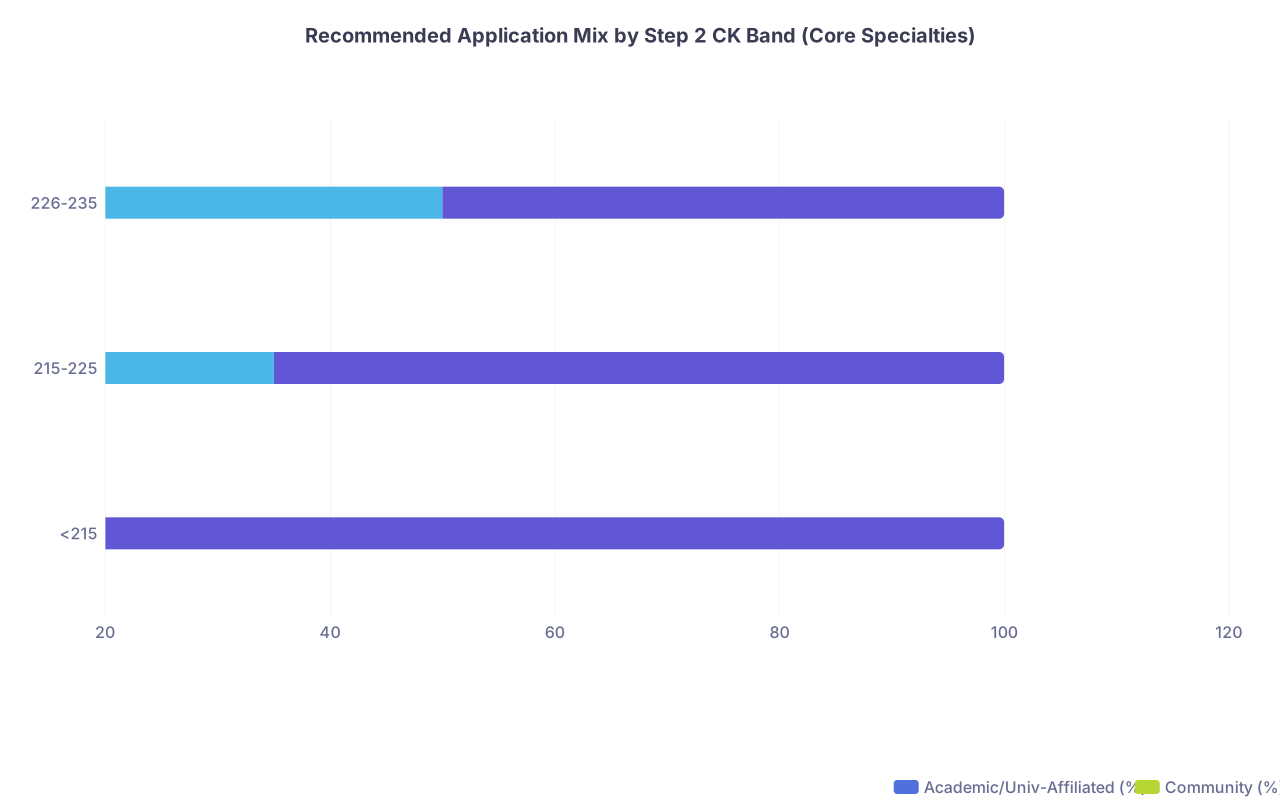
| Category | Academic/Univ-Affiliated (%) | Community (%) |
|---|---|---|
| <215 | 20 | 80 |
| 215-225 | 35 | 65 |
| 226-235 | 50 | 50 |

| Step | Description |
|---|---|
| Step 1 | Know Step 2 CK score |
| Step 2 | Prioritize community 80 to 90 percent |
| Step 3 | Academic 20 to 40 percent with strong ties |
| Step 4 | Balanced mix 40 to 60 percent academic |
| Step 5 | Use usual strategy by specialty |
| Step 6 | Target IMG DO friendly and underserved programs |
| Step 7 | Leverage home and rotation sites |
| Step 8 | Score below 215 |
| Step 9 | Score 215 to 225 |
| Step 10 | Score 226 to 235 |
FAQ (exactly 5 questions)
1. With a low Step 2 CK, should I completely avoid academic programs?
No. The data show that academic programs still match applicants with low scores, especially home students and those with strong clinical performance or meaningful ties. You should avoid random high-prestige academic programs with no connection, but targeted academics with real links can be better bets than unknown community sites.
2. Are community programs always more forgiving of low scores?
Not always. Many community programs quietly use hard cutoffs and are flooded with applications, particularly in desirable locations. Some mid-tier academic or university-affiliated programs in less popular regions are actually more flexible than “nice city” community hospitals.
3. How many academic vs community programs should I apply to with a 220 Step 2 CK in internal medicine?
A reasonable starting pattern is about 20–40 percent academic/university-affiliated and 60–80 percent community. Within the academic portion, heavily weight your home institution and places where you rotated or have strong letters. Within the community portion, focus on programs with historical DO/IMG presence or underserved missions.
4. Can strong research compensate for a low Step 2 score at academic programs?
For most core specialties, strong research helps but rarely erases a very low score. It is more likely to help when your score is slightly below average (say 230 vs a program mean of 240) than when it is severely low (e.g., <215). PDs still worry about board pass rates, especially for low bands.
5. If my Step 2 is much better than my Step 1, does that help at academic programs?
Yes. Many PDs specifically look for upward trends. A poor Step 1 (when it was scored) followed by a markedly better Step 2 suggests growth and better test preparation. At some academic programs, especially those concerned about board pass rates, an improved Step 2 can partially rehabilitate a weak earlier score and keep you in contention.