
Low Step scores do not automatically mean you will not match. That belief is lazy, data-illiterate, and flat-out wrong.
Does a low Step score make things harder? Yes. For some specialties, brutally so. But the “no chance” narrative you hear in group chats, Reddit threads, and from that one loud kid in your class is not backed by NRMP data.
Let’s walk through what the numbers actually say—and then I’ll show you what people who do match with lower scores tend to have in common.
Myth vs Reality: What NRMP Data Actually Shows
The NRMP isn’t subtle. They publish exactly what happens to applicants with a wide range of Step scores in their “Charting Outcomes in the Match” and Program Director Surveys.
If you never look at those and just repeat rumors, you get myths like:
- “Below 220 = no chance”
- “Below 230 you can’t do IM”
- “If you fail Step 1, you’re done”
- “PDs don’t even open your application under 240”
None of those statements are universally true. Some are pure fiction.
Here’s the core reality:
- Lower scores = lower match rate
- But not zero
- And specialty + application strategy changes the equation more than people think
To make this concrete, let’s look at Step 2 CK ranges and approximate match rates for US MD seniors in a few common specialties, pulled from patterns in recent NRMP reports (exact numbers shift year to year, but the trend is stable):
| Step 2 CK Range | Internal Med | Family Med | Psych | Gen Surg | Ortho |
|---|---|---|---|---|---|
| < 220 | Lower, but many still match | Many match | Some match | Very low | Nearly zero |
| 220–229 | Majority match | Majority | Majority | Moderate | Low |
| 230–239 | Strong | Strong | Strong | Better | Moderate |
| 240–249 | Very strong | Very strong | Very strong | Strong | Strong |
Is this perfect? No. Is it directionally right? Yes. The match probability is a gradient, not a cliff.
The other thing hiding in plain sight: even in the lowest score bins, people match. Every year. In multiple specialties.
The Step Score Trap: Why Your Brain Is Lying to You
I’ve watched this movie a hundred times:
- Student gets back Step 2 CK: 218
- Group chat goes silent for a second
- Then someone types: “Bro you have to do prelim”
- Panic Googling. Reddit doomscrolling.
- Suddenly they’re convinced they’re done.
The problem? They’ve made three bad assumptions.
They assume programs use fixed score cutoffs across the board.
Programs do use filters. But those cutoffs vary wildly—by specialty, by program type, by year, sometimes by the whim of a single PD. A 215 might be auto-screened out at a top-tier academic IM program and totally acceptable at a solid community program.They assume Step is the only serious filter.
NRMP Program Director Survey consistently shows this isn’t true. Step scores are important, but so are:- Failed attempts
- Class ranking
- Clerkship grades
- Letters from known faculty
- Whether you rotated there
- Fit for program type (academic vs community)
They ignore the numerator and denominator problem.
People love to say “Nobody matches ortho with <240.” That’s usually based on a tiny number—maybe 1 or 2 people in that bin even applied. If 1 of 3 matches, that’s 33%. The data matters, the sample size matters more.
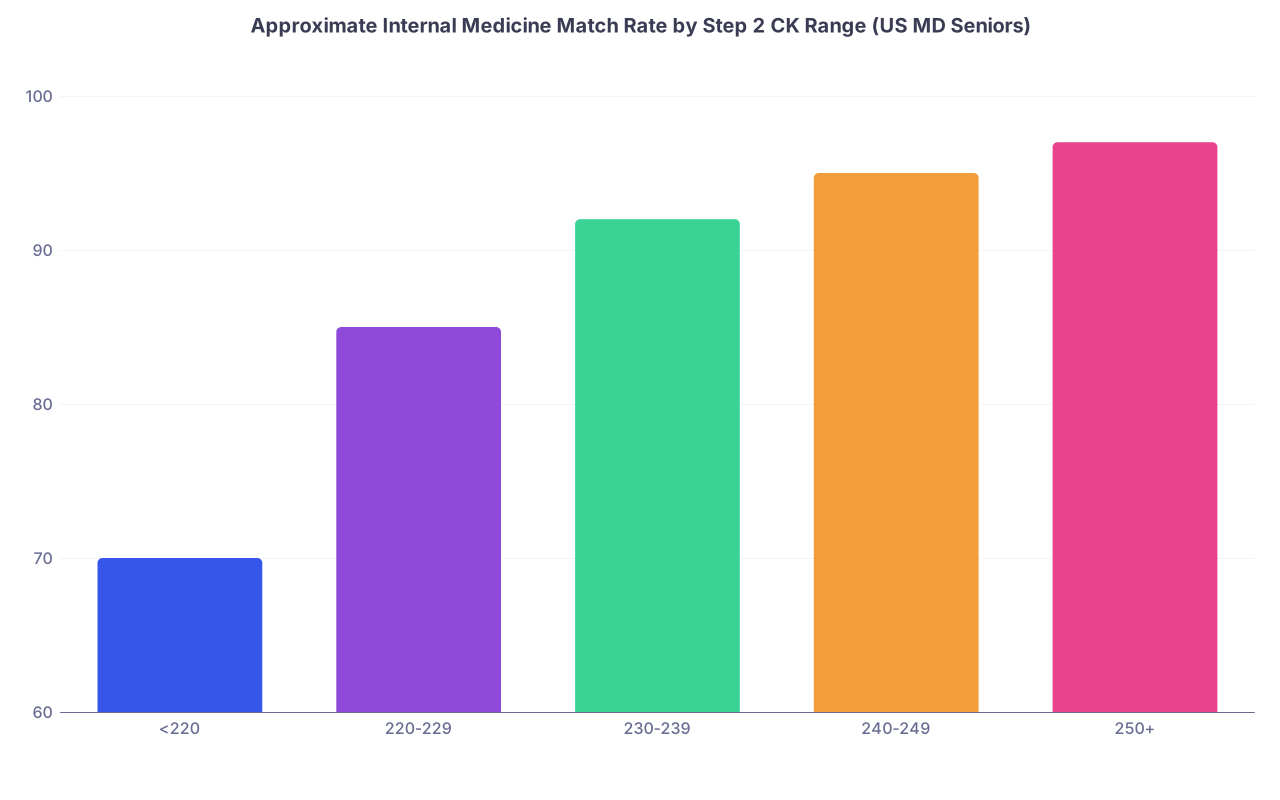
Here’s the general picture of how match rates change with Step 2 CK scores for categorical IM for US MD seniors (approximate, based on aggregated NRMP trends):
| Category | Value |
|---|---|
| <220 | 70 |
| 220-229 | 85 |
| 230-239 | 92 |
| 240-249 | 95 |
| 250+ | 97 |
A 70% match rate isn’t “you’re doomed.” It’s “you need to play this intelligently.”
Step 1 Pass/Fail: What Changed, What Did Not
The pass/fail shift for Step 1 gave people a false sense of safety—until they saw their Step 2 CK score and realized that’s now the main numeric gatekeeper.
Let me be blunt:
- Step 1 pass/fail did not remove standardized test pressure.
- It just moved almost all of it onto Step 2 CK.
- Programs are now even more likely to treat Step 2 as the primary screen.
But the same principle still applies: lower score = harder, not impossible.
If you have:
- Step 1: Pass
- Step 2 CK: 215–225
You’re not “unmatchable.” You’re in a group where:
- Competitive surgical subspecialties are basically off the table unless you have extraordinary circumstances (elite research, insane connections, strong home support).
- But primary care, psych, peds, IM, and many prelim programs are still absolutely possible—if you stop pretending you’re a 255 applicant and adjust.
Specialty Reality Check: Where Low Scores Hurt and Where They Hurt Less
Let’s crush a few broad myths and replace them with actual patterns.
1. Hyper-competitive surgical fields (ortho, derm, plastics, neurosurg)
Here the bad news is mostly real:
- Low Step 2 CK (<230) as a US MD senior? Match probability drops to “rounding error” territory unless you have a unicorn application (T20 school, high-impact research, insanely strong advocacy from big-name faculty).
- For DO and IMGs, the threshold for realistic competitiveness is usually even higher.
If you’re sitting on a 215 trying to “prove everyone wrong” by applying to derm at 20 programs, that’s not brave; it’s delusional. And expensive.
2. General surgery, EM, OB/GYN
These are middle ground:
- Lower Step 2 scores do hurt. Below ~220, match probability starts to fall off meaningfully.
- But people do match with lower scores every year, especially at community and newer programs, or by doing a prelim year and reapplying.
This is where strategy and program selection matter more than hero fantasies.
3. IM, FM, peds, psych, neurology, pathology
This is where the mythology is most wrong.
For these specialties (especially FM and psych), the NRMP data consistently shows:
- Match rates remain solid even as you go down into the lower score bins—especially for US MDs and many DOs.
- Program type changes. Maybe you’re not going to UCSF IM with a 214, but you can absolutely match into a solid community IM program if you apply broadly and are not a walking red flag.
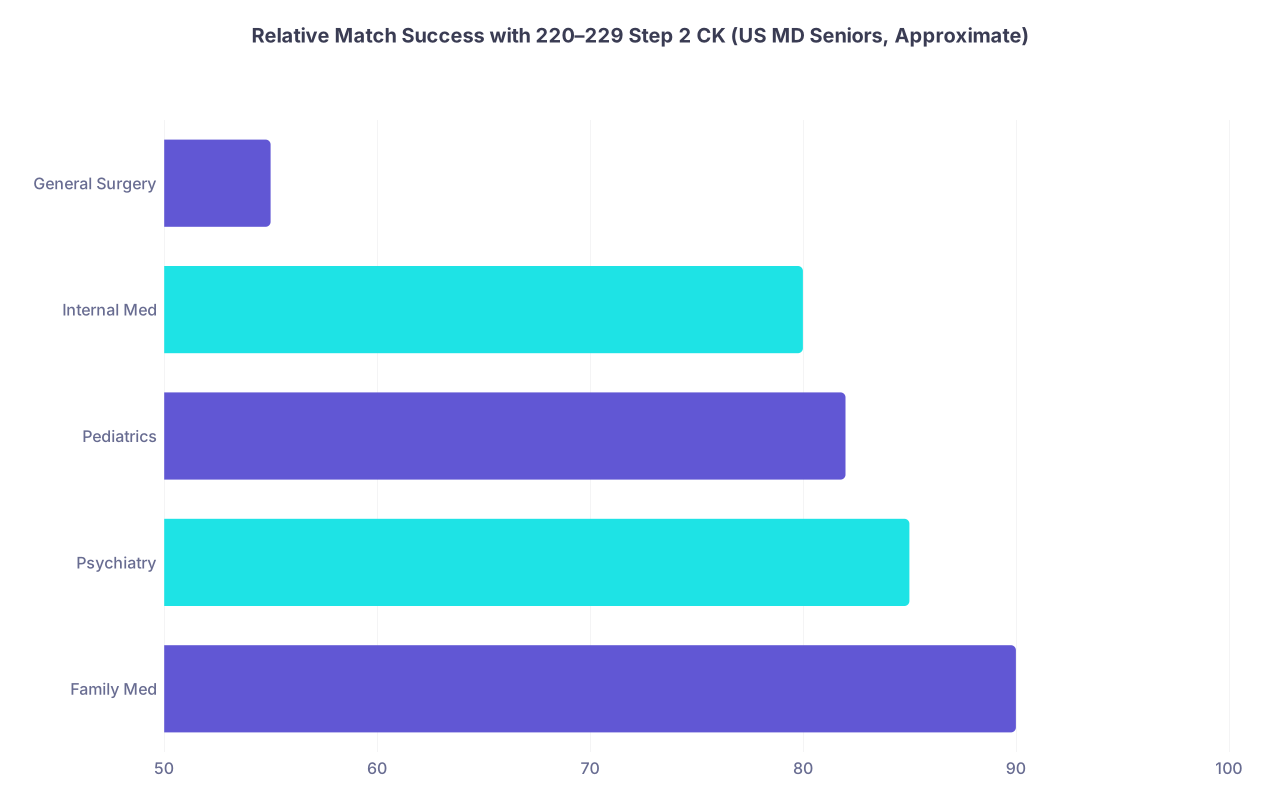
For context, here’s a rough illustration of match rates by specialty for applicants with a “modest” Step 2 CK (say 220–229), again for US MD seniors:
| Category | Value |
|---|---|
| Family Med | 90 |
| Psychiatry | 85 |
| Pediatrics | 82 |
| Internal Med | 80 |
| General Surgery | 55 |
Number not exact, trend very real.
What Actually Predicts Matching With a Low Step Score
You cannot change your Step score. You can absolutely change almost everything else.
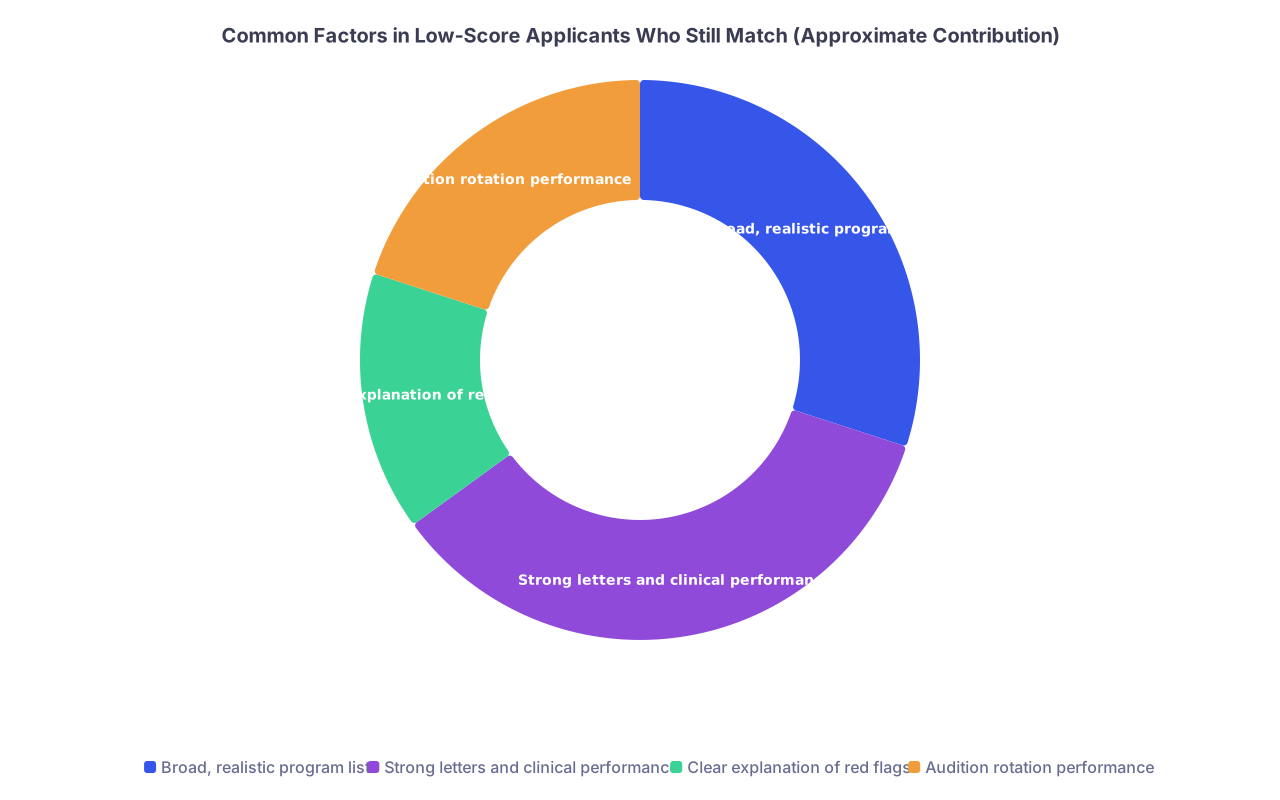
From PD survey data, plus watching real applicants, this is what separates “low score and matched” from “low score and unmatched.”
1. Applying like you know your situation
People who match with low scores:
- Apply broadly (60–100+ programs in some fields, especially if DO/IMG)
- Include a lot of community and mid-tier academic programs
- Target programs with a track record of taking lower scores and IMGs/DOs
- Don’t waste half their list on 250+ programs “just in case”
People who don’t match with low scores:
- Apply to 20–30 programs
- Heavy on prestige, light on realism
- Ignore advice from their dean’s office because “they don’t get it”
2. Owning the red flag—without writing a sob novel
If you’ve got:
- A Step failure
- A very low score
- A gap year for academic reasons
You don’t hide it. You explain it.
The people who recover from this tend to:
- Acknowledge it briefly in their personal statement or an addendum
- Take responsibility without melodrama
- Show concrete change: improved clerkship grades, solid Step 2 after a bad Step 1, better time management, remediation completed
The ones who get torpedoed?
- Ignore it completely and hope no one notices
- Or blame everyone except themselves (school, prometric, neighbors, “test anxiety” with no evidence of changed approach)
3. Making the rest of the app loud
If your score is quiet, the rest of your app has to be loud:
- Honors in core clerkships (especially in the specialty of interest)
- Strong letters from people who actually know you and are known to the specialty
- Evidence you work well with staff, patients, and teams—because low scores + “difficult to work with” is a hard no
This is not theoretical. I’ve seen:
- A 209 Step 2 DO → matched categorical IM at a good community program: had outstanding clinical comments, multiple honors, and two letters that basically said “we’d take this student if we could.”
- A 220 MD → unmatched psych: applied to 30 programs, mostly academic, no away rotations, generic letters, mediocre interview skills. They didn’t lose because of the number alone.
Concrete Strategy: How to Play a Low Step Hand
Let’s talk tactics. Because “stay positive” is useless.
Step 1: Get brutally honest specialty advice
You need one or two realists in your corner:
- A specialty advisor in your field of interest
- Or your dean’s office / academic advisor who has access to your school’s match data
Ask them direct questions:
- “With a Step 2 of 218, what realistic specialties and program types have taken people like me from our school?”
- “How many programs did they apply to? What else did they have going for them?”
If the answer is “nobody has matched derm from here with that score,” believe them. Pivot.
Step 2: Tailor your program list using data, not vibes
This is where most people cut corners. And then pay for it.
Use:
- Program websites (look at resident schools and whether they have DO/IMGs)
- FREIDA
- Your school’s internal match list
- Word-of-mouth from recent grads
Build a list that’s:
- Heavy on community / mid-tier academic programs
- Contains programs that have historically taken DOs/IMGs or lower-range scores
- Not overloaded with places that historically interview at 240+ averages

Step 3: Over-apply on purpose
If you’re in the low-score range, you’re not in the “40 applications is enough” club.
For US MDs with low scores in moderately competitive fields, I’ve seen successful matches with:
- IM / FM / peds: 60–100+ programs
- Psych / neuro: 60–80+
- General surgery / OB / EM (with lower scores): 80–120, plus realistic backup considerations
Yes, it’s expensive. Yes, the system is broken. But playing a broken system like it’s fair doesn’t make you noble; it just makes you unmatched.
Step 4: Fix everything that’s still fixable
You can’t change the number. You can still:
- Crush audition rotations: be present, early, reliable, and teachable
- Get at least 1–2 letters from people in your target specialty who will actually advocate for you
- Clean up your personal statement—no trauma dump, no score obsession, just a coherent story and evidence you understand the specialty

The Psychological Game: Not Letting a Number Own You
Let’s talk about the mental side for a second, because I’ve watched people sabotage themselves here more than anywhere.
Here’s what tends to happen when students internalize “low score = no match”:
- They interview poorly—apologetic, tentative, unsure
- They undersell their strengths because they’re fixated on their weakness
- Or they overcompensate with bravado that comes off as insecurity
The applicants who do not let this kill them mentally approach it differently:
- They treat the score like a data point, not a moral judgment
- They prep for interviews specifically around “Tell me about your Step score” with a calm, brief, accountable answer
- Then pivot fast to what they bring to a program: work ethic, team skills, clinical performance, alignment with program mission
I’ve literally heard PDs say:
“I care about the failed Step, but I care more how they talk about it. If they’re mature and reflective, I move on. If they’re defensive, I red flag it.”
| Category | Value |
|---|---|
| Broad, realistic program list | 30 |
| Strong letters and clinical performance | 35 |
| Clear explanation of red flags | 15 |
| Audition rotation performance | 20 |
When to Pivot, When to Push
Not everyone should “chase their dream specialty no matter what.” Sometimes the courageous move is to change direction.
Rough guide:
- If your dream specialty is hyper-competitive (ortho, derm, plastics, neurosurg) and your Step 2 is <230 with no insane compensating strengths: you probably need to pivot.
- If your target is gen surg, EM, OB with a low 220s score: you can try, but you need a robust backup plan. Prelim year + reapply is a real path, but not guaranteed.
- If your target is IM, FM, peds, psych, neuro, path, with Step 2 in the low 200s: you’re still very much in the game if you act like it.
And yes—sometimes the best decision is to choose a less competitive specialty where you can build a solid, satisfying career, rather than burning multiple cycles chasing something the data says is nearly impossible.
That’s not giving up. That’s playing the long game.