
What actually happens to your career if your Step score is 210 or you barely passed after a retake—are you basically locked out of competitive jobs forever?
Let me answer that directly: no, a low Step score is not a permanent ceiling. But it is a structural disadvantage in a system that overuses test scores as a lazy filter. You are not doomed. You are also not “fine” if you pretend the score doesn’t matter.
Time to separate myth from reality.
The Hard Truth: How Much Step Scores Actually Matter
People on forums talk like Step is destiny. Program directors sometimes talk like it too. Reality is more nuanced—and more annoying.
Here is what the actual data show from the NRMP Program Director Survey and match outcomes:
- Step scores are heavily used for screening into interviews, especially in competitive fields.
- Once you’re in the room, the score matters less than you think.
- Over time, your Step score becomes almost irrelevant compared with your residency performance.
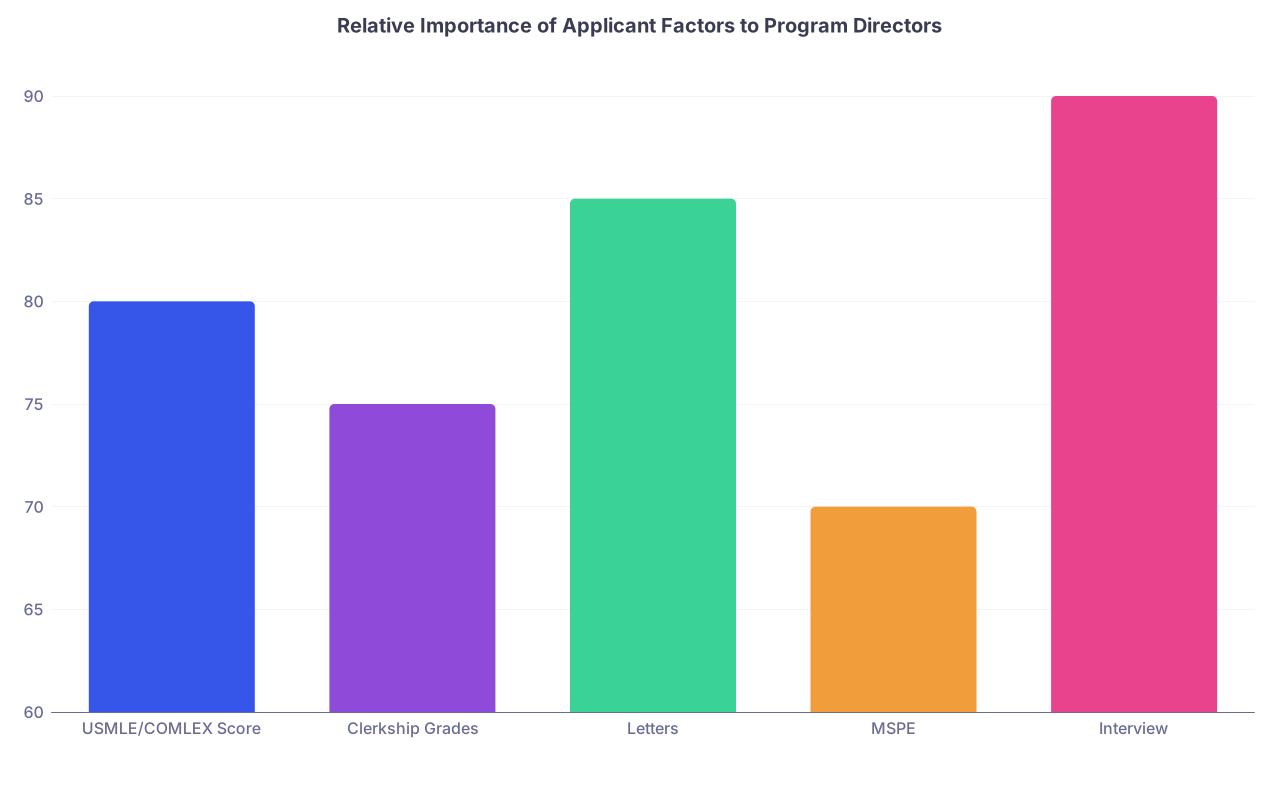
| Category | Value |
|---|---|
| USMLE/COMLEX Score | 80 |
| Clerkship Grades | 75 |
| Letters | 85 |
| MSPE | 70 |
| Interview | 90 |
That chart summarizes what PDs actually rank high when asked: interview performance, letters, and clinical performance are right up there with scores. Not Reddit myths. Data.
So what does a low Step score really do?
It doesn’t tattoo “mediocre physician” on your forehead.
It mostly does three things:
- Shrinks the pool of programs that will even read your file.
- Makes some specialties substantially harder to crack.
- Forces you to be more strategic and less naive than your classmates.
You’re not capped forever. But you are playing a different game now.
Myth: “A Low Step Score Means I’ll Never Match”
I’ve watched students with Step 1 in the 190s and Step 2 CK ~220 match into solid internal medicine and family medicine programs. I’ve also watched people with 250s go unmatched because they applied stupidly, or had garbage letters, or interviewed like a mannequin.
The match is brutal, but it’s not single-variable brutal.
Let’s be precise.
| Specialty Type | Impact of Low Step | Still Realistically Possible? |
|---|---|---|
| Ultra-competitive (Derm, Ortho, PRS, ENT, NeuroSurg) | Severe | Rare without exceptional compensators |
| Competitive (EM, Anesth, Rad, Road specialties) | Moderate–High | Possible with strong narrative & strategy |
| Core (IM, Peds, FM, Psych, Neuro, OB/GYN) | Moderate | Yes, with smart targeting |
| Safety (Transitional, prelim IM/GS) | Lower | Often used as backup route |
If your Step is low, where do most people actually land?
They match into:
- Community internal medicine
- Family medicine
- Pediatrics
- Psychiatry
- Transitional or prelim-then-categorical paths
Not as Plan F. Often as very solid careers with good lifestyles and real autonomy.
Key point: Low Step scores make it harder to match into specific specialties and specific programs, not to match at all—provided you adapt early and apply broadly and intelligently.
Myth: “Step Is a Permanent Ceiling on Fellowship and Future Jobs”
This one gets repeated constantly. “If you don’t crush Step, forget cards, GI, heme/onc.” Wrong. I’ve seen way too many counterexamples.
Let’s break the timeline.
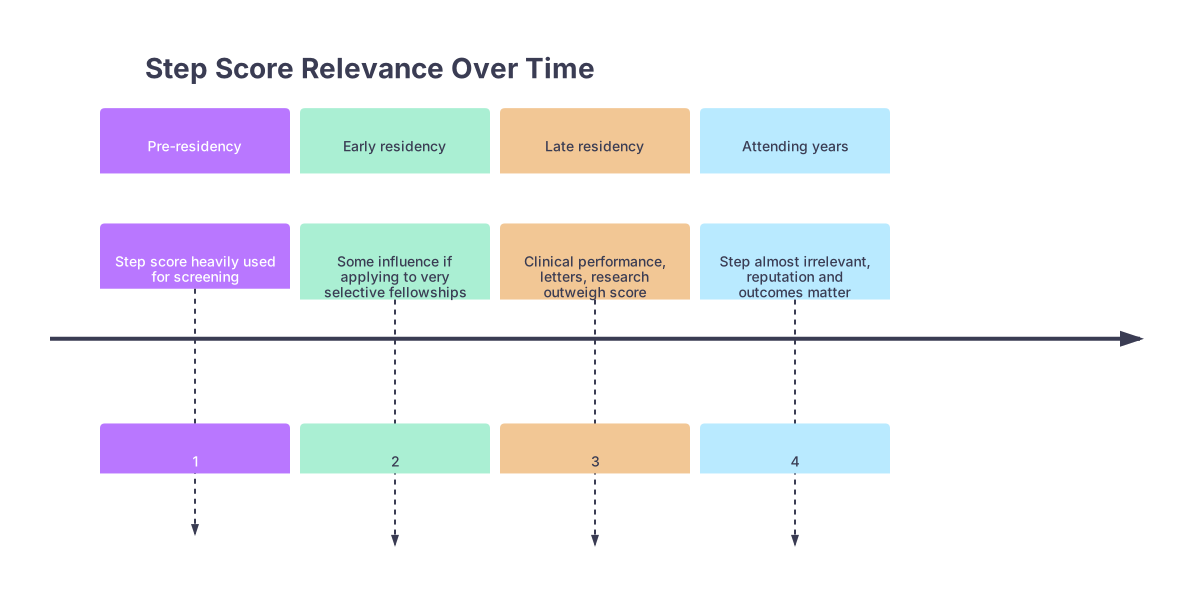
| Period | Event |
|---|---|
| Pre-residency - Step score heavily used for screening | 1 |
| Early residency - Some influence if applying to very selective fellowships | 2 |
| Late residency - Clinical performance, letters, research outweigh score | 3 |
| Attending years - Step almost irrelevant, reputation and outcomes matter | 4 |
Step scores matter most at one choke point: getting into residency. After that, the hierarchy shifts:
- For fellowship, top programs care more about your residency program’s reputation, your in-training exam performance, letters from known faculty, and your research in the field.
- For jobs, community groups and hospital systems care about: are you board-certified, are your references solid, are you a problem?
Do some hyper-elite fellowships glance at your Step history? Yes. Does a 215 bar you from cardiology forever? No. I’ve seen cardiology fellows with unimpressive Step scores who crushed their residency, did real research, and had heavy-hitting letter writers.
A bad Step score is a weak first move, not a checkmate.
Where Low Step Scores Hurt the Most (And Where They Don’t)
Let’s be unapologetically specific.
Low Step scores are most toxic when:
- You’re applying to ultra-competitive specialties directly from med school.
- You’re applying to university, research-heavy, brand-name programs.
- You’re an IMG without strong US clinical experience and letters.
But people neglect the flip side: there are entire segments of the system that are far less Step-obsessed than you think.
Community programs—especially in IM, FM, Peds, Psych—often:
- Care more about: visas, red flags, communication, genuine interest.
- Use Step cutoffs, but lower and more flexible ones.
- Are much more influenced by good letters, a strong personal statement, and your behavior on away rotations.
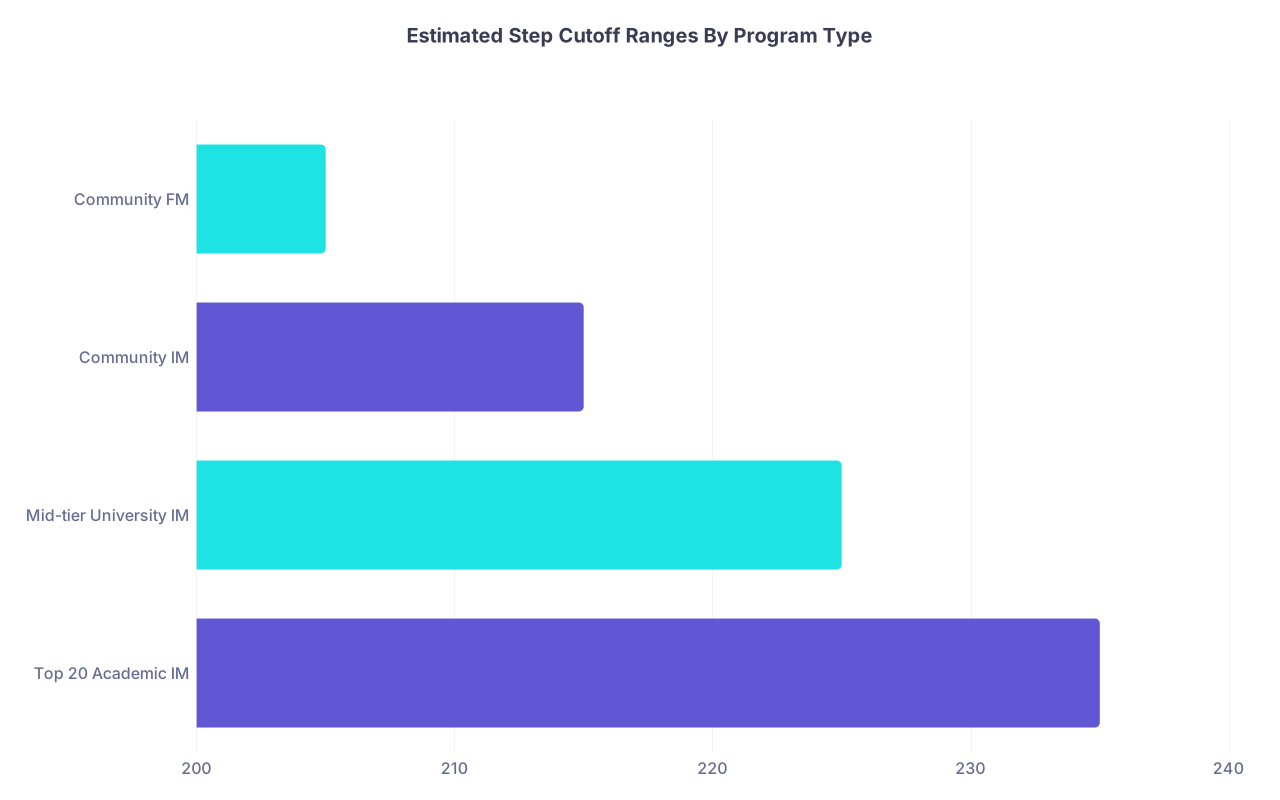
| Category | Value |
|---|---|
| Top 20 Academic IM | 235 |
| Mid-tier University IM | 225 |
| Community IM | 215 |
| Community FM | 205 |
Are those hard rules? No. But they reflect the pattern: the more “prestige,” the more Step fetish. Lower-tier programs care more about, “Will this person show up, do the work, and not implode?”
So if your score is low and your entire strategy is “aim only at massive-name programs in super competitive fields,” that’s not ambition. That’s delusion.
The Real Ceiling: Your Strategy, Not Your Score
Let me be blunt. For most low-score applicants, the biggest ceiling isn’t the three digits on the score report. It’s ego, denial, and terrible strategy.
The “I’ll just apply to 80 derm programs with my 220” brigade. The “I don’t want to do FM so I’d rather scramble into nothing” crowd. That’s how people end up unmatched—and then they blame the test.
If your score is low, here’s what reality-based strategy actually looks like:
Choose your target specialty with ruthless honesty.
Not: “What do I like on YouTube?”
Actual questions:- Can I see myself content in IM/FM/Psych/Peds if the competitive thing doesn’t materialize?
- Do I have something extra (serious research, connections, insane story) that truly offsets the score?
Use Step 2 CK as a correction, not a fantasy.
- If Step 1 was mediocre and Step 2 is a 20+ point jump, that does change the narrative.
- If both are low, then your narrative has to shift to: clinical strengths, work ethic, and fit, not “test scores are misleading.”
Apply broadly in a way that matches your real competitiveness.
Broad for you ≠ broad for your 260 friend.
Broad means: lots of community programs, geographic flexibility, and genuine backup plans (prelim IM, FM, Psych, etc.), not just wish-listing.Exploit the few things that actually move the needle despite low scores:
- Strong letters from people programs recognize.
- Away rotations / audition rotations, done well, where people remember your name.
- A coherent story that explains the score without sounding whiny or defensive.
You do this correctly, your “ceiling” moves.
What Actually Overcomes a Low Step Score?
Not vibes. Not saying “I’m more than a number” and then having nothing else to show for it.
Program directors are not monsters. They’re pattern-recognition machines under time pressure. If you want them to ignore a low score, you give them other patterns to latch onto.
I’ve seen low-score applicants get traction when they had:
- A very clear upward trajectory: bad Step 1, significantly stronger Step 2, strong in-service exams.
- Evidence they function really well in clinical environments: honors in core rotations, narrative comments that sound like, “We tried to recruit this student.”
- One or two letters where someone essentially says, “Ignore the test score, this person outperforms their metrics in real life.”
You know what I haven’t seen work? Hand-waving.
The PS paragraph that says, “My score does not define me” and then… moves on. No explanation, no ownership, no compelling story of change. Just vibes.
If you’re going to address the score, do it in a sentence or two, clearly and unemotionally:
- Owned: “I underperformed on Step 1 due to weak test-taking strategies and overreliance on passive review. I changed my approach for Step 2 CK with structured question-based learning and scored 18 points higher.”
- Not owned: “Due to circumstances beyond my control, my Step 1 does not reflect my true abilities.”
One makes PDs think, “Okay, they learned.”
The other makes them think, “Excuse factory.”
The Long Game: How Your Step Score Fades Into the Background
Let’s fast-forward.
You’ve matched. You’re a PGY-2. You’re in the work.
What matters now?
- Milestones and evaluations
- In‑training exam scores
- How attendings talk about you when you’re not in the room
- Whether nurses and staff actually like working with you
- Whether you can carry a service without drama

When faculty sit down to decide who they’d write a big-deal fellowship letter for, your old Step score is at best a side note. Your day-to-day performance is the main story.
Later, when you’re applying for a job in a community group or hospital system, they care about:
- Are you board-certified or board-eligible?
- Any professionalism or quality issues?
- How do your references describe you?
- Can you communicate like a normal human being?
I’ve never heard a community practice partner say, “We really liked her, but her Step 1 was a 210 so we passed.” What I have heard: “Great clinician, great with patients, no drama—we hired her instantly.”
Your Step score matters tremendously in a ~1-2 year window. Then it decays fast—if you keep stacking better data points on top of it.
When a Low Score Does Become a Ceiling
There is one scenario where your score can turn into a real, long-term ceiling: when you allow it to psychologically shrink your ambitions so much that you never test any doors at all.
The student who decides, “Well, my score is low, guess I’ll just stop trying for anything even slightly challenging.” So they:
- Don’t seek out mentors.
- Don’t ask to join research or QI projects.
- Don’t push for leadership roles or teaching.
- Don’t explore fellowships because “they’re probably too competitive.”
It becomes a self-fulfilling prophecy. Not because programs said no. Because they never got asked.
On the other side, I’ve seen residents with mediocre scores but relentless forward motion. They:
- Became the “go-to” person on their service.
- Showed up at conferences, asked questions, made themselves known.
- Knocked in-training exams out of the park.
- Asked faculty bluntly, “What would it actually take for me to get into cards/GI/etc. from here?”
Those people keep finding ceilings—and then finding cracks in those ceilings.
The Contrarian Bottom Line
Let me strip it down.
A low Step score:
- Is a real and measurable disadvantage for matching into certain specialties and top-tier programs.
- Is heavily overused as a lazy proxy for “good doctor potential.”
- Is not a lifelong tattoo on your career unless you let it become your entire story.
Your actual “ceiling” depends far more on how fast you stop catastrophizing, accept the data, and pivot to a strategy that fits your reality.
If you remember nothing else, remember these:
- Your Step score is most powerful as a gatekeeper into residency, not as a permanent label on your future as a physician.
- The ceiling most people hit isn’t created by their score; it’s created by denial, bad strategy, and fear of changing course.
- Long term, clinical performance, relationships, and reputation drown out a bad test score—if you consistently give people new evidence to believe in.
You are not just a number. But you also do not get to pretend the number doesn’t exist. Handle both truths at once, and that “ceiling” becomes a lot more breakable than anyone on Reddit wants you to believe.