
“If my Step score is low, I’ll just apply to community programs. They don’t care about scores… right?”
That line gets tossed around every year like gospel. Usually by someone with a 21x Step 2 score who’s been “advised” by three upperclassmen and one very optimistic dean.
Let me be blunt: community programs care about scores. University programs care about scores. Rural programs, suburban programs, prestige-brand-name programs. They all care.
What changes isn’t whether they care. It’s how they use scores, how rigid their cutoffs are, and what they’re willing to overlook if the rest of your file is strong.
You’re in the “Strategies for Low Step Scores” bucket. So you do not have room for magical thinking or lazy myths. You need accuracy, not comfort.
Let’s dissect the big lies you’ve probably heard—and then I’ll tell you what actually works if your score is below where you wanted.
Myth #1: “Community programs don’t care about scores”
Here’s what actually happens behind the curtain.
Most community program PDs and coordinators do not have time to “holistically” read 2,000 applications line by line. So they use filters. Often very crude ones.
I’ve sat in rooms where someone literally said: “Alright, filter at 220 for interview offers and see how many that gives us.” That was a community internal medicine program. Not MGH. Not Hopkins. A solid, mid-tier community IM program with zero NIH money.
Do community programs sometimes have lower filters than big-name academic places? Yes. But “lower” is not the same as “none.”
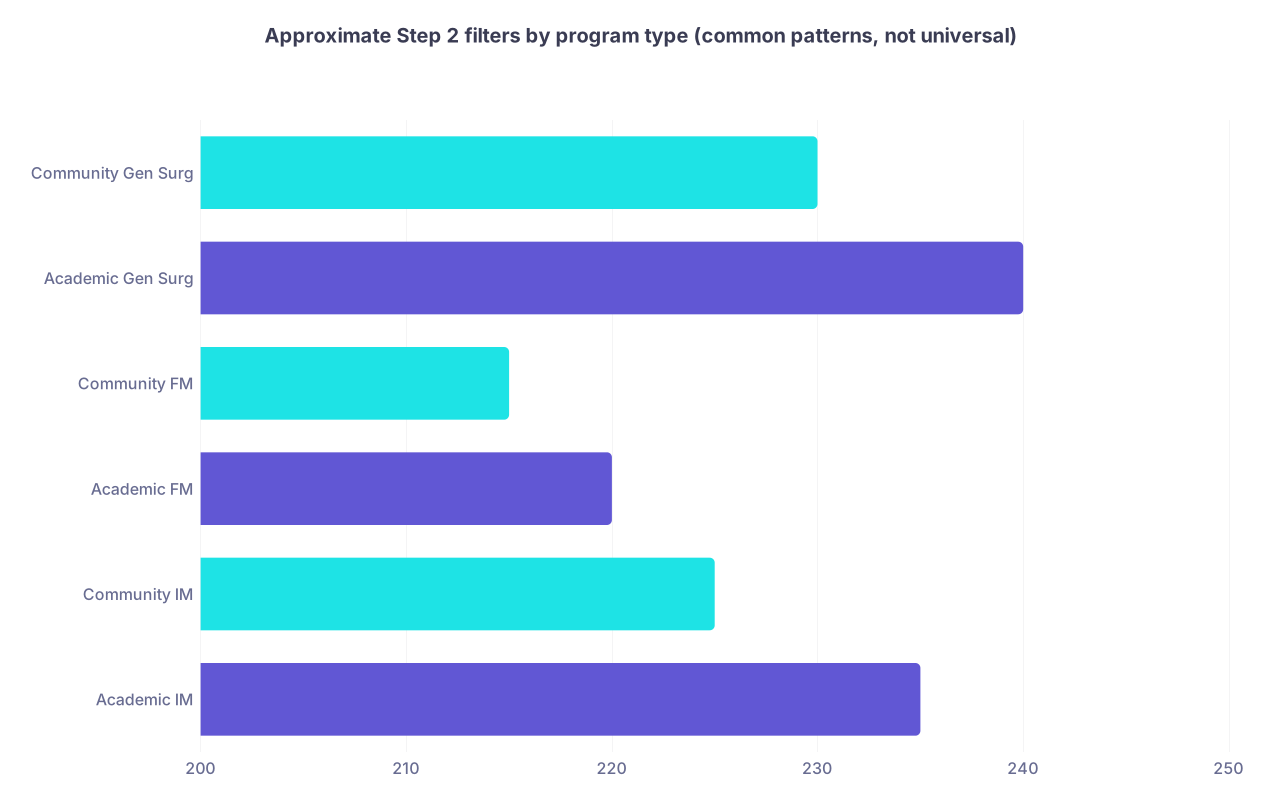
For many non-ultra-competitive specialties, here’s the kind of pattern you’ll see:
| Category | Value |
|---|---|
| Academic IM | 235 |
| Community IM | 225 |
| Academic FM | 220 |
| Community FM | 215 |
| Academic Gen Surg | 240 |
| Community Gen Surg | 230 |
These are rough, but they match what I’ve heard repeatedly from PDs and residents across the US over the last several cycles.
The myth exists because relative to academic programs, community programs look flexible. But if you’ve got a 205 Step 2 and you think every community IM program will “understand” because “they care more about work ethic,” you are setting yourself up to be filtered into oblivion.
So the correction is this: community programs often care slightly less rigidly, but they absolutely still use scores to thin the herd.
If your strategy for a low score is just “more community programs,” you don’t have a strategy. You have a wish.
Myth #2: “If Step 1 is pass/fail, my low Step 2 doesn’t matter as much”
Step 1 going pass/fail removed one screening knob. So what did programs do?
They cranked the other knob: Step 2.
For many PDs, Step 2 has quietly become the primary standardized metric. Not because they think it’s fair. Because it’s fast.
I’ve heard the same sequence over and over in PD panels:
“Since Step 1 is pass/fail, we rely more on Step 2 and clerkship performance now.”
Translation: “We use Step 2 to screen and clerkships to justify our decisions after the filter.”
For low scorers, Step 1 P/F did not save you. It concentrated risk on a single test instead of two.
And there’s an ugly part nobody wants to say out loud. When Step 1 was numeric, if you bombed Step 1, you still had Step 2 as a “redemption arc.” Now, if Step 2 is your first real numeric data point and it’s bad, there’s nothing to offset it statistically. You have to offset it narratively and clinically.
So no, Step 1 going P/F did not make low Step 2 scores less important. It made them more central.
Myth #3: “Low score? Just apply to less competitive specialties and you’ll be fine”
This is one of the more dangerous half-truths.
Yes, specialty competitiveness matters. But people chronically misunderstand what that means.
They think: “Derm is competitive, FM is not. Therefore any score will work for FM.” That’s wrong.
Specialties have different applicant pools. A 220 in dermatology is dead-on-arrival. A 220 in internal medicine might be perfectly serviceable. But there’s a floor even in “non-competitive” fields.
You can’t simply run away from competitiveness. Some specialties that look “easy” are deceptively tough for low scorers because:
- They get flooded by IMGs with very high scores.
- There are fewer positions overall (e.g., some smaller surgical fields).
- Many programs are small and risk-averse; they don’t want a remediation headache.
Here’s the other trap: the “dumping ground” specialties where people with low scores all flock—neurology (in some regions), psychiatry, pathology a few years ago, prelim medicine or surgery—to “just get in somewhere.” When everyone with issues runs to the same fields, they stop being soft landings.
You still need to respect rough score realities. Something like:
| Specialty Type | More Comfortable Zone | Red Flag Zone (needs strong story) |
|---|---|---|
| Highly competitive (Derm, Ortho, Plastics, ENT) | 250+ | < 240 |
| Mid-high (Radiology, Anes, EM, Gas, GI-track) | 240+ | < 230 |
| Mid (IM, Gen Surg, Neuro, OB/Gyn) | 230+ | < 220 |
| Relatively less competitive (FM, Psych, Peds) | 220+ | < 210 |
These are not hard cutoffs. I’ve seen people with 208 match psych and people with 218 match IM at decent places. But below those “red flag” zones, you’re in explanation territory. You can still match. You just do not get to be generic.
Myth #4: “If I crush everything else, my low score won’t matter”
This is the comforting version of “holistic review.”
Here’s the real version: holistic review starts after filters. If your score never clears the first screen, nobody will ever see how charming, hardworking, or research-heavy you are.
The game isn’t: “Score does not matter if I have great X, Y, Z.” The game is: “Can I convince enough programs to manually override their usual reaction to my score?”
To do that, you need tangible, not vague, strengths:
- Truly outstanding clinical performance with clear language in MSPE and letters like “top 5% of students I’ve worked with in 20 years.”
- Concrete trust signals: sub-I at their institution where you were clearly excellent, or at similar places.
- A pattern of reliability: no repeated failures, no professionalism incidents, strong narrative about growth.
What doesn’t cancel a low score:
- Generic “hard worker” comments in letters.
- One research poster.
- A personal statement that just says you “learned resilience.”
I’ve watched files that looked like this: Step 2 214, one failed shelf early M3, then high honors on later rotations with a rock-solid sub-I letter. That person matched internal medicine at a community program with ICU exposure and reasonably strong fellowship placements. Not glamorous, but solid. Because their file told a coherent story: rough start, clear upward trend, now performing safely above concern-level.
If your file says: 219 Step 2, middling clerkships, lukewarm letters, vague PS? Programs read “risk with no upside.”
You cannot erase a low score. You can drown it in enough concrete evidence that you’re safe and improving.
Myth #5: “If my score is low, I just need to apply to 100+ programs and I’ll be safe”
This is how people burn $3,000 and still do not match.
More is not automatically better. More random is usually worse.
Program directors can see nonsense, scattershot applications. When your profile screams “should really be applying FM or IM” but you send 50 applications to general surgery and 30 to EM, they know exactly what’s happening. You look desperate and poorly advised.
You’re much better off doing a targeted, data-informed spread.
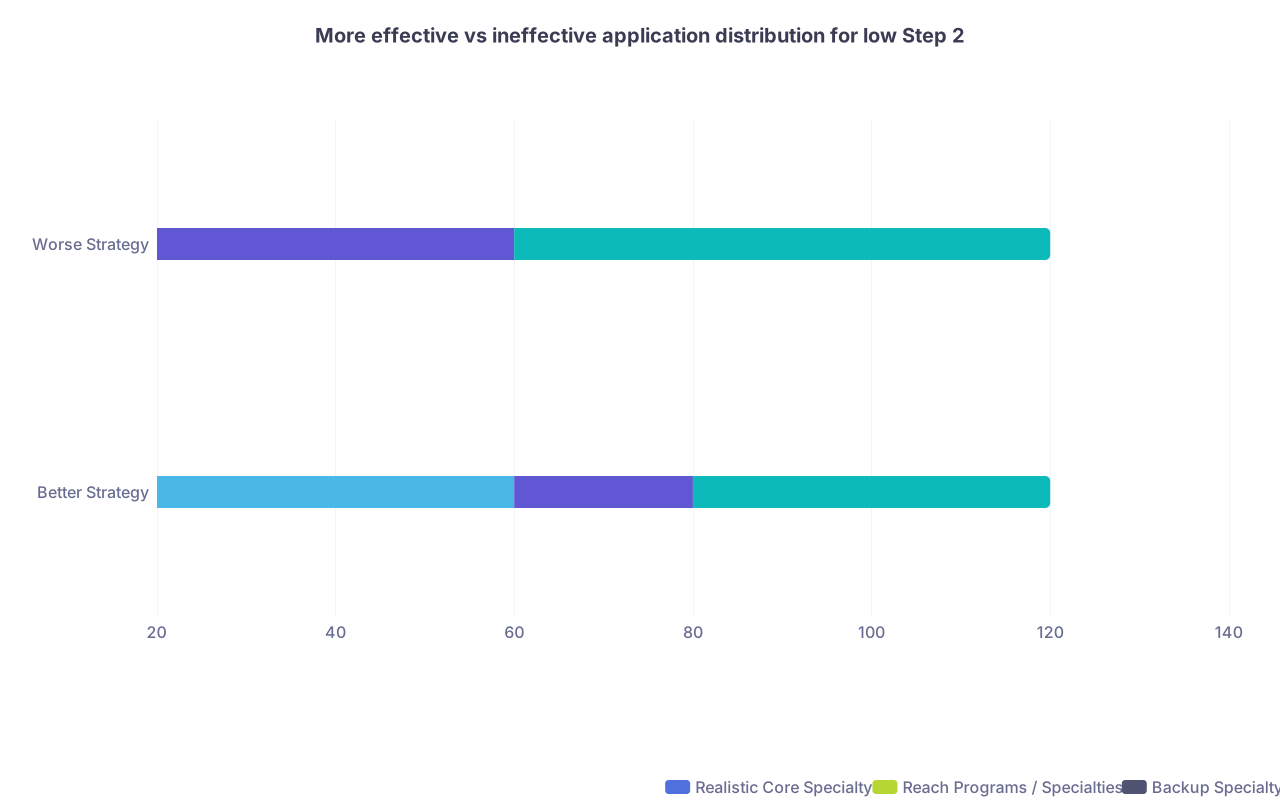
Something like:
| Category | Realistic Core Specialty | Reach Programs / Specialties | Backup Specialty |
|---|---|---|---|
| Better Strategy | 60 | 20 | 40 |
| Worse Strategy | 20 | 40 | 60 |
The “better” version for a 214/215 Step 2 US grad might be:
- 50–70 applications in a realistically reachable core specialty (e.g., FM, IM in less competitive regions).
- 20ish in reach-but-still-plausible programs within that field (usually geography sacrifices here).
- 30–40 in a backup specialty you’ve actually prepared for with at least one rotation and a coherent story.
What doesn’t work is spraying prestige programs, “cool” cities, and aspirational specialties because you’re clinging to a fantasy narrative.
You’re not trying to impress anyone with where you apply. You are trying to avoid SOAP.
Myth #6: “Letters and personal statements don’t really matter—scores rule everything”
For high scorers, sometimes this is almost true. If you’re at 260+, programs will forgive boring essays and generic letters.
For low scorers, this is absolutely false.
Once you’ve cleared whatever score filter a program is using, your letters and narrative become the mechanism to change how they perceive that score.
There’s a big difference between:
“John is a solid student. He showed up on time, was pleasant to work with, and cared about patients.”
and
“I have worked with hundreds of students. John is in the top 10% for clinical judgment and work ethic. If I had a position at our program, I would rank him highly without hesitation, despite his test performance not fully reflecting his abilities.”
One is filler. The other is an explicit override.
Same with your personal statement. If your Step 2 is 207 and you pretend it doesn’t exist, programs will write the story for you: poor test taker, maybe disengaged, maybe overwhelmed, who knows.
You don’t have to overshare trauma or beg for sympathy. But you do need to frame your score in the context of growth, not helplessness. One focused paragraph like:
“My Step 2 score is not where I wanted it to be. It reflects a period where I under-estimated the exam while juggling [brief, specific context], and I learned the hard way that effort without structure isn’t enough. Since then, I’ve approached every clinical rotation with the discipline I lacked then, which is why my performance on [sub-I, later shelves, etc.] shows a much more accurate picture of me now.”
That’s a controlled admission with a pivot to evidence.
If your letters and narrative don’t actively work to reframe the score, you’re leaving the biggest available lever untouched.
So what does work if your Step score is low?
Let me rewrite the fantasy and give you the actual playbook.
You’re not going to “trick” programs into forgetting your score. You’re going to persuade enough of them that:
- You are unlikely to fail their in-training exams or boards.
- You are safe, hardworking, and low-drama on the wards.
- You understand your weaknesses and have built habits to compensate.
That means:
Being brutally realistic about specialty choice. If your dream was ortho with a 210 Step 2, you can keep dreaming. But you also need a parallel reality plan in something like FM, IM, or PM&R with real prep, not last-minute panic.
Doubling down on away rotations and sub-Is where you can be seen and trusted as a person, not a number. Programs are far more willing to flex for “the MS4 we loved for 4 weeks” than for “some anonymous ERAS file”.
Using geography to your advantage. The coasts are brutal. If you’re serious about matching with a low score, you look at the Midwest, South, Rust Belt, community-heavy areas. This isn’t exile. It’s your launchpad.
Getting at least one letter that explicitly vouches for you despite the score. You want language that says: “Yes, we see the number, and we still trust this person.”
Writing a personal statement that acknowledges reality without wallowing in it, and that clearly explains why you’re not a walking risk for board failure.
And then—yes—applying broadly. But broadly within a rational, data-aware plan, not flailing.
One last myth: “A low score means my career is over”
No. It means your options narrow and your margin for error shrinks. That’s different.
I’ve watched low scorers become outstanding community attendings, fellowship-trained subspecialists, EM physicians at busy trauma centers, academic hospitalists who teach residents. The common theme wasn’t magical luck. It was realism early, humility, and disciplined execution.
You don’t control the number that already exists. You control how honestly you face it and how strategically you respond.

| Step | Description |
|---|---|
| Step 1 | Low Step 2 score |
| Step 2 | Identify realistic specialties |
| Step 3 | Apply with caution and strong narrative |
| Step 4 | Do rotations in realistic field |
| Step 5 | Secure strong override letters |
| Step 6 | Target community and mid-tier programs |
| Step 7 | Apply broadly with backup |
| Step 8 | Below common filter for dream specialty? |
Key points
- Community programs absolutely care about scores; they just tend to have slightly lower filters, not no filters.
- With a low score, you don’t get to be vague or generic. You need a coherent story, override letters, and a realistic specialty and geography plan.
- You’re not trying to erase the number—you’re trying to convince enough programs that, despite it, you’re a safe, hardworking resident they won’t regret taking.