
Last September, I watched a program director in internal medicine push a file to the center of the conference table and say, “I don’t care that his Step 1 was trash. Did you read the rotation eval?”
Everyone around the table nodded. That student, with a Step 1 in the low 210s and a shaky Step 2, ended up ranked in our top 10. Why? Because of one month. One rotation. At our place.
Let me walk you through how that actually works behind the scenes—and how a single away or home rotation can completely re-write the story your Step score is telling about you.
The Ugly Truth About How Committees Actually Use Step Scores
You already know Step scores matter. What you probably do not know is how fast committees move past them if something stronger hits the table.
Most residency selection meetings go something like this:
Folder or ERAS screen comes up.
Someone reads: “Step 1 pass, Step 2 CK 222.”
There’s a brief pause. You can feel the room calibrate: borderline, maybe below our usual range.
Then one of three things happens:
- There’s nothing else exciting → you’re dead in 5–10 seconds. Move on.
- There’s something mildly positive (research, decent letters) → maybe middle of the rank list.
- There’s a glowing rotation evaluation or letter from someone we know and trust → the entire tone of the room flips.
Programs pretend they follow objective cutoffs and holistic review. In reality, Step scores are screening tools and tie-breakers. Once you make it into the serious consideration pile, your Step becomes background noise unless it’s massively high or catastrophically low.
A brilliant rotation, especially at the program you’re applying to, does two things that Step scores can’t:
- It puts your performance in their context, with their patients, under their faculty.
- It gives the committee permission to say: “The score is the outlier. The rotation is the truth.”
That’s the lever you’re trying to pull.
Why One Rotation Can Outweigh a Bad Step: The Political Reality
Let me tell you what really happens in those ranking meetings.
Every program has a few “anchor voters” in the room: the PD, maybe the APD, and 1–3 faculty whose opinions everyone defers to. If one of those people says, “I’d be happy if this person matched here,” you’re not just in the game—you’re dangerous to everyone above you.
How does someone with a low Step score get that kind of backing? Not with a personal statement. Almost never with research. It’s usually one of three things:
- They rotated with us and crushed it.
- They rotated with our close colleague at another site who calls or writes a powerful letter.
- Our residents are loudly advocating for them because they saw them in action.
The rotation is the easiest and most controllable of these three.
During your rotation, the faculty you work with are subconsciously answering one question:
“Would I want this person as my resident at 2 a.m. when everything is falling apart?”
Step scores don’t answer that. A month on their service does.
The Exact Mechanism: How a Rotation Becomes More Powerful Than Your Score
Let’s unpack the pipeline from “solid rotation” to “ranked high despite low Step.”
You see the pattern. The test score is one line on the screen. The rotation, if you do it correctly, becomes:
- A formal evaluation in their system
- An in-person impression they still remember months later
- A letter that sounds different from the generic praise they see all day
- A topic of conversation in the workroom that reaches the PD before your file is even reviewed
By the time your application hits the committee, you’re not just “Applicant #237 with Step 220.” You’re “That student from September on wards who stayed late, helped with discharges, and did that killer presentation on DKA.”
That familiarity is nuclear-level radiation for a weak Step score. It decays its significance very quickly.
What Committees Actually Say When a Rotation Overrides a Score
Here are real phrases I’ve heard in rank meetings:
- “Yeah, the Step’s low, but I worked with her. She’s excellent.”
- “The letter from Dr. K is one of the strongest this year. I’d take that over a 240 any day.”
- “If we’re talking about who I want here at 3 a.m., it’s this guy, not the 260 who never looked up from his iPad.”
- “This Step score doesn’t match his performance on our service. I trust the rotation more.”
Notice the logic: the rotation is treated as direct observation, the test as noisy data.
So for borderline scores, the conversation stops being “Is this score acceptable?” and becomes “Do we trust this rotation enough to ignore the score?” If the answer is yes, your Step effectively disappears from the discussion.
Choosing the Right Rotation: Not All Months Are Equal
Here’s where most students screw this up. They think any away rotation will do.
No. Some rotations barely move the needle. Others can bulldoze a 25-point Step deficit.
If you’re trying to override a low Step score, you need:
The right specialty at the right program.
Rotating in heme/onc at a place when you’re applying for internal medicine there? Helpful, but weaker than doing straight wards.
Rotating at a random community site when you want a university position? Less compelling than being seen at the exact program.Rotations with decision-makers, not just nice people.
The attending who “loves teaching” but barely shows up to rank meetings is not your best ally.
You want PDs, APDs, firm leaders, clerkship directors, or high-volume letter writers known to the program.Rotations where your work is visible, not hidden.
ICU with heavy nursing-driven care where students barely write notes? Harder to shine.
A busy ward month with scut, admits, and discharges? That’s where your reputation is built.
Here’s a rough hierarchy of how powerful certain rotations are for overriding a low score.
| Rotation Type | Impact on Low Step Override |
|---|---|
| Core specialty rotation at target PD | Extremely High |
| Away rotation at top-choice program | Very High |
| Subspecialty at same institution | Moderate |
| Rotation with known letter-writer | High |
| Random outside elective with strangers | Low |
If your Step is weak and you’re not setting up at least one month in the exact program (or its tight affiliate) where you want to match, you’re voluntarily fighting with one hand tied behind your back.
How to Perform on That Rotation So People Forget Your Score
Here’s the twist: you don’t need to be a genius. You don’t need to know every obscure fact. Committees are not looking for brilliance. They’re looking for reliability.
Let me translate how attendings think when they write evaluations.
They don’t write: “Student scored 222, therefore B+.”
They write: “Student I could trust versus student I could not trust.”
What actually moves the needle:
Consistency over flash.
Showing up early daily and following through on promised tasks is ranked higher than one dazzling teaching session. Faculty will forgive medical knowledge gaps. They do not forgive unreliability.Owning your patients.
When an intern or resident says, “I didn’t have to chase them for labs/notes/follow-up,” that carries more weight than your Step score ever did.Protecting the team’s time.
Students who see what needs to be done and quietly do it—call the family, print the discharge instructions, update the med list—get championed in the back room.Being teachable, not performative.
Overconfident students with high scores get torched in discussion.
Curious students who say “I don’t know, but I’ll look it up and get back to you” get praised.Delivering one or two standout moments.
A clean, well-structured presentation.
A well-researched, 5-minute talk.
Catching one key detail that changes management.
Those become stories faculty retell at rank time.
You’re not trying to be perfect. You’re trying to generate memorable, positive anecdotes people will bring up months later in a committee meeting.
The Letter That Erases the Score
A single line in a strong letter can cancel out your Step score in the minds of the right people.
I’ve seen letters like this:
“Although his Step scores are not reflective of our usual applicants, I can say unequivocally that he was one of the top 5 students I have worked with in the last 10 years.”
Or:
“If we’re basing decisions on day-to-day clinical performance, work ethic, and maturity, I would rank her above many residents in our current PGY-2 class.”
When a PD or senior faculty writes something that blunt, the room listens. That’s someone putting their reputation on the line for you.
The secret you’re not told: PDs trust other PDs and well-known attendings more than they trust Step. If your low score looks like the outlier and the letter looks like the truth, the letter wins.

Your job on that rotation is to give the letter writer real material. Not “hardworking and pleasant.” Everyone says that. You want them to point to specific behaviors: managing a difficult family conversation, stepping up during a code, organizing the team’s morning pre-rounds.
Specificity is what makes the letter believable enough to override your score.
Timing: When That Rotation Helps You the Most
A common mistake: doing the key rotation too late.
If your target program builds their rank list based heavily on people they know, you want that rotation:
- Before or during early interview season, so you’re fresh in their mind when they send invites
- Early enough that the letter can be uploaded and visible to other programs too
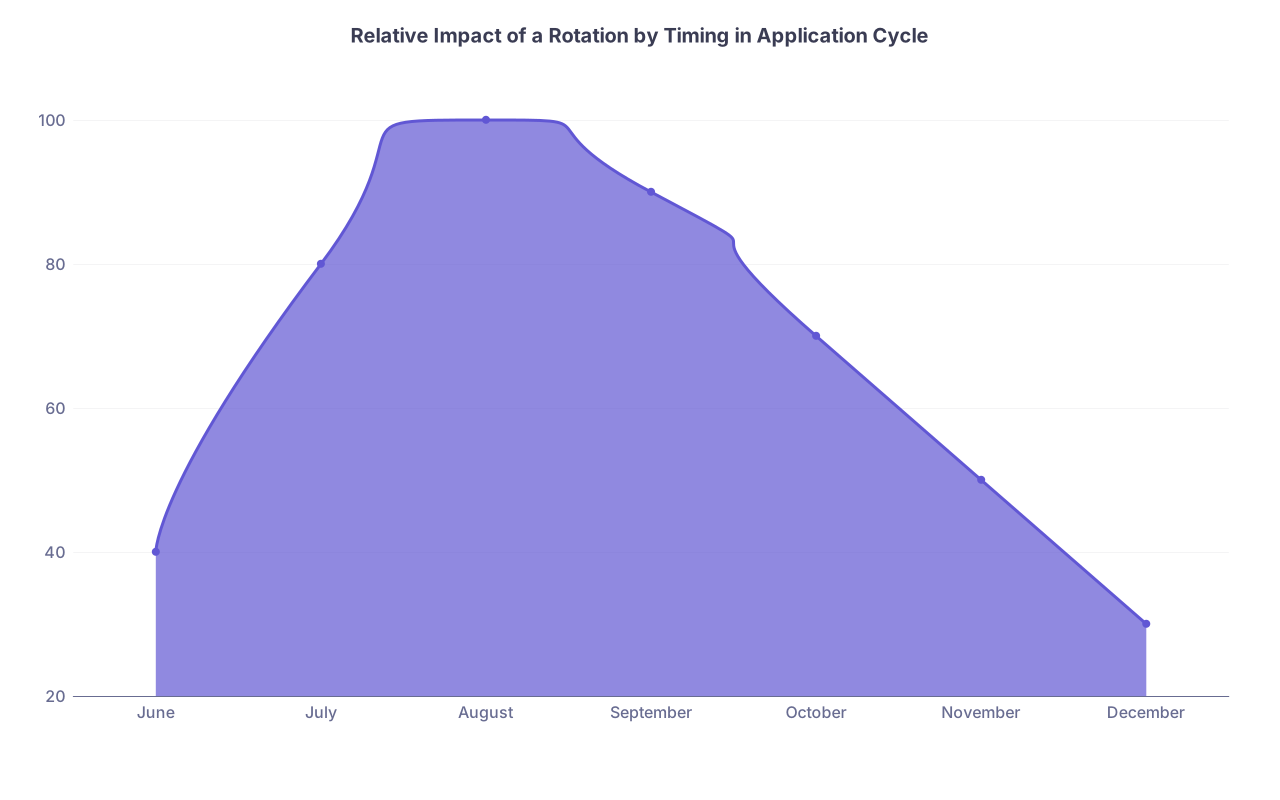
Here’s roughly how the timing pressure looks during application season.
| Category | Value |
|---|---|
| June | 40 |
| July | 80 |
| August | 100 |
| September | 90 |
| October | 70 |
| November | 50 |
| December | 30 |
August and September rotations are gold. By November and December, some programs already have a good sense of who’s at the top of their list.
If you’re using a rotation to rehabilitate a low Step score, you want that narrative correction happening before your name gets filtered out or mentally placed in the “probably not” bin.
What Happens If Your Rotation Is Just “Fine”?
Let’s be blunt. A neutral rotation doesn’t override anything. At best, it stops people from doubting you more.
If faculty say, “Yeah, I remember them, they were fine,” that translates to:
“Step 220 + neutral rotation = mid or low rank if we have room.”
You need at least one person in the room willing to say something stronger than “fine.”
That doesn’t mean you must be the top student they’ve ever seen. It does mean you need to:
- Stand out in some dimension: reliability, kindness, maturity, organization
- Avoid any hint of red flags: laziness, poor attitude, dishonesty
- Leave at least one faculty or resident feeling, “I’d be happy to work with them for 3 years”
Because at rank time, “I’d be happy to work with them” uttered out loud in the room is a stronger force than your Step score.
How Committees Balance High Scores vs Great Rotations
This is where it gets interesting.
You might think the 255 applicant automatically beats you. Not necessarily.
Inside the room, it often looks like this:
- Applicant A: Step 255, generic letters, never rotated with us
- Applicant B: Step 222, did a fantastic rotation with us, residents loved them
Someone will say: “Look, A is stronger on paper, but B is a known quantity. No risk.”
Or: “We’ve had our share of high-Step disasters. I’ll take the person we know works well with the team.”
So the decision isn’t just “score vs rotation.” It’s “uncertain upside vs proven fit.”
Here’s how programs actually weigh those things.
| Factor | Typical Weight Once Screened In |
|---|---|
| Rotation at our program | Very High |
| Letter from known faculty | Very High |
| Resident feedback | High |
| Step 2 CK score | Moderate |
| Step 1 (if pass/fail) | Low |
| Personal statement | Low |
Once you’re past initial thresholds, that rotation can absolutely push you above people with much higher scores, because you carry less risk and more certainty.
How to Set This Up If You Already Took a Hit on Step
If your Step score is already in the books and it’s not where you wanted, here’s the honest playbook:
Be strategic with where you rotate.
Aim for at least one month at your realistic top-choice program(s). Not just the shiny name, but the places that might rank you if they knew you.Signal interest clearly during the rotation.
You don’t have to grovel. But let the PD/APD know—directly or through your attending—that you’re very interested in their program. It changes how they think about your performance.Address the score if they bring it up, not preemptively.
If a PD says, “I see your Step 2 was a 215, what happened?”
You give a brief, honest, non-dramatic answer and pivot hard to how your clinical performance is stronger than your test suggests. Then back that up every day.Ask for the right letter at the right time.
Ideally near the end of the rotation, with something like:
“Working here has made this my top program. If you’d feel comfortable, I’d be very grateful for a letter that speaks to my clinical performance, especially since my Step scores are not as strong as I’d like.”
That last line does two things: it shows you’re self-aware, and it tells them exactly how to override the weak point in your application.

Where This Strategy Won’t Save You
Let me be clear: a single rotation is powerful, but it’s not magic.
It will not completely rescue you if:
- Your Step score is extremely low and below hard program cutoffs that filter you out before anyone looks
- You have professionalism issues or major red flags documented in MSPE or elsewhere
- You do a rotation but act entitled, tired, or disinterested—people notice
Also, some hyper-competitive programs in fields like derm, ortho, or neurosurgery will still heavily weight scores because they’re drowning in 260+ applicants. Even there, though, a killer rotation can be the difference between “we’ll take the known 235” vs “the unknown 250.”
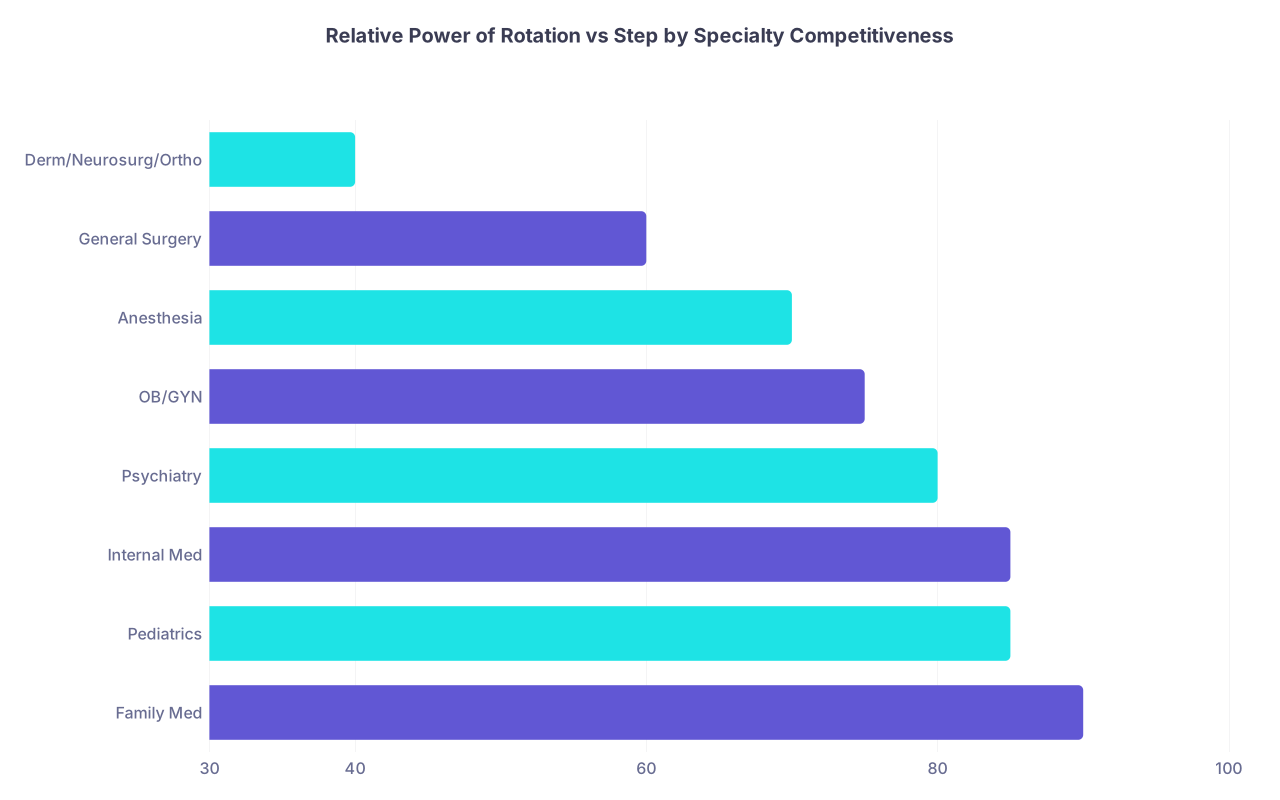
But in core fields—IM, peds, FM, psych, OB/GYN, anesthesia—a strong rotation at the right place can absolutely bulldoze through a mediocre Step performance.
| Category | Value |
|---|---|
| Family Med | 90 |
| Pediatrics | 85 |
| Internal Med | 85 |
| Psychiatry | 80 |
| OB/GYN | 75 |
| Anesthesia | 70 |
| General Surgery | 60 |
| Derm/Neurosurg/Ortho | 40 |
That chart is not “official data.” It’s how programs actually behave when the doors close.
The Bottom Line You’re Not Being Told
Faculty won’t announce this to a lecture hall full of students, but here’s how it really works:
- Programs don’t trust Step scores as much as you think once they’ve seen you in person.
- A single, outstanding rotation—especially at your target program—creates a story strong enough to erase the story your low Step score is telling.
- What committees want most is not brilliance. It’s reliability, maturity, and fit. Rotations reveal that better than any exam ever will.
If your Step score is lower than you hoped, do not waste energy on regret. Put everything into setting up—and then absolutely crushing—the right rotation at the right place. That’s the lever that actually moves.
FAQ
1. If my Step score is below many programs’ “cutoff,” can a rotation still help me get an interview?
Sometimes. If you rotate at that exact program and impress key faculty, they can push to “override” the typical cutoff and invite you anyway. But if your score is far below their absolute minimum and the filters are rigid, even a great rotation might not break through. This is very program-dependent and often doesn’t get advertised.
2. Is it better to do multiple away rotations or one really strong one at my top choice?
If you’re trying to counter a low Step score, one high-impact rotation at your realistic top-choice program is usually more valuable than three scattered aways where no one really gets to know you. Depth beats breadth here. You want a place where you’ll be remembered and talked about in the rank meeting.
3. Should I bring up my low Step score during a rotation or wait for them to ask?
Don’t lead with your score. Let your performance redefine their impression of you first. If a PD or faculty directly asks, give a concise, honest explanation without excuses, then immediately reinforce how your clinical work is much stronger than that number suggests. Spending too much time talking about the score only keeps it in the spotlight—the whole point of the rotation is to move it into the background.