It’s late November. Your friends with 250+ Step scores are casually comparing interview numbers while you’re refreshing your email every 20 minutes. You know your Step 1 or Step 2 score is below the magic number for your dream specialty. Yet every time someone posts their invites on Reddit, you see something infuriating:
“Got interviews at MGH, UCSF, Penn, Mayo… Step 1 220.”
You stare at the screen thinking: How? Same specialty. Same year. You’ve got a better score, decent clinicals, and nothing. They have a lower score and a top-10 invite.
Let me tell you what actually happens behind those closed doors. Because what you see on forums and what happens in program director meetings are not the same world.
The First Ugly Truth: Step Is a Filter, Not a Decision
Inside most academic programs, the first-pass sort is brutal and mechanical.
Some coordinator pulls a report from ERAS. Someone in leadership says:
“Okay, auto-screen below 220 unless exception flagged.”
Or for more competitive spots:
“Let’s start at 240+ and work our way down.”
That’s it. Not personal. Not intellectual. Just survival. They have 1500 applications and need to get to 200–300 to seriously review.
But here’s what no one tells you: the filter is leaky by design.
There are always exception buckets. Always. And that’s exactly where “low Step but top interview” applicants live.
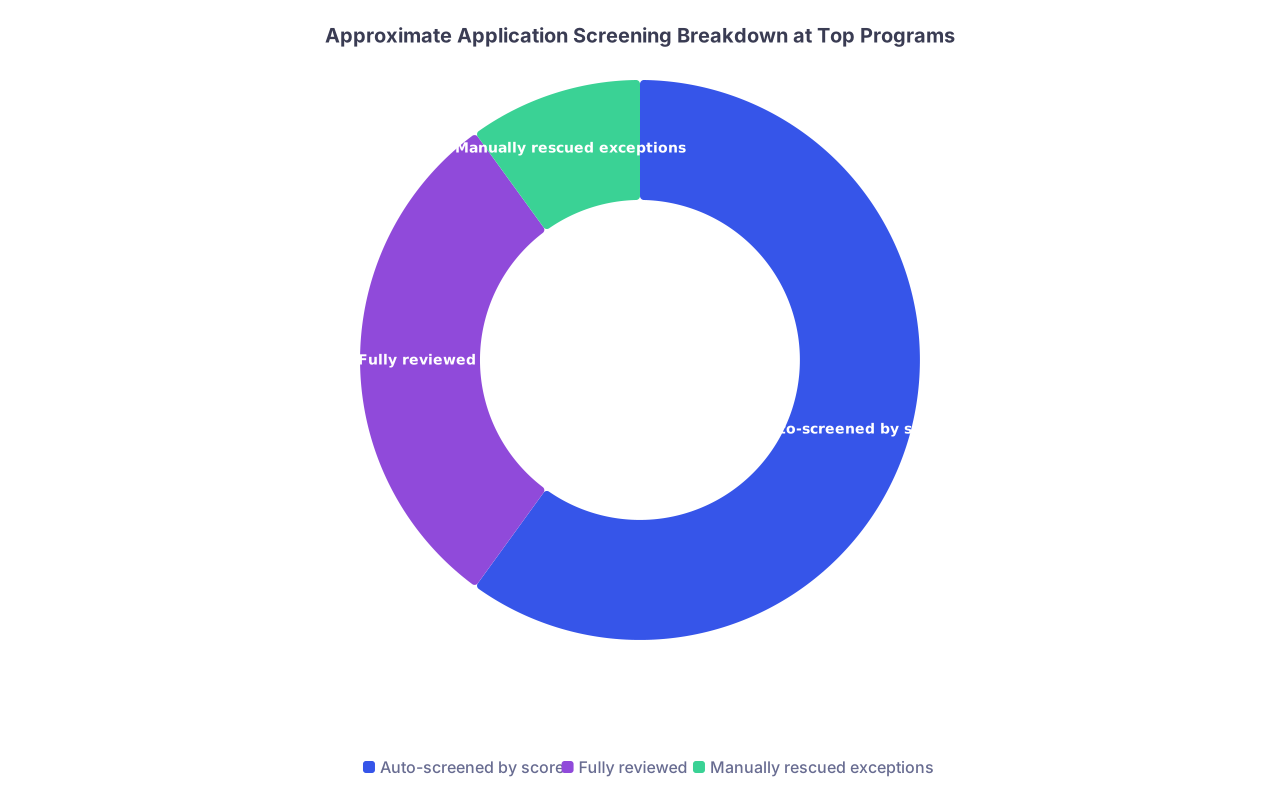
| Category | Value |
|---|---|
| Auto-screened by score | 60 |
| Fully reviewed | 30 |
| Manually rescued exceptions | 10 |
Those buckets look like this, behind the scenes:
- Home students
- Strong away rotators
- Applicants with internal champions (faculty calling in favors)
- Big-name research with someone they know
- Underrepresented in medicine with compelling context
- “Dean’s email” candidates from certain schools
So yes—someone with a 218 can absolutely jump over your 240. If they’re in an exception bucket.
You’re not losing to their score. You’re losing to their leverage.
The Home/Away Rotator Advantage: The Quiet Cheat Code
You want the most uncomfortable truth? For many top programs, once you’ve rotated there and impressed people, your Step score becomes a lot less important.
Direct quote from a PD in a top-20 IM program:
“If I’d trust you to cross-cover my MICU as a senior, I don’t care if your Step is 225.”
That’s not performative. I’ve seen them rescue applicants from the Step graveyard because they were loved on the wards.
Here’s the actual workflow in many places:
- The system auto-screens by score.
- Faculty look at the “rotated here” list.
- Someone says: “Why is Maria not on the invite list? She crushed on wards.”
- Coordinator pulls the file back from the reject pile.
Now Maria has a 222 and an interview at a top five program. Not because of a magical personal statement. Because she already auditioned and won.

| Step | Description |
|---|---|
| Step 1 | All ERAS applications |
| Step 2 | Score-based auto screen |
| Step 3 | Normal review |
| Step 4 | Auto reject pool |
| Step 5 | Rotated here or home student list |
| Step 6 | Faculty advocate |
| Step 7 | Ask coordinator to pull file |
| Step 8 | Added to interview pool |
This is why you’ll hear: “I had a 225 and still got interviews at [insert giant name program]” and think the system is random. It’s not random. They rotated there. You didn’t.
If your score is weak and you’re not planning very strategic away rotations, you’re already playing from behind.
Research: Not “You Have Papers,” but Whose Name Is on Them
On paper, ERAS makes research look like a numbers game: X publications, Y presentations, Z posters. That’s not how PDs and academic attendings actually scan it.
They’re playing a different game: Do I recognize any of these names?
You list:
- “Poster at regional conference, Dr. Smith, local attending.”
Another applicant with worse Step lists:
- “Co-author, Journal of [Big Name], with Dr. So-and-so (who the PD has been on panels with for 10 years).”
Guess who gets the benefit of the doubt?
At top academic programs, reputation is currency. A letter or paper co-signed by someone in their “network map” is worth far more than five low-impact posters with unknowns.
I’ve seen ranking discussions where someone literally says:
“This is [PI name]’s student. We should meet them.”
No one in that room cares that the applicant has a 225 instead of 245. They care that they’re vouchsafed by someone they respect, or fear, or owe a favor.
So yes, some low Step applicants are getting interviews because of research. But not because they “did research.” Because they did connected research.
If your Step is low and your only research is with people no one at big programs knows, you’re not playing the same game they are.
The Letter That Overrules the Number
Let me be blunt. Most letters are wallpaper. The ERAS version of elevator music.
- “Hard-working, compassionate, pleasure to work with…”
- “Will make an excellent resident…”
- “Among the top students I’ve worked with…” (they say this for 40 people every year)
Program directors skim 100 of these and forget them immediately.
But once in a while, a letter lands that makes the room stop.
Things like:
“I trust this student with my sickest ICU patients already.”
“I would take them into my own program without hesitation.”
“This is the resident you want on your worst call night.”
Or my personal favorite:
“If you do not interview this applicant, you are making a mistake.”
Those letters get people pulled off the reject list even when their Step is ugly.
This is where low Step applicants quietly win: they found a faculty member who actually knows them, is actually influential, and is willing to spend political capital on a strong, specific letter.
Top programs are hyper-aware of this. The PDs talk. They know who writes inflated nonsense and who almost never goes out on a limb. So when a generally stingy letter writer suddenly says “top 1%,” people listen.
If your Step is weak and your letters are lukewarm, generic, or all from non-cores, you will lose every time to the 225 who has a nuclear letter from a known name.
Underrepresented, Nontraditional, and the Context Card
Another reality the internet conveniently ignores: some applicants aren’t playing the same game by design. They are, frankly, supposed to be treated differently.
Most large academic centers now actively track and prioritize:
- Underrepresented in medicine (URiM)
- Significant life adversity (not “I was stressed in college,” but real obstacles)
- First-gen college / first-gen medical
- Veterans
- Career-change applicants with serious prior careers
There are PD meetings where someone will say:
“Yes, the Step is 15 points lower than our average, but if we’re serious about diversity and equity, these are exactly the candidates we should interview.”
And they mean it. Because they’re being watched—by GME, by their chair, by accreditation.
Here’s the part you don’t see: these candidates are not always weaker overall. Sometimes that 225 came from someone who worked full-time, had kids, and still outran your “full-time student with no responsibilities” 240 in terms of actual grind and resilience.
So they get an interview with a lower score, because the file tells a different story. And because the program is not only allowed but expected to weigh that context.
If your background is fairly standard, your bar is just higher. Complaining that a URiM or nontraditional applicant “got in with a lower Step” misunderstands the mandate those programs are operating under.
The “Known Quantity” Factor: Pipeline Schools and Dean’s Emails
Another quiet advantage: certain med schools have semi-formal pipelines to certain residencies.
You know the combinations:
- Hopkins → Hopkins / MGH / Penn
- UCSF → UCSF / Stanford / OHSU
- WashU → WashU / Midwest powerhouses
There are schools where the PDs say, year after year:
“We know their clinical training. We trust their grades. We’ve hired their residents before and they work.”
So when a borderline Step score comes across their desk from those schools, the reaction is very different than the same score from “Unknown State Med #5.”
Behind the scenes, you see exchanges like:
- Dean’s office: “We have a student a bit below your usual Step range, but clinically excellent and a great fit for academic medicine. Could you give them a look?”
- PD: “Send me the name.”
- Coordinator: pulls the file off the discard pile and adds an interview slot.
Does this happen for every student at those schools? No. But it happens enough that low Step applicants from big-name schools end up with interviews at big-name programs while you’re still waiting for a community invite.
Again: not fair. Just real.
Personality, Charisma, and “Fit” (Yes, Even Pre-Interview)
You think personality only matters on interview day. It does not.
Some applicants leak charisma through their entire file. Not in a cheesy way, but in a “I want to work with this person at 2 a.m.” way.
The signals:
- Personal statement that tells a specific, grounded story—not trauma porn, not clichés, but how they think and operate under pressure.
- LORs that mention how they function on teams: “glue person,” “everybody’s favorite intern already,” “nurses love working with them.”
- Leadership roles that aren’t just titles, but with outcomes that show initiative and follow-through.
In PD meetings, more than once I’ve heard:
“Okay, Step is low, but this is the kind of person who will be great on our wards. Let’s meet them.”
You want to know the harsh corollary? A 250+ with robotic vibes, generic PS, and letters that call them “very smart, quiet, reserved” will absolutely lose interviews to a 225 who sounds like a future chief resident.
Top programs are not just collecting brains. They’re building teams. They’d rather take the slightly lower Step score who will not melt down on night float and who can talk to patients like humans.
Strategic Signaling vs. Shotgunning
Another thing: the low Step applicant who somehow got that Harvard interview? A lot of the time, they did not randomly apply to 80 reach programs and pray.
They did targeted work.
They:
- Emailed PDs or APDs intelligently, with a brief note: “I know my Step is below your median. Here is why I still believe I would add value to your program…”
- Attached a CV with clear alignment to that program’s strengths (global health, QI, med ed, whatever).
- Mentioned faculty by name that they’ve actually read or worked with.
- Got their own mentors to send quiet side emails.
Contrast that with the 235 applicant who sends zero communication and just “hopes the numbers speak for themselves.”
Yes, PDs are busy. Yes, many cold emails get ignored. But not all. I’ve watched PDs say:
“This applicant acknowledged their score head-on and still made a strong case. That’s mature. Let’s give them a shot.”
Those are the interviews you never hear explained on social media. The “I reached out, owned my weakness, and still got the invite” stories.
They’re rare because most people are either too scared or too lazy to do it properly.
The Part No One Likes: Some People With Low Step Are Just Better on Paper
This stings, but it’s true. Sometimes the person with the 223 and Hopkins IM + 3 first-author papers + glowing letters + killer PS + away rotation + URiM status is, on balance, simply a stronger applicant than the person with a 240 and an otherwise forgettable application.
A 10–20 point difference in Step does not outweigh:
- True academic productivity
- A track record of responsibility and leadership
- Known performance in that exact hospital system
- LORs that could double as adoption papers
Programs don’t rank numbers. They rank trajectories. They’re asking:
“Who will be the resident we’re proud we took a risk on in five years?”
Sometimes that person had a bad test day. Or a weak preclinical foundation but phenomenal clinical growth. Or their priorities are skewed away from standardized tests and toward patient care and systems work.
Top programs are not blind to that. In fact, the best ones are deliberately hunting for it.
So What Can You Actually Do If Your Step Is Low?
Let me cut through the noise and tell you where low Step applicants actually gain ground. None of this is magic. All of it takes planning.
| Lever | Impact on Top Program Interviews |
|---|---|
| Strong away rotation | Very high |
| Powerful, known LORs | Very high |
| Connected research | High |
| Targeted PD outreach | Moderate to high |
| School reputation/pipeline | Moderate |
Choose away rotations like your career depends on it.
Because it does. One great rotation at the right place can cancel out a 10–15 point deficit, if you get an advocate who will fight for you.Hunt for letters, not just attendings.
Work with faculty who are (a) respected, (b) honest, and (c) willing to go specific. Ask your dean who writes impactful letters. Then go work with them and earn one.Align your research with real people, not just topics.
You’re not just doing “cardiology research.” You’re working with Dr. X, who did fellowship at Program Y and knows half their faculty. That’s the network effect.Own your score in your communication.
Don’t pretend they won’t notice. In rare, high-value emails, you can say: “My Step 2 score does not reflect my clinical performance, which is better captured by…” and then back it up with grades and narrative comments.Play the realistic plus dream mix.
Apply broadly, but don’t waste time emotionally on 30 impossibly out-of-range programs. Pick a small set of top programs where you offer something genuinely aligned with them, and push hard there.If you have real context, tell it.
Not as an excuse, but as part of your story: “I worked full-time supporting family through med school,” “first-gen with limited test prep access,” etc. Some programs will use that to legitimately recalibrate your score.
FAQs
1. Is there any Step score that completely kills chances at top programs?
Yes. There’s a floor where it becomes extremely difficult unless you have truly extraordinary offsetting strengths. For many competitive specialties, a Step 2 below ~220 is basically nonviable at top-10 programs unless you are a known, loved home/away student or a heavily recruited, mission-critical candidate (URiM, major research star, etc.). People slip through, but those are outliers, not a plan.
2. Do PDs actually look at Step 1 now that it’s pass/fail?
They still look at it, but mostly as: pass vs. fail, number of attempts, and pattern with Step 2. With P/F Step 1, Step 2 quietly became the main numeric screen. If your Step 1 was just a pass and your Step 2 is low, you’re in the same bucket as the “low Step” applicants we’re talking about—and all the same exception mechanisms apply.
3. Does doing two or three away rotations help more if my Step is low?
Up to a point. One excellent away where you crush it and get a champion is worth more than three average aways where you’re forgettable. If your score is low, I’d rather see you pick one or two surgically chosen aways at realistic places where you can actually stand out, rather than scatter-rotating everywhere.
4. Should I address my low Step in my personal statement?
Usually no. The PS is not the place to apologize for a number; it’s the place to show who you are beyond numbers. The exception: if there’s a single clear, verifiable reason (illness, family emergency, etc.) and you can briefly mention it without sounding like you’re begging for pity. Even then, I’d rather see that context in your MSPE or advisor letter than you spending half your PS on it.
5. If I don’t have big-name research or faculty, am I just doomed?
No, but you need to stop playing only the “stats game” and lean hard into the things you can control: clinical performance, away rotations, targeted communication, and building one or two strong, specific letters from people who actually know you. You might not jump straight to MGH, but you can absolutely land at a strong academic or hybrid program and build from there.
Two things to walk away with. First, low Step applicants who get top interviews almost never win on numbers; they win on connections, context, and performance where it actually counts. Second, if your Step is weak, pretending you’re in the same lane as the 260 crowd is delusional. You need a different strategy, aimed at the exception pathways the rest of them don’t even realize exist.