
It’s early December. You’re sitting in the call room after another marathon day on medicine. Your inbox has been dead for a week. Your Step 1 was below average, your Step 2 barely above water, and every time someone mentions “holistic review,” you can feel the lie from across the room.
Then a senior resident says casually, “You know Dr. R? She made a call for me. That’s why I got that interview at [insert big-name program].”
And you realize something you suspected but never fully understood:
There are backchannels.
They’re real.
And you’re either on them… or you’re not.
Let me walk you through what actually happens behind the curtain when attendings and program directors decide whether that low-Score applicant is worth a shot.
Because if your numbers are weak, the quiet advocacy is not optional. It’s your lifeline.
How Programs Really See Low Scores (Not the PR Version)
First, strip away the brochure language.
Programs will tell you they “review applications holistically.” Sure. On paper.
What actually happens in most competitive specialties and mid-to-top-tier programs looks more like this:
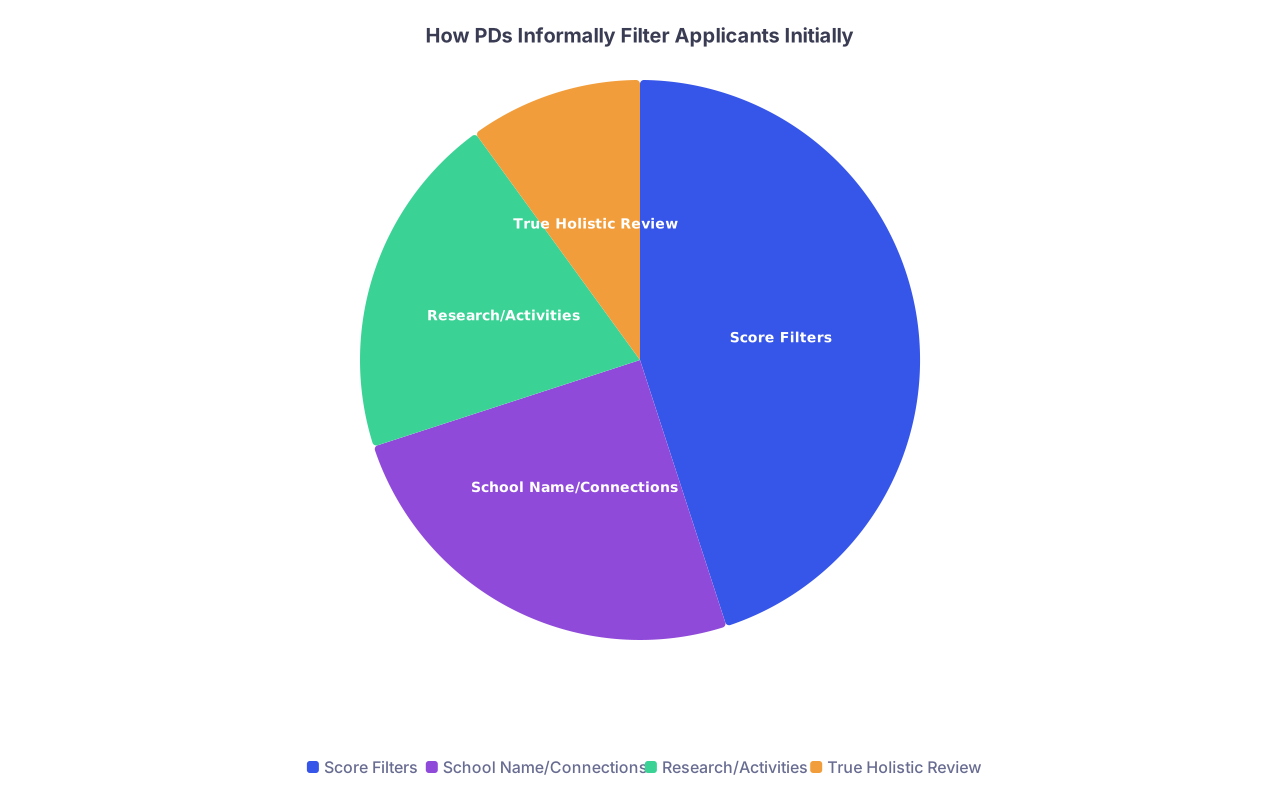
| Category | Value |
|---|---|
| Score Filters | 45 |
| School Name/Connections | 25 |
| Research/Activities | 20 |
| True Holistic Review | 10 |
The staff coordinator runs a filter in ERAS.
Some version of: Step 1 pass only, or Step 2 ≥ 230, or some internal threshold they never publish.
Then PDs and APDs look at the filtered pile and start sorting.
Only after that does “holistic” review kick in.
Where do you fit if your scores are low?
You do not enter through the front door.
You get in one of three ways:
- You’re from their own med school or home program.
- You have a very strong, very specific story that jumps off the page.
- Someone they trust signals: “Look again. This one is ours.”
That third one is the backchannel.
And it doesn’t mean one blanket “good student” comment. Backchannel advocacy has levels. Some are almost useless. Some are nuclear.
The Hierarchy of Backchannel Influence
Let me tell you how this really plays out at program meetings and in PD inboxes. Because not all “I’ll put in a word for you” is created equal.

Level 0: The Generic Letter
This is what most students think is powerful and most PDs barely register.
The chair or attending writes in your LOR:
“X will make an excellent resident and I recommend them without reservation.”
You know who else they said that about? Everyone. That phrase is wallpaper.
No one picks up the phone for a 205 Step 2 because the letter said “excellent.”
Does it help you compared to having no letter? Of course. But it doesn’t override a red flag score. It just puts you in the “not clearly terrible” bucket.
Level 1: The Quiet Email
This is the “soft nudge” that happens more than you think.
An attending who knows someone on the faculty or PD side sends an email. Something like:
“Hey [First Name],
Just wanted to flag this applicant, [Name, AAMC ID]. Step scores are not reflective. Worked closely with them on [service]. Top 5% of students I’ve worked with in the last few years. Great team player, handles stress well. Worth a closer look.”
Does this get you an automatic interview? No.
Does it move you from the “probably filtered out” pile into the “maybe we should discuss” pile? Often, yes.
I’ve seen borderline applicants with 220–225 Step 2 in competitive IM programs get interviews on the strength of exactly this kind of targeted email.
The keys that make it work:
- It’s sent to someone the writer actually knows, ideally on a first-name basis.
- It’s specific – “top 5%,” “worked with them on night float,” “ran the list like a PGY2” – not vague fluff.
- It lands before the interview list is finalized, not after.
Level 2: The Phone Call With Context
This is where the tone changes.
PDs will absolutely take calls from people they trust. Especially from:
- Their own residency classmates
- Co-faculty at national conferences
- People they’ve co-authored with
- Former colleagues from prior institutions
Here’s the kind of call that moves the needle:
“Listen, I know you’re going to screen on scores and their Step 1 is ugly. But I worked with them directly for four weeks on wards. They functioned like an intern by week two. No hand holding. No drama. I’d rank them ahead of half my current PGY1s.”
Or:
“You’re going to see a 214 Step 2 and want to say no. I’m telling you this is not a ‘dumb’ student. Major family crisis that month, they barely even should have tested. Their clinical performance is top-tier. You will regret not interviewing them.”
Those words land. Because every PD has been burned by ignoring this exact type of person in the past.
That's the dirty secret: the low-score rockstar who outperforms their 260 co-interns. Once a PD has had one of those, they’re way more willing to honor the right phone call.
Level 3: The “Do Me a Favor” Ask
This is rarer but real. And it’s blunt.
At the PD level or senior faculty level, the conversation goes like this:
“I need you to interview this person. They’re one of ours.”
Or:
“This student has a bad Step, but I will personally vouch for them. Please give them a shot. If they disappoint you, you can blame me.”
This kind of ask usually gets an interview. Not a guaranteed rank, but an interview.
Programs live and die on relationships with feeder schools, other departments, and national colleagues. Saying no to a reasonable favor from someone you trust has a cost.
Do not kid yourself: this is where a lot of low-score applicants get their foothold. Not because they gamed the system, but because someone in power was actually willing to spend social capital on them.
Level 4: Internal Protection
The strongest backchannel of all is being “internal.”
If you’re at the same institution where you want to match, the rules change. Not officially. Practically.
You’ve been on their wards. You’ve scrubbed in their ORs. They know how you respond when the ED dumps four admits at 4:30 pm. That familiarity is gold.
The conversation in the ranking meeting might literally sound like:
“Yeah, their Step is trash. But they’re already functioning like an intern on our service. I’d rather have them than a 250 we don’t know who might melt down in October.”
I’ve watched PDs bump internal low-score applicants up the rank list over “perfect paper” externals, purely because the resident and faculty feedback was rock solid.
Who Actually Makes These Calls (And Who Doesn’t)
Students wildly misjudge this.
They chase big titles. “I need the Department Chair’s letter.” No, you don’t. You need someone who knows you and is willing to stick their neck out. Those are not always the same people.
| Potential Advocate | Typical Influence Level | Comments |
|---|---|---|
| Department Chair | High | Only if they actually know you well |
| Program Director (your home) | Very High | Gold standard if they believe in you |
| Clerkship Director | Moderate to High | Strong if they can be specific |
| Famous Research PI | Low to Moderate | Helps more for research-heavy programs |
| Random Attending (1–2 days contact) | Low | Almost useless |
| Senior Resident/Fellow | Indirect but Real | Their input shapes faculty opinions |
The people who most often actually make behind-the-scenes moves:
Home program PDs
They email colleagues, especially for borderline or low-score home students they like.Clerkship directors
Medicine, surgery, peds. These people talk constantly with other institutions.Senior, well-liked attendings
The ones who always get asked to do faculty development, sit on committees, or lead residency interviews.
The ones who rarely make meaningful calls:
- Assistants you barely worked with
- The big-name researcher you saw twice in lab
- The attending who said, “Yeah I’ll write you a letter,” but couldn’t pick you out of a lineup
You want influence? You need proximity + credibility. Someone who knows your actual work and is respected by people running programs.
What Makes an Attending Actually Stick Their Neck Out
This part matters. A lot.
Most attendings will happily write you a letter. Very few will spend political capital on you.
So what flips that switch?

Here’s what I’ve consistently seen make the difference:
You were consistently excellent when it was hard, not when it was easy.
Night float. Post-call chaos. New intern meltdown. If you were the calm one who just did the work without theatrics, attendings remember that.You acted like a junior resident, not a visiting student.
Owning tasks. Tracking details. Calling consults under supervision. Volunteers to help, doesn’t vanish at 3 pm.You were coachable and not defensive.
The student who says, “Got it. I’ll fix that,” and then actually does — those are the ones people back. Nobody wants to stake their reputation on someone fragile or argumentative.You disclosed your score story like an adult, not a victim.
The attending cannot advocate for you if they don’t understand why your numbers don’t match your performance. I’ve seen this exact conversation:Student: “I’ll be honest, my Step 1 is a 205. I underperformed. My dad was in the ICU during that period and I didn’t reschedule when I should have. I’ve worked hard since then — my shelf scores and clinical evals are much stronger. I want to match in IM here or at a program like this. I’d be grateful for any advice on making that possible.”
That gives the attending ammo. And permission to speak about it.
You explicitly asked for targeted support.
Most students stop at: “Can you write me a strong letter?”
The savvy ones follow up later with: “Dr. X, I know Program Y filters heavily on Step scores. If you know anyone there and feel comfortable doing so, I’d be deeply grateful if you could flag my application.”
If that sounds too direct to you, then you do not understand how the game is played. Respectful, clear asks are how things get done.
How Backchannel Advocacy Actually Plays Out During Application Season
Let’s walk through a typical sequence so you see the timing, because mistiming kills a lot of chances.
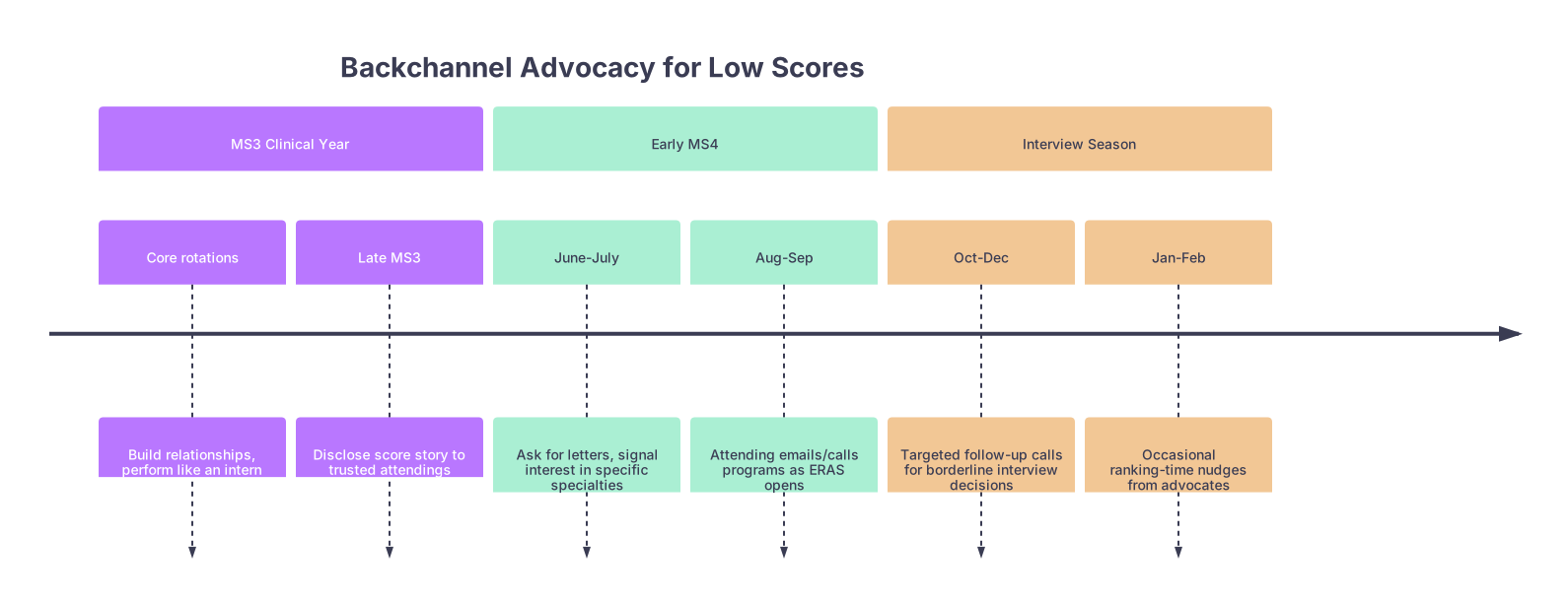
| Period | Event |
|---|---|
| MS3 Clinical Year - Core rotations | Build relationships, perform like an intern |
| MS3 Clinical Year - Late MS3 | Disclose score story to trusted attendings |
| Early MS4 - June-July | Ask for letters, signal interest in specific specialties |
| Early MS4 - Aug-Sep | Attending emails/calls programs as ERAS opens |
| Interview Season - Oct-Dec | Targeted follow-up calls for borderline interview decisions |
| Interview Season - Jan-Feb | Occasional ranking-time nudges from advocates |
Phase 1: MS3 – Building the Only Thing That Matters
During core rotations, your real job is not just “honors.” It’s creating one or two people who will say, “I’ll go to bat for you.”
If you’re rotating in the specialty you want with low scores, this is your audition. Act like a sub-I even if it’s just a core. Be reliable. Show up early. Help the interns. Present clearly. Don’t be weird.
By the end, you want at least one attending thinking:
“If this kid matched here, I would be happy to have them on my team.”
If that’s not true, no backchannel in the world will save you.
Phase 2: Late MS3 / Early MS4 – Controlled Transparency
This is where you have the “I need your honest help” conversation with one or two attendings you trust.
You do not trauma-dump. You frame:
- What your scores are
- Why they’re low (succinctly, factually)
- How your performance since then contradicts those numbers
- What specialty/level of program you’re realistically targeting
Then you shut up and listen to what they say.
If they respond with:
“Yeah, I can see that. You’ve been solid on the wards. I think you can absolutely be a good [insert specialty].”
You follow with:
“Would you be comfortable writing a strong letter for me? And, where appropriate, possibly reaching out to colleagues at programs where you think I’d be a good fit?”
If they hesitate, they’re not your advocate. You thank them and mentally move on.
Phase 3: ERAS Season – The Quiet Nudges
As applications go out (September, October), here’s what happens if you’ve set this up right.
Your attending, clerkship director, or PD might:
- Email a small list of specific programs, not 50, but maybe 3–8.
- Mention you in passing at national meetings or on Zoom calls.
- Reply to a PD who asks, “Anyone from your place we should look out for?”
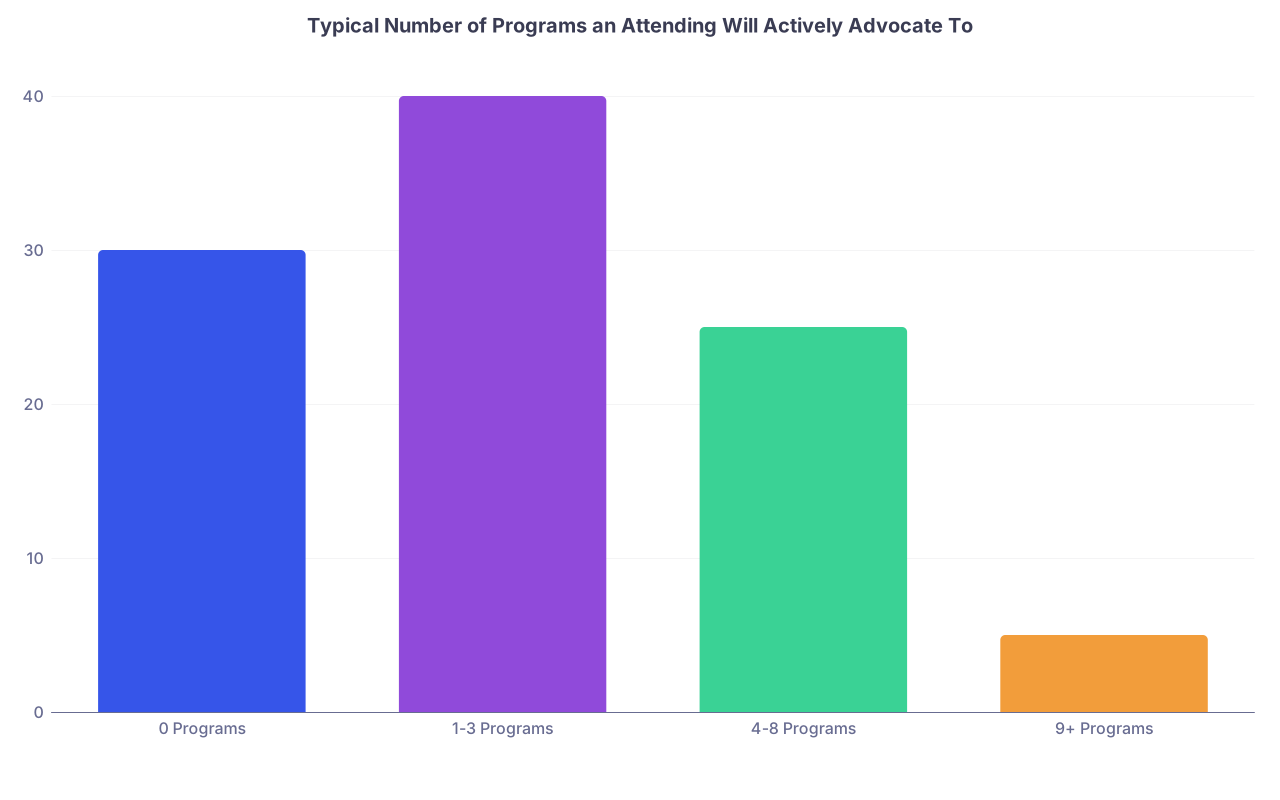
| Category | Value |
|---|---|
| 0 Programs | 30 |
| 1-3 Programs | 40 |
| 4-8 Programs | 25 |
| 9+ Programs | 5 |
They are not going to blanket the nation for you. No one does that. They’ll pick a targeted list where your profile fits.
The good news: even one or two well-placed nudges can be enough to get you a handful of interviews, especially at mid-tier or slightly above programs that know how to spot overlooked talent.
Phase 4: Interview and Rank Season – The Second Wave
There’s a second, quieter wave of advocacy most students never see.
It happens after you’ve interviewed and you’re on the fence for that program.
In rank meetings, faculty sometimes say:
“By the way, Dr. Z from [another institution] called me about this applicant. Said they punched way above their score level. Anyone else interview them?”
If the interviewers nod and say, “Yeah, they were solid,” you slide upward.
If you were mediocre or awkward, no phone call in the world can fix that.
Sometimes an attending will even send a follow-up note around January:
“Hope interview season’s going well. Just wanted to reiterate my strong support for [Name]. They’d be a great fit for a program like yours.”
Subtle. But programs remember who shows up twice.
How To Actually Ask For This Help Without Being Awkward
Students overcomplicate this.
Here’s a completely acceptable, professional way to set this up in an email after you’ve already had some prior rapport:
Dear Dr. [Name],
I wanted to thank you again for the opportunity to work with you on [rotation/service] and for agreeing to write a letter of recommendation for my residency applications.
As we discussed, my Step scores are not as strong as I’d hoped, but my clinical evaluations and recent performance have been much stronger. I’m applying in [specialty] this year and I’m especially interested in programs similar to [home institution] in terms of culture and training intensity.
If you feel comfortable doing so, I would be deeply grateful if you could consider reaching out to any colleagues at programs where you think I might be a good fit, particularly if score filters might otherwise prevent my application from being reviewed closely.
I completely understand that you have many demands on your time, and I appreciate any support or guidance you’re able to offer.
Sincerely,
[Your Name]
That’s it. Direct, respectful, and clear about the type of help you’re hoping for, without demanding anything.
When Backchannels Will Not Save You
I’ll be blunt: backchannel advocacy is not magic. It does not fix everything.
Here’s when it mostly fails:

You’re applying wildly above your lane.
Step 1 fail, Step 2 barely passing, no real research, mediocre evals… and you’re aiming for derm, plastics, or top-5 IM. No. Not even five phone calls will force a program to take a candidate they perceive as a major risk.You were average or worse on the rotation.
Attendings are not going to risk their reputations for someone who was “fine.” They spend capital on the student who actually made the team better.Your story doesn’t align.
If you claim your Step was a fluke because of personal issues, but your shelves, OSCEs, and clerkship comments are also weak or chaotic, PDs can see the pattern. They believe patterns, not excuses.You’re difficult.
Arrogant, dismissive of nurses, blaming everyone else, needing constant ego protection — word gets around. You might not realize it, but attendings talk. No one wants to attach their name to a future problem.You wait too long.
Asking for “help making calls” in January is late. Not impossible, but late. Many rank lists are essentially set by then.
Backchannels amplify what’s already true about you. They don’t fabricate it.
How to Position Yourself So People Want to Vouch for You
If your scores are low, your entire clinical life should be built around one question:
“Would this attending fight for me in a room of skeptical PDs?”
Here’s what that actually looks like in practice during your rotations:
- You know your patients cold. No hand-wavy answers.
- You follow through on every task without needing reminders.
- You’re present when things are busy, not just when rounds are done.
- You absorb feedback quickly and visibly.
- You treat nurses and staff with complete respect. Word gets back.
And you show a level of maturity that telegraphs, “This person will be safe and functional at 2 am with sick patients.”
If you do that, your low score becomes “the annoying hurdle we have to explain away” rather than “evidence they’re not cut out for this.”
That’s the shift. Once people see you as the former, the calls and emails start to feel justified.
FAQs
1. Do programs ever explicitly say, “We’re interviewing this person only because of a phone call”?
Not in those exact words, but I’ve sat in rooms where someone says, “We’re including this person because X strongly recommended them,” or “I’d normally screen this out on scores, but Y says they’re excellent.” Everyone understands what’s happening. No one pretends otherwise. It’s not corruption; it’s trusted colleagues vouching for proven performance.
2. What if no one I worked with seems influential or connected?
You’re probably underestimating who knows whom. Clerkship directors, long-time faculty, and PDs attend national meetings, serve on committees, and have trained at multiple institutions. You don’t need a celebrity; you need someone respected and plugged into the specialty. Your job is to ask, “Do you know programs where I might be a good fit?” and let them connect the dots.
3. Is it bad to tell an attending, “This program is my dream; would you be willing to reach out to them specifically?”
It’s not bad if you’re reasonable. Saying, “My dream is MGH Derm” with a 215 is delusional. But saying, “I’d really love a shot at [solid but realistic program]; would you feel comfortable reaching out if you know someone there?” is fine. The key word is “comfortable.” Give them an easy out. The ones who truly believe in you will step up without resenting the ask.
Key points:
Low scores don’t end you, but they do change the rules. Your numbers won’t walk you through the front door; people will. Build relationships that justify real advocacy, be transparent about your story, and make it painfully easy for attendings to see you as “worth fighting for” when they pick up the phone.