
The most dangerous mistake low Step score applicants make with letters of recommendation is assuming, “Any strong letter will help me.” Wrong. The wrong strong letter can quietly kill your application at screening.
If your scores are weak, your letters are not “extra.” They’re a survival tool. And most applicants treat them like an afterthought.
Let me walk you through the landmines I’ve seen people step on—then show you how to avoid them.
1. Choosing Letter Writers Who Subtly Confirm Your Weakness
The biggest LOR mistake low score applicants make? Picking the wrong people to talk about them.
You can’t afford that.
The seductive but deadly “big name” letter
I’ve seen this play out over and over:
- Applicant with Step 1 204, Step 2 217 applies to IM.
- Pushes hard for a letter from a nationally known researcher they barely worked with.
- Letter arrives. It’s three paragraphs of generic praise about “participation” in a project and “interest in research.”
- Not a single line about clinical reasoning, reliability, or performance with patients.
Programs read that and think:
“Student probably wasn’t great clinically if this is the best they could get.”
For a low score applicant, that’s fatal.
What to prioritize instead
You want writers who can say, very specifically, that your clinical performance significantly outpaced what your board scores would predict.
If you pick between:
- Famous PD who vaguely remembers you, vs
- No-name community preceptor who watched you grind through 4 weeks and go the extra mile for every patient
For you, the low score applicant, the community preceptor wins. Every time.
Do not:
- Chase prestige over substance
- Ask someone who supervised you for 1–2 days
- Use someone who didn’t see you in direct patient care if you have better options
Look for:
- Attending who saw you take ownership on the wards
- Someone who saw you deal with adversity or long hours
- A person who spontaneously praised you without you fishing for it
If the person has ever said:
“You work way above your level”
or
“I’m happy to write you a very strong letter,”
that’s your person.
2. Letting “Faint Praise” Letters Go Out Unchallenged
You probably think: “If they agreed to write, it’ll be fine.”
Nope.
A letter that sounds “fine” to you can read as a quiet rejection to programs.
The code words that quietly sink you
I’ve sat in meetings where faculty said things like:
- “This is a nice letter, but there’s nothing here that explains their Step 2 214.”
- “If this was my student and I truly believed in them, this letter would be a lot more enthusiastic.”
For low score applicants, neutral = negative.
Red flag phrases:
- “X is a solid medical student.”
- “I believe X will be a competent resident.”
- “X completed the rotation and met expectations.”
Those sound okay to you. To a PD, especially with your 2-digit Step score staring at them, that reads as:
“This is the most positive thing anyone could honestly say.”
How to reduce the risk of faint praise
Do not just ask:
“Can you write me a letter of recommendation?”
Instead, ask:
“Would you feel comfortable writing me a strong, supportive letter of recommendation for residency?”
Then stop talking. Let them answer honestly.
If they hesitate, if their answer sounds like:
“I can write you a letter”
instead of
“I’d be happy to write you a strong letter”
You walk away. Politely, but firmly.
This is not about ego. You simply cannot afford “meh” letters when your scores are already a liability.
3. Ignoring the Score Elephant in the Room
A major mistake: letting all your letters talk about your work ethic and bedside manner while no one addresses the obvious: your low Step scores.
Programs notice the silence.
They think:
- “Did anyone talk about whether this score reflects their true ability?”
- “Is this a pattern or a fluke?”
If no one vouches for your true capability, your file becomes “too risky.”
Use letters to reframe the narrative
You want at least one letter that directly or indirectly helps reframe your scores.
Not:
“Despite low board scores, the student is actually good.”
Instead, something like:
- “X’s performance on our inpatient rotation was at or above the level of many interns I’ve supervised.”
- “While standardized tests have not consistently reflected X’s strengths, their clinical reasoning, reliability, and patient care have been outstanding.”
- “Based on their performance on my service, I would have no hesitation having X take care of my own family member.”
That’s how you neutralize risk.
How to help a writer do this without being pushy
You do not script:
“Please say my Step score doesn’t matter.”
You do say something like:
“I know my Step scores are weaker than average, so I’m trying to make sure programs see that they’re not the full story. If you feel it’s appropriate, I’d be grateful if you could comment on how my clinical performance compares to others at my level.”
Reasonable attendings understand this. The good ones will help.
4. Relying on Generic, Template-Style Letters
If your scores are weak, you cannot afford any letter that sounds Ctrl+C/Ctrl+V.
You’re already in the maybe/no pile. Generic letters shove you into “no” faster.
What generic looks like to a PD
A typical template letter:
- Paragraph 1: “I am writing to support X for your residency program.”
- Paragraph 2: Stock phrases about “hard working,” “professional,” “team player.”
- Paragraph 3: “I recommend X without reservation.”
To you, that sounds… fine.
To someone who reads 500+ letters a cycle, it sounds like nothing.
Programs are trying to answer:
- “Can this person actually function as a resident?”
- “Will they be a problem at 2am?”
- “Is their low score a predictor of future struggle?”
Template language does not answer those questions.
You need specifics. Or you lose.
You should be helping your letter writers remember details:
- Cases you took ownership of
- Times you stayed late to finish tasks
- Difficult patient/family encounters you handled well
- Concrete improvements you made across the rotation
Do the mental work for your writer.
You can send a one-page highlight sheet with:
- Your name, ERAS ID, photo
- What specialty you’re applying to
- 4–6 bullet points of specific behaviors or cases they saw you handle
- Your CV + personal statement
You’re not writing the letter. You’re reminding them what they actually observed so the letter becomes sharp instead of vague.
5. Bad Mix of Letter Types for Low Score Applicants
Content is one problem. Composition of your letter “set” is another.
Choosing the wrong mix of letters is a common—and avoidable—mistake.
| Letter Mix Type | Impact |
|---|---|
| 2 core specialty clinical + 1 sub-I + 1 non-clinical mentor | Strong |
| 1 core specialty + 1 research + 1 non-clinical | Risky |
| 3 research letters, no strong clinical | Very weak |
| 1 vague chair letter + 2 generic ward letters | Weak |
| 2 detailed ward letters + 1 community preceptor | Good |
If your Step scores are low, you’re already a risk academically. Programs want reassurance from people who saw you function in real clinical chaos.
Common mix mistakes
Too much research, not enough clinical
- Three glowing research letters saying you’re “diligent and thoughtful” won’t fix a 208.
- One research letter max, and only if it’s truly strong. Focus on clinical performance.
All letters from non-specialty attendings when you could get specialty letters
- Applying to IM with:
- 1 FM letter
- 1 Psych letter
- 1 Research letter
- Programs will wonder: “Did nobody in IM want to write for this person?”
- Applying to IM with:
Overweighting pre-clinical or basic science letters
If your scores are already weak, a letter from a preclinical course director saying, “They passed anatomy” isn’t helping you.
What you should be aiming for
For a low score applicant, your best defensive line-up usually looks like:
- 2 strong clinical letters in your chosen specialty (inpatient rotations, sub-I, acting internship)
- 1 additional clinical letter (another specialty or strong community/preceptor letter)
- 1 “bonus” letter only if it’s actually powerful (research PI who knows you well, long-term mentor)
If your school allows only 3, prioritize 3 strong clinical letters rather than cute extras that don’t move the needle.
6. Not Controlling Timing – Last-Minute or Missing Letters
Late letters hurt low score applicants more than strong ones. You’re already borderline. Any sign of disorganization reinforces doubts.
I’ve watched applicants with low 220s Step 2, solid rotations, and decent personal statements lose out because:
- Half their letters came in after programs had already done first-pass screens.
- One key sub-I letter was missing until November.
- A writer simply never uploaded the letter, and they “didn’t want to bother” them.
Programs do early cuts. If your best letter isn’t there when they first open your file, they might never see it.
Build yourself a real deadline system
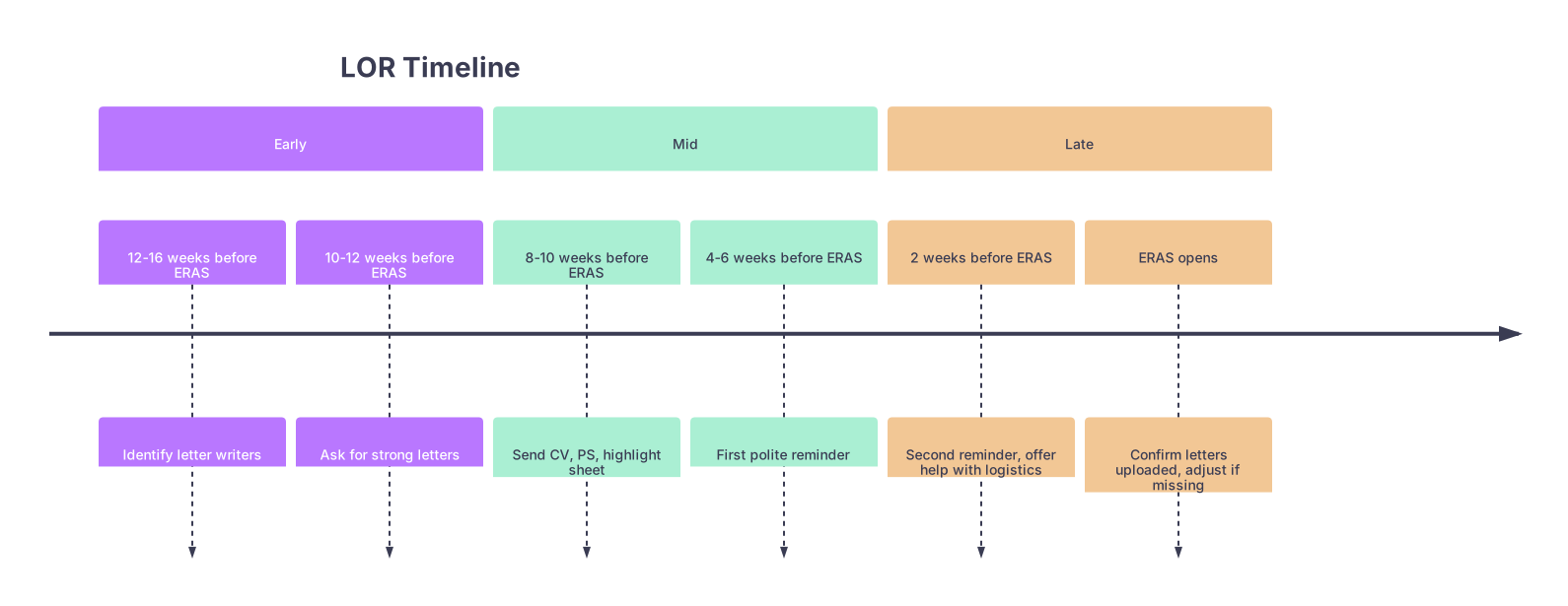
Here’s the structure I’d use:
| Period | Event |
|---|---|
| Early - 12-16 weeks before ERAS | Identify letter writers |
| Early - 10-12 weeks before ERAS | Ask for strong letters |
| Mid - 8-10 weeks before ERAS | Send CV, PS, highlight sheet |
| Mid - 4-6 weeks before ERAS | First polite reminder |
| Late - 2 weeks before ERAS | Second reminder, offer help with logistics |
| Late - ERAS opens | Confirm letters uploaded, adjust if missing |
Do not:
- Ask 3 weeks before ERAS and expect a thoughtful letter.
- Assume “They said yes, so it’ll be in on time.”
- Wait until October to panic when a key letter is still missing.
Treat letters like a major exam. You calendar them. You track them. You follow up.
A simple spreadsheet with:
- Writer name
- Date asked
- Date they agreed
- Date you sent materials
- Date uploaded (check ERAS)
That level of boring, obsessive tracking is what protects you from last-minute disasters.
7. Failing to Brief Writers on Your Red Flags and Strengths
Another common error: you give your writers nothing but your CV and hope they “figure it out.”
They won’t. They’re busy. They’ll default to generic.
You need to strategically brief them
When your scores are low, your letter writer needs context. Or they’ll unintentionally write something that makes your weaknesses look worse.
Do not send a 5-page life story.
Do send a tight, targeted packet:
One-page summary that includes:
- What specialty you’re applying to and why
- Your Step and COMLEX scores (do not hide them; they’ll see anyway)
- Any clear upward trend (e.g., “Step 1 205 → Step 2 224”)
- Your Match strategy (community vs academic vs geographic preferences)
Rotation highlights specific to that writer:
- “On your service, I especially remember…” with 3–5 bullet points
- Cases, patient encounters, or feedback you received
Your concerns and goals (one short paragraph):
- “My scores are below average, so I’m trying to show programs that my clinical performance and work ethic are much stronger than my test results suggest.”
- “My main goal is to match into a solid, training-heavy program where I can work hard and grow, not necessarily a ‘name brand’ institution.”
Good attendings appreciate this clarity. It lets them write a letter that actually strengthens your story instead of wandering around it.
8. Using Character Letters That Don’t Answer the PD’s Question
Low score applicants often panic and overcompensate with “character” letters:
- Pastor
- Family friend
- Volunteer coordinator pre-med
- High school teacher
These might be beautiful letters. They don’t answer the question residency programs are asking:
“Can this person safely and competently take care of sick patients in our program?”
If your Step scores are low, you need evidence of competence, not just goodness.
When a non-physician letter might actually help
Rarely, a non-physician letter can be useful in addition to strong clinical letters if:
- It shows you worked 20–30 hours a week throughout med school to support family
- It documents extreme adversity you handled with maturity and consistency
- It highlights long-term reliability, leadership, or resilience that directly relates to residency-level responsibility
But it should never replace a core clinical letter. Ever.
If choosing between:
- 2 IM clinical + pastor
- 3 IM clinical
With low scores? You go with 3 IM clinical. Every time.
9. Forgetting That Every Letter Must Be Consistent with Your Story
Big mistake: treating letters as independent “nice things” people say rather than coherent chapters in one story.
For a low score applicant, your story must be tight:
- “Scores are weaker, but clinical performance is strong.”
- “Maybe not a genius test-taker, but absolutely safe, reliable, and hard working.”
- “Will show up, take feedback, and grow.”
If one letter says:
- “Quiet but dependable”
And another says:
- “Very outspoken leader, sometimes too assertive”
That inconsistency makes you look unpredictable. PDs hate unpredictable.
How to tighten your narrative
When you talk to writers, you can frame your identity:
“On your rotation, I really focused on being dependable and thorough with my patients, even if I wasn’t the loudest person on rounds. I’m trying to show programs that I’ll be a safe, hard-working intern they can rely on.”
Or:
“I know I ask a lot of questions, but I’m trying to grow quickly and not miss things. I want programs to see that I’m coachable and committed.”
You’re not telling them what to write. You’re giving them the lens.
When multiple letters describe you with variations of the same core traits—reliable, prepared, clinically sound, cares deeply about patients—it starts to look real. And safe. Which is what you need.
10. Assuming Weak Scores Mean You Should “Hide” Behind Letters
Here’s the last, ugly mistake: giving up your own voice and hoping letters will “speak for you.”
You see it when applicants:
- Don’t talk to letter writers directly—only email.
- Avoid mentioning their scores or struggles.
- Hope that a glowing letter will magically erase those numbers.
Programs smell that kind of avoidance.
Letters are supporting evidence, not magic erasers. If your own personal statement, experiences section, and interview energy don’t align with what your letters say, you look either coached or inconsistent.
You still have to:
- Own your low scores calmly.
- Show insight about what went wrong and how you’ve adapted.
- Demonstrate that you can function at a resident level despite them.
Letters should amplify that story. Not replace it.
What You Should Do Today
Do not just nod and move on. Change something concrete.
Today, do this:
Make a list of 5–7 potential letter writers.
- Mark each as: Strong clinical / Weak clinical / Research / Non-clinical.
Put a star next to the ones who:
- Saw you on the wards or in clinic for at least 3–4 weeks
- Gave you specific praise at some point
- Would likely remember you without prompting
Draft a one-page highlight sheet for the strongest 2–3 clinical attendings.
Then email or talk to one of them within the next 48 hours and ask directly:
“Would you feel comfortable writing me a strong, supportive letter of recommendation for residency?”
Your letters can either quietly confirm every fear a PD has about your scores—or they can be the reason someone in that room says, “You know what? Let’s give this one a chance.”
Start controlling that outcome now.