
Your low Step score is not what kills your application. How you explain it is.
I have seen strong candidates bury themselves with one clumsy paragraph. Not the score. The explanation. One badly worded “mitigating circumstance” answer can move you from “borderline but interesting” to “hard pass” in under 15 seconds.
Let me walk you through the landmines so you do not step on them.
The Harsh Reality: How Programs Actually Read Your Explanation
Program directors are not sitting there eager to forgive you. They are busy, cynical, and pattern-recognition experts. When they see a low Step score with an attached explanation, their brain automatically scans for three things:
- Accountability – Do you own it, or do you blame everything else?
- Trajectory – Is this an isolated dip, or part of a larger problem?
- Risk – Will this person struggle with in‑training exams and board pass rates?
They are not grading your excuse. They are judging your reliability.
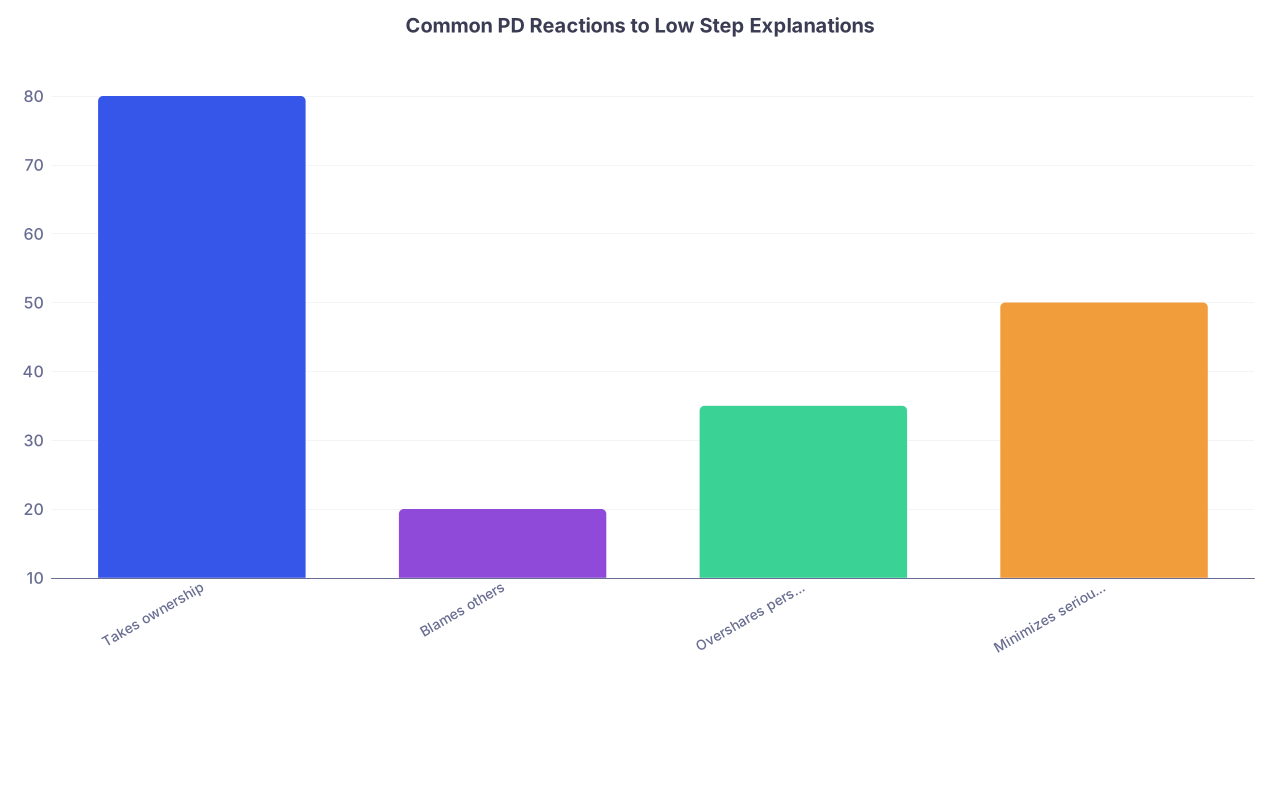
| Category | Value |
|---|---|
| Takes ownership | 80 |
| Blames others | 20 |
| Overshares personal details | 35 |
| Minimizes seriousness | 50 |
Here is the mistake: applicants treat the explanation box (ERAS “Additional Information,” email responses, or interview answers) as therapy. It is not therapy. It is risk assessment from the program’s point of view.
So your primary job is simple: do not scare them.
Category 1: The Blame Game – Phrases That Scream “I Lack Ownership”
Nothing tanks your credibility faster than blaming everyone and everything except yourself.
Phrases that hurt you
Avoid these like they are contaminated sharps:
- “The exam was unfair because…”
- “My score does not reflect my knowledge.”
- “I had several poorly written questions on my exam.”
- “Prometric had technical issues and it really threw me off.”
- “My school did not adequately prepare us for the exam.”
- “The new scoring system / question style disadvantaged me.”
- “I was not given appropriate testing accommodations.”
Are some of these occasionally true? Yes. Does saying them help you? Almost never.
What a PD hears:
- “The exam was unfair…” → This person externalizes failure. Will they do this when they fail an in‑service or get negative feedback?
- “My score does not reflect my knowledge.” → Then why should I trust your self‑assessment now?
- “My school did not adequately prepare us.” → So you lack initiative and wait to be spoon-fed.
- “Accommodations” (when framed as complaint) → Is this going to be an ongoing logistical headache?
A better framing (if something genuinely abnormal happened) is extremely brief and completely free of blame:
- Instead of: “Prometric had technical issues and it really threw me off.”
- Say: “There was a brief testing center disruption, but I take full responsibility for not adapting better in the moment.”
Key features:
- Short.
- Calm.
- You still own the outcome.
Category 2: The Personal Drama Dump – Oversharing That Backfires
You are human. Life happens. Illness, deaths, relationships, mental health. But mishandling these topics in an application is a common and serious mistake.
Phrases that raise red flags
- “I was going through a bad breakup at the time.”
- “A close friend betrayed my trust and I was not in the right headspace.”
- “My roommate was very noisy and I could not study properly.”
- “I was involved in a complicated legal situation.”
- “I struggled with depression and anxiety for years and still do.”
- “I had family drama that made it impossible to focus.”
- “There were several conflicts with my school administration.”
What programs hear:
- Unstable personal life.
- Ongoing mental health or interpersonal issues that may resurface.
- Difficulty setting boundaries and maintaining performance under stress.
Do not misinterpret this. I am not saying your struggles are not real or not valid. I am saying residency selection is brutally risk‑averse.
If you must reference personal hardship:
- Keep it high-level and non‑sensational.
- Emphasize resolution and current stability.
- Make the pivot to evidence of improvement quickly (e.g., Step 2, coursework, research productivity).
For example:
Poor version:
“My Step 1 score was low because I was going through severe anxiety and depression and had frequent panic attacks. I was on and off medications and therapy, and things at home were very bad.”Stronger version:
“During my Step 1 preparation, I experienced a significant personal challenge that affected my performance. Since then, I addressed those issues with professional support, adjusted my study approach, and my Step 2 CK score (248) better reflects my current abilities and stability.”
You are not hiding your humanity. You are managing how much risk you present on paper.
Category 3: The Minimizer – Phrases That Make You Look Delusional
Another frequent mistake: talking about your score like it is “actually not that bad” when it clearly is, relative to the specialty.
Dangerous minimization phrases
- “Although my Step score is slightly below average, it should not be a concern.”
- “My score is only a few points below the cutoff.”
- “Despite this minor setback, I am confident I can perform at the same level as my peers.”
- “The low score was just a fluke.”
- “I am actually very strong in test‑taking; this exam was an exception.”
- “Score alone does not define a good physician.”
Again, some of these sound harmless. They are not.
What PDs hear:
- You do not understand competition in their specialty.
- You are trying to argue them out of reality.
- You are more interested in defending your ego than honestly assessing your weaknesses.
You need a tone of sober realism:
- Acknowledge the problem clearly.
- Do not argue with the data.
- Show what you changed and how things improved.
For example:
- Bad: “My Step 1 was just a fluke, and I believe it does not represent my abilities.”
- Better: “My Step 1 score was below my target and below the average for applicants in this specialty. I reassessed my study methods, increased my question‑bank volume, and sought structured mentorship. Those changes are reflected in my Step 2 CK performance (254) and on my clinical evaluations.”
Notice: no minimizing. No begging. Just reality and trajectory.
Category 4: The Overcompensator – Long, Emotional Essays No One Wants To Read
Another classic self‑inflicted wound: turning a simple explanation into a 600‑word confession.
Program directors skim. They have 1000+ applications. When they see a giant block of text explaining your Step score, here is what usually happens:
- They do not finish reading it.
- They assume you are high‑maintenance.
- They doubt your judgment.
Problematic patterns
- Multi‑paragraph “journey” about your Step prep.
- Emotional descriptions of “cramming,” “burnout,” “feeling lost.”
- Listing every resource you used as if that proves effort.
- Trying to justify your study schedule minute‑by‑minute.
- Re‑describing your entire life story leading up to the exam.
You do not need to show pain. You need to show insight and adjustment.

Keep your explanation tight:
- 2–4 sentences in ERAS text boxes.
- 20–30 seconds in an interview answer before pivoting to improvement.
Example of what not to do:
“I started studying for Step 1 with high expectations, but over time I became overwhelmed by the sheer volume of resources. I switched from UWorld to another q‑bank, then back, then added multiple review books and online lectures. I struggled with time management and sleep, and my anxiety increased daily. The day of the exam, I barely slept and had a panic attack before walking into the center…”
That reads like a case presentation on test anxiety. Not what you want.
Compressed version that does the job without self‑sabotage:
“During my Step 1 preparation, I did not yet have an effective system for structuring my study schedule and resources, which contributed to a lower score than I aimed for. Since then, I simplified my resources, created a question‑focused plan, and worked closely with a faculty mentor. My Step 2 CK performance and improved shelf exam scores reflect these changes.”
You are allowed to sound like an adult.
Category 5: The “Special Snowflake” – Arguing You Are Different From Every Other Applicant
Some applicants try to “intellectualize” their low score. They argue that traditional metrics do not capture their unique greatness.
Common versions:
- “Standardized tests are not designed for individuals who think outside the box.”
- “My true strengths lie in clinical reasoning and bedside manner rather than test scores.”
- “I prioritize patient care over test performance.”
- “I do not believe standardized tests define a good physician.”
- “My diverse background and non‑traditional path are more important than one exam.”
Programs already know scores are imperfect. They still have to care.
When you attack the test itself or the system, you signal poor adaptability. Residency is full of hoops you will not like: in‑service exams, board prep, institutional modules. They need people who can operate inside constraints, not rail against them.
A better angle:
- Acknowledge limitation.
- Affirm commitment to meeting expectations.
- Point to specific evidence that you can and have done better.
For example:
- Bad: “Standardized tests do not measure my true potential as a compassionate physician.”
- Better: “While my Step score is below the typical range for this specialty, I recognized that standardized exams are an essential component of residency and board certification. I worked to strengthen this area, as shown by my improved performance on later standardized assessments and my active engagement in a structured board‑prep curriculum.”
You are not special for disliking standardized tests. Everyone does. What matters is whether you learned to handle them anyway.
Category 6: The Timing and Consistency Trap
Even if you word your explanation well, you can still sabotage yourself by inconsistency or poor timing.
Common mistakes
Different stories in ERAS, emails, and interviews.
A PD reads one explanation in your application and then hears a completely different version on interview day. That is how you trigger distrust.Suddenly adding a new, more dramatic reason later.
“Actually, it was because of a serious illness I never mentioned before…”
Now it sounds manufactured.Having your letter writers hint at things you never own yourself.
Example: “Despite health challenges that impacted exams, the student has persevered…” when you never acknowledged any of this anywhere else.Bringing it up when nobody asked.
If a program did not raise your Step score in an interview, do not force the issue unless it is absolutely necessary.
You want:
- One coherent, consistent explanation.
- The same basic content across:
- ERAS “Additional Info” (if used),
- Any emails where they ask about it,
- Your interview answer.
What A Strong, Low‑Risk Explanation Actually Sounds Like
Let me give you concrete before‑and‑after examples. Assume Step 1 = 208, Step 2 CK = 245.
Weak, self-sabotaging version
“My Step 1 score does not reflect my true knowledge or commitment to medicine. The exam was extremely unfair and contained many poorly written questions. At the time, I was also dealing with personal issues and did not receive adequate guidance from my school, which had recently changed its curriculum. I have always been more clinically oriented and do not feel standardized tests accurately represent my capabilities as a physician.”
This hits almost every landmine:
- Blames exam, school.
- Vague “personal issues.”
- Attacks standardized tests.
- Zero clear ownership.
Strong, DS-ready version
“My Step 1 score was lower than I anticipated and below the typical range for applicants in this specialty. I realized my study approach was too passive and resource‑heavy, with insufficient emphasis on timed questions and spaced review. I simplified my resources, adopted a structured question‑based strategy, and met regularly with a faculty mentor to monitor my progress. These changes are reflected in my Step 2 CK score (245) and in improved performance on subsequent shelf exams.”
What this communicates:
- Awareness.
- Specific change in behavior.
- Upward trajectory.
- No drama. No blame.
That is what you are aiming for.
Quick Comparison: Phrases That Hurt vs. Phrases That Help
| Situation | Phrases That Hurt Your Case | Safer, Helpful Alternatives |
|---|---|---|
| Blaming circumstances | “The exam was unfair and the testing center was chaotic.” | “There were some unexpected challenges on test day, but I have since focused on improving my preparation and test‑day strategies.” |
| Personal hardship | “Family drama made it impossible for me to study.” | “A significant personal challenge affected my performance at that time, which has since been addressed, as reflected in my later scores.” |
| Minimizing score | “My score is only slightly below average and should not matter.” | “My score is below the range I was aiming for, and I used that feedback to change my study methods, leading to improved performance.” |
| Attacking tests | “Standardized tests do not measure my true abilities.” | “I recognized that standardized exams are an important part of residency, so I worked deliberately to strengthen this area.” |
| Long emotional story | Multi‑paragraph explanation of anxiety, burnout, and every detail. | 2–4 concise sentences focusing on cause, adjustment, and improvement. |
How To Decide If You Should Explain It At All
You also need to avoid the mistake of over‑explaining when it is not necessary.
Use this basic framework:
- Pass/Fail Step 1 with a fail on first attempt – Yes, you probably need a brief explanation plus evidence of improvement.
- Very low Step 1 for a competitive specialty (e.g., Derm, Ortho) but strong Step 2 – Short explanation may help, especially if programs explicitly ask.
- Borderline but passing score, no fails, good Step 2, no one asked – Often better to remain silent.
- Score affected by clearly documented, resolved medical issue – One honest, concise explanation, consistent across documents.

| Step | Description |
|---|---|
| Step 1 | Low Step Score |
| Step 2 | Brief explanation needed |
| Step 3 | Short explanation can help |
| Step 4 | Answer concisely |
| Step 5 | Often safe not to bring it up |
| Step 6 | Failed attempt? |
| Step 7 | Applying to very competitive specialty? |
| Step 8 | Program specifically asks? |
If you do not have a clear, strategic reason to explain, forcing an explanation can draw more attention to a problem they might have overlooked.
Final Checklist: Before You Hit Submit or Open Your Mouth
Run your explanation through this filter:
- Is it under 4 sentences (or under 30 seconds aloud)?
- Is there zero blame language?
- Did you avoid emotional oversharing?
- Did you clearly show what you changed going forward?
- Is the story consistent across all parts of your application and interviews?
- Does it sound like an adult professional, not a hurt student?
If you answer “no” to any of these, you are not done editing.
FAQ (Exactly 5 Questions)
1. Should I always explain a low Step score in my ERAS application?
No. If you have a passing score, no failed attempts, and a clearly stronger Step 2, you do not always need to explain. Use an explanation when (a) programs explicitly ask, (b) you have a fail or extremely low score, or (c) you can clearly demonstrate a resolved issue and upward trend. Otherwise, drawing attention to it may do more harm than good.
2. Is it safe to mention mental health as a reason for my low score?
Only with great care. Overly detailed mental health disclosures can be interpreted as a sign of ongoing instability, fair or not. If you choose to mention it, keep it general (e.g., “a health issue”), emphasize treatment and stability, and always pivot to concrete evidence of improved performance and reliability.
3. Can I talk about family illness or death affecting my exam performance?
Yes, but briefly and without emotional detail. A single line referencing a significant family event that affected your preparation can be reasonable, especially if followed by evidence of recovery and better results later. Long narratives about grief or family conflict usually hurt more than they help.
4. What if my school curriculum really did change and hurt our Step performance?
You can mention curricular transition as context, but never as your primary excuse. Frame it as: “Our school was in a curriculum transition, and I initially relied too heavily on internal materials instead of board-style questions. I learned from that and shifted to a question-focused approach, which is reflected in my Step 2 performance.”
5. How should I answer in an interview if they directly ask why my Step score is low?
Give a concise, calm, three-part answer: (1) brief acknowledgment of the lower score, (2) one clear factor you controlled poorly (study strategy, timing, resource overload), and (3) specific steps you took afterward and how your later scores or evaluations improved. Then stop talking and let them ask a follow‑up if they want more.
Key points to remember:
- Your low Step score is not the end of your application, but a bad explanation can be.
- Avoid blame, oversharing, and minimization; focus instead on ownership, adjustment, and clear improvement.
- Keep your story short, consistent, and professional—anything else looks like risk, and programs do not like risk.