
The residency match is not fair when your Step scores are low—and pretending it is will get you burned.
Programs are already looking for reasons to cut their interview list. A low Step 1 or Step 2 score is one strike. The real danger is stacking extra red flags on top of that and pretending they “won’t matter that much.” They will. Especially in ERAS.
This isn’t about scaring you. It’s about protecting you from the exact mistakes I’ve watched sink otherwise solid candidates year after year.
If your Step scores are below average for your target specialty, your margin for error on the rest of your ERAS is razor thin. You do not get the benefit of the doubt. You can’t afford any avoidable red flags.
Let’s walk through the seven that hurt you the most when your scores are already a problem—and how to avoid each one.
1. Unexplained Fails, Withdrawals, or Gaps in Training
A low Step score is one thing. A pattern of academic or professionalism concerns is something else entirely.
Programs are wary of:
- Unexplained USMLE/COMLEX failures
- Course or clerkship failures
- Leaves of absence or long gaps with no clear explanation
- Sudden changes in med schools or programs
When your score is low, every one of these becomes amplified.
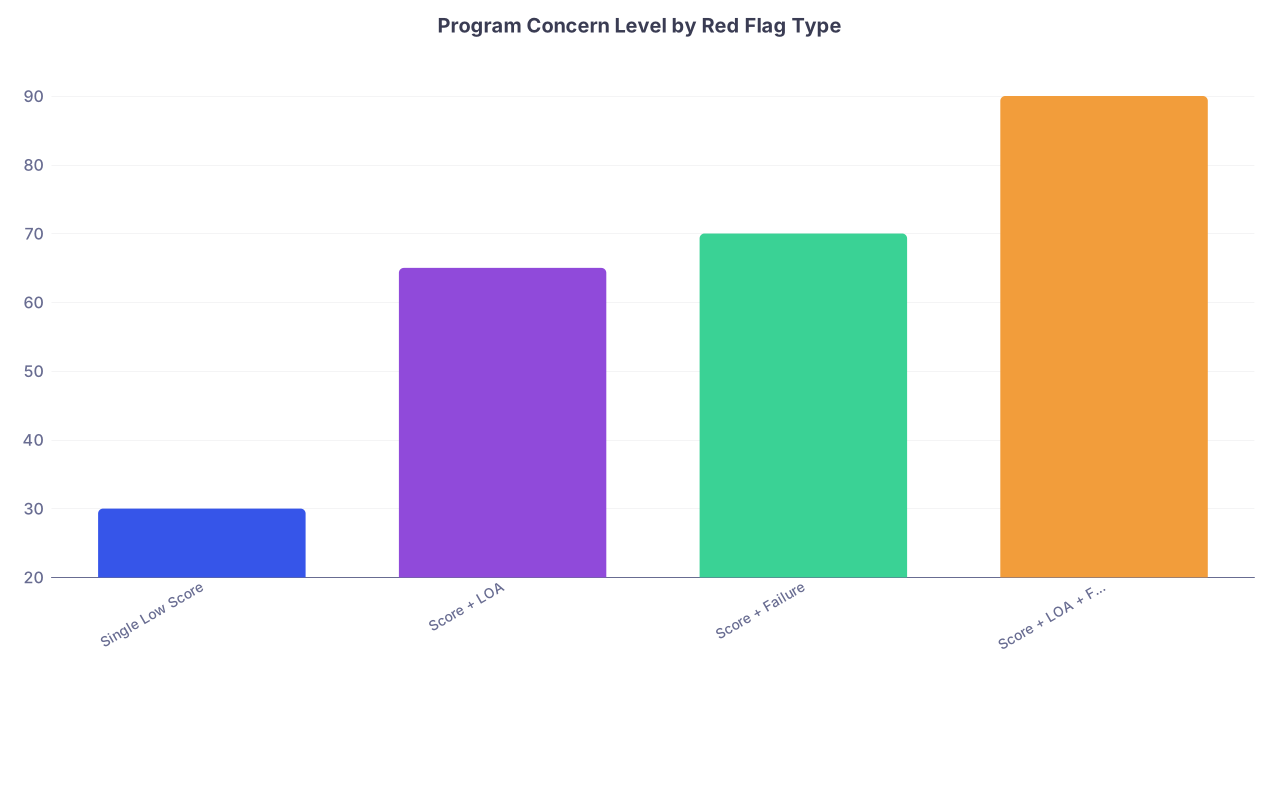
| Category | Value |
|---|---|
| Single Low Score | 30 |
| Score + LOA | 65 |
| Score + Failure | 70 |
| Score + LOA + Failure | 90 |
Here’s the mistake:
Students with a low Step score try to hide these issues or mention them vaguely, hoping programs will “overlook it.” They won’t. Silence looks like you’re either in denial or hiding something worse.
What you must do instead:
Own it directly in your application materials.
Use the Additional Information section or a brief mention in your personal statement, depending on severity. Keep it tight:- What happened (one sentence)
- What you did to address it (1–2 sentences)
- What’s different now (1–2 sentences, with evidence)
Back your explanation with recent proof.
If Step 1 was low but Step 2 is a clear improvement, say that your new score reflects your improved study strategy and time management—and make sure that’s true. If you repeated a clerkship and honored it, that goes in your favor if you highlight it clearly.Avoid the two extremes that kill you:
- Over-defending (“I only failed because the exam was unfair…”)
- Under-explaining (“I had personal issues.” Full stop.)
Programs don’t need a life story. But they do need enough context to feel confident this won’t repeat during residency. If you don’t give them that, your low score becomes the tip of a very ugly iceberg in their minds.
2. Toxic or Vague Letters of Recommendation
When your Step scores are low, your letters either save you or destroy you. There’s not much middle ground.
The red flags you absolutely cannot afford:
- Lukewarm letters packed with generic fluff and faint praise
- Backhanded comments (“Not the strongest test taker…”)
- Comparisons that place you in the “below average” or “middle of pack” bucket
- Letters from people who don’t know you well and clearly recycled a template
I’ve seen app files where the Step 1 was 214, Step 2 was 222, but the applicant matched a solid IM program because their chair letter called them “one of the most reliable and resilient students I’ve supervised in the last five years, particularly in the face of academic challenges.” That’s not luck. That’s deliberate planning.
The most common mistake?
Letting anyone write a letter without knowing exactly how strong and specific it will be.
You avoid this by:
Asking directly: “Do you feel you can write me a strong, supportive letter?”
If they hesitate, that’s a no. Don’t rationalize it.Choosing writers who’ve seen you struggle and improve.
The attending who watched you grind through a hard rotation and get better week by week is a better choice than a “famous” name who barely remembers your face.Making it easy for them to highlight your strengths beyond scores:
Give them:- A short paragraph about your Step challenge and how you responded
- Concrete examples of procedures, complex patients, or leadership roles you took
- Your CV and personal statement draft
Your Step scores will already make PDs question your test performance. Your letters must answer a different question:
“Is this someone I can trust at 2 a.m. when things are falling apart?”
If a letter doesn’t help answer that with a yes, it’s not neutral when your scores are low—it’s a liability.
3. A Personal Statement That Pretends Your Scores Don’t Exist
You don’t have to turn your personal statement into a confession booth. But pretending nothing is wrong when your Step scores are clearly below average is a bad look.
The red flag isn’t the low score itself.
The red flag is the disconnect between your narrative and your record.
Two specific mistakes:
- Writing a generic “I’ve always wanted to be a doctor” essay that could belong to any applicant with a 260.
- Overcompensating with grandiosity—talking like you’re the future of academic medicine while your transcript shows repeated struggles with exams and average clinical grades.
Programs read thousands of these. They can smell denial.
What you should do instead:
Acknowledge your vulnerability briefly and strategically if your score is a major outlier for the specialty. One or two sentences.
Example:
“Standardized exams have never been my strongest measure, as reflected in my Step 1 score. That weakness forced me to build more disciplined study systems, which contributed to a stronger performance on Step 2 and on my core clinical rotations.”Pivot quickly to evidence of growth:
- Improved Step 2 or shelf scores
- Consistent strong evaluations on rotations
- Specific examples of complex patients you managed well
Make your core theme something that reassures programs:
- Work ethic under pressure
- Coachability and response to feedback
- Reliability and follow-through
You’re not trying to convince them your score “doesn’t matter.” It does. You’re showing that your score is not the whole story—and that you know exactly where your weaknesses are and what you’ve done about them.
If your statement feels like a glossy brochure that ignores the elephant in the room, it hurts you more when your numbers are already shaky.
4. Sloppy, Generic, or Mass-Applied Personalization
With strong scores, you can sometimes get away with laziness in your written materials. With low scores? Sloppy is fatal.
The red flags programs notice immediately:
- Misspelling the program or city name
- Referencing the wrong specialty (“I am excited to pursue a career in Internal Medicine” in a Psych application)
- Reusing the exact same paragraph for every program, with obvious copy-paste artifacts
- Writing “Your program” 10 times instead of referencing anything specific

When your scores are low, PDs aren’t hunting for reasons to forgive you. They’re hunting for reasons to move on quickly. A generic or error-filled application hands them that excuse on a silver platter.
You avoid this problem with a system, not willpower.
Here’s a simple structure that helps:
| Item Type | Must-Have Detail |
|---|---|
| Program Name | Correct full name, double-checked |
| Location Detail | One specific thing about region |
| Fit Statement | 1 sentence tying you to that program |
| Specialty Detail | A line showing you understand the field |
You do not need a totally unique statement for every program. That’s fantasy. What you need is:
- A solid base personal statement
- A short, customized paragraph you can swap for each program or region
- A ruthless proofreading pass by another human being
If you can’t be bothered to spell the program name correctly, no one is going to sit there and philosophize about how your 218 could still be “good enough.”
5. Weak or Nonexistent Home/Away Rotations in the Specialty
This one hurts the most in competitive fields (derm, ortho, ENT, plastics, etc.), but it matters everywhere when your scores are low.
Programs are terrified of taking someone who:
- Has never really shown they can function in that specialty’s clinical environment
- Chose it impulsively or late without much exposure
- Could flame out under the real workload
Red flags on ERAS:
- No rotation in the specialty at your home institution and no away rotations
- Only a brief elective, and it’s not recent
- No letters from core faculty in that specialty
- Evaluations that mention concerns about work ethic, reliability, or knowledge base
For a high scorer, some of this can be overlooked. For you, it’s deadly.
You counter this by building a record that screams: “Yes, my scores are low—but in the environment that actually matters, I show up and perform.”
That means:
- Prioritizing at least one strong home rotation in the specialty
- Securing at least one away rotation where you can get a letter (if your school and finances allow)
- Treating every day on those rotations like a month-long interview:
- Early, prepared, proactive
- Reading about your patients the night before
- Accepting feedback without ego and improving visibly
I’ve watched PDs fight for low-score students because their residents said, “This student worked harder than half our interns and fit right in with the team.” That kind of endorsement doesn’t show up by accident.
Missing or weak specialty rotations don’t look like “COVID messed things up” anymore. They look like you never really proved yourself where it counts.
6. Unrealistic Application Strategy and Poor Program List
This one quietly wrecks more low-score applicants than almost anything else.
If your scores are below average, your application strategy is part of your evaluation. Programs won’t see your list, but they will see the outcomes. If you only apply to reach programs and ignore safety nets, you end up unmatched—and then reapplying with a red flag that’s very hard to erase.
I’ve seen this pattern too many times:
- Step 1: barely passing or significantly below specialty average
- Step 2: small bump but still weak
- Student applies to 40–60 programs, but 80% are top-tier university or highly competitive regions
- Few or no community programs, no backup specialty, no preliminary/TY year
- Result: 0–2 interviews → unmatched → now applying as a reapplicant with the same scores plus a new scar
Do not do this to yourself.
You need to be brutally realistic about where your numbers land you:
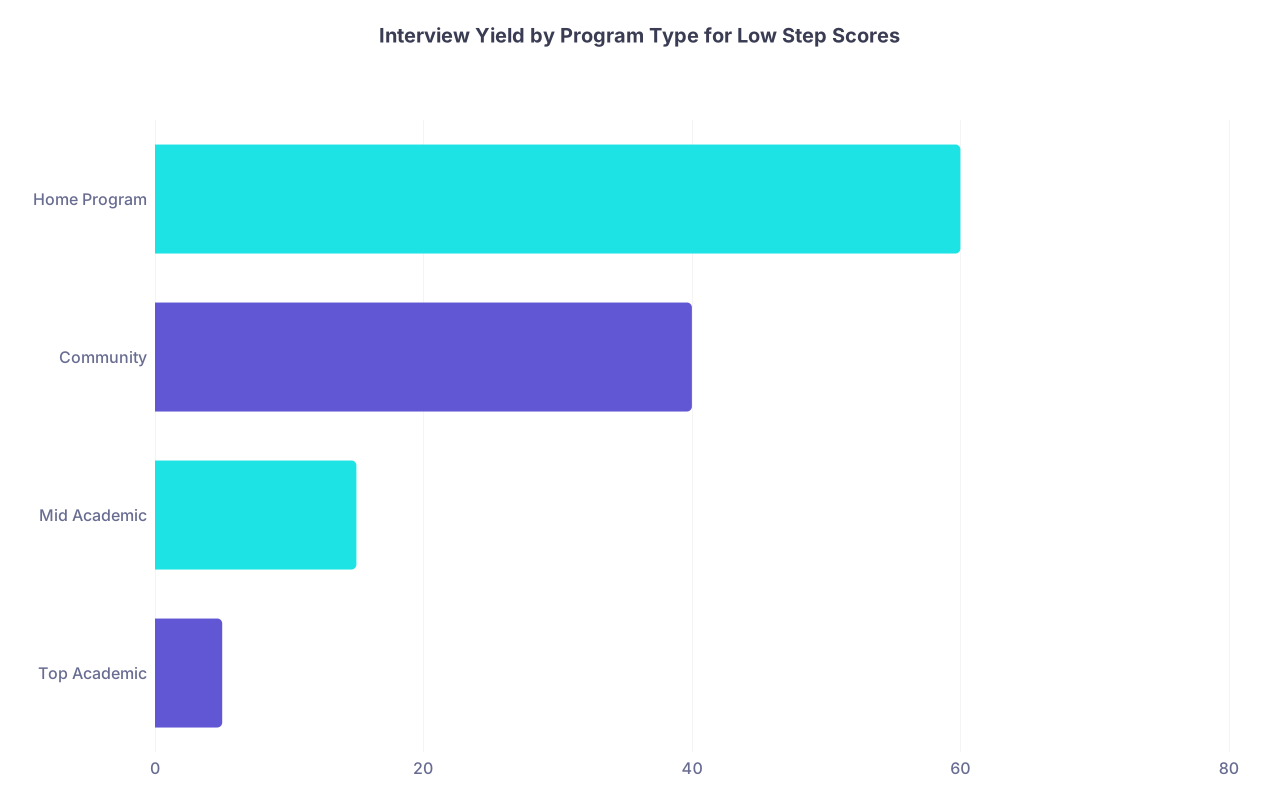
| Category | Value |
|---|---|
| Top Academic | 5 |
| Mid Academic | 15 |
| Community | 40 |
| Home Program | 60 |
Roughly speaking, with low scores you should be:
- Overweighting community and mid-tier academic programs
- Aggressively including programs known to be more holistic or IMG-friendly (even if you’re AMG)
- Strongly considering a backup specialty that aligns with your interests but is less score-obsessed, particularly if you’re far below specialty norms
- Talking to advisors who will actually tell you the truth, not just “follow your dreams”
The red flag here isn’t in ERAS itself; it’s in your outcome. An unmatched low-score applicant looks worse next year than a first-time low-score applicant with a realistic plan.
If you’re not building a program list that matches your score profile, you’re gambling your entire career on wishful thinking.
7. Vague, Defensive, or Dishonest Communication
The final red flag is less about a single document and more about how you present yourself across ERAS, emails, and interviews.
Low Step scores make programs nervous about three things:
- Can you pass future exams (ITE, boards)?
- Can you keep up with the workload?
- Are you self-aware and coachable, or are you going to blame everyone else?
You will confirm or calm those fears with how you communicate.
Red flags that sink you:
- Dodging direct questions about your scores or failures
- Blaming your school, the test, or your schedule without taking responsibility
- Over-explaining with emotional, chaotic stories that make you seem unstable
- Exaggerating experiences or research and then stumbling when asked for details
- Sending needy or aggressive emails before or after interviews

| Step | Description |
|---|---|
| Step 1 | Low Step Score |
| Step 2 | Red flag - not coachable |
| Step 3 | Possible growth story |
| Step 4 | Risk but acceptable |
| Step 5 | High risk - pass |
| Step 6 | How does applicant explain it |
| Step 7 | Recent performance? |
The safe path:
When asked about your scores, answer in under 60 seconds:
- Brief statement of what went wrong
- Clear description of what you changed
- Evidence it worked (Step 2, shelves, rotations)
When talking about challenges, use “I” more than “they”:
- “I underestimated the transition to dedicated study time and didn’t adjust quickly enough.”
- “I realized my approach to learning wasn’t efficient for board-style questions, so I…”
In emails, be concise and professional:
- No long emotional appeals
- No “Please rank me highly” nonsense
- No multiple follow-ups when programs go silent
And above all: Do not lie or embellish.
With low scores, you might feel desperate. Desperation pushes people to pad research, inflate roles, or “forget” to mention that LOA. Programs verify. Residents talk. Faculty remember.
If they catch even one dishonest detail, your low score stops being the problem. Your integrity does.
Pulling It Together: How to Survive Low Scores Without Extra Red Flags
You can’t erase your Step scores. You can absolutely refuse to hand programs more reasons to say no.
Keep these core points burned into your brain:
Control the story, don’t hide from it.
Low scores, failures, and gaps must be acknowledged briefly, owned fully, and followed by concrete proof of growth. Silence is a red flag. So is a 10-paragraph sob story.Every weak area demands a compensating strength.
Low scores demand:- Strong, specific letters
- Solid home/away rotations in the specialty
- Clean, error-free, non-generic application materials
If you’re weak on all fronts, no one will “see your potential.” They’ll just see risk.
Your strategy is part of your professionalism.
An unrealistic program list, late applications, or sloppy communication don’t look like optimism. They look like poor judgment. With low scores, you must be more disciplined, more intentional, and more prepared than the average applicant.
You’re allowed to have a weak test day. You’re not allowed to build a weak application on top of it and call it bad luck.