
What if your low Step score is not the problem—your application strategy is?
Everyone obsesses over the number on their score report. 220 vs 240. Pass vs “high pass.” But I’ve watched more people sabotage their match with a bad strategy than with a bad score.
You can survive a low Step score.
You will not survive a delusional, overreaching, badly constructed application list.
Let’s walk through the ways people blow this—especially those with low scores—and how you’re going to avoid joining them.
The Most Dangerous Myth: “I’ll Just Swing for the Fences”
Here’s the first landmine: the fantasy that a “reach-heavy” list is bold, ambitious, or somehow noble.
What it usually is: suicidal.
I’ve literally seen a student with a 214 on Step 1 and barely passing some core clerkships apply to:
- Dermatology
- ENT
- Ophthalmology
- A sprinkle of “backup” internal medicine programs… all university, all top tier.
Outcome? Zero interviews, SOAP panic, unnecessary trauma.
Let me be blunt: overreaching is not confidence. It’s denial.
How Overreaching Looks in the Real World
A few classic patterns:
- Applying only to university programs in competitive cities (NYC, Boston, SF) with a Step score below those programs’ typical ranges.
- Choosing a highly competitive specialty (derm, ortho, neurosurgery, plastics, ENT, ophtho) with:
- Below-average Step scores
- No research in the field
- Mediocre clinical evaluations
- Tossing in “backups” that are just as unrealistic: major academic centers, big-name institutions, no community programs.
You’ll hear people say things like,
“I know my score is low, but if I apply to 70 programs, one of them has to bite.”
Wrong. Programs are not choosing lottery winners. They’re filtering by criteria.
Here’s what happens with an overreach list: Most of your apps die at the first filter—score cutoff, IMG status, visa needs, gaps in training. They never even see your personal statement.
The Reality You Don’t Want to Ignore: Numbers Still Matter
Yes, Step 1 is pass/fail now (for many of you). Step 2 is not. And older Step 1 scores still live in ERAS.
Programs deny this publicly and use it privately. I’ve sat with attendings scrolling through applications: “Under 220? I don’t have time to look at it this year.”
Not fair? Correct. Real? Also correct.
Typical Score Ranges vs Your Odds
You don’t have to match these numbers to match. But if you’re far below them, you cannot build your list as if you’re “average.”
| Category | Typical Step 2 Range |
|---|---|
| Very competitive (Derm, Ortho, ENT) | 250+ |
| Competitive (EM, Anesth, Rad) | 240–250 |
| Mid-range (IM, Gen Surg, OB/GYN) | 235–245 |
| Less competitive (FM, Psych, Peds) | 225–240 |
Notice what I did not say: “If your score is below these, you’re doomed.” You’re not. But if you’re 215 gunning for ENT with no research and no connections, you’re building a fantasy, not a strategy.
You want to avoid two idiotic extremes:
- “Scores don’t matter at all now that Step 1 is pass/fail.”
- “My score is low, so I might as well give up.”
Both are wrong. The correct position: scores matter, but context matters more. And your list has to reflect both.
The Silent Killer: Underestimating “Fit” When Your Score Is Low
High-score applicants can get away with being lazy about fit. Low-score applicants cannot.
When your numbers are weak, you do not have the luxury of being generic.
Programs that are actually willing to look past scores have patterns:
- They’ve taken applicants from your school before.
- They’re community-based or newer programs with less name recognition.
- They value geographic ties heavily.
- They have a track record of taking “nontraditional” or lower-scoring applicants and turning them into strong residents.
If you ignore those patterns, you’re done.
Example of a Dumb Strategy
US MD, Step 2 = 222, middle-of-the-class clinical grades, no red flags.
Applies in internal medicine to:
- Mass General
- UCSF
- NYU
- Columbia
- Penn
- Hopkins
- Then maybe 10 more “mid-tier” academic hospitals he’s vaguely heard of.
Total apps: ~25.
Here’s the problem: That’s a list for someone with a 245+ and strong research. This person will get filtered out before anyone reads their letters.
They should have:
- 10–15 realistic academic programs (usually mid-tier or lower-tier)
- 20–30 community programs
- Included multiple states and regions where they can articulate some tie or reason to be there
Instead, they spent $700 to get automated rejections.
The Illusion of “Casting a Wide Net”
You’ve probably heard this comforting line: “Just apply everywhere. Cast a wide net.”
On its face, it sounds reasonable. In practice, people misuse it.
Applying to 80 programs that will all auto-screen you out based on score, visa status, or graduation year is not casting a wide net. It’s burning money.
A wide net is only wide if the holes are the right size.
How Programs Actually Filter You
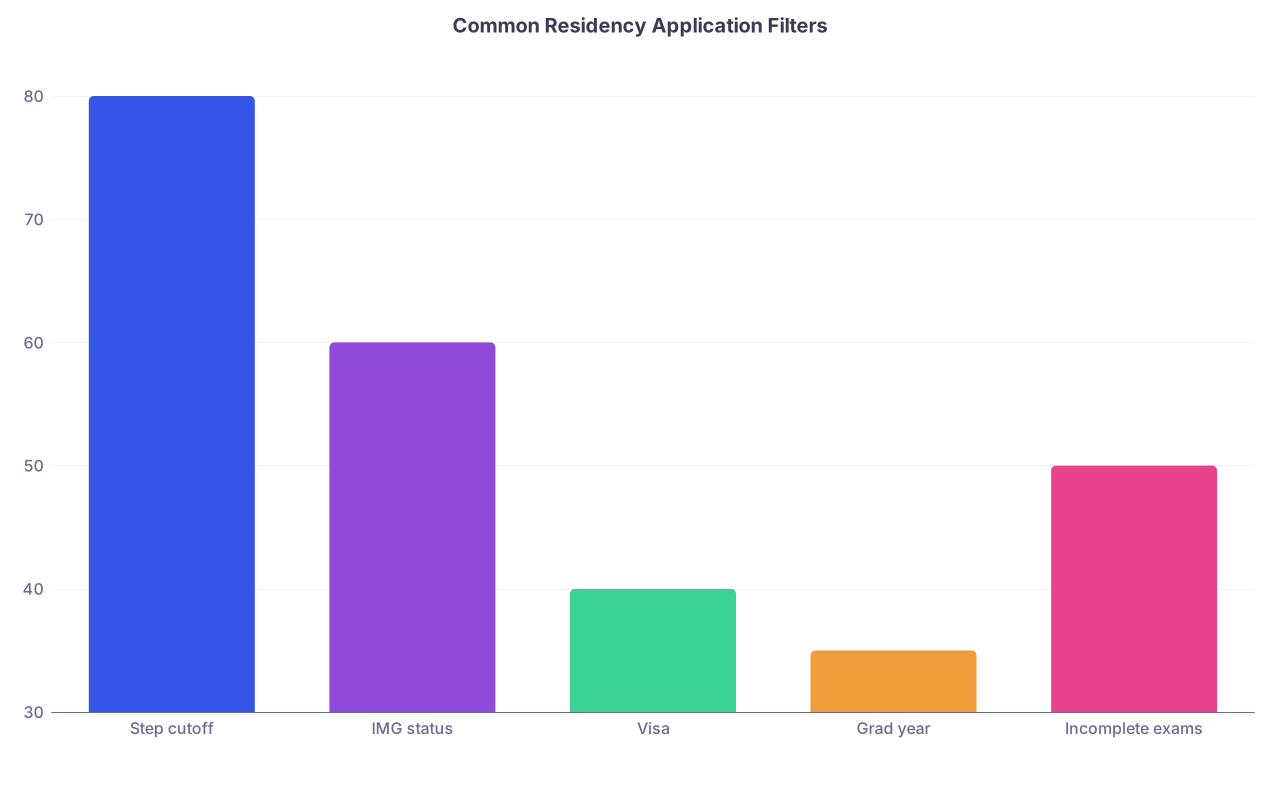
Most programs don’t read all apps. They can’t. They use filters:
- Step 2 minimum (explicit or unofficial)
- Step 1 fail = hard stop for some programs
- Graduation year cutoffs (for IMGs / older grads)
- Visa requirements
- No attempt/score on required Step by a certain date
| Category | Value |
|---|---|
| Step cutoff | 80 |
| IMG status | 60 |
| Visa | 40 |
| Grad year | 35 |
| Incomplete exams | 50 |
(Values = approximate percentage of programs that use this as a major screen in some specialties.)
If 60 of your 80 programs have a Step cutoff above your score, you don’t have a “wide net.” You have 20 real chances and 60 illusions.
You need:
- A lower proportion of reach programs
- A higher proportion of “realistic” programs that historically interview applicants like you
- A few true safeties, especially if your score is significantly below average
Mistake: Single-Specialty Obsession With No Escape Plan
Here’s where I see absolute carnage every year.
Person decides: “It’s ortho or nothing.” Score: 225. Mediocre letters. Light ortho research.
No parallel plan. No prelim backup. No alternative specialty.
Match week: “Nothing.” SOAP chaos. Identity crisis. Months (or years) of lost momentum.
I’m not telling you not to chase a dream. I’m telling you not to tie your entire future to a dream that statistically hates low scores.
Competitive Specialties That Punish Low Scores
We both know the list, but let’s be concrete:
| Specialty | Risk Level with Low Scores |
|---|---|
| Dermatology | Extreme |
| Orthopedics | Extreme |
| Neurosurgery | Extreme |
| ENT | Extreme |
| Plastics | Extreme |
| Ophthalmology | Extreme |
If you insist on one of these with a low score, you must:
- Have a parallel application to a less competitive field
- Or apply for prelim surgical or transitional year spots intentionally
- And be emotionally prepared for a multi-year path, including research years or a second application cycle
The dumb move is pretending you’re an average ortho applicant when your scores and CV say otherwise.
Ignoring Geography: The Quiet Way Strong Applicants Go Unmatched
Low scores narrow your options. Geography narrows them further. Combine the two recklessly and you’re in danger.
A student with a 228 applying only to:
- California
- Boston
- NYC
- Seattle
…is asking for trouble. Those places are hyper-saturated with strong applicants. Programs have the luxury of being pickier.
You avoid this mistake by being strategic with geography, not sentimental.
Think Like a Program Director, Not a Tourist
Programs are more willing to take a chance on a lower score if:
- You have real ties to the area (family, grew up there, partner’s job, prior schooling).
- Fewer high-stat applicants are desperate to be there.
- The program struggles to recruit—smaller cities, less flashy locations.
If you apply with a low or just-okay score and only apply to dream cities, you’re betting your future on winning a popularity contest you’re not even invited to.
Misreading “New” or “Unknown” Programs
Here’s something many low-score applicants get completely wrong.
They want prestigious names, so they ignore:
- Newer residency programs
- Community-based programs without a big academic brand
- Programs outside major metros that you’d have to google to find on a map
But these can be exactly where you still have a shot.
Are some new programs disorganized or poorly run? Yes. Are all of them? No.
The mistake is assuming that no-name = bad and big-name = safe. For a low-score applicant, big-name is often where your application goes to die quietly.
You should:
- Evaluate new/community programs carefully (case volume, faculty stability, ACGME status, board pass rates).
- Include a chunk of them in your list—especially in less glamorous locations.
- Stop acting like your self-worth is tied to brand name.
Delaying Step 2 or Hiding Scores: A Subtle Form of Self-Sabotage
Another big mistake: trying to “protect” yourself by delaying Step 2 or hoping programs won’t notice your weaker result.
Programs notice everything that’s missing.
Typical scenario:
- Student did badly on Step 1 (or barely passed, or is an IMG with older exams).
- Convinces themselves: “If I don’t take Step 2 yet, they can’t filter me out on that.”
- Applies without a Step 2 score to moderately competitive or competitive specialties.
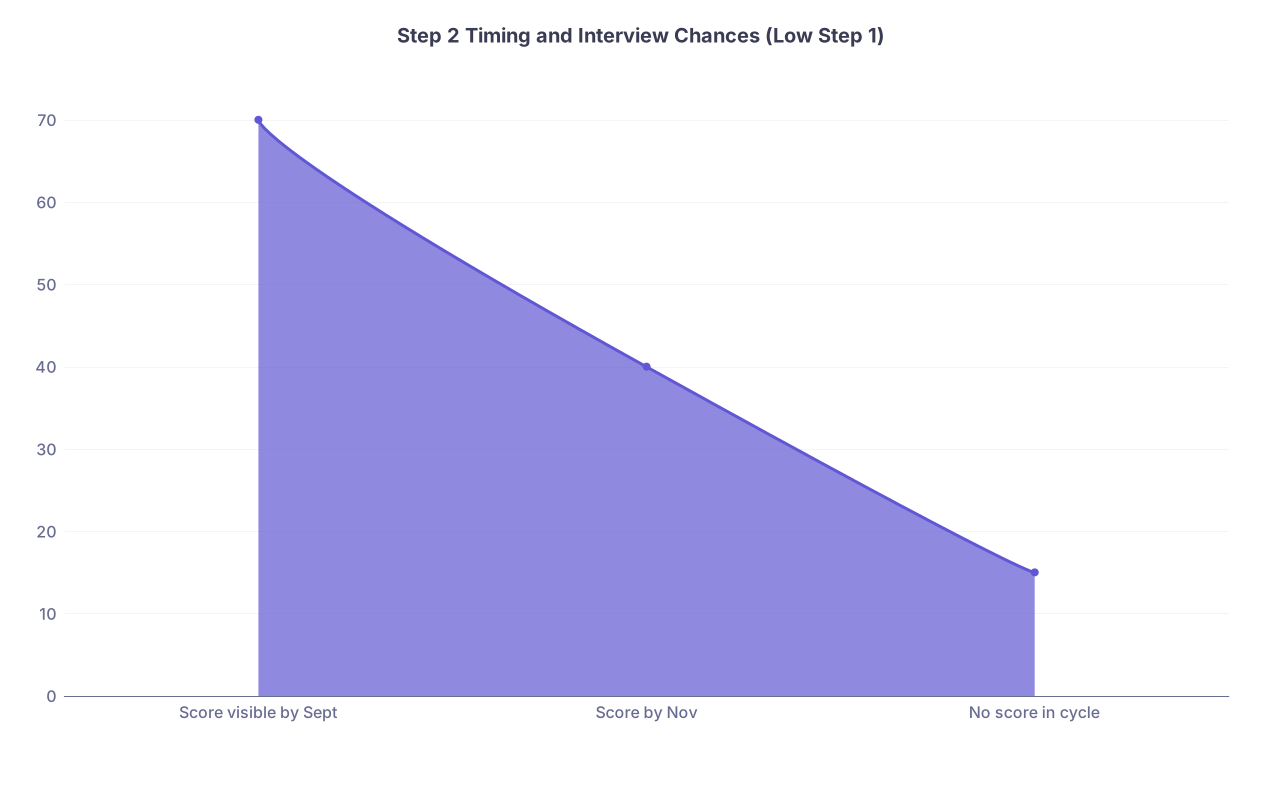
Result: Many programs auto-screen incomplete apps. You just removed the one possible way to prove you’ve improved.
If your Step 1 is weak or you’re pass/fail with a shaky academic record, a solid Step 2 score is your recovery shot. Not taking it early enough to be on your application is a major unforced error.
| Category | Value |
|---|---|
| Score visible by Sept | 70 |
| Score by Nov | 40 |
| No score in cycle | 15 |
(Values = rough relative odds of getting at least some interviews, based on what I’ve seen anecdotally.)
Do not hide. If you need Step 2 to redeem you, get it done early and show the improvement.
Red Flag Blindness: Pretending Your Application Is “Average”
Some of you have more than just low scores:
- Step failure(s)
- Remediation or repeated courses
- Extended time to graduate
- Professionalism concerns
- Leaves of absence
If that’s you and you build a “standard” list like nothing happened, you’re not being brave. You’re lying to yourself.
Programs that are open to any of these issues are fewer. You need:
- More applications, yes—but to the right places.
- Very clear, honest explanations in your personal statement or MSPE addendum.
- Support from advisors who know which programs have historically forgiven similar red flags.
The mistake: ignoring evidence. If three advisors say, “You absolutely need a parallel plan,” and you shrug them off because you “believe in yourself,” that’s not confidence. That’s arrogance disguised as optimism.
SOAP and Backup Plans: Not Planning for the Worst
I’ve watched otherwise smart people enter Match Week like deer in headlights because they never truly allowed “unmatched” into their mental vocabulary.
If your score is low, you plan for that possibility. Not because you’re resigned to failing, but because you’re not stupid.
Minimum safety planning:
- Know which specialties tend to have unfilled spots in SOAP (FM, prelim IM, psych, peds, etc.).
- Know which states/regions often have SOAP vacancies.
- Think through what you would be willing to do if you went unmatched:
- Reapply to a different specialty next year
- Do a research year
- Pursue a prelim year
- Strengthen your application with additional clinical experience
The mistake isn’t going all in on your first-choice specialty. The mistake is acting like there is no world where that doesn’t work.
How to Build a Smart List When Your Score Is Low
Let me pull this together into something practical. Not a formula—just a structure.
Assume you’re a US MD/DO with a Step 2 score of ~225 applying to internal medicine with no major red flags.
A smart-ish list might look like:
- 10–15 academic programs that:
- Aren’t top tier
- Are in regions where your school has sent grads before
- 25–35 community IM programs across multiple states
- A mix of “slightly reach,” “reasonable,” and “safer” choices based on:
- Program fill rates
- Historic interview patterns for your school
- Your geographic ties
If you also have a Step failure, chronic remediation, or are an older IMG, you probably need:
- Higher total application numbers
- More heavy emphasis on community and less in saturated geographic areas
- Much earlier Step 2 (if not already done)
Is that more work? Yes. More expensive? Yes.
But that’s the cost of recovering from a weaker numerical profile.
A Simple Sanity Check Before You Hit Submit
Before you lock in your application list, ask yourself three harsh questions:
- If I removed all the “reach” programs, would I still have enough realistic options?
- Would a brutally honest advisor familiar with my school and my scores say this list is safe, risky, or delusional?
- If this exact list produced zero interviews, would I be surprised—or would I know, deep down, that I overreached?
If your stomach drops when you answer those, fix your list now. It’s much easier to swallow your pride in September than your SOAP outcome in March.

| Step | Description |
|---|---|
| Step 1 | Know your scores and red flags |
| Step 2 | Add parallel less competitive specialty |
| Step 3 | Proceed with primary specialty |
| Step 4 | Prioritize realistic and safety programs |
| Step 5 | Include community and new programs |
| Step 6 | Balance reach vs realistic vs safety |
| Step 7 | Check geography is not overly narrow |
| Step 8 | Confirm Step 2 timing and visibility |
| Step 9 | Prepare SOAP backup plan |
| Step 10 | Competitive specialty? |

The Bottom Line: How Not to Let Strategy Destroy Your Match
Let’s end this cleanly.
If you remember nothing else, remember this:
- Your score is data, not destiny—but you have to treat it honestly. Build your list around your actual profile, not the one you wish you had.
- Overreaching quietly kills your chances. Too many reaches, prestige obsession, and fantasy geography turn your application into a very expensive act of denial.
- Low score = higher need for strategy. More targeted programs, earlier Step 2, parallel plans, and a realistic SOAP backup are not “pessimistic.” They’re how you protect your future.