
It’s late July. ERAS is about to open, and you’re sitting there staring at one number on your transcript like it’s a verdict on your entire career. Step 1 pass with an “average” score. Or worse, a low Step 2 CK. Maybe even a fail on your record.
You’re not thinking about letters or personal statements or clerkship narratives. You’re thinking: “Are PDs just going to toss my application in the trash when they see this?”
Let me tell you what actually happens on the other side of that screen. The conversations that are not in the NRMP Program Director Survey. The stuff attendings say in the workroom when they pull up your application and you are not there to defend yourself.
Because “low Step score” does not mean one thing. It means different things depending on where you’re applying, when you took the exam, and what else you did right (or wrong).
Let’s walk through how PDs really look at low scores—and what you can still do about it.
How Your Application Is Really Screened
First, you need to understand the workflow. Not the glossy brochure version. The tired-assistant-program-director-at-11:30-pm version.
Most programs don’t lovingly “review all applications holistically” the way they claim. They triage.
Here’s the usual pattern in competitive and mid-tier programs:
- Someone (PD, APD, chief, sometimes a coordinator with filters) exports an ERAS spreadsheet.
- They apply a few hard filters:
- Only complete apps.
- Only US grads, or only within 3–5 years of graduation for IMGs.
- Step 2 CK cutoff (if they use one).
- Then they slice by:
- Home students.
- Rotators (audition electives).
- AOA / class rank.
- Known schools vs unknown.
After that, PDs and APDs start actually opening individual files.
That first pass is where low Step scores can quietly kill you—before anyone ever reads your “My journey into medicine began…” essay.
Here’s the part most applicants don’t know: a lot of program directors never even see your name if you’re below their spreadsheet cutoff. Once that filter is set, you’re invisible unless someone specifically goes fishing below the line.
What “Low Step Score” Means in Real Life
You think “low” means “worse than my friends.” PDs think “low” in a much more specific, program-dependent way.
| Program Type | Rough 'Low' Step 2 CK Range |
|---|---|
| Hyper-competitive (Derm, Ortho) | < 245–250 |
| Competitive University IM/EM | < 235–240 |
| Community IM/FM/Neuro/Peds | < 225–230 |
| Safety / Underserved-heavy | < 215–220 |
These aren’t official numbers. They’re the “let’s be honest” ranges I’ve heard PDs use in real meetings.
Huge point: PDs talk about “low” relative to their usual applicant pool, not relative to the national mean. A 228 looks different at MGH Internal Medicine than at a small community IM program in the Midwest.
Also, the Step 1 pass/fail change reshuffled how they think:
- Now Step 2 CK is the de facto standardized academic bar.
- A marginal Step 1 pass combined with a strong Step 2 (say 250+) is massively redeeming.
- A low Step 2 with a pass Step 1 and lukewarm clerkships? That’s a problem they cannot ignore.
The 4 Main “Buckets” PDs Put Low Scores Into
I’ve sat through enough rank meetings to tell you: PDs don’t just see “low score.” They mentally classify you into one of a few stories.
1. The “One-Bad-Day” Story
Example: Strong preclinical performance, honors in core clerkships, strong narrative comments—then a 220 on Step 2 CK when most of your peers are at 240+.
What PDs say behind closed doors:
- “We’ve both had bad test days. Look at their evals. This is probably not a cognitive ceiling.”
- “Everything else is solid. I’m not worried about them passing boards.”
Programs that buy this story:
- Most academic IM, peds, neuro, EM.
- Some surgical programs if everything else sings and you have strong letters.
Key: The rest of your file has to loudly contradict the low score. If the exam is the only weak point, PDs are surprisingly forgiving.
2. The “Pattern-of-Underperformance” Story
Example: Average or below-average basic science grades, marginal clerkship evals (“meets expectations”), no honors, and a 218 Step 2 CK.
What PDs actually think:
- “This is not just the exam. This is their level.”
- “We’re going to be fighting to get them through in-service exams and boards.”
This is where a low score hurts the most. Not because of the number itself, but because it confirms a pattern.
Here, PDs worry about:
- ACGME milestones.
- Board pass rates (yes, their pass rate is tracked and compared; they care).
- Needing remediation resources that the program doesn’t have.
3. The “Red-Flag” Story (Fails, Remediations, Multiple Attempts)
This is a different category. A fail is not “low.” It’s a red flag that triggers explicit discussion.
Common PD reactions:
- “What happened?”
- “Did they learn from it?”
- “Have they clearly turned it around, or are we inheriting a problem?”
A Step fail with later strong performance (e.g., fail Step 1, pass on second attempt, then 245 on Step 2, strong clerkships) is not a death sentence. But you will be discussed, explicitly, in meetings.
Programs differ here more than anywhere else:
- Some university programs: automatic screen-out for any fail.
- Many community programs: willing to consider if the narrative and later data look good.
- Underserved-focused/safety-net programs: often the most flexible if you show grit and mission fit.
4. The “Overachiever-Except-This” Story
This one is rarer but interesting.
Example: Gold Humanism, stellar leadership, big-name research, great narratives, but a 225 Step 2 CK.
I’ve heard actual quotes like:
- “How are they this impressive with that score?”
- “Maybe they overextended. Maybe they’re not a test-taker. But I like them.”
At some programs, this is a net positive. You look like someone who doesn’t reduce to a number. The problem is at ultra-competitive fields where scores are used as a lazy first-pass filter—your file might never be opened to appreciate the rest.
Specialty-Specific Truths About Low Scores
You already know some specialties are brutal. Let me spell out, bluntly, how low scores are actually treated.
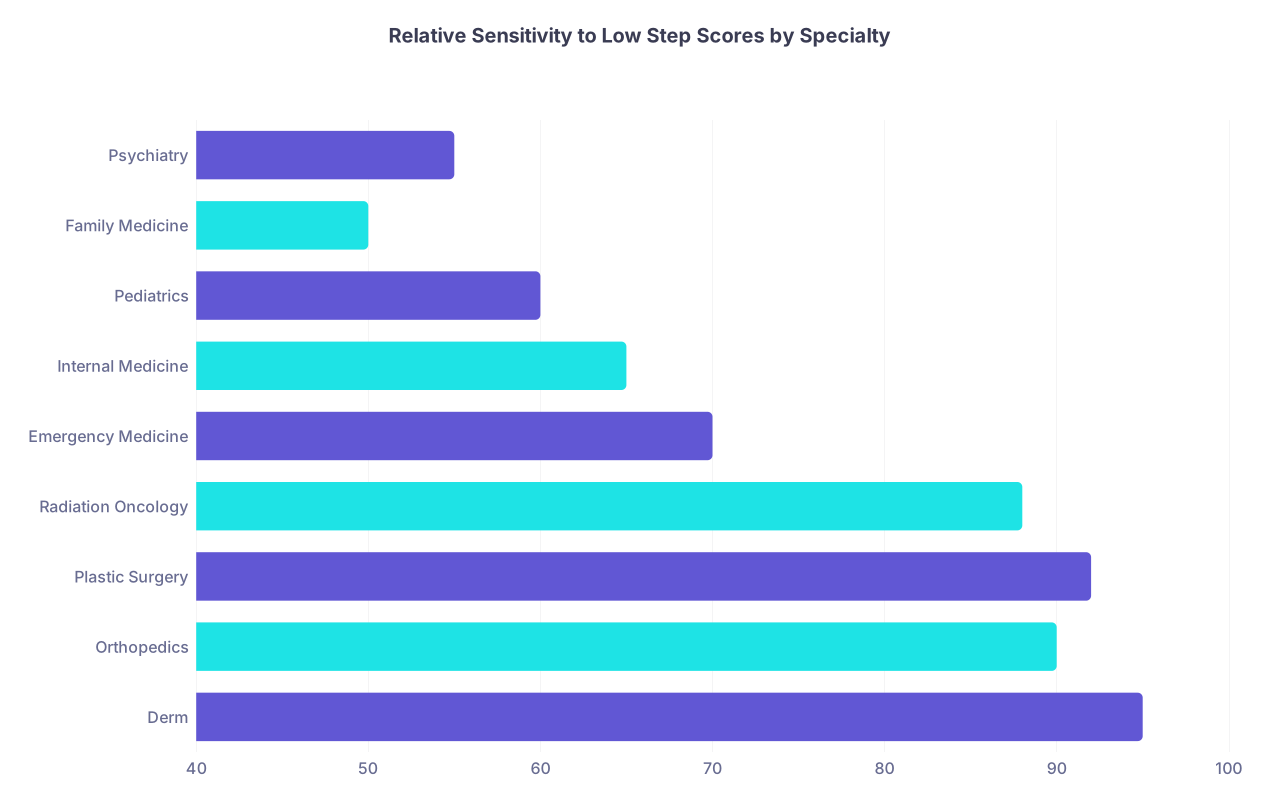
| Category | Value |
|---|---|
| Derm | 95 |
| Orthopedics | 90 |
| Plastic Surgery | 92 |
| Radiation Oncology | 88 |
| Emergency Medicine | 70 |
| Internal Medicine | 65 |
| Pediatrics | 60 |
| Family Medicine | 50 |
| Psychiatry | 55 |
Surgical Subspecialties (Ortho, Plastics, ENT, Neurosurgery)
This is where low scores hurt the most. PD mindset is pretty consistent:
- They’re flooded with applicants with 250+.
- They use score cutoffs aggressively to cut down the stack.
- Even with stellar research and connections, a truly low score (<235) is a serious drag.
I’ve literally watched an ortho PD say: “We have 400 apps with 250+; I’m not spending time below 230 unless someone calls me personally.”
Brutal, but honest.
With a low score here, your realistic options:
- Apply VERY broadly.
- Lean hard on away rotations and personal connections.
- Have a true backup specialty you’d actually be OK with.
Internal Medicine (Academic vs Community)
Academic IM (think big-name university programs):
- Step 2 CK is heavily weighted but not everything.
- A 225–230 isn’t ideal, but strong clerkships, research, and letters from known people can compensate.
- Score cutoffs tend to be around 220–225 at many places; the truly elite ones are higher.
Community IM:
- Much more flexible as long as there’s no fail and you look reliable.
- They care about: Can you function on day 1? Are you likely to pass ABIM?
I have seen IM PDs rank applicants with 215s over 245s because they trusted their work ethic and bedside behavior from an audition rotation.
Family Medicine, Psychiatry, Pediatrics
This is where low Step scores are least toxic.
PD thinking here:
- “We’re not running a test-prep factory. We want people who will show up, be kind, and not disappear.”
- “If the score is low but they have strong evals and clear interest in this field, I’m fine.”
Red flags (unexplained fail, unprofessionalism, no commitment to the specialty) matter more than raw numbers.
For FM and Psych especially, personal story and fit genuinely matter. It’s not just brochure talk.
Emergency Medicine
Pre–Step 1 pass/fail, EM was getting more score obsessed. Now it’s more about:
- SLOEs (standardized letters) — these absolutely dominate.
- How you did on EM rotations.
- Step 2 CK still matters, but a low score with strong SLOEs can get plenty of interviews.
I’ve heard EM PDs say, “I’ll take a 225 with a strong SLOE from a trusted faculty over a 250 with a lukewarm SLOE any day.”
What PDs Look For to “Offset” a Low Score
This is where most students get it wrong. They try to write an emotional personal statement to “explain” their score. PDs do not care about your “test anxiety” paragraph. They care about evidence.
Here’s the real offset calculus.
1. Shelf Exams and Clerkship Grades
PDs notice if:
- Your Step 2 CK is low, but your shelves were fine/honors.
- Your core rotations are all high pass/honors with strong narrative comments.
That suggests the exam isn’t reflecting your day-to-day performance.
Conversely, if your shelves were barely passing and your Step 2 is low, there’s no counter-narrative. That’s when they say, “This is their level.”
2. Strong, Specific Letters (Not Generic Fluff)
A letter that says:
“Despite a below-average board score, I am not at all concerned about this student’s ability to pass internal medicine boards. They consistently demonstrated strong clinical reasoning and initiative. I would be delighted to have them as a resident.”
That line alone has literally flipped discussions in ranking meetings. I’ve watched it happen.
PDs read between the lines. If nobody is willing to directly vouch for your cognitive ability, your low score is going to carry more weight.
3. Clear Trend Upwards
If you had:
- Weak preclinical, then strong clinical.
- Poor early exams, then better shelves.
- Step 1 trouble, then strong Step 2.
PDs love that line: “They improved every year.” It tells them you adapt and can climb.
If everything is flat or trending downward, they get nervous.
4. Extra Work That Shows You Can Handle Complexity
Research, QI projects, substantial teaching roles—these help only if they’re real and substantial.
A PD is more impressed by:
- “Led a multi-site QI project that changed clinic no-show rates.”
than:
- “Third author on a case report.”
They’re looking for signal that you can handle responsibility, not more filler lines on ERAS.
How to Talk About a Low Score (Without Digging the Hole Deeper)
You will be tempted to over-explain. PDs hate that.
A few case-based approaches, straight from interview rooms.
Scenario 1: One Low Score, Everything Else Solid
What you say if asked:
“I was disappointed with that score. I think it reflected more of my test-taking than my actual clinical ability. Since then, I’ve focused on X, Y, and Z, and you can see that my clerkship performance and shelf exams were significantly stronger. I feel very confident about handling in-service and boards.”
Short. Honest. Then move on.
What you do NOT do:
- Launch into a 5-minute saga about anxiety, family drama, or a breakup.
- Blame the school, the exam, the pandemic, or anything else.
Scenario 2: A Fail on Step 1 or Step 2
You have to own it, but with a clear turning point.
“I failed Step 1 the first time. That was a wake-up call. I changed how I studied, I met with faculty, and I structured my time differently. I passed on the second attempt, and since then I’ve passed all shelves on the first attempt and scored X on Step 2. I’m not proud of that failure, but I am proud of how I responded to it.”
The key is to have actual data showing improvement. If Step 2 is also low, the story gets much harder to sell.
Strategic Moves If You Already Have a Low Step Score
Let’s talk tactics. Because hand-wringing doesn’t change your score, but a few smart decisions can dramatically improve your match odds.
1. Fix Step 2 CK If It Is Not Taken Yet
If Step 1 was marginal or you’re anxious about performance, PDs are unbelievably clear about this one thing:
Do not rush Step 2 CK just to “get it in early” if your practice scores are trash.
They would rather see:
- A later, stronger score (even if it delays some invites)
than:
- An early, weak score that locks their perception of you for the entire cycle.
2. Target Programs Strategically (Not Just by Name)
Here’s what PDs won’t tell you publicly: not all “university programs” are actually more competitive than all “community programs.” There’s a pecking order inside each region that everyone in the region knows.
| Program Label | How PDs Quietly See It |
|---|---|
| Big-name University | High score bar, national draw |
| Mid-tier University | Regional, somewhat flexible |
| Large Community | More holistic, scores moderate |
| Small Community | Very flexible, need warm bodies |
Your best bet with a low score:
- Apply heavily to large and small community programs.
- Include some regional mid-tier universities where you have ties.
- Do not waste your entire budget on the top 10 glamorous programs unless you have unique leverage (home student, huge connection).
3. Use Away Rotations Intelligently
Audition rotations can absolutely override mediocre scores—if you perform like a star and the PD values resident input.
I have seen:
- EM and IM programs take 220-range applicants over 250s because the low-score applicant was outstanding on rotation and beloved by residents.
But this only works if:
- The rotation is at a place that actually interviews rotators.
- You explicitly signal you’ll rank them highly.
- You show up early, stay late, and actually help.
If your score is low and you’re doing an away just “for fun” at a place you’d never realistically go? You’re wasting time.
4. Craft a Specialty Backup That’s Real
PDs can smell a fake backup. FM PDs hate being the “plan B dumping ground” for sad failed derm applicants.
If your score threatens your chances in a hyper-competitive specialty:
- Pick a backup you can articulate a genuine interest in.
- Get at least one letter specifically in that specialty.
- Put real effort into those applications; don’t make them obviously half-baked.
What PDs Really Fear About Low Scores
Here’s the uncomfortable truth.
Direct quotes I’ve heard in meetings:
- “If they fail boards, that’s a black mark on our program.”
- “We don’t have the faculty time to remediate someone who can’t pass exams.”
- “I don’t want to be dealing with probation or remediation paperwork for three years.”
The fear is not that you’re dumb. It’s that you’ll be high-maintenance from a regulatory standpoint.
So your entire job, with a low score, is to show them:
- This is not a pattern.
- You have improved.
- You’ve already done the work to fix the underlying issues.
- People who worked with you clinically don’t share those fears.
Do that convincingly, and your low score turns from “deciding factor” into “footnote.”

| Step | Description |
|---|---|
| Step 1 | See Low Step Score |
| Step 2 | Red flag discussion |
| Step 3 | One-bad-day story |
| Step 4 | Take a chance if fit is good |
| Step 5 | Screen out or low rank |
| Step 6 | Any fails or multiple attempts |
| Step 7 | Clerkships and shelves strong |
| Step 8 | Strong letters vouch? |
| Step 9 | Improvement later? |
The Bottom Line
A low Step score closes some doors. It does not close all of them. The biggest difference I’ve seen between the student with a 220 who matches and the one who doesn’t is not “luck.”
It’s whether they:
- Faced the number honestly.
- Built a realistic list.
- Got people to vouch for them in writing.
- Put themselves in front of programs where they actually had a shot.
You are not your Step score. But if you pretend it does not matter at all, you’ll behave like it doesn’t matter—and that’s how you get burned.
Face it, then build around it.
With that mindset, you can still carve out a residency you’re proud of. The next step, once you’ve accepted your score reality, is lining up the right mentors and rotations to give programs a different story to believe about you. That’s your job for this season. The interview trail—and how to win those rooms even with a weak number on your transcript—that’s a story for another day.