
It’s late February. The interview dinners are done, the thank‑you emails are sent, and your ERAS portal is finally quiet. Somewhere in a windowless conference room, your name is on a screen in front of a program director who has been staring at applicant files for eight straight hours.
You know your weak spot. A low Step 1 before pass/fail. Or a Step 2 CK that’s 15–20 points below the program’s “average.” You’re staring at your own rank list at home, but what you really care about is their list.
What are they saying about you in that room? Is your score going to sink you? Or are they willing to “forgive” it?
Let me tell you what really happens.
What Rank Day Actually Looks Like
Most applicants have a fantasy that ranking is this super precise, data‑driven process. Some algorithm behind an algorithm. It is not. It’s a pretty human, pretty messy, pretty political meeting.
Here’s the real anatomy of a typical rank meeting for a mid‑to‑large residency program:

| Step | Description |
|---|---|
| Step 1 | Start Rank Meeting |
| Step 2 | Set cutoffs and tiers |
| Step 3 | Review auto ranked list |
| Step 4 | Move up or down |
| Step 5 | Leave as is |
| Step 6 | Finalize list |
| Step 7 | Submit to NRMP |
| Step 8 | Borderline candidates |
There’s usually:
- A program director (PD) running the show
- 2–8 core faculty who interviewed you
- Maybe a chief resident or two
- Occasionally a coordinator in the back keeping track of the spreadsheet and NRMP rules
By the time they walk into that room, there’s already a “draft” rank list generated. That draft is built off some combination of:
- Interview scores
- File review scores (sometimes from before interviews)
- USMLE scores and class rank / MSPE tier
- Subjective comments (“amazing”, “awkward”, “would not want on nights”)
They do not open 400 files from scratch. They start from a list and then start arguing about the edges.
And that’s where your low Step score lives: at the edges.
Where Step Scores Actually Show Up In Their Heads
On paper, every program will parrot the same thing: “We review applications holistically. Scores are only one part of the application.”
I’ve sat in enough ranking meetings to translate that for you:
- Scores are a gate for some programs.
- Scores are a tie‑breaker for almost all programs.
- Scores are a convenient excuse when someone just doesn’t like a candidate but doesn’t want to say it out loud.
For most academic internal medicine, general surgery, EM, OB‑GYN, anesthesia, and rads programs, there’s some kind of internal, not‑public “comfort zone” for Step 2 CK. They know exactly what it is. They just won’t print it on the website.
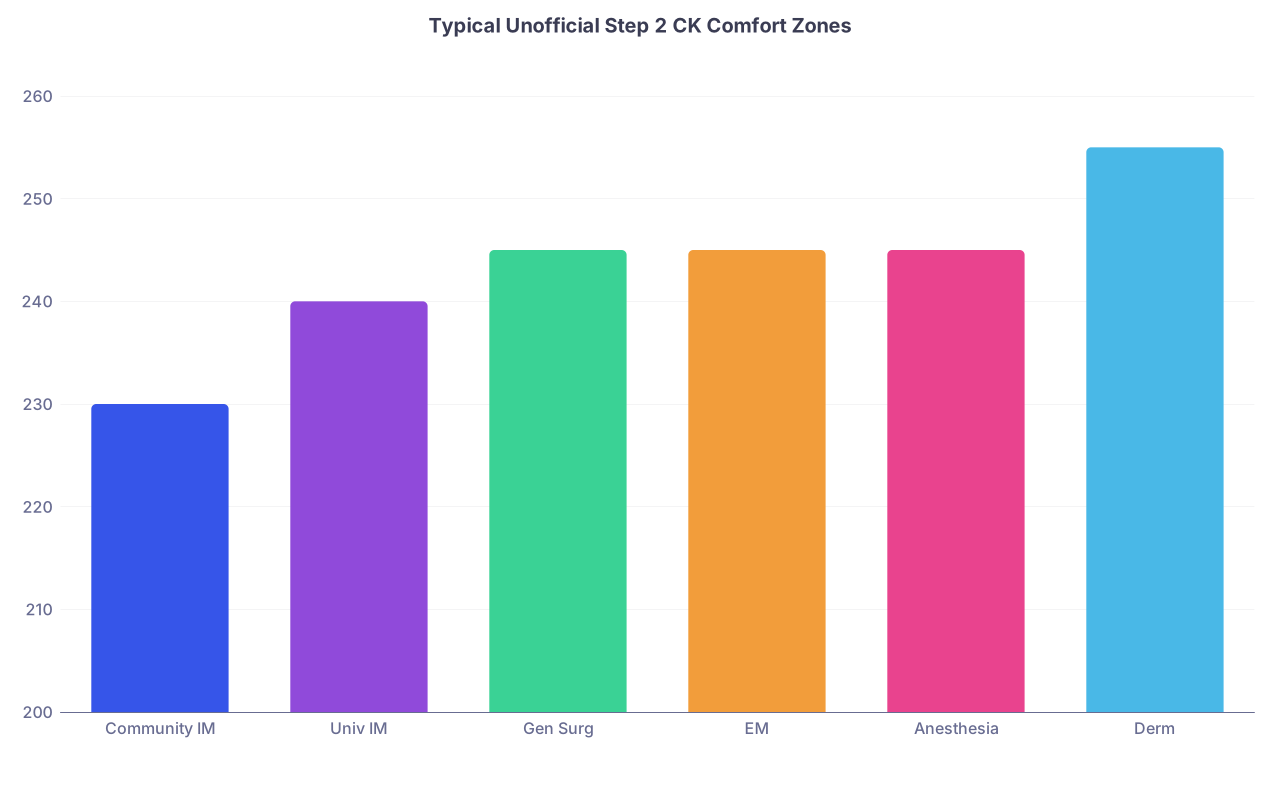
| Category | Value |
|---|---|
| Community IM | 230 |
| Univ IM | 240 |
| Gen Surg | 245 |
| EM | 245 |
| Anesthesia | 245 |
| Derm | 255 |
Those aren’t hard cutoffs. They’re psychological zones. Below that, you’re under the microscope. Above that, your score basically stops mattering unless you’re in the 260+ “wow” range.
On rank day, nobody is saying:
“Her Step 2 CK was a 234. We cannot rank her.”
The conversation sounds more like:
“She was great in person. Score’s a little soft for us, but her letters are fantastic.”
“Yeah, I really liked her on interview day. I’d be comfortable putting her in our second tier.”
Or the opposite:
“He was kind of quiet, and with that 225, I’m not sure he can handle our call schedule.”
“Agree. Let’s leave him where he is. We have plenty above him.”
Your Step score becomes either a liability they have to consciously override, or a reason not to fight for you.
How They Actually Talk About A Low Step Score
There are a few standard narratives that show up every single year. I’ve heard these lines more times than I can count.
1. “Low but trending up”
This is the narrative you want.
Example scenario: Step 1 = 205, Step 2 CK = 234. Borderline for an academic IM or EM program, but not catastrophic.
You’ll hear:
“Step 1 was low, but Step 2 is respectable. Looks like they figured it out.”
“And their clerkship comments are strong. I’m not worried they’ll flunk our in‑service.”
That “upward trend” buys you a lot of forgiveness. If your letters talk about improvement, maturity, or “came into their own on the wards,” faculty will explicitly say: “Story fits the numbers.”
If you have a low score and your later pieces are stronger, that’s the story they build around you, if someone is willing to advocate.
2. “Outlier in an otherwise strong file”
This is the second‑best story.
Example: strong school, honors in key rotations, glowing letters, solid research, but Step 2 CK is 228 at a program where their usual is around 240–245.
Discussion:
“Score is lower than our average, but everything else is strong.”
“Yeah, I’d feel okay ranking them in the middle. Just not in our top 10.”
You still get on the list. You just lose altitude. This is where many good applicants with one weak score end up: still ranking, just not as high as their interview performance alone would suggest.
3. “Pattern of concern”
This is where things get ugly.
Pair a low score with:
- Repeated clerkship “needs improvement” comments
- A failed shelf
- A remediation or LOA
- Vague or lukewarm letters
You’ll hear things like:
“Between the 214 and the marginal comments in surgery, I’m worried about performance.”
“We do not have the bandwidth for someone who’s going to struggle with the boards and on service.”
This is when your score becomes the anchor dragging you down the list or off it entirely. Notice it’s almost never just the score. It’s the score plus something that confirms the worry.
4. “We can take a chance here” (often for home or rotator students)
This is the exception that everyone swears doesn’t exist. It absolutely exists.
Every year, someone with an objectively low Step score (I’m talking 210–220 range at relatively competitive programs) lands a solid spot. Why?
Because the conversation in the room goes like this:
“Her Step is low, but she destroyed our sub‑I. She knows how we work. Residents loved her.”
“Yeah, I’m fine with that. She’s basically already part of the team.”
Or:
“He’s a home student, great fit, and he’ll work his ass off for us.”
“We owe it to our own.”
Nobody will say this publicly, but being known and trusted massively blunts a low score. They’ll still drop you a tier compared to if you had a 250, but they won’t drop you off the list.
Where Score Cutoffs Actually Hit: Before Rank Day
Here’s the brutal truth: for most programs, your score hurts you long before rank day.
The worst damage happens here:
- When they decide who to interview
- When they build the initial rank file before the full committee meeting
By the time they’re in that conference room, the low‑score applicants have already been filtered down to:
- People with some strong redeeming feature (home, rotator, special letter, diversity priorities)
- People who just made the cutoff and interviewed decently
- People someone specifically wants to discuss
Everyone else? They never make it to the “should we move this person up or down?” part of the meeting.
So if you’re in the room at all—meaning you interviewed and you’re on the preliminary rank list—you’ve already jumped the first wall.
That matters more than people realize.
What Low Scores Do To Your Tier
Most medium‑to‑large programs think in tiers even if they don’t call them that. Top, middle, bottom, and “don’t rank.”
Think of something like this:
| Tier | Typical Description | How Low Scores Play In |
|---|---|---|
| Tier 1 | “Automatic rank high” – stars, standout interviews, often 240+ | Low scores almost never here unless a major insider |
| Tier 2 | “Solid gets” – we’d be happy if they match here | Low scores allowed if upward trend + strong fit |
| Tier 3 | “Backup” – fine but not exciting or with concerns | Low scores common; need strong redeeming factor |
| NR | “Do not rank” – risk or bad fit | Very low scores plus other red flags often end here |
A low Step score is rarely a “do not rank” by itself unless it’s way out of sync with the program’s usual floor (e.g., <210 for a reasonably competitive university program) and there’s no offsetting strength.
Much more often, here’s what happens:
You give a Tier 1 interview with Tier 1 letters but a Tier 3 score. They compromise and drop you in Tier 2. Or they like you but are uneasy, so you slide from a potential Tier 2 into Tier 3.
Important detail most applicants don’t realize: even being in Tier 3 still gets you ranked. And in many specialties and programs, people from that “backup” tier match there every year.
You don’t need to be their favorite child. You just need to be above the people you’re competing with.
The Voices That Matter Most In That Room
On rank day, not all voices are equal. Who talks about you—and how strongly—matters more than your three‑digit score.
The people whose words move you up despite a low score:
The program director
If the PD says, “I liked this applicant,” you’re staying ranked. Full stop.
If the PD says, “I’m worried about them,” it’s over.Your strongest interviewer
Programs often have each interviewer “own” a set of applicants. If your primary interviewer really connected with you, you’ll hear:“This was one of my favorites. Score is lower than average, but I think they’ll be great here.”
That single sentence can erase 10–15 points of Step deficit.A respected faculty advocate
That letter writer you thought was just a name on a page? If they are well‑known to the PD (“Oh, Laura wrote them a letter? She doesn’t write strongly for many people”), your low score gets selectively ignored.A chief resident who worked with you
Chiefs don’t control the room, but they influence vibes.“We loved working with them on wards. Always prepared, always early, very teachable.”
Turns a 225 from “risk” into “probably fine.”
So what happens if no one really speaks for you? Then your score defaults to “average weight” again. Which, if it’s low, quietly pushes you down the list.
How Programs Justify Ranking You Despite A Low Score
Here’s what the internal logic sounds like when they decide to rank you higher than your score “deserves”:
“We’re not trying to win the in‑training exam. We’re trying to get good residents who fit our culture.”
“Scores predict board passage, not bedside manner. We can teach them test‑taking.”
“We’ve had residents with 260s who are disasters on the wards. I’ll take someone with a 225 who works hard and is normal.”
That last one comes up a lot. Every PD has a story of a “high scorer meltdown.” They remember those vividly. So when someone argues for you—low score but strong performance—they can anchor to a negative memory of a high scorer who failed clinically. That’s your best friend.
Your job, long before rank day, is to give them enough ammunition that someone in that room can say:
“Listen, I know the number isn’t great, but everything else points the right way.”
That means:
- Rock-solid letters that specifically talk about work ethic, teachability, and growth
- A personal statement that doesn’t sound like AI sludge and that acknowledges adversity without turning into a pity party
- An interview that makes people say “fit” and “easy to work with” behind closed doors
When those are in place, a low score becomes a narrative beat instead of the whole story.
How You Can Shift The Conversation Before Rank Day
You don’t get to sit in that room. But you can influence what they say about you when the door closes.
If you’re carrying a low Step score, your strategy should be very deliberate:
1. Make Step 2 your redemption arc (or OET/COMLEX counterpart)
If Step 1 is your problem and you haven’t taken Step 2 yet: this is your one chance to rewrite the story. A 20‑point jump changes everything.
Do not schedule it during your heaviest sub‑I. Do not wing it because you’re “tired of studying.” Programs look at Step 2 more heavily now anyway, and for you, it’s your lifeline.
If Step 2 is also low, then you lean even harder on the other pieces: sub‑Is at target programs, in‑person performance, networking, and absolute top‑tier letters.
2. Engineer at least one strong in‑person ally
Away rotations are not about “exposure to another system.” They’re auditions. For you, with a low score, they’re essentially your only chance to override the number.
On an away or home sub‑I, you want at least one attending or chief who will say on rank day:
“I worked with this person closely. They’re better than their score. I’d be happy to have them in our program.”
That sentence is worth more than 10–15 score points.
3. Control the narrative in your MSPE and personal statement
You don’t need a sob story. But you can’t pretend a 202 Step 1 that jumped to 236 Step 2 doesn’t exist. If your school dean’s letter or your statement briefly references growth, maturity, or changing study strategies, it pre‑packages the explanation in a way PDs can accept.
Bad: “I am not good at standardized tests.”
Better: “My early exam performance did not reflect my eventual clinical strengths, and I sought structured feedback to improve. The result is evident in my subsequent scores and clerkship evaluations.”
You’re handing them the language they’ll use about you. Give them something clean.
4. Be the resident they want at 2 a.m., not the Step number on the spreadsheet
On interview day, your mission is simple: make it very easy for someone to picture you on their team.
That looks like:
- Actually answering questions like a human being, not reading a script in your head
- Showing insight into your own weaknesses and how you’ve worked on them
- Asking questions that prove you understand residency is hard work, not a victory lap
If they walk away thinking, “I could handle a night float with this person,” your low score starts to fade into the background.
What Happens To You On That Screen
Let me pull back the curtain on the actual moment your name comes up.
There’s a spreadsheet. Or a rank‑list software screen. Your name is sitting next to a bunch of numbers: interview score, Step 1/2, maybe a “file score,” plus some comments.
They scroll.
Your name appears in a cluster of similar borderline or mid‑range applicants. They pause. If someone remembers you, they say something. If no one does, you live or die by the numbers.
Someone might say:
“Remind me about this one… oh right, the 228 Step 2, but great letter from Dr. X.”
Quick back‑and‑forth. Thirty seconds, maybe a minute. You either move up 5–10 slots, stay where you are, or get nudged down.
It feels brutal to describe, but that’s how it works. It’s not a philosophical debate about your worth as a human being. It’s:
“Is this person safe?”
“Will they fit?”
“Do I remember anything good or bad about them?”
Your score is just part of the shorthand for “safe.” Everything else—the stuff you poured yourself into over four years—is the shorthand for “fit.”
On that day, behind those closed doors, nobody is shocked that some good people with low scores will fall further down the list than they deserve. They also know some people with mediocre people skills and great scores will scan higher than they should.
That’s the game you walked into.
Years from now, you will not remember the exact words some tired attending said about your Step score in a windowless room. You’ll remember that, in spite of all that quiet judgment, you still found a place to train, to grow, and to prove that a three‑digit number was never the whole story.