
The biggest myth about low Step scores is that your application “speaks for itself.” It doesn’t. People speak for it. Or against it. And the ones who matter most are your faculty champions behind those closed selection committee doors.
Let me walk you through what really happens when your 214 or 221 or barely-passed Step score pops up on the screen in a residency selection meeting—and how a single well-positioned attending can literally pull you back from the reject pile while everyone else is ready to move on.
What Actually Happens in Selection Meetings (Not the Brochure Version)
You’ve seen the public-facing version: holistic review, mission fit, “we look at the whole applicant.” That’s the marketing line. The internal reality is a lot messier, and a lot more human.
Here’s the typical flow in many programs (IM, FM, EM, psych, even some surgical fields):
- A coordinator or chief resident projects the ERAS list or a spreadsheet in a conference room.
- Columns: name, school, Step 1 (if still shown historically) / Step 2, class rank/quartile, red flags, home vs away, special notes, faculty comments.
- Committee goes applicant by applicant, or—at busier places—batch by batch.
- The first thing people look at is the score column. Deny it all they want. Eyes go there first.
If your Step score is below their informal cut line, here’s the unvarnished play-by-play you never see:
“Next one: John Smith, Step 2 is… 217.”
Mild silence. Somebody shifts in their chair.
“Any advocates?”
If no one speaks within about three seconds:
“Alright, move on.”
You just got quietly buried. No evil intent. Just inertia and no one willing to burn political capital on you.
Now contrast that with what happens when you do have a faculty champion.
“Next: John Smith, Step 2 217.”
Another silence. Then:
“Hold up—John was on my inpatient team in July. I’d like to discuss him.”
You went from “auto-skip” to “pause, reconsider” in one sentence. That’s the power of a champion, and you don’t get that power by accident.
What a Faculty Champion Actually Does for You
People romanticize this. They imagine some senior attending “pulling strings.” That’s not really it. It’s more subtle and more procedural.
A real champion does three concrete things:
They change default decisions.
Programs have default behaviors:- Below X score: do not interview.
- Prelim: de-prioritize unless utility to service.
- No home rotation: lower confidence.
A champion interrupts that default. “We should interview this one.” That sounds small. It’s not. The default is your enemy if your score is weak.
They give the committee a reason to overrule the score.
Committees don’t like exceptions that feel random. Champions give a narrative that feels safe:- “Score doesn’t reflect his performance. He handled high-volume wards better than several of our matched residents.”
- “There’s a documented life event around the exam—this isn’t a chronic ability issue.”
- “I’d trust this person with my family member. Period.”
That gives everyone else cover to nod “yes” without feeling reckless.
They pre-sell you before the meeting ever happens.
The real work is done in hallways, not in the conference room:- “Hey, when you see Jane Doe from our school, flag her. Her Step is 221 but she’s the best on my research team.”
- “I put strong comments on her SLOE; she’s a must-interview for us.”
By the time your name comes up, at least two people already think of you as “the low score but strong candidate,” rather than “the low score we can skip.”
If you’ve got a low Step score and no champion, you’re betting your life on strangers reading every line of ERAS with infinite patience. They don’t. They’re tired, behind on charts, and your file is one of 800.
How Low Scores Are Quietly Filtered Before Champions Even Enter the Room
Let me be blunt: half your battle happens before humans even talk about you.
A lot of programs run some version of screening. Sometimes it’s explicit: “anything below 220 goes to auto-reject” (yes, this still happens despite the “holistic” language). Sometimes it’s softer: “flag these as ‘tier 3’ and only review if needed.”
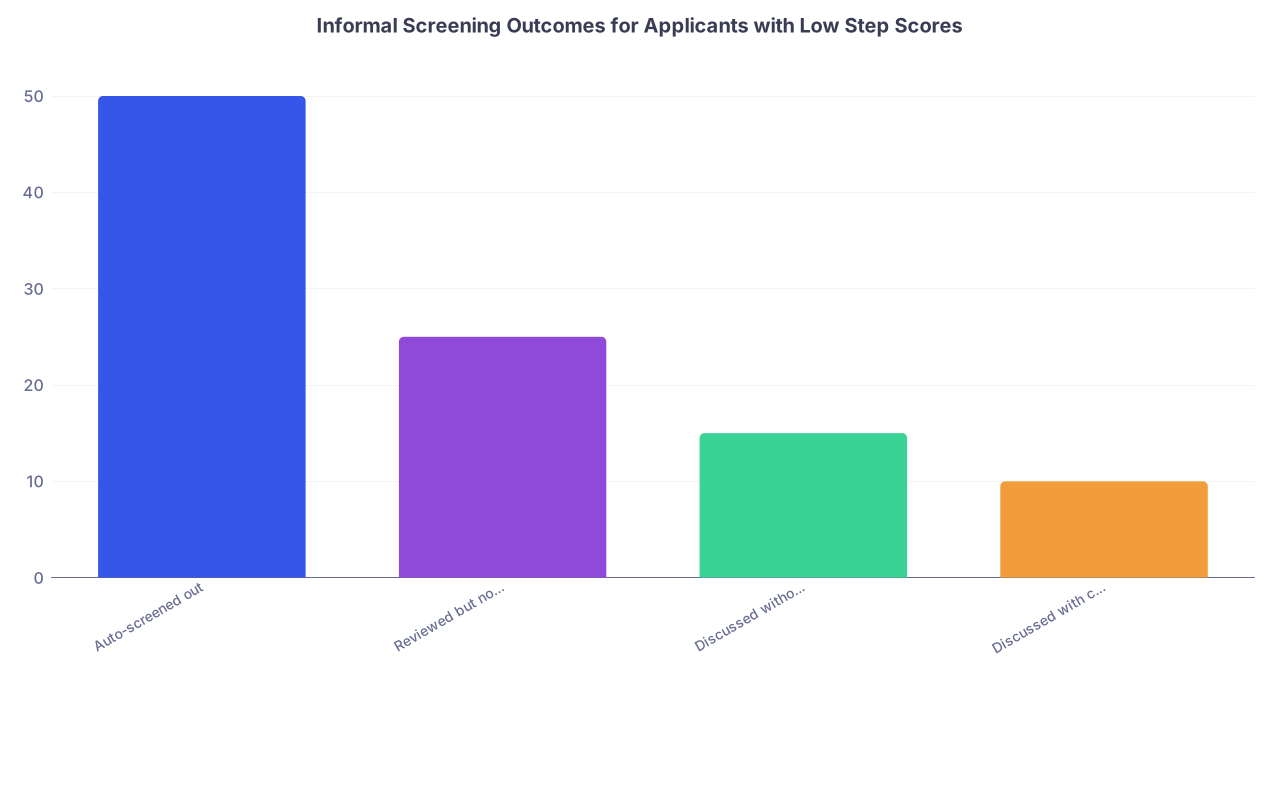
| Category | Value |
|---|---|
| Auto-screened out | 50 |
| Reviewed but not discussed | 25 |
| Discussed without advocate | 15 |
| Discussed with champion | 10 |
If your Step is low, your path usually looks like this:
- File gets tagged as “borderline” or “concern.”
- Unless there is a note in the system: “Dr. X recommends,” the file might never hit full discussion.
- The coordinator might say: “Any comments on these borderline ones?” If no one recognizes your name, that’s end of story.
Here’s where home programs and visiting rotations matter more than applicants understand. The programs where you rotated or did research are the ones where a living, breathing human actually knows you. They’re the only ones who can inject your name into the “wait, don’t auto-kill that one” bucket.
What Makes Someone Willing to Be Your Champion (This Part Everyone Gets Wrong)
A lot of students think, “If I worked hard and was nice on the rotation, the attending will champion me.” That’s the floor, not the ceiling.
Faculty put their own reputation on the line when they go to bat for you. If they get burned too often, the committee stops listening to them. So they’re selective.
Here’s what makes a faculty member think, Yes, I’m willing to stake some capital on this person:
They saw you handle real pressure, not just smile and pre-round.
The stories that get told in meetings sound like:- “Night float was a disaster and he quietly stabilized three admissions while the senior was tied up.”
- “She stayed two hours late to call families and update everyone without being asked.”
Champions lean on specific memories. If all they remember is “pleasant, on time, did notes,” that rarely justifies overriding a 208.
You showed insight into your low score instead of excuses.
When your Step came up on rounds or in 1:1:- Bad answer: “The exam was just unfair, I’m a bad test taker.”
- Better: “I underperformed. I didn’t adjust my study strategy early enough. I’ve changed my approach for in-service exams and saw improvement.”
The faculty member then tells the committee: “He knows he underperformed, he adjusted, and his in-service is now 240-ish level questions.” That’s a much smaller leap of faith.
You made your goals and vulnerability explicit.
Many of you try to “hide” your low score from faculty. That’s a mistake. I’ve seen scenarios like:- Student privately says: “I know my 214 hurts me. If there’s anything you think I can do to show I belong in this specialty, I’d appreciate your honesty.”
- That level of transparency flips a switch in a lot of attendings. You become a person they remember, not just a name on a list.
You followed up like a professional, not a beggar.
Champions don’t appear out of thin air. You cultivate them. The students who get advocacy:- Send a thoughtful email after rotations.
- Ask directly but respectfully: “If you feel comfortable, would you be willing to support my application, perhaps with a letter or by reaching out to programs where you have connections?”
The ones who don’t ask? Often don’t get offered.
How Champions Actually Argue for You in the Room
People imagine dramatic speeches. Reality is quieter and more surgical.
I’ve watched this play out dozens of times. Here’s the anatomy of a good “rescue” argument:
Acknowledging the weakness upfront.
The savvy champion does not pretend your score is fine. That kills credibility. They’ll say:
“Yes, his Step 2 is 216, below our usual. I want to explain why I still think we should rank him.”That single sentence disarms the “score hawks” on the committee.
Providing 2–3 concrete performance anecdotes.
Not “She’s great.” Concrete:- “She took ownership of complex patients—ran the list efficiently, anticipated management changes.”
- “Our nurses specifically asked for her back on the floor. That’s rare for a student.”
- “She outperformed some of our current PGY-1s in clinical reasoning.”
Committees trust stories more than adjectives.
Contextualizing the score without whining.
If there’s context—illness, family crisis, visa issues—they’ll give it succinctly:- “He had a documented family emergency during exam period; his shelf exams before and after were solid.”
- “She took Step during a personal health issue; her subsequent performance and in-service show no ongoing concern.”
The goal is not excuses. It’s explaining why the score might be an outlier.
Connecting you to the program’s needs.
The clincher is when your champion says:- “We keep saying we want residents who are teacher-leaders; he’s already doing peer teaching and curriculum work.”
- “She’s committed to underserved care; that aligns with what we claim is our mission.”
That gives the PD a story they can repeat: “Yes, score is low, but they fit us perfectly.”

| Step | Description |
|---|---|
| Step 1 | Low Step Score Applicant |
| Step 2 | Screened as Borderline |
| Step 3 | Likely Not Discussed |
| Step 4 | Champion Flags Applicant |
| Step 5 | Detailed Discussion |
| Step 6 | Do Not Interview or Rank |
| Step 7 | Interview and Higher Rank |
| Step 8 | Any Faculty Champion? |
| Step 9 | Committee Persuaded? |
There’s nothing magical here. It’s just someone with social capital choosing to spend it on you.
Who Has Real Pull—and Who Doesn’t
Not every attending who “likes you” can actually move the needle. This is another thing nobody tells you.
Rough hierarchy of champion power in most programs:
| Role | Typical Influence Level |
|---|---|
| Program Director | Very High |
| Associate / Assistant PD | High |
| Clerkship Director | High |
| Longstanding Core Faculty | Moderate to High |
| New or Adjunct Faculty | Low to Moderate |
A few inside truths:
- A Program Director championing you is like a nuclear option. If the PD says “I want this person,” you’re getting ranked unless there’s a true red-flag.
- Associate PDs and clerkship directors are often the real workhorses. They actually interact with students, then vouch for them repeatedly in committee.
- A generic attending who worked with you for three days? They can help with “soft” reputation, but if they never show up to selection meetings, their voice is diluted.
So, when you think about who to impress on rotations, don’t just chase the “famous name.” Focus on:
- Core faculty who routinely staff teaching services.
- Clerkship directors and site directors.
- Faculty known to be “voices in the room” at your institution.
Ask a senior resident quietly: “Who actually matters on the selection committee?” They’ll tell you.
How to Intentionally Build Champions When You Have a Low Score
Let me be concrete. Here’s the playbook I’ve seen work for low-score applicants who still matched well.
1. Choose your rotations strategically
If your Step is weak and you know your clinical skills are better than your numbers, your best weapon is face time.
Prioritize:
- Home program sub-I in your target specialty.
- Away rotation at a realistic target program, not just a prestige grab.
- Rotations with known teacher-faculty, not pure service black holes.
You want settings where:
- Attendings actually see you think.
- Residents give input to faculty about who’s strong.
- There’s some distance between service pressure and evaluation (pure scut rotations don’t highlight your strengths).
2. Name the elephant with the right people
On a sub-I, at some point during a quiet moment with a trusted attending or clerkship director, you say something like:
“Dr. Patel, I want to be transparent because I respect your opinion. My Step 2 is a 219, which I know is below many programs’ average. I’m working hard to show that my clinical performance is significantly stronger than that number. If you see areas where I’m falling short of residency-level expectations, I’d really value the feedback.”
That conversation does three things:
- Shows insight.
- Signals that you’re serious and self-aware.
- Plants the seed: “If I believe in this person, they’ll actually need my help.”
3. Ask directly for advocacy—correctly
When asking for a letter or advocacy, your wording matters. Faculty resent entitlement but usually respect clarity.
Better version:
“If you feel you can honestly write me a strong letter or support my application in other ways, I’d be very grateful. I know my Step score is not a strength, so I’m relying on people who’ve seen me work to represent me fairly.”
You just:
- Gave them an out if they can’t support you strongly.
- Signaled that your file needs more than a generic letter.
Some will say, “Yes, I can,” and then they go on to write that line in your MSPE addendum, talk to their contacts, or explicitly bring up your name in meetings.
4. Keep your champions equipped with ammo
Do not assume they remember every detail of your story.
Before ERAS season or before they go into their own program’s selection meeting, send a concise, high-yield email:
- One short paragraph reminding them who you are.
- Bullet your key strengths and updates (research accepted, leadership positions, new honors).
- Brief mention that you’re aware of your low Step but have X/Y evidence of higher performance (shelf scores, in-service, etc.).
Now, when your name pops up in front of them or their colleagues, they have fresh material to argue with.
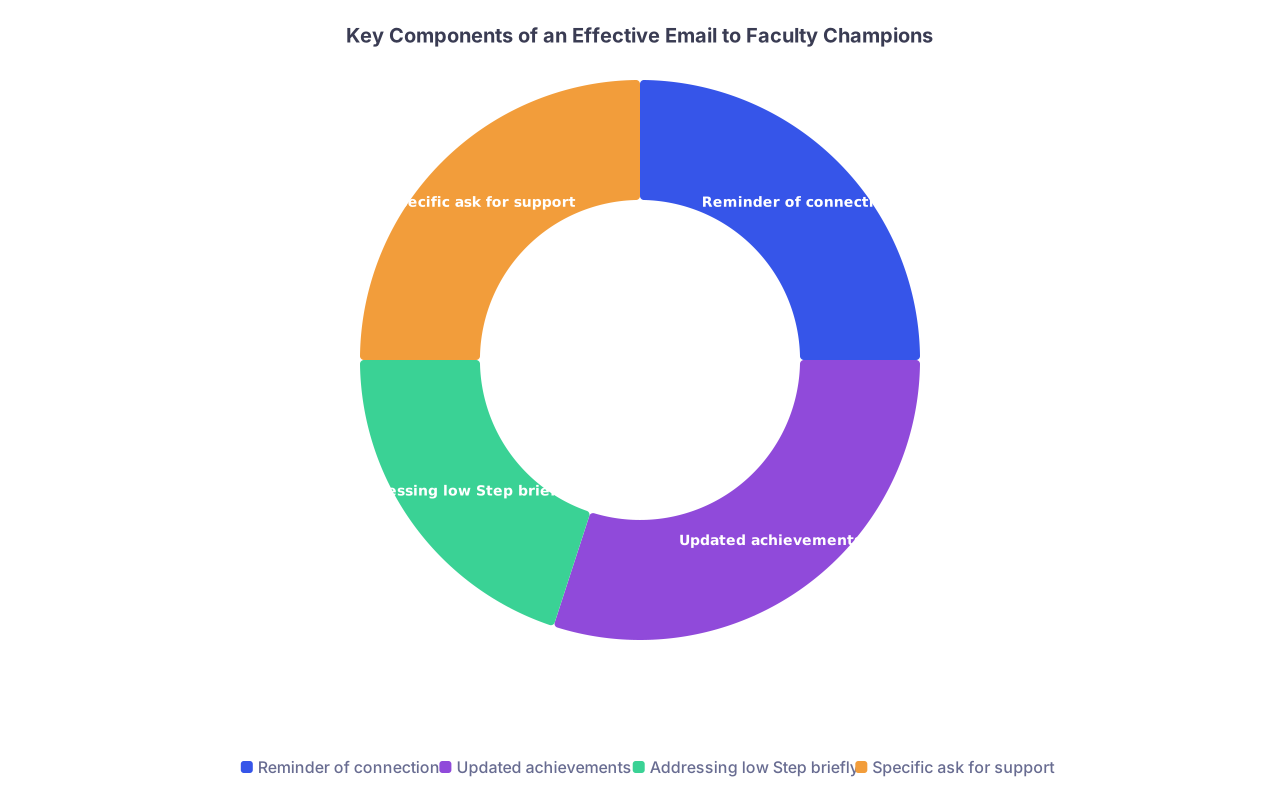
| Category | Value |
|---|---|
| Reminder of connection | 25 |
| Updated achievements | 30 |
| Addressing low Step briefly | 20 |
| Specific ask for support | 25 |
This is how you get comments like:
- “I just heard from her—she’s now first author on that paper we started.”
- “He’s continued to show growth; his recent evaluations back me up.”
That transforms you from “old student” to “current, active candidate.”
When Champions Cannot Save You
You need to hear the limits too. Champion power isn’t infinite.
Champions typically can’t rescue you if:
- You have multiple red flags: low score + professionalism issue + failed rotation. At some point, you’re asking them to argue against the entire file.
- Your performance with them was average at best. They might like you, but no one’s burning capital on “fine.”
- Their program is score-obsessed and under pressure. For ultra-competitive surgical subspecialties, a single mid-level faculty advocate often gets steamrolled by “we must maintain our averages.”
Sometimes I’ve heard:
“I like her a lot, but with a 205 we’d be downgrading our board pass rate risk. I just can’t sell that to the chair.”
That’s the cold economics. Champions can bend culture a bit; they can’t rewrite institutional risk tolerance.
So your goal isn’t “find one savior and relax.” It’s:
- Stack multiple small advantages.
- Give multiple people reasons to argue for you.
- Make your narrative so coherent that opposing you feels almost petty.
FAQ: Faculty Champions and Low Step Scores
1. Can an amazing letter from a big-name faculty overcome a very low Step score (e.g., <210) at a competitive program?
Occasionally, but not reliably. A letter from a famous name opens doors to consider you. It doesn’t erase institutional concerns about board pass rates or reputation. You still need performance data, rotation stories, and ideally multiple faculty voices. One “star” letter plus a 205 in an ultra-competitive program is still a long shot.
2. How many champions do I realistically need?
You don’t need ten. You need two or three people who know you well enough to speak in specifics, ideally in different contexts (clinical, research, leadership). One at your home institution, one at a place where you rotated, and maybe one in your target specialty who has connections. Depth beats breadth here; three honest advocates beat eight lukewarm letters.
3. Should I explicitly mention my low Step score when asking a faculty member to advocate for me?
Yes, briefly and maturely. If you pretend it does not exist, they will either assume you lack insight or they will be blindsided when they see your ERAS. Frame it as: “I know this is a weakness, here is what I’ve done since, and here is why I’m asking for your support.” That lets them calibrate their advocacy and respect you more.
4. Can residents act as effective champions in selection meetings?
Sometimes, but with limits. In many programs, residents are present and their opinions carry weight, but they rarely override attendings or PDs. Residents can do crucial groundwork—talking you up, pushing your name into conversations, giving strong evals that faculty then quote—but the final “override the score” move usually comes from attendings or leadership.
5. What if I’m at a school without a strong home program in my specialty? How do I get champions then?
You have to manufacture your “home” through away rotations, research collaborations, and networking at neighboring institutions. Do aways at realistic programs where teaching faculty are involved in selection. Join research projects with attendings who have national ties in the specialty. Go to regional conferences and actually talk to faculty. Your goal is to create somewhere that thinks of you as “one of ours,” even if your med school doesn’t house that specialty.
Strip it down to essentials:
- Low scores are initially filtered, then quietly buried—unless a live human intentionally stops that process.
- Faculty champions aren’t accidental; you build them through real performance, honest conversations, and smart follow-up.
- Your job with a low Step score is to make it easier—and safer—for someone in that room to say, “Despite this number, we should take a chance on this one.”