
The idea that you must hide a low Step score in residency interviews is dead wrong. Trying to bury it usually makes things worse, not better.
Let me be blunt: by the time you’re sitting in that interview chair, they already know your score. They invited you anyway. The “hide and hope” strategy is fear-driven, not data-driven. And programs can smell that fear.
You’re not getting torpedoed for the number at this stage. You get torpedoed for how you handle the number.
Let’s dismantle this myth properly.
What Programs Actually See And Do With Your Step Score
There’s this fantasy that if you just never mention your Step score, programs might forget about it. No. Here’s what actually happens behind the curtain.
Programs use Step scores heavily on the front end: to screen, filter, and triage hundreds or thousands of applications. That’s the part where a low score really hurts.
But once you’re in the interview pile, the score’s role changes. At most places, it drops from “primary weapon” to “background variable.”
I’ve watched PDs and selection committee meetings. The script is boringly consistent:
“Her Step 1 is a 214. But she has excellent comments from the sub‑I, strong letters, and the chair knows her.”
Or:
“He’s got a 228, which is below our mean, but look at this upward trend and the comments about work ethic.”
Do they see the score? Yes. Do they care? Yes. Do they obsess over it during an interview if you’re already in the room? Less than you think.
Here’s the rough dynamic:
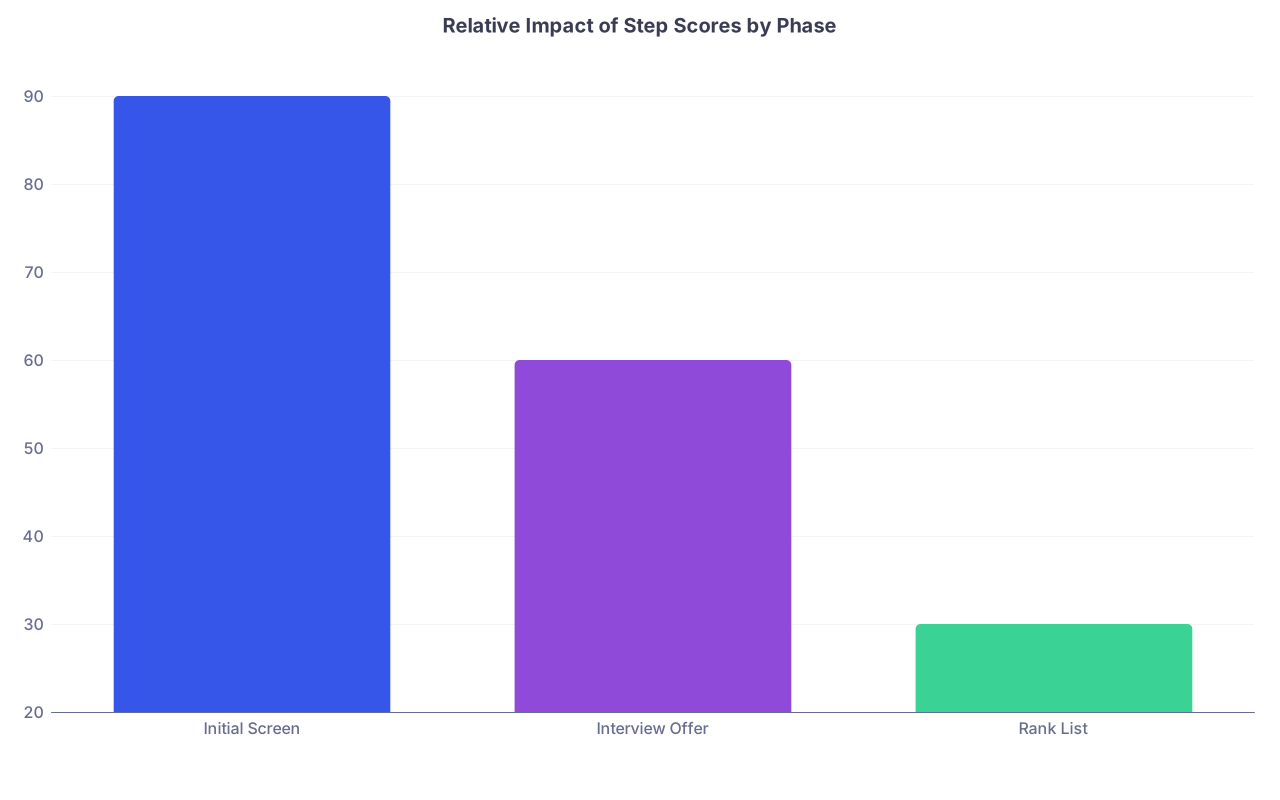
| Category | Value |
|---|---|
| Initial Screen | 90 |
| Interview Offer | 60 |
| Rank List | 30 |
No, those numbers aren’t some secret NRMP table. They’re representative of a real pattern: Step scores dominate the screening phase, then fade as clinical performance, letters, and interview impressions take over.
If you’ve been invited, the program has already done the mental math: “This score is low for us, but we’re still interested.” They are testing one main thing in person:
Is this someone I want working on my team at 3 a.m.?
Your instinct to hide the score fights that goal. It makes you look defensive, insecure, sometimes even evasive. And that’s what tanks applicants with low scores far more than the score itself.
Why Hiding Your Score Backfires In The Room
I’ve seen this play out in real time on interview days.
Scenario one: The applicant dodger. Program director says, “Tell me about a challenge you faced in medical school.” Applicant picks some safe, vague time-management anecdote, carefully avoiding any reference to the obvious red flag in the file: that Step 1 205 with a repeat attempt.
The PD flips through the ERAS printout. You can practically hear the thought: “So we’re just… pretending this didn’t happen?”
That discomfort shows. In follow-up discussions, I’ve heard phrases like:
- “Didn’t seem very self-aware.”
- “Glossed over weaknesses.”
- “I worry how they’ll handle feedback.”
Scenario two: The overcompensator. Applicant goes into panic confession mode and can’t stop talking about their score. Every question becomes an apology tour. “I know my Step 2 is low, but…” three times per answer.
Committee reaction?
- “They’re obsessed with the score.”
- “I’m not sure they see their other strengths.”
Both extremes—total avoidance and anxious oversharing—send the same meta-message: I’m not secure in who I am as an applicant. That’s poison in a team-based profession.
If you’re hiding the score, the score owns you. If you address it calmly, you own it.
What The Data Actually Shows About “Low” Scores
Let’s talk about the monster under the bed: what a “low” Step score actually does to your odds.
When people say “you’re doomed,” they’re almost always talking about getting interviews, not how to behave once you have them.
NRMP Charting Outcomes data (and its pre–Step 1 pass/fail predecessors) consistently shows only a few things:
- Higher Step scores correlate with higher match rates, especially in competitive specialties. Fine.
- Below some threshold, interview invitations drop off sharply. Again, that’s screening.
- Among people who get interviews, non-test factors dominate: AOA, letters, research, audition rotations, and interview evaluations.
What it does not show is that talking about your score in an interview tanks you. Because programs don’t punish self-awareness. They punish poor judgment and poor fit.
Let’s compare two fictional but very realistic IM applicants for context:
| Factor | Applicant A | Applicant B |
|---|---|---|
| Step 1 | 205 | 205 |
| Step 2 CK | 221 | 221 |
| Rotations | Solid, but generic | Strong sub-I at home IM |
| Letters | Generic mix | 2 strong from IM faculty |
| Interview style | Defensive, avoids score | Candid, explains growth |
| Rank committee comment | “Unclear insight” | “Resilient, good fit” |
Same numbers. Very different outcomes. I’ve watched committees put someone like Applicant B in the top third of the rank list, while A sinks to “only if we go deep.”
Not because the score changed. Because the narrative around it did.
How To Talk About A Low Step Score Without Sounding Weak
You do not need a TED talk about your Step score in every interview. But you do need a clean, controlled, honest way to handle it when it comes up—or when your broader “growth story” calls for it.
You’re aiming for three elements: ownership, context, and trajectory.
Forget fluffy, generic phrasing. You need something that sounds like an adult physician explaining a complication to a colleague.
Here’s the structure I’ve seen work, word-for-word, in actual interviews.
1. State the fact without flinching
Do not mumble the number. Do not say “not as high as I hoped.” Say it cleanly.
Example:
“My Step 1 score was a 208, which is below the average for your program.”
Short. Clear. Controlled. No melodrama.
2. Give concise, relevant context (not a life story)
Context is not an excuse dump. It’s a brief explanation that shows you can analyze your own performance.
Good example:
“At that time, I relied too heavily on passive learning—reading and videos—without enough question-based practice. I underestimated how different the exam style would be from my school tests.”
Bad example:
“Well, I had three exams that month, and my grandmother was sick, and I also had to move apartments…”
Programs have heard every life-circumstance narrative. The only thing they reliably care about is whether you extracted a lesson and changed your behavior.
3. Show the trajectory with proof
No handwaving. Show receipts: later metrics, rotations, comments.
Example:
“For Step 2, I changed my approach completely—dedicated time daily to UWorld, tracked weak areas, and did more active recall. That led to a 235, and that same disciplined approach carried into my sub-I, where I received strong feedback on clinical reasoning and reliability.”
You’re telling a simple story: I struggled, I analyzed, I adapted, I improved. That is exactly the arc every PD wants to see in a trainee.
4. Stop talking once you’ve made the point
The temptation to keep explaining is huge. Don’t. Finish with a forward-looking sentence and move on.
“I’m confident the habits I built during that period reflect how I’ll approach residency—especially when I encounter new challenges.”
Then shut up. Let them change topics. You did your job.
Should You Ever Bring It Up First?
This is where people love absolutist rules. “Never bring it up unless they ask.” Or “Always address it early.”
Both are bad takes.
Here’s the reasonable approach:
- If your low score clearly fits into a bigger, important story of growth—your MS2 slump, mental health turnaround, or pivot in study habits—it’s fair game in a “tell me about a challenge” question.
- If they don’t mention it and you have a stronger, more relevant challenge story (family, language barrier, big research project under pressure), you don’t need to shoehorn your Step score into everything.
What you can’t do is pretend it doesn’t exist at all. You need a ready, rehearsed answer. Because the worst version of this is being visibly rattled the first time someone says, “Walk me through your Step journey.”
Programs do notice when the topic makes you physically tense, rambling, or evasive. That’s the signal to them, not the number itself.
The Real Red Flags Around Low Scores (It’s Not What You Think)
Let’s separate fake “red flags” from real ones.
A 210 in a program with an average of 240? Not ideal. But not an automatic red flag.
The true red flags interviewers whisper about behind closed doors are more like:
- Blaming everyone else: “The school didn’t prepare us,” “The questions were unfair,” “Our dean’s office messed up our schedule.”
- No change in strategy: low Step 1, modest Step 2, no clear description of what they did differently.
- Disorganized narrative: the story about the score doesn’t match what’s in the MSPE or letters.
- Low score plus weak clinical comments: “middle of the pack,” “required close supervision,” “slow to accept feedback.”
In contrast, a low score coupled with clear growth, strong comments, and adult-level self-reflection is not a red flag. It’s a resilience marker.
I’ve watched PDs say things like:
“Honestly, I’d rather have the 215/240 applicant who struggled then improved and has excellent rotation feedback than the 250/250 who seems arrogant and rigid.”
That’s not feel-good mythology. It’s how they protect themselves from residents who crumble the first time something doesn’t go their way.
Specialty Reality Check: Where This Matters More, And Less
Let’s not sugarcoat this: some specialties are unforgiving with scores on the front end. Derm, ortho, plastics, neurosurg, ENT—if your numbers are far below their norms, you’re fighting uphill just to get in the door.
But you’re reading this as someone who already has interviews. That changes the game.
For mid-competitiveness fields—internal medicine, peds, psych, FM, OB/GYN, many anesthesia programs—a below-average score is something they’ve seen plenty of. Community and lower-tier academic programs in particular are used to interviewing applicants across a wide score range.
Where does your approach to the score matter most?
- At programs that pride themselves on “training up” students from all backgrounds, your narrative of growth and grit is a huge asset.
- At highly academic places, your ability to talk analytically about your own learning process is itself a proxy for how you’ll approach research, QI, and complex patients.
Trying to hide the score wastes both opportunities.
How To Practice Without Sounding Scripted
You can absolutely rehearse this without turning into a robot.
Record yourself answering a question like: “Can you talk about your board scores?” or “Tell me about a time you faced an academic setback.”
Listen for three things:
- Do you actually say the number out loud, clearly?
- Do you spend more than 20–25 seconds on the “what went wrong” part? If so, you’re over-explaining.
- Do you pivot cleanly to your improvement and current strengths?
If your answer runs over 90 seconds, it’s too long. You’re bleeding insecurity. Tighten it.
Have someone—not your best friend, someone a little blunt—ask you the question and watch your face when you answer. If they say “you looked uncomfortable” or “you sounded guilty,” that’s your project. The content might be fine. The delivery is what needs work.
Bottom Line: Stop Letting The Score Drive The Interview
The myth says: if you don’t hide your low Step score, it will define your interview.
Reality: acting like you need to hide your low Step score is what defines your interview.
So here’s what actually works:
- Programs already know your score and invited you anyway; at the interview stage, they’re primarily evaluating judgment, self-awareness, and fit—not re-litigating your percentile.
- Hiding, dodging, or over-apologizing for your score is far more damaging than calmly owning it, giving concise context, and demonstrating upward trajectory.
- A low score plus a strong, coherent growth narrative beats a high score with denial or arrogance. Every time, in every committee room that actually cares about the humans they’re hiring.
Stop treating your Step score like a crime scene. Treat it like one chapter in a much longer story—and tell that story like the future colleague you want them to see.