
Is a 250 Step 2 the Only Fix for a Low Step 1? Data-Driven Answers
What if your Step 1 came back lower than you wanted and everyone around you says the same thing: “You have to crush Step 2 — like 250+ — or you’re screwed”?
Let’s be blunt. That advice is lazy, half-true, and often wrong.
I’ve watched plenty of applicants match competitive specialties without a 250 Step 2. I’ve also watched people with a 250 Step 2 still get hammered by their low Step 1 and a weak overall application. The myth that “one monster Step 2 score fixes everything” is comforting. It’s also not how program directors think.
Let’s walk through what the data and real-world behavior actually show.
What Programs Really Look At Now: Not Just One Number
Since Step 1 went pass/fail for current cohorts, a lot of older residents still give outdated advice. But even for those of you with a numeric Step 1 on your record, program priorities have already shifted.
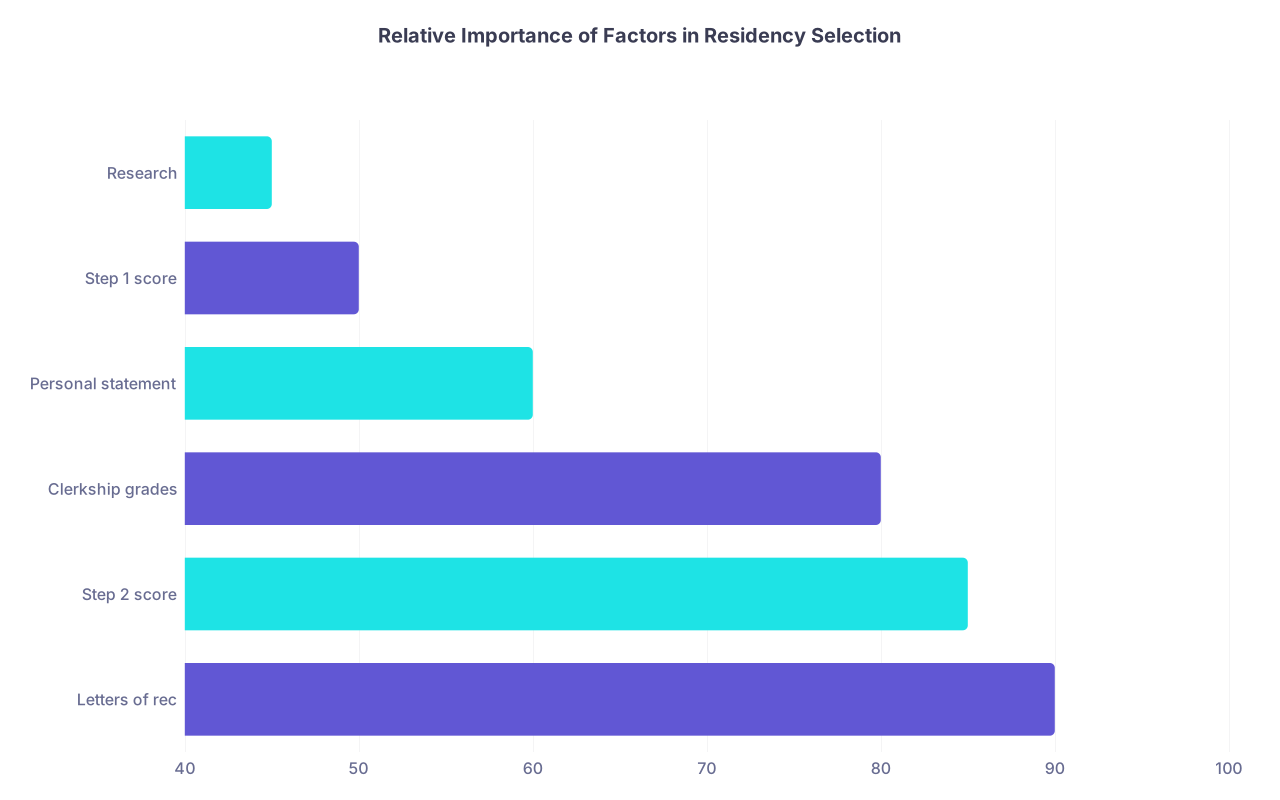
Here’s what program directors actually say they care about, from NRMP Program Director Survey trends (2018–2023) and consistent PD chatter in meetings and on panels:
- Step 2 CK performance
- Clinical grades (especially core clerkships and sub-I’s)
- Class rank / AOA / deans’ letter
- Letters of recommendation (specialty-specific, ideally)
- Fit with the specialty and program (evident in the personal statement and interviews)
- Red flags (failures, professionalism, gaps)
A single 250 Step 2 doesn’t automatically erase a 210–220 Step 1. It helps. But PDs don’t stare at one score in isolation. They look for patterns.
If you think, “Low Step 1 + huge Step 2 = problem solved,” you’re misreading how risk-averse PDs really are.
| Category | Value |
|---|---|
| Letters of rec | 90 |
| Step 2 score | 85 |
| Clerkship grades | 80 |
| Personal statement | 60 |
| Step 1 score | 50 |
| Research | 45 |
Numbers are approximate (and vary by specialty), but the shape is right: Step 2 is big, but it’s not the only lever, and Step 1 is no longer the nuclear bomb it used to be.
What a “High” Step 2 Really Does for a Low Step 1
Let’s translate the magical “250 Step 2” into realistic outcomes.
1. It reframes your ceiling — but doesn’t erase your floor
A strong Step 2 does three useful things:
- Proves your knowledge base is current
- Suggests your Step 1 underperformance may have been an outlier
- Lowers anxiety for PDs about whether you can pass boards in residency
But your Step 1 score is still on the page. If you have a 215 Step 1 and 252 Step 2, PDs do not suddenly pretend the 215 never happened. What they think is more like:
- “Ok, this person clearly improved and probably figured out how to study”
- “They likely won’t have board troubles in residency”
- “We still want to know what changed between the two exams”
So yes, it helps. A lot. But “fix” is the wrong word. It compensates. It doesn’t delete.
2. It moves you between buckets, not into a magical category
Programs do rough mental triage:
- “Definitely interview”
- “Maybe, depends on rest of app”
- “Probably no”
A 250 Step 2 can move you from “probably no” → “maybe” or from “maybe” → “definitely interview” depending on specialty and school. That’s valuable. But if the rest of your file is mediocre, it won’t carry you into the top bucket by itself.
| Profile | PD Perception Without Strong Step 2 | PD Perception With Strong Step 2 |
|---|---|---|
| 215 Step 1, average MS3, no red flags | Risky, likely screen out | Maybe, worth a look |
| 220 Step 1, strong MS3, good LORs | Borderline but redeemable | Solid, likely interview |
| 205 Step 1, weak MS3, professionalism issues | Hard pass | Still hard pass |
Notice the pattern: Step 2 only helps if the rest of the application isn’t already on fire.
So What Counts as “Good Enough” Step 2 With a Low Step 1?
People obsess over the 250 benchmark because it’s round and sounds impressive. The reality is more nuanced.
Step 2 targets vary by specialty
For a low Step 1 applicant:
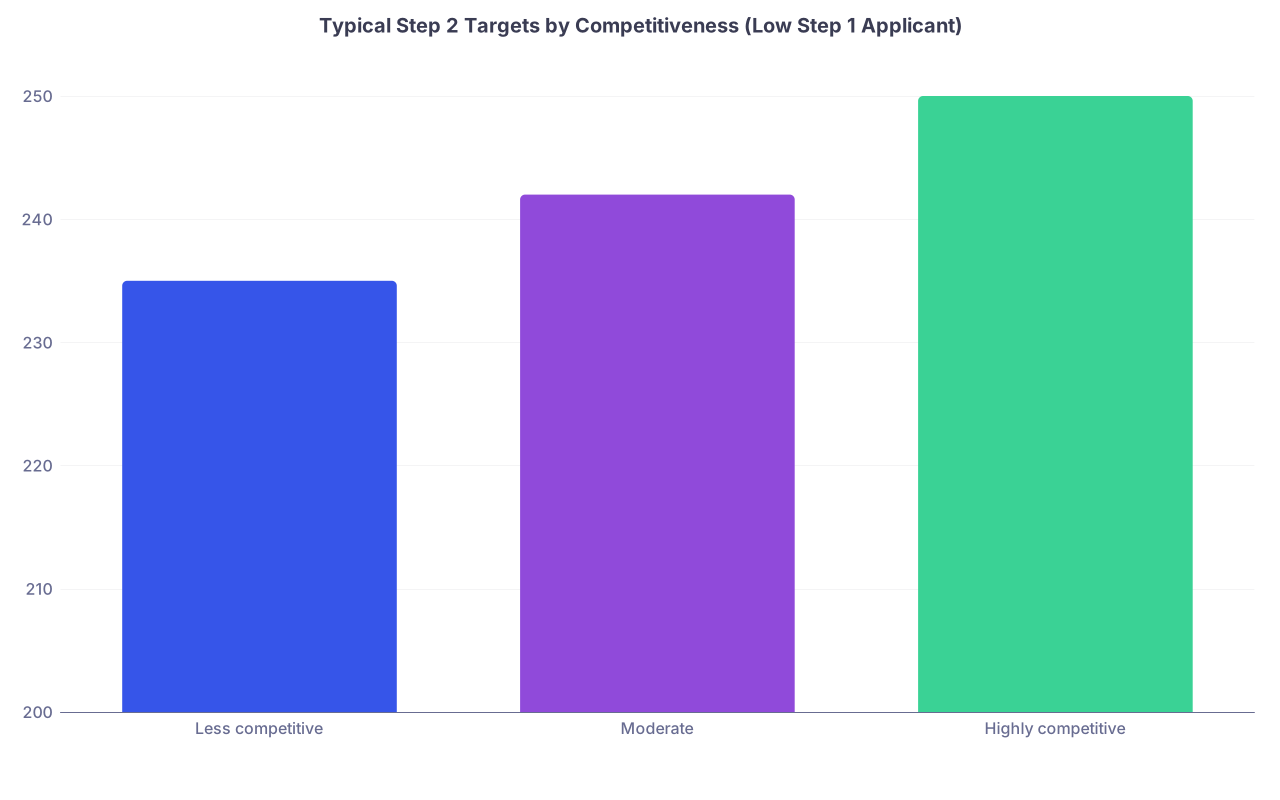
- Less competitive fields (FM, psych, peds, IM at non-elite programs)
- A Step 2 in the 230s–240s can be enough to keep you competitive if the rest of your application is solid.
- Moderately competitive (EM, OB/GYN, mid-tier IM, anesthesia)
- You probably want 240s to comfortably offset a low Step 1, but again, not mandatory if you have strong clinicals and LORs.
- More competitive (radiology, gas at top programs, ortho, derm, plastics, ENT, ophtho, neurosurg)
- Here, a low Step 1 is a heavier anchor. A 250+ Step 2 helps a lot, but here’s the key: lots of applicants also have 250+ Step 2 and higher Step 1. You’re not suddenly “above the bar.”
| Category | Value |
|---|---|
| Less competitive | 235 |
| Moderate | 242 |
| Highly competitive | 250 |
Those aren’t official cutoffs. They’re realistic ballpark targets. Programs do not run formulas like “if Step 2 ≥ 250 then ignore Step 1.” That’s fantasy.
The delta matters more than the absolute
A 30-point jump from Step 1 to Step 2 is a big deal and PDs notice. Example:
- 215 Step 1 → 245 Step 2 (30-point jump): That screams serious improvement.
- 222 Step 1 → 247 Step 2 (25-point jump): Also solid.
- 230 Step 1 → 238 Step 2 (8-point jump): Fine, but doesn’t tell a story of major growth.
If your Step 1 was low, you’re not just chasing a raw number. You’re trying to show a trajectory.
Where the “250 or Bust” Myth Fails Completely
Let me go after the core myth: that Step 2 is the only fix.
There are several situations where Step 2 alone cannot save you, even if you nail it.
1. Severe red flags
If you have any of these:
- Step 1 failure
- Course or clerkship failures
- Major professionalism incidents
- Extended leaves without solid explanation
…a 250+ Step 2 may help, but it doesn’t “clear” you. PDs worry about reliability, not just knowledge. They’ve seen too many “good test takers” implode clinically or behaviorally.
2. Weak clinical performance and generic letters
Imagine this file:
- 218 Step 1
- 250 Step 2
- Mostly pass-level clerkships, no honors in core rotations
- Generic letters: “hardworking,” “pleasant,” nothing specific
- No clear commitment to the specialty
That 250 looks nice. But PDs are thinking: “Will this person function on day one?” The answer isn’t obvious from their record. And that’s a problem.
Flip it:
- 218 Step 1
- 240 Step 2 (not 250)
- Honors in medicine and sub-I
- Chair letter saying: “Top 10% of students I’ve worked with in 10 years”
- Specialty-specific away rotation with a strong letter
That second applicant matches more reliably than the first in almost every specialty.
3. Unrealistic specialty choice
You can’t use Step 2 to brute-force your way into anything you want. Some people try:
- 205–215 Step 1
- 250 Step 2
- No research, no specialty LORs, limited exposure
- Aiming for derm, plastics, neurosurgery
Could someone with those stats and insane networking and a strong story slip through at a smaller or newer program? Extremely rarely, yes. But “possible outlier” and “realistic strategy” are not the same thing.
What Actually Moves the Needle Besides Step 2
If you’re in damage-control mode after a low Step score, here’s the contrarian truth: spreading your effort across multiple high-yield levers beats obsessively tunnel-visioning on a single monster Step 2 number.
1. Clerkship and sub-I performance
For PDs, a strong sub-I with a great letter is more predictive of how you’ll function as an intern than a Step score. They know this. They talk about it openly.
If you have a low Step 1, you should be ruthless about:
- Honoring core rotations in your target field (and medicine, always)
- Showing up early, owning your patients, writing good notes, being reliable
- Making sure attendings know your name, face, and that you want their specialty
You’re not just “doing well clinically.” You’re creating letter writers who can say, “Ignore their Step 1; they’re excellent on the wards.”
2. Letters that explicitly contextualize your scores
One of the most underused weapons: letters that directly address your exam trajectory.
The best letters for low-Step applicants say things like:
“Although their Step 1 score was below our usual benchmark, their Step 2 score and performance on the wards are much more representative of their ability. I strongly suspect the Step 1 result reflected test anxiety more than knowledge.”
Is that magic? No. But it gives PDs permission to discount the earlier score. Without that framing, they default to suspicion.

3. Strategy in school list and program targeting
I’ve seen applicants sabotage themselves by applying like this:
- Low Step 1, decent Step 2
- Applying mainly to top 20 academic powerhouses “to prove they can do it”
That’s not strategy. That’s ego.
Real strategy for someone with a low Step 1:
- Mix of academic and community programs
- Heavy emphasis on mid-tier and lower-tier programs in multiple regions
- Extra attention to programs historically friendlier to “non-perfect” applicants (more community-heavy, less prestige-chasing)
- Use away rotations to get known at realistic target programs
| Program Type | Number of Programs | Target Profile |
|---|---|---|
| Top academic | 5–8 | Reach, only if strong Step 2 + LORs |
| Mid-tier academic | 20–25 | Core target |
| Community | 20–30 | Safety and realistic matches |
| Home / Away sites | 3–5 | Places where you have direct exposure |
You’re not trying to impress Reddit. You’re trying to match.
When You Should Push Hard for a Big Step 2
Now the part where I don’t sugarcoat: there are times when going all-out for the highest Step 2 you can get is absolutely the right move.
You should treat Step 2 like a life-or-death exam if:
- Your Step 1 is <220 and you still want any moderately or highly competitive specialty
- You have a single failure on record (course or exam) and need to re-demonstrate reliability
- Your school isn’t particularly prestigious and you need a more “portable” signal of ability
- Your clerkship grades are fine but not stellar, and you don’t have unusually strong letters
In these cases, a 250 Step 2 isn’t the only fix. But it’s a huge one. Getting a 230 instead of 250 can absolutely change which programs give you a shot.
Just don’t lie to yourself: you’re not chasing a magic number. You’re trying to get into a zone where PDs stop worrying about your test-taking and can focus on the rest of your file.
| Category | Value |
|---|---|
| <230 | 20 |
| 230-239 | 40 |
| 240-249 | 65 |
| ≥250 | 80 |
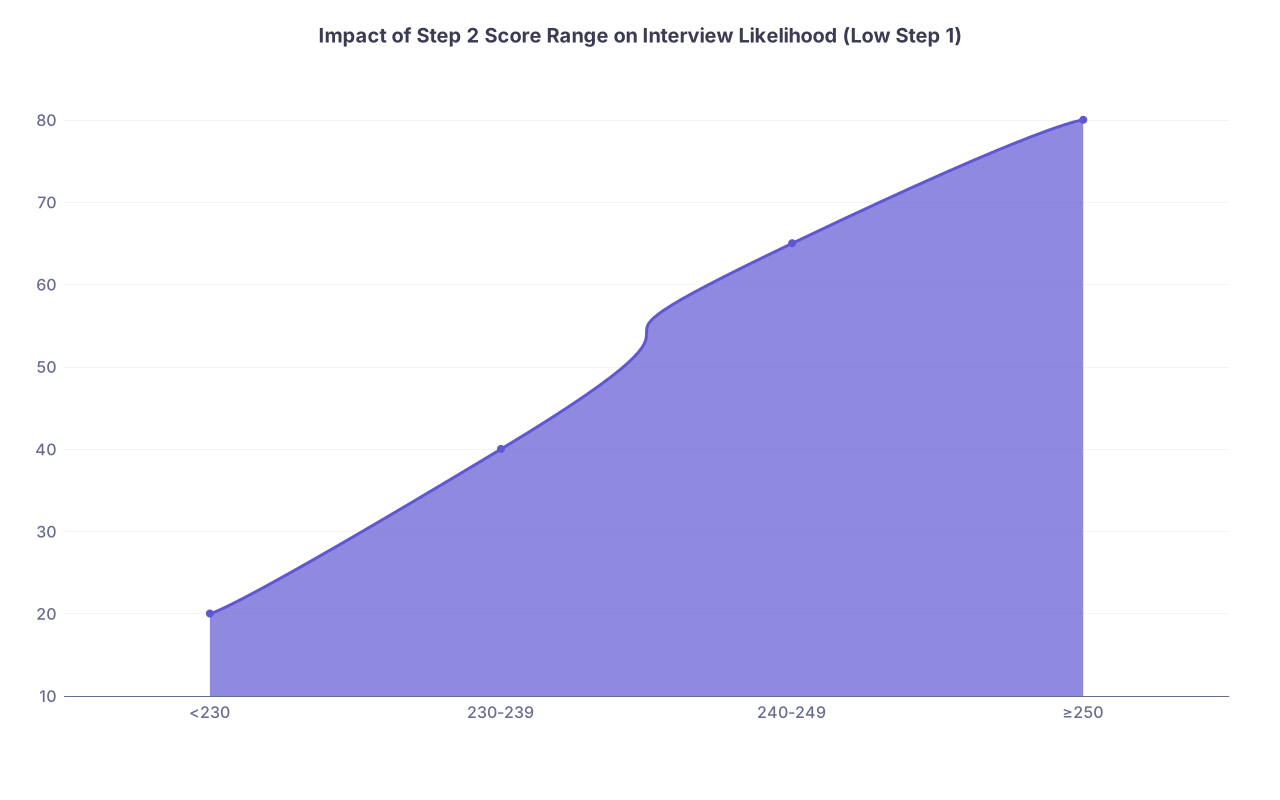
These numbers are illustrative, but they reflect what I’ve seen: each band dramatically changes your odds, especially with a low Step 1.
How To Talk About a Low Step 1 + Higher Step 2
Programs will notice the discrepancy. You can either hope they ignore it (they won’t) or control the narrative.
In your personal statement or interview, you want a short, non-dramatic explanation, for example:
- “I underperformed on Step 1 because I approached it like undergrad exams — content-heavy, not practice-heavy. I changed my strategy completely for Step 2, focused on question-based learning, and my score reflects that shift.”
- Or: “I was dealing with [briefly state issue without oversharing] during my Step 1 prep. Those circumstances were resolved by the time I took Step 2, and I’m confident my Step 2 result is a better reflection of my capabilities.”
Then you shut up about it. Don’t center your whole identity on one bad score.

| Step | Description |
|---|---|
| Step 1 | Low Step 1 |
| Step 2 | Higher Step 2 |
| Step 3 | Brief specific reason |
| Step 4 | Show changed study approach |
| Step 5 | Point to strong clinicals and LORs |
| Step 6 | PD fills in gaps with doubts |
| Step 7 | Explain? |
That’s the real risk: if you don’t frame it, PDs will make up their own explanation.

The Brutal, Useful Truth
Let me strip this down.
- A 250 Step 2 is not the only fix for a low Step 1. It’s one powerful lever among several.
- You can absolutely match — even in moderately competitive fields — without hitting 250, if you compensate with strong clinicals, letters, specialty commitment, and smart program targeting.
- A big Step 2 score helps most when it’s part of a consistent story of improvement and reliability, not a lone shiny number in a weak file.
If you bombed Step 1, you’re not doomed. But you also don’t get a clean slate just by chasing one hero score. Stop looking for a single magic fix. Build a coherent, evidence-backed case that you’re exactly the kind of resident they’d be stupid to pass up.