
The idea that “programs auto-filter everyone below a single Step cutoff” is lazy, comforting, and wrong in the ways that matter most.
It’s a story people tell to explain away a complicated, messy truth: scores do matter, but directors are not robots running a single ≥230 query and calling it a day. If they were, the NRMP charts would look very different from what we actually see.
Let’s unpack what really happens to low Step scores in residency applications—who actually hard-filters, who doesn’t, how Step 1 going pass/fail changed the game, and what you can strategically do if you’re below the magical numbers Reddit likes to worship.
What Program Directors Say They Do vs What They Actually Do
Every couple of years, NRMP runs the Program Director Survey. This is as close as you get to reading their group chat, statistically.
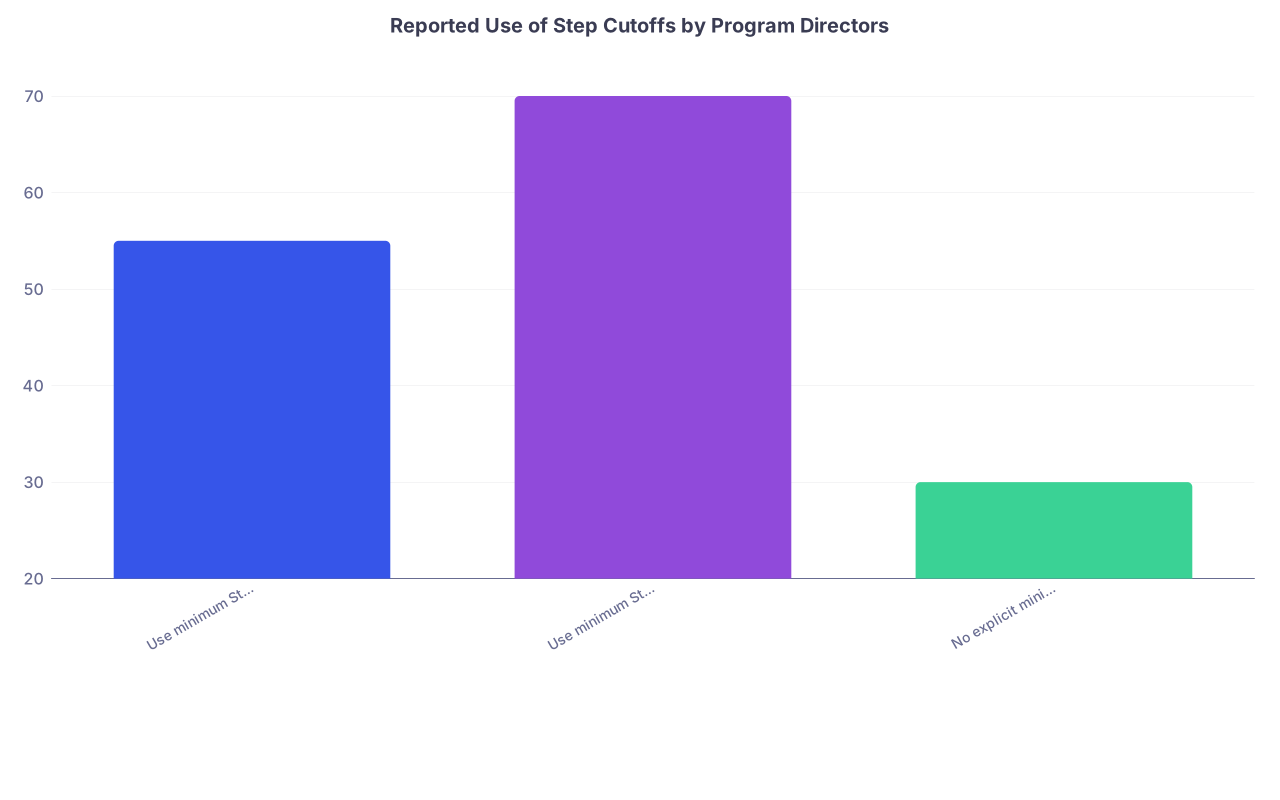
| Category | Value |
|---|---|
| Use minimum Step 2 | 55 |
| Use minimum Step 1 (pre-P/F) | 70 |
| No explicit minimum | 30 |
The surveys (pre–Step 1 pass/fail) consistently showed something like this across specialties:
- A majority of PDs report using some kind of minimum Step score.
- But they also rank lots of applicants who fall below those “minimums.”
That’s the key contradiction students miss. On the same surveys where PDs say “yes, we use minimum Step scores,” they also admit:
- They “often consider” applicants below the stated threshold if there are other strengths.
- They care heavily about class ranking, MSPE language, failed attempts, and institutional reputation.
Translation: “We have a ‘cutoff.’ Then we break our own rule constantly when we actually review files.”
I’ve watched this happen in real time. A PD says at noon conference, “We don’t look at anyone below 230.” Fast-forward to rank meeting and someone’s pushing hard for a 218 with strong letters from a trusted home institution and great interview performance. Nobody stands up and screams, “But the cutoff!” They shrug and move on. Because the “cutoff” was never absolute to begin with.
The Myth of the Single Magic Number
You imagine a filter like this:
- “Show me all US MDs with Step 1 ≥ 230. Delete the rest.”
Reality is closer to:
- “For this stack of 1,200 apps, we need a way to not drown. So we start with some score ranges, then prioritize certain schools, then our own rotators, then anyone flagged by faculty, then our diversity/equity goals, then we re-open the pile when we realize our initial sort was too strict.”
Programs are constrained by:
- Time: many PDs and APDs are reviewing hundreds of applications in short bursts between patient care, meetings, and teaching.
- Applicant volume: popular specialties get 60–80 applications per spot. They literally can’t “holistically” read all of that.
- Risk tolerance: they are very allergic to repeated failures and professionalism concerns, much more than “one score that’s 10–15 points below average.”
So do they use Step filters? Yes—as a rough sorting and triage tool, not as holy law.
Step 1 Pass/Fail: Did It Kill the Cutoff?
No. It just moved the battlefield.
Before Step 1 went pass/fail, most PDs anchored on Step 1. Now they anchor on Step 2 CK. The updated PD survey data and what PDs openly say at conferences is depressingly consistent:
- Step 2 CK is now the key numeric signal to compare academic performance.
- Step 1 failures are still a red flag, even though it’s pass/fail. A fail isn’t “meh, whatever.” It’s “we need an explanation and evidence of recovery.”
So if you have:
Step 1: Pass, Step 2: 225 The game is: your Step 2 is below many programs’ historical averages. That doesn’t mean you’re auto-deleted everywhere. It does mean you’re on the bubble at a lot of places unless something else pushes you higher in the pile.
Step 1: Fail then Pass, Step 2: 240+ Directors will absolutely look at you. The narrative shifts to: “Did this person fix what went wrong? Are there any other concerns?”
The blunt truth: they did not stop filtering. They re-routed the filter to Step 2 CK and to “any Step failure” flags.
What the Match Data Actually Shows About Low Scores
If there were universal, hard, single-number cutoffs, you’d see a cliff in the NRMP data. For example:
- Everyone above 240 matching.
- Everyone below 220 never matching.
But that isn’t what the data show.
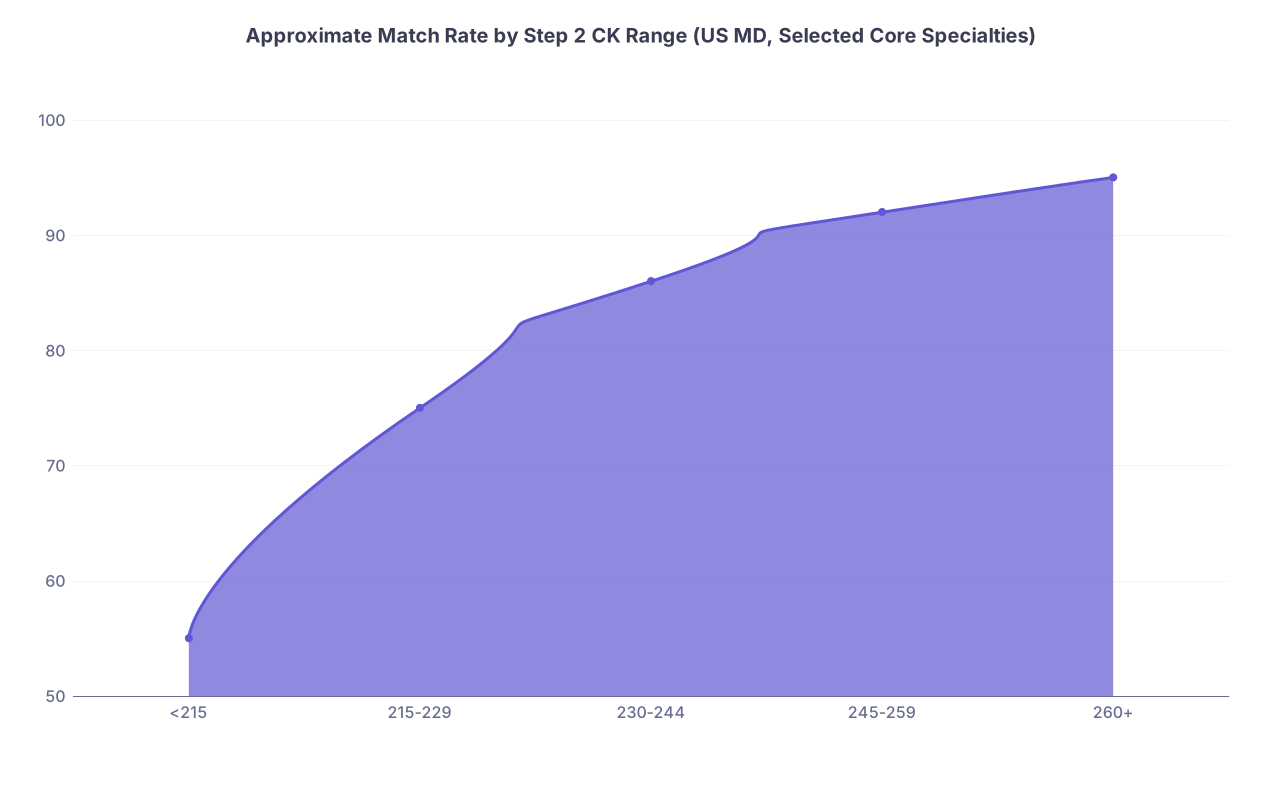
| Category | Value |
|---|---|
| <215 | 55 |
| 215-229 | 75 |
| 230-244 | 86 |
| 245-259 | 92 |
| 260+ | 95 |
(These are approximate, blended patterns drawn from NRMP outcomes across IM, FM, peds, psych—exact numbers vary by year and specialty, but the curve looks like this.)
Notice something:
- There’s a gradient. Not a wall.
- People with “low” scores still match. In less competitive specialties, often at very high rates—especially US MDs.
- As scores drop, your odds fall and your margin for error disappears—but you’re not instantly dead.
If universal hard cutoffs existed, that <215 group would be near 0%. It’s not. Many PDs clearly do not enforce absolute single-number bans. They use scores as one factor among several.
Now, in the hyper-competitive specialties (derm, ortho, ENT, plastics, neurosurgery), the curve is more brutal. Still not 0, but close. That’s not because of some monolithic “everyone under 250 auto-trashed.” It’s because they’re drowning in applicants with 260s plus research, plus glowing letters, plus home connections.
So the right conclusion is:
- Low or modest scores shrink your option set and raise the bar for everything else.
- They do not automatically disqualify you across the board.
Who Actually Uses Hard Filters—and How
Here’s the part applicants underestimate: not all programs behave the same way. A small community FM program in the Midwest and a big-name tertiary-care anesthesia program in a coastal city are playing two different games.
| Program Type | Step Filter Behavior |
|---|---|
| Hyper-competitive academic | Aggressive Step 2 filters, few exceptions |
| Mid-tier university | Uses ranges, makes exceptions regularly |
| Large community | Soft thresholds, more holistic review |
| Small community / rural | Minimal filtering, focus on fit |
| Home program for you | Most flexible about your low score |
I’ve seen the back-end filters on ERAS and Thalamus. They’re often more complex than “<230: reject.”
Examples of real-life filters:
- “Show US MD and DO, Step 2 ≥ 220 OR Step 1 ≥ 230 if no Step 2 yet.”
- “Flag anyone from our school or our rotators regardless of score.”
- “Exclude anyone with 2+ failures unless faculty specifically requests review.”
- “Sort by Step 2, but keep a separate list of URiM candidates and non-traditional backgrounds for holistic review.”
So yes, some programs absolutely hard-filter below a number and never look back. Usually the ones:
- Drowning in applications.
- In very popular specialties.
- With high historical board averages they’re trying to protect.
But plenty of programs either:
- Use soft banding (“we’ll mostly look at 230–250, but we’ll peek below for strong stories”), or
- Have no meaningful filter beyond “no serial failure + passes all required exams.”
That’s why you still see 214s in internal medicine, 220s in anesthesia, 225s in EM. It’s not an accident or a data entry error. Those PDs knew the number and chose them anyway.
What Matters More Than One Low Number
The obsession with “Is 225 a death sentence?” is the wrong question. The right one is: “What story does my pattern tell?”
Program directors are much more concerned with:
- Trend: Did you improve? Steady performance > random spikes.
- Failures: Fails on Step, shelves, or courses are bigger red flags than a low-but-passing score.
- Context: Did you take Step 2 early while chiefing a service, or last minute after coasting through?
- Corroboration: Do your clerkship comments, MSPE, and letters match the test story? Example: Great clinical comments and one mediocre score are easier to overlook than the reverse.
They use test scores as proxies for:
- “Will this person pass our boards?”
- “Will this person keep up with the cognitive demands of this specialty?”
- “Will this person tank our pass rate stats and make my chair furious?”
If you make those questions easy to answer positively, your low score becomes an annoyance, not a fatal flaw.
That’s why someone with:
- Step 2: 220
- Strong upward trend, no fails
- Honors in medicine and surgery
- Personal phone call letter from a respected faculty the PD knows
…will reliably beat a 245 with shaky evaluations and a vague, generic MSPE.
Concrete Strategies If You’re Below the “Cutoff”
You can’t rewrite your score report. You can rewrite how easy it is for a PD to dismiss you.
1. Pick your specialty with your eyes open
There’s fantasy and there’s data.
If you’re sitting on a 215 Step 2 and cling to matching ortho at a top-10 program, that’s not “grit,” that’s denial. The NRMP Charting Outcomes spells this out every cycle: low scores in hyper-competitive fields are nearly unrecoverable unless you have bizarrely strong compensating factors (think: PhD with 20 first-author ortho publications + home program pulling hard).
Conversely, that same 215 in family medicine or psych with a good application and appropriate geographic strategy? Very matchable.
2. Control what you can: Step 2 and shelf alignment
If Step 1 is low (or a fail) and you haven’t taken Step 2:
- You do not have the luxury of mediocrity on Step 2. PDs want to see a clear rebound.
- Align your Step 2 prep with medicine and surgery shelves. Honoring those rotations plus a solid Step 2 number forms a convincing “I turned it around” narrative.
Once Step 2 is already low, your job shifts:
- Show clinical excellence: honors or strong narratives in core rotations.
- Show reliability: no professionalism flags, no extra “concern” language in MSPE.
- If possible, crush any in-training exam during intern year if you SOAP or reapply later—it’s basically a second chance board signal.
3. Play the numbers game differently: where and how you apply
You make a massive mistake if you apply like a 250 when you’re a 220.
- Apply more broadly and less aspirationally.
- Target regions and programs that:
- Historically take more DOs and IMGs (they’re already used to looking beyond a perfect test profile).
- Aren’t in the obvious big coastal cities that everyone else wants.
- Have higher resident satisfaction but lower brand-name recognition.
Use past resident rosters. If a program has:
- DOs, IMGs, and graduates from mid-tier schools
- A spread of test scores (you’ll see it in CVs and alumni outcomes)
…they’re less likely to have a rigid, unforgiving filter.
4. Maximize “inside the building” advantages
The single biggest cheat code against score filtering: being a known quantity.
- Away rotations / sub-Is at realistic programs in your specialty.
- Absolutely stellar performance with documented comments.
- Face time with the PD and key faculty.
I’ve seen PDs bend their stated score “cutoff” again and again for:
- “Best rotator we had this year, I don’t care about the 225.”
- “Our faculty love this student, we’ll support them through boards.”
Inside support breaks the filter. Cold applications do not.
5. Control your narrative in your personal statement and MSPE
No, you do not write a 3-page confessional about your 214. But ignoring it entirely when it’s a glaring outlier is also a mistake.
Better pattern:
- Brief, factual explanation if there’s a clear cause (illness, family crisis, test-day disaster) AND you have subsequent evidence of rebound.
- Emphasize what changed in your study strategy, support network, and habits.
- Then move quickly to strengths: clinical performance, work ethic, specific patient-care stories.
You are not trying to win an argument about whether your score is “actually fine.” You are signaling: “I faced a setback, I adjusted, and here’s the proof that you won’t have a board liability on your hands.”
The One Thing You Should Actually Fear
The scariest pattern to PDs isn’t “one low Step score.”
It’s inconsistency.
- Step 1: 223
- Step 2: 222
- Multiple borderline shelf scores
- Middling comments, vague MSPE
That screams: “Ceiling might already be here.” Programs are not terrified of average; they’re terrified of a resident who can’t pass the boards on the second try after remediation and resources.
A low Step with a strong rebound and clear story is less concerning than a slightly-below-average but flat performance with no sign you ever broke a sweat.
Program directors do not sit behind some magic ERAS button that says “Filter <230: Destroy Career.” They’re too busy, their applicant pools are too diverse, and their real risk calculations are more nuanced than students give them credit for.
Scores are gates, not guillotines. They determine how hard you have to work to get someone to read the rest of your file, how many programs you need on your list, and how ruthlessly you have to be honest about which specialties and locations are still in play.
Years from now, you will not remember the exact number that once felt like a life sentence. You’ll remember whether you let that number define your ceiling—or treated it as one variable in a much longer, much messier story that you kept writing anyway.