
Are Low Step Scores Worse Than a Gap Year? What Outcomes Show
What actually hurts your Match chances more: a mediocre Step score on your ERAS, or disappearing for a year to “fix” it?
This debate plays out in every advising office and every doom-scroll session on Reddit. Some dean tells you, “Programs hate gaps.” A resident says, “Just apply anyway, they care more about Step than time off.” Your classmates swear some magical “research year” cured all their problems.
Let’s cut through the folklore and look at what outcomes actually show.
The Big Myth: “Programs Hate Gaps More Than Low Scores”
The common story goes like this:
Low Step score? Whatever. Everyone has weaknesses. But a gap year? Program directors will immediately think: remediation, professionalism issue, visa problem, failure, discipline. So you should avoid any gap in training at all costs.
That’s mostly wrong.
Here’s the uncomfortable truth:
For many competitive and even mid-tier programs, a low Step score is a hard screen. A gap year is not.
And if you think I’m exaggerating, go read the NRMP Program Director Surveys (2018, 2020, 2021, 2022). PDs literally tell you how they filter.
What PDs Actually Use To Screen
Before USMLE Step 1 went pass/fail, PDs in many specialties admitted:
- Step 1 and Step 2 CK were either the #1 or #2 factor for granting interviews.
- A large proportion of programs use numerical cutoffs. Some literally plug your score into an auto-filter.
A gap year? Not a top factor. It shows up as a “concern” if unexplained, but it’s not an automated reject in most systems. It becomes a problem when:
- It’s unexplained,
- It’s obviously remediation without improvement, or
- It’s stacked on top of already weak metrics.
So no, a gap year isn’t automatically worse. What’s more toxic to your application is a permanently low Step score with no narrative of growth or mitigation.
Step Scores vs Gap Years: What the Match Data Actually Suggests
Let’s put some structure on this. Assume we’re talking about Step 2 CK now, since Step 1 is pass/fail for most recent cohorts.
Where Low Step Hurts the Most
There’s a strong pattern across specialties:
- Higher average Step 2 CK → more competitive specialty.
- Below-average Step 2 CK → fewer interviews, more rejections before anyone reads your PS or experiences.
For context, pre–Step 1 P/F, Step 1 means for matched applicants in competitive specialties were already high. Step 2 CK now fills that role.
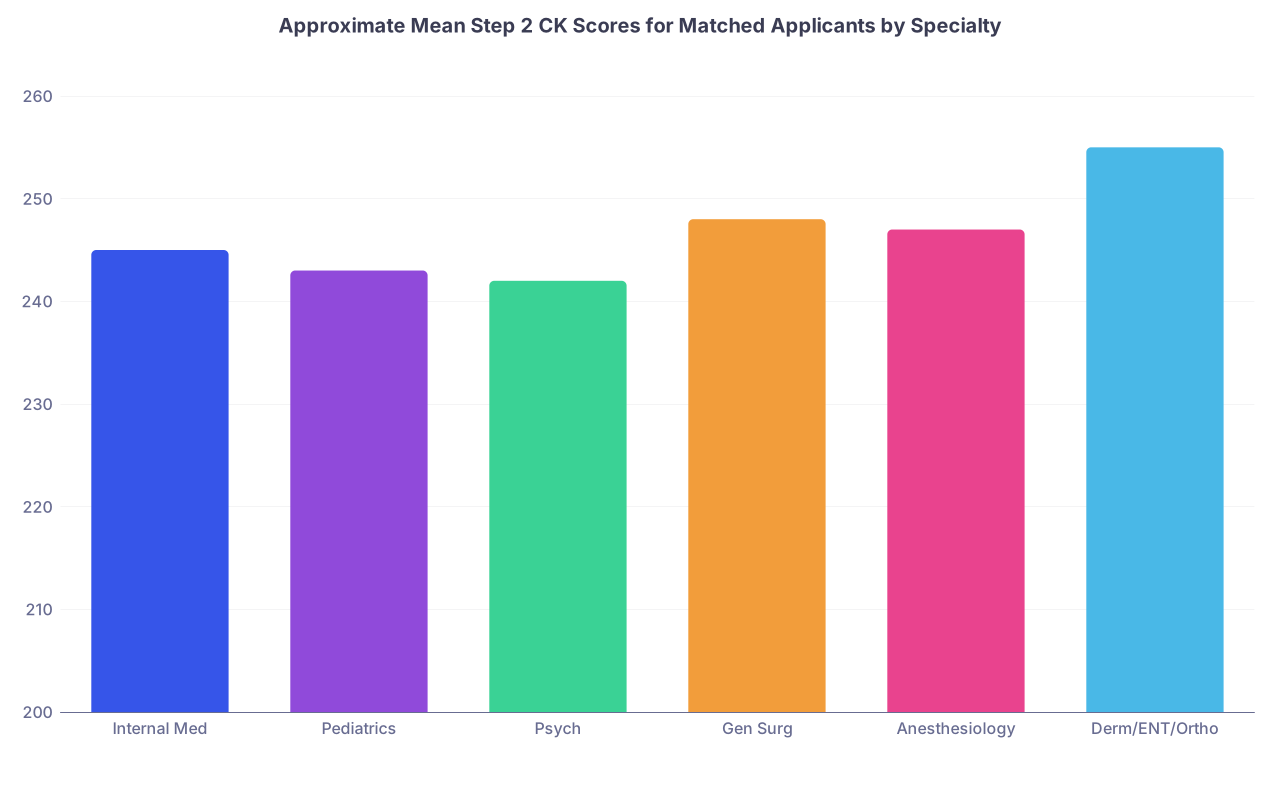
| Category | Value |
|---|---|
| Internal Med | 245 |
| Pediatrics | 243 |
| Psych | 242 |
| Gen Surg | 248 |
| Anesthesiology | 247 |
| Derm/ENT/Ortho | 255 |
You don’t need to memorize the numbers. Just notice the pattern:
- If your Step 2 CK is 20+ points below the typical matched range in a given specialty, you’re not “a bit below average.” You’re in probable auto-screen territory for many programs.
That’s where a gap year might be strategically smarter than just bombing ERAS with a bad score.
Where Gaps Actually Matter
Programs do care about:
- Extended time to graduation without explanation
- Repeated failures (Step fails, course failures, leave of absence with no improvement afterward)
- Obvious attempts to “hide” a bad year
But there’s a difference between:
- An unexplained hole in your training timeline
and - A documented, intentional research year, or a structured extra year for MPH, MBA, advanced degree, major research fellowship, etc.
PDs are not allergic to time off. They’re allergic to mystery and stagnation.
Case-by-Case: When Low Score Is Worse, When a Gap Is Worse
Let’s walk through realistic scenarios. Because the answer is not one-size-fits-all.
Scenario 1: Step 2 CK 235, Wants Internal Medicine
Typical matched IM score: around mid-240s. You’re a bit below, but not catastrophic. You’re at a mid-tier MD school or solid DO program, no major red flags, some research, okay letters.
- Applying now with a 235: You will likely match somewhere in IM if your application is otherwise solid and your list is broad.
- Taking a gap year to slightly increase to maybe 242 next year: That’s not a smart trade. You lose a year of earning as a physician and gain…maybe a few extra mid-tier interviews?
Here, a gap year is worse than a low-but-passable score. You don’t fix average by delaying your career.
Scenario 2: Step 2 CK 218, Wants Dermatology
Derm requires insane board numbers and a heavy research CV. Your 218 is not just “suboptimal.” It’s game-ending at most derm programs.
- Apply straight with 218 + no derm research year? That’s basically lighting your ERAS money on fire.
- Take a legit research year in derm at a respected institution, publish, network, and maybe retake Step 2 if allowed (or show other strong metrics)? That’s your only remotely rational shot.
In this world, not taking a gap year is the bigger mistake. The low Step score is the fatal blow. The gap year is your hail-mary attempt to offset it.
Scenario 3: Step 2 CK 225, Wants Psychiatry or Family Medicine
Psych and FM are less board-obsessed. They definitely look at scores, but they’re more willing to interview based on fit, clerkship performance, and interest.
- With 225, you’re below the mean but absolutely still in range to match if the rest of your app is strong.
- A gap year just “to improve score” is usually a bad deal, especially if you don’t have a plan for what that year actually produces (rotations, research, a second degree, clear story).
Here again, the low score is not fatal. The gap year costs more than it gives.
Scenario 4: Step 2 CK 205 After a Fail, Wants Any Residency
This is where many students panic and make impulsive decisions.
You have:
- Step 1: Pass, but maybe on second attempt
- Step 2 CK: 205 after a previous fail, or barely passing
- No strong home program support, no big-name mentors
If you apply right now, many programs won’t touch the application. The double hit of failure + low score signals risk. Your biggest enemy isn’t the gap year; it’s that your file screams “struggle with standardized tests and possibly with heavy cognitive load.”
Here, a structured extra year can help:
- Intensive USMLE remediation (if retake is possible/allowed)
- Strong away rotations in less competitive specialties (FM, IM, Psych)
- Showing consistent clinical performance and strong new letters that say, in effect: “This person functions at residency level despite weak tests.”
This is one of the rare cases where a gap year is not only acceptable, it might be the only way to produce a coherent upward trajectory.
What Programs Actually Prefer: Clear Narrative Over Raw Timeline
Most PDs don’t sit around saying “We hate gap years.” They say:
- “We hate uncertainty.”
- “We hate unexplained problems.”
- “We hate when there’s a red flag and zero evidence of growth.”
I’ve heard versions of this more than once:
“I’ll take the guy who had a Step 1 failure, took a structured year to fix it, crushed Step 2, and has clear letters saying he turned it around — over the one who barely passed, rushed through, and stayed mediocre.”
The problem is not the presence of a gap. It’s when the gap exists and nothing meaningful happens in it.
A Useful Comparison
Here’s how PDs often read these two profiles:
| Profile | Likely Impression |
|---|---|
| Low Step score, no gap, no explanation | Questionable test-taking, no evidence of improvement |
| Low Step score, structured gap year with research and better performance | Struggled but grew, motivated, took initiative |
| Gap year with vague description and minimal output | Possible professionalism or competence issue |
| Solid Step score, no gap | Straightforward, low-risk applicant |
You see the pattern. It’s not the year off; it’s the story it tells.
When a Gap Year Actually Backfires
Let me be blunt: a “gap year” that amounts to Netflix, a token volunteer gig, and one case report no one cares about? That’s worse than just owning your low score and moving on.
You should absolutely not take a year off if:
- Your Step 2 score is within realistic range for the specialty you’re applying to.
- You have no credible plan for making that year produce outcomes: substantial research, a degree, publications, strong new letters, improved scores (if retake possible), or deep specialty immersion.
- You’re just trying to “wait out” the low score, as if time alone makes PDs forget.
Time is not the intervention. Signal is the intervention.

| Step | Description |
|---|---|
| Step 1 | Low Step Score |
| Step 2 | Apply this cycle with broad list |
| Step 3 | Switch specialty and apply without gap |
| Step 4 | Reassess career goals or seek intensive advising |
| Step 5 | Take gap year with clear plan and deliverables |
| Step 6 | Within realistic range for target specialty |
| Step 7 | Can change target specialty to less competitive |
| Step 8 | Can produce strong outcomes in a structured year |
The Hidden Cost Nobody Talks About: Opportunity Loss
Everyone fixates on “what PDs think.” You should also think about what you lose by taking a year:
- One year of residency salary
- One year closer to attending pay
- One year of actual clinical experience
- One year of your life you don’t get back
If your Step 2 CK is 230 and you’re aiming for internal medicine, taking a year off just to try for 238 is like trading a car for a slightly nicer steering wheel.
On the other hand, if your score is 208 and you’re dead set on radiology, that extra year of serious research and reorientation might be the only path that doesn’t end in serial unmatched cycles.
This isn’t romantic. It’s math.
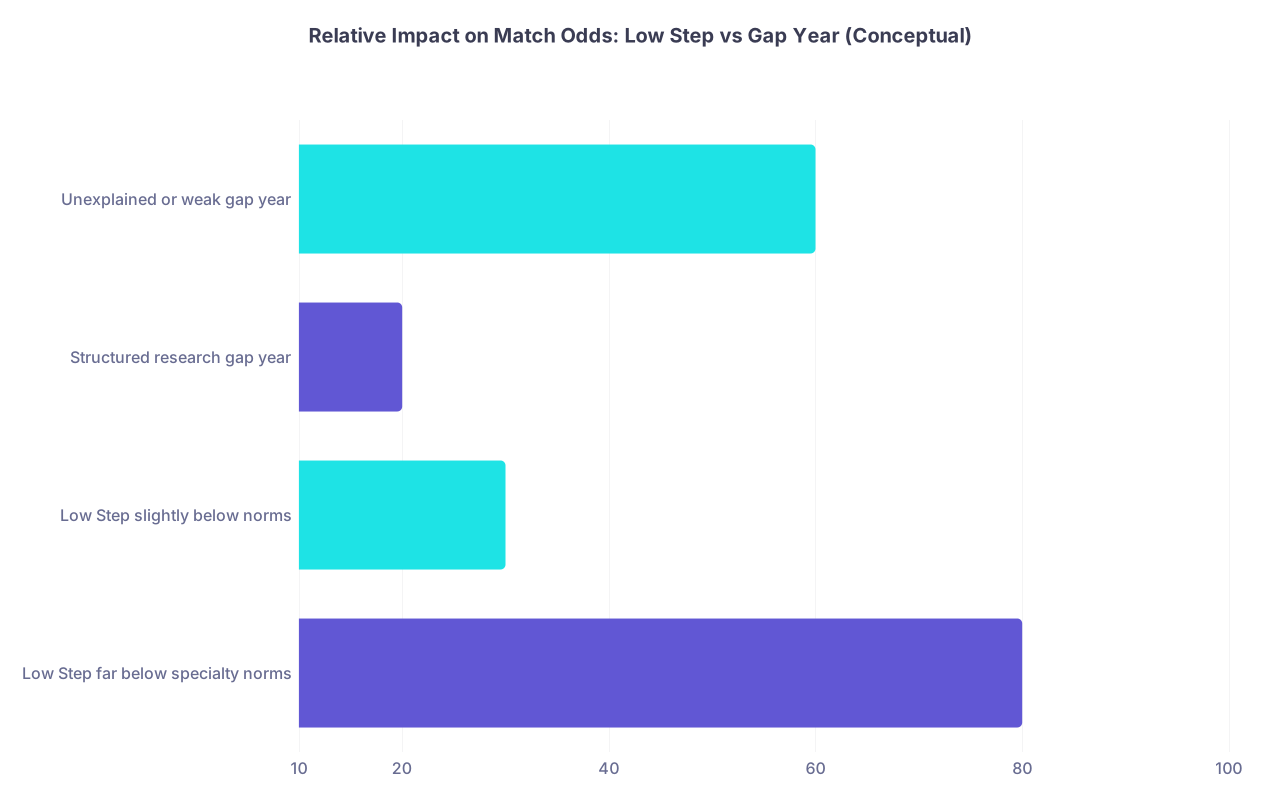
| Category | Value |
|---|---|
| Low Step far below specialty norms | 80 |
| Low Step slightly below norms | 30 |
| Structured research gap year | 20 |
| Unexplained or weak gap year | 60 |
Interpretation: the higher the number, the more harmful it is. A severely low Step score is often more damaging than a well-executed research year. A useless gap year? Almost as bad as a very low score.
So Which Is “Worse” In Reality?
Let’s answer the original question directly.
Are low Step scores worse than a gap year?
Most of the time:
- If your Step 2 CK is slightly or moderately below average for a less competitive specialty → Low Step is acceptable. Gap year is often worse.
- If your Step 2 CK is dramatically below the norm for a highly competitive specialty → The low score is the main problem. A targeted gap year may be your only realistic correction.
- If your Step 2 CK is catastrophically low or tied to multiple failures → Neither is “good,” but a well-structured extra year that shows real improvement is less bad than doing nothing and hoping for miracles.
In other words, low scores and gaps are not equal. But they’re not even the right comparison. The real variable that matters is: Do you show a believable upward trajectory and a coherent story, or not?
How to Decide Your Own Path (Without Lying to Yourself)
If you’re sitting with a disappointing Step score and wondering whether to apply or pause, here’s the ruthless framework I’d use:
- Look up NRMP data and see where your score sits relative to matched applicants in your target specialty. Not just applicants. Matched.
- If you’re within ~10 points of that mean and not loaded with other red flags, applying now with a smart list is usually better than pausing a year.
- If you’re 15–20 points below and not willing to switch to a less competitive specialty, a gap year is not insane — but only if you can turn it into real academic, clinical, or testing improvement.
- If you can’t design a year that yields substantial, concrete output, then a gap year becomes cosmetic. Cosmetic gaps don’t fix structural problems.
One more hard truth
No gap year can erase a USMLE transcript. The score will always be there. What you can do is:
- Change specialties to one where that score is survivable, or
- Build such a strong counter-narrative (research, letters, obvious growth) that a few PDs decide you’re worth the risk.
That’s strategy. Not superstition about timelines.
Key Takeaways
- A low Step score far below your specialty’s norms usually hurts more than a well-explained, productive gap year.
- A pointless or weakly justified gap year often looks worse than applying with a slightly below-average but acceptable Step score.
- What programs care about most is not the absence of a gap, but the presence of a clear, upward trajectory and a coherent story of how you responded to setbacks.