
What actually happens to the applicant with a 209 Step 1 or a 219 Step 2 who refuses to accept they’re “done”? Do they really get blacklisted forever, or is that just the story anxious MS2s tell each other on Reddit?
Let me be blunt: the “once low score, always screwed” narrative is lazy, comforting pessimism. It lets people give up early and call it realism. The actual data and real-world outcomes are a lot messier—and a lot more hopeful—than the doom posts you’ve read.
You are not a score. Programs know it. They just won’t stick their necks out for you if you don’t give them anything else compelling to work with.
Let’s walk through what the evidence actually shows and what people who do climb out of the “low score” bucket tend to do differently.
What Programs Really Do With “Low Score” Applicants
First, define terms. “Low score” is not a diagnosis; it’s a relative label.
In practice, here’s what people usually mean:
- Step 1 (when it was scored): <220 for competitive specialties, <210 for most IM/FM/psych/peds conversations
- Step 2 CK: under ~230 in competitive fields, under ~220 in less competitive ones
- A fail on Step 1 or Step 2 at any score
The common myth: Once you’re in that bucket, every program filters you out, and that’s the ballgame.
Reality: programs use step scores as a blunt, early screening tool. Not a permanent branding iron.
| Use Case | What Actually Happens |
|---|---|
| Initial filter | Hard cutoffs at/near posted minimums, sometimes slightly higher in competitive fields |
| Post-interview ranking | Score matters, but far less than interview performance and fit |
| Red flags (fails) | Needs explanation and compensation (strong Step 2, strong letters) |
| Holistic review programs | Scores contextualized with school, story, trends, and experiences |
I’ve sat in rooms where PDs say things like:
- “Anyone under 220 goes to the ‘maybe if something else is insane’ pile.”
- “Step is a quick screen. Once I’m actually reading, I care mostly about: letters, narrative, and whether I believe this person will show up and do the work.”
The label “low score applicant” matters the most at one choke point: that first sort. After that, you either get read or you do not.
So your job is not to magically erase your score. Your job is to make the rest of your file so targeted and strong that enough programs choose to ignore the label and actually read you.
The Data: Low Scores Hurt. They Don’t Bury You.
Let’s look at numbers instead of vibes.
NRMP’s Charting Outcomes and Program Director Surveys are dry, but they answer the question you actually care about: “Does a low Step score doom me?”
Programs absolutely care:
- In the 2021 NRMP PD Survey, Step 2 CK was one of the top criteria across almost every specialty for getting an interview.
- Step failures were repeatedly flagged as a major concern.
But here’s what people conveniently ignore: the match rate for applicants with “less-than-stellar” scores is far from zero—if they adjust expectations and strategy.
Take internal medicine as a rough example (using data patterns, not exact year-specific numbers):
- US MD seniors in IM with Step 1 in the mid 220s had match rates well above 90%.
- Even those significantly below that, who still matched, tended to have: strong clinical grades, solid letters, and enough programs on the list.
Same story in family med, psych, peds: match rates for “lowish” scores stay reasonably high as long as the rest of the file isn’t weak and the specialty choice isn’t delusional.
Where do low scores really punish you?
- Competitive fields (derm, ortho, plastics, ENT, etc.)
- People who apply too few programs
- People who don’t compensate elsewhere (no research, mediocre letters, no story)
Programs are not allergic to low scores. They are allergic to risk with no upside.
If you bring a low score plus: poor narrative, generic letters, limited work, and bad specialty choice—then yes, your “label” will feel permanent. Because nothing contradicts it.
The Myth of the Permanent Scarlet Letter
The exaggerated myth: “PDs will always see me as that 204 forever. I’ll never get past it.”
Evidence says otherwise.
Here’s what actually changes the conversation:
1. A Strong, Later Performance
Programs care a lot about trajectory. A weak Step 1 followed by a strong Step 2 CK used to be one of the classic “redemption arcs.”
I’ve seen:
- 204 Step 1 → 245 Step 2 CK → matched categorical IM at a mid-tier academic program.
- 210 Step 1 → 232 Step 2 CK → pediatrics at a solid university program, not community.
No one in those final ranking meetings was talking about the old Step 1 numeric ghosts. They were saying things like, “They clearly figured out how to study,” and “their Sub-I attending loves them.”
With Step 1 now pass/fail, Step 2 CK has just taken over the same role. If yours is low, fine. You can’t rewrite history. But if anything later in your record clearly contradicts the idea that you’re “weak” (strong shelf exam trend, in-service scores during prelim year, academic work), that label loses power fast.
2. Performance That Matters Locally
Once you’re actually in a program—prelim, transitional, or categorical—scores start to fade into the background. What replaces them:
- How you show up on wards
- Evaluations from attendings and seniors
- Whether you can be trusted at 2 a.m. when things go sideways
I’ve watched PDs argue to keep or advance a resident with a low test track record because, “She’s one of the people I’d want covering the ICU at night.”
No one says, “Yeah, but remember her 211?” They’re too busy worrying about who can safely staff their service.
That’s how people with ugly Step histories still land competitive fellowships. Interventional cards, GI, heme/onc—filled with residents who were not all 260 machines in med school but crushed it once on the ground.
3. A Compelling, Coherent Story
This part gets dismissed as “soft,” but it’s what distinguishes the rare low-score applicant who gets serious looks.
When a PD reads your application, they’re silently asking:
- Does this trajectory make sense?
- Do the letters match the story they’re telling?
- Do I believe this person will be solid at 3 a.m. while I’m at home?
If your app reads like: “I had a bad test day, please ignore this one data point,” it sounds like excuse-making. If it reads like: “Yes, my test history is imperfect, here’s what changed, and here’s the actual evidence of my current performance,” that’s different.
I’ve seen personal statements with a single, clear paragraph owning the low score, followed by focused, results-backed growth. Those are memorable. And yes, they get interviews.
How People Actually Climb Out of the “Low Score” Bucket
Let’s talk strategy. Not the motivational poster version. The “what have I seen actually work” version.
Step 1: Choose the Right Target, Not the Dream Fantasy
You do not get to say: “I’m a 210/220 applicant, but I’ve always wanted ortho, so I’m just going to ‘believe in myself.’”
That’s not grit. That’s denial.
What works:
- Align specialty with your whole record: clinical strengths, letters, personality, test history.
- If you’re truly set on something competitive, understand the trade: research years, aways, and still a real risk of not matching. Many bail out too late and eat the consequences.
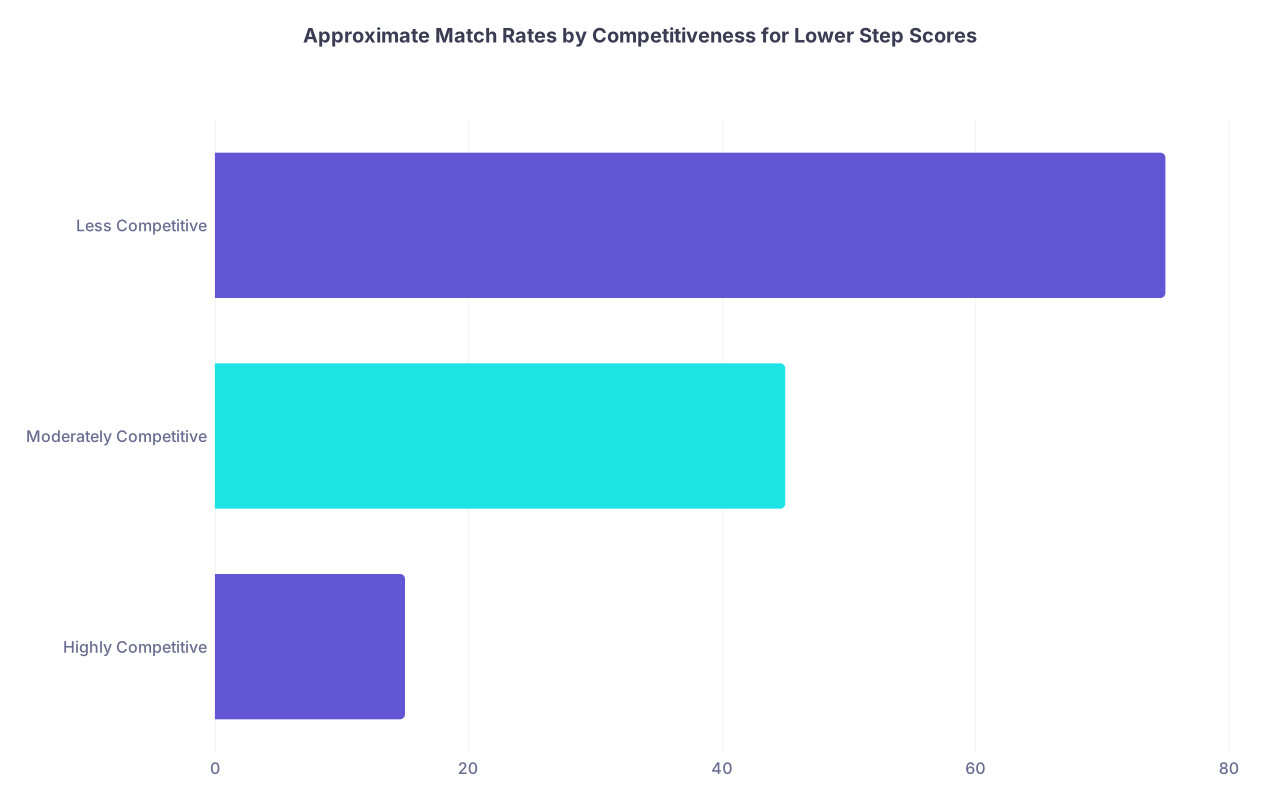
| Category | Value |
|---|---|
| Highly Competitive | 15 |
| Moderately Competitive | 45 |
| Less Competitive | 75 |
Those are illustrative, not exact NRMP numbers, but the pattern is real: your odds improve dramatically as you aim at less cutthroat fields.
The label “low score” weighs different depending on where you aim it.
Step 2: Overwhelm the Risk With Evidence
Programs will forgive a low score if you create enough counterweight. The successful “low score but matched well” folks tend to stack several of these:
- Strong clinical performance and honors on key rotations
- Killer letters from people who actually know them and will go to bat
- Tangible productivity: QI projects, posters, publications (even small ones)
- Extra work that shows reliability: chief roles, tutor roles, leadership that isn’t just fluff
The idea is not to “hide” your score. It is to drown it out.
I’ve seen applicants with a 210 Step 1 and ~225 Step 2 get IM university interviews because they had:
- Two first-author posters at ACP
- Enthusiastic letters from subspecialty faculty
- A Sub-I evaluation that read like a love letter
No one is thrilled by their scores. But they’re not gambling blind: there’s clear evidence this person performs.
Step 3: Fix the Narrative, Not Just the Numbers
If you blew Step 1/2 and then just “move on” without addressing why, programs assume you haven’t changed anything.
The ones who climb out:
- Get real about what went wrong (not just “bad test day”)
- Change how they study, how early they start, and how they get feedback
- Mention this concisely in their personal statement or in interviews, then immediately point to specific results
Something like:
“I underperformed on Step 1 because I relied on passive review and underestimated timed practice. Before Step 2, I overhauled my study approach: daily timed blocks, weekly tutor check-ins, and spaced repetition. That change has carried into my clinical work—you can see the same pattern in my clerkship shelf improvements and my Sub-I evaluations.”
That’s a story. It acknowledges the red flag, then shows why it’s no longer predictive.
Prelim Years, SOAP, and Second Chances
This is the part nobody wants to think about, but it’s where the “always stuck” myth really dies.
No categorical spot? Low Step score plus overreach? You’re not done. You’re just off the easy path.
Here’s what I’ve watched people do:
- Match a prelim IM or transitional year.
- Work like a maniac, collect stellar evaluations, and make themselves indispensable.
- Take or retake Step 3, do better, and re-apply with PDs calling on their behalf.
Does this guarantee a categorical spot? No. But I’ve seen it work often enough that calling the initial low score “permanent” is just false.
And yes, SOAP can be very ugly. It can also be the doorway into a spot where your work ethic—and not your test history—becomes your primary currency.
If you treat a prelim year like a holding pattern, you’ll stay labeled. If you treat it like a brutal, one-year audition, it can rewrite your story.
Where the Myth Feels True—and Why
People cling to the “once low, always stuck” myth because they:
- Aim at the wrong specialties
- Apply to too few programs
- Do nothing compelling to offset the risk
- Expect PDs to “see their potential” without evidence
- Take one cycle of failure as permanent proof
On top of that, the people who do climb out of the hole don’t usually sit around on public forums documenting every detail. They’re busy trying to survive intern year.
So your sample is biased: loud horror stories, silent slow wins.
Is it harder to match with low scores? Yes. You will work more, compromise more, and likely accept less glamour than you once imagined.
But “harder” and “impossible” are not the same word.
The Bottom Line
You’re not permanently branded. You’re just inconvenient.
Programs prefer high scores because they’re easy. When you don’t have that, you must give them different reasons to take the risk.
If you want the short version to walk away with, it’s this:
- A low Step score limits options; it does not end them. Specialty choice, application volume, and how you compensate elsewhere matter more than Reddit wants to admit.
- Trajectory and performance can absolutely override your early label—strong Step 2/3, powerful letters, and real clinical work speak louder over time.
- The people who escape the “low score” box don’t argue with reality; they adjust to it, stack evidence, and keep moving—even when that means a prelim year, an unglamorous field, or a slower path.
If you’re willing to do that, your score becomes a chapter. Not your title.