
Research does not magically erase a low Step score. In some fields it helps a lot. In others it barely moves the needle. And in a few, it can actually trick you into a false sense of security that gets you burned on Match Day.
Let me be blunt: the “I’ll just do a ton of research and it’ll offset my 210” strategy is one of the most common, costly myths I see every single cycle.
You’re being sold a comforting story: publications > scores. The data say otherwise.
What Programs Actually Screen On (Not What They Say)
Programs love to talk about “holistic review.” Then they apply numeric filters before anyone even looks at your name.
NRMP Program Director Survey after survey shows the same pattern: in most specialties, Step 2 CK score (and formerly Step 1) is a primary screen. Research productivity is nice—but it’s secondary, and often only considered after you’ve cleared the test-score hurdle.
Here’s a reality snapshot, simplifying from PD surveys and published competitiveness data:
| Specialty | Score Importance | Research Importance | Notes |
|---|---|---|---|
| Dermatology | Very High | Very High | Research helps, but not with very low scores |
| Neurosurgery | Very High | Very High | Scores and research both gatekeepers |
| Plastic Surgery | Very High | High | Research strong, but scores must be solid |
| Internal Med (academic) | High | Moderate-High | Research helpful for top programs, not for screening out low scores |
| Family Med | Moderate | Low | Research rarely compensates for poor scores |
Does research matter? Of course. But the hierarchy is usually:
- Don’t get screened out by scores.
- Among those who pass the screen, stand out with research, letters, and fit.
The myth flips that order. It assumes you can be irresistible on paper with enough PubMed entries that PDs will overlook weak exams. Outside a few very specific contexts, that’s simply not how most committees work.
Where Research Actually Moves the Needle
Let’s sort out where research can meaningfully help a low-ish scorer—and where it’s mostly lipstick on a pig.
Ultra-competitive specialties: research is necessary, not sufficient
This is where the myth is most dangerous: derm, plastics, neurosurgery, some ENT and ortho programs.
You hear the same story from MS2s on every campus:
“Yeah I’m at a 220 now but I’m taking a research year in derm, I’ll be fine.”
No. You might be more competitive than you would have been without research, but you’re still playing uphill against applicants with:
- 245–255+ Step 2 CK
- Dedicated derm/neurosurg research years
- Multiple first-author papers in the field
- Home program chair letters
Research in these fields behaves like a multiplier, not a substitute. If your baseline (scores, clinical performance) is strong, research multiplies your chances. If your baseline is weak, it doesn’t magically flip the script.
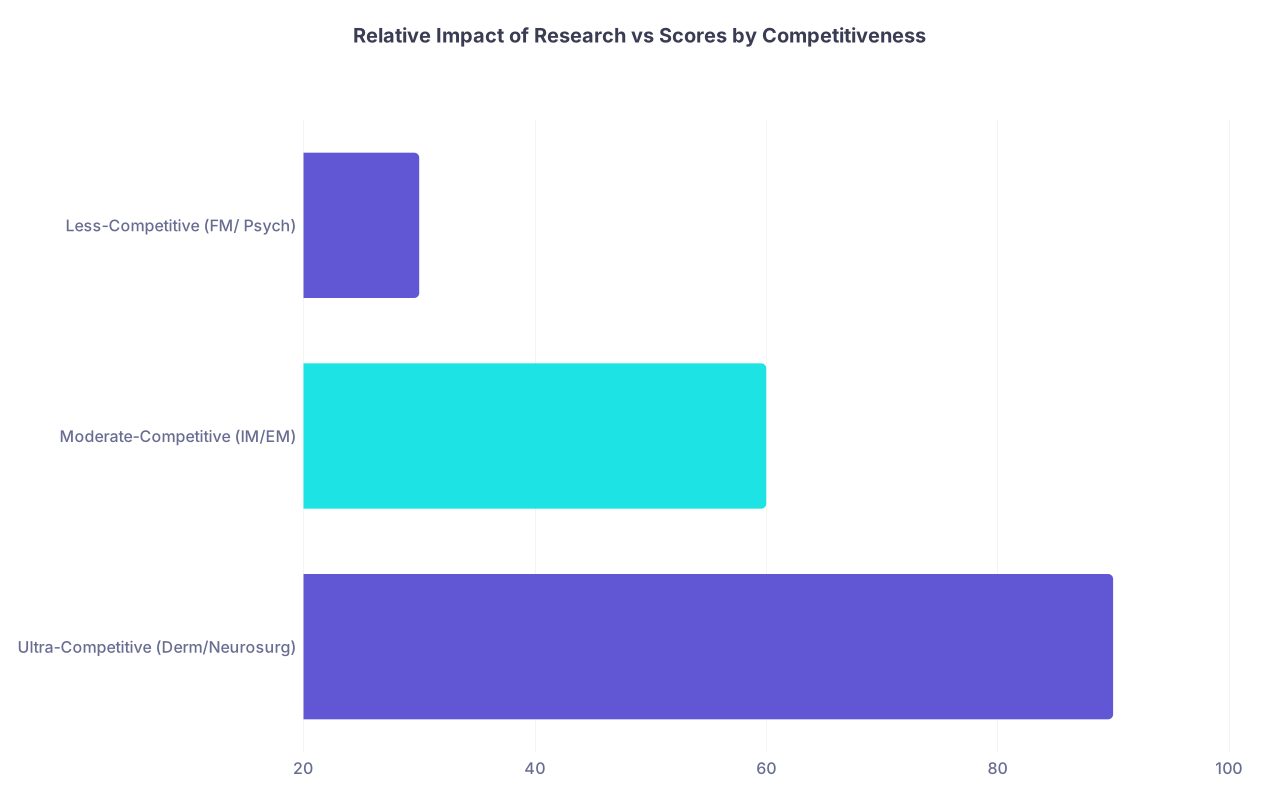
| Category | Value |
|---|---|
| Ultra-Competitive (Derm/Neurosurg) | 90 |
| Moderate-Competitive (IM/EM) | 60 |
| Less-Competitive (FM/ Psych) | 30 |
The myth says: “Derm loves research so if I stack publications, they’ll ignore scores.”
Reality: You often need both. You may get a bit of grace for a slightly below-median score if your research is elite, but low scores are still usually fatal outside special circumstances (known by the department, unique skillset, home program politics).
Academic internal medicine, radiation oncology, heme/onc pathways
Here research matters more—but still does not auto-compensate for everything.
Scenario I’ve seen multiple times:
- Applicant A: Step 2 CK 220, two oncology case reports, strong heme/onc interest
- Applicant B: Step 2 CK 250, no publications, solid but generic IM application
At a mid-tier community IM program, Applicant B wins on paper almost every time.
At a research-heavy academic program with a strong heme/onc division, Applicant A may still struggle for interviews, but if they get one—then the research helps. Now they can have a focused story, future goals, and a PI advocating for them.
So research is an amplifier in academic fields. It amplifies a decent baseline. It doesn’t turn a 210 into a 250.
Less competitive specialties: research is often optional
Family medicine, many community psych programs, some peds programs—these are not research-driven fields at baseline.
I’ve watched students with 205–215 obsess over getting “one more poster” in FM, while ignoring the far more useful moves:
- Raising Step 2 CK from 215 to 225
- Crushing core clinical rotations and shelf exams
- Fixing red flags in professionalism or communication
- Getting strong, specific letters from community preceptors
That extra QI poster? Nice. But no PD is saying, “We usually don’t interview below 220, but this one FM QI abstract at a local meeting really changes things.”
In these fields, research is icing. If your cake is bad, icing won’t save it.

The Hidden Cost: What Research Steals From You
People talk about research like it’s a free power-up. It’s not. It costs time, energy, and often your best shot at fixing the core problem: scores.
I’ve watched this play out in real time:
- MS2 with a weak preclinical foundation decides to cram for Step 1 while simultaneously trying to launch two projects, “because derm likes research.”
- Their Step 1 (back when it was scored) comes out poor. They then double down: “I’ll take a research year to fix this.”
- That year ends with a couple of middle-author papers, one pending manuscript, and… no improved test-taking skills. Step 2 CK is still weak.
- Now they’re one year behind, with mediocre scores and okay research in a field that expects elite results in both.
If that same student had said:
“I have one shot to fix my academic signal—Step 2 CK. I’m going to get boring, stop chasing low-yield research busywork, and learn how to test well,” their outcome would have been very different.
Research has opportunity cost. It often replaces:
- Dedicated Step 2 prep
- Stronger clinical performance and letters
- Networking with programs where your current profile is realistic
- Time to build a coherent application narrative instead of a frantic CV dump
A year is a long time. Spending it on five poster presentations with no change in your ability to succeed on exams is a poor trade in most scenarios.
When Low Scores + Strong Research Do Work Together
There are narrow situations where research can meaningfully “rescue” a low score. Notice how specific they are.
Case 1: Known by the department and heavily mentored
If you’ve worked closely with a well-connected PI in your target specialty for 1–2 years, and that PI is genuinely willing to go to bat for you, the game changes slightly.
Scenario that can work:
- Step 2 CK: 218
- 1–2 first-author papers in the target field
- Strong presentation at a national specialty conference
- PI is a big name and personally calls PDs: “This student is the real deal. Ignore the test scores. Here’s why.”
Even then, most programs won’t ignore their filters. But some will. Especially if:
- You’re at their home institution
- They trust your mentor’s judgment
- Your ERAS signals and away rotations align with them
This is not “research compensates for low scores in all fields.”
This is “powerful relationships sometimes override numbers at the margins.”
Case 2: You pivot strategically, not delusionally
Sometimes research is part of a salvage operation—but only when paired with a realistic shift in target specialty.
Example:
- MS3 aimed for ortho. Step 2 CK 215, no real chance at competitive ortho programs.
- They have decent ortho research but decide not to throw themselves against the wall repeatedly.
- They pivot to PM&R or anesthesia, bring their ortho research as evidence of MSK or procedural interest, and deliberately target mid-tier, less hyper-competitive programs.
Here, research supports the story: interest in the body system or procedural work. But it works because the applicant stopped pretending that research alone would get them into the originally desired ultra-competitive field.
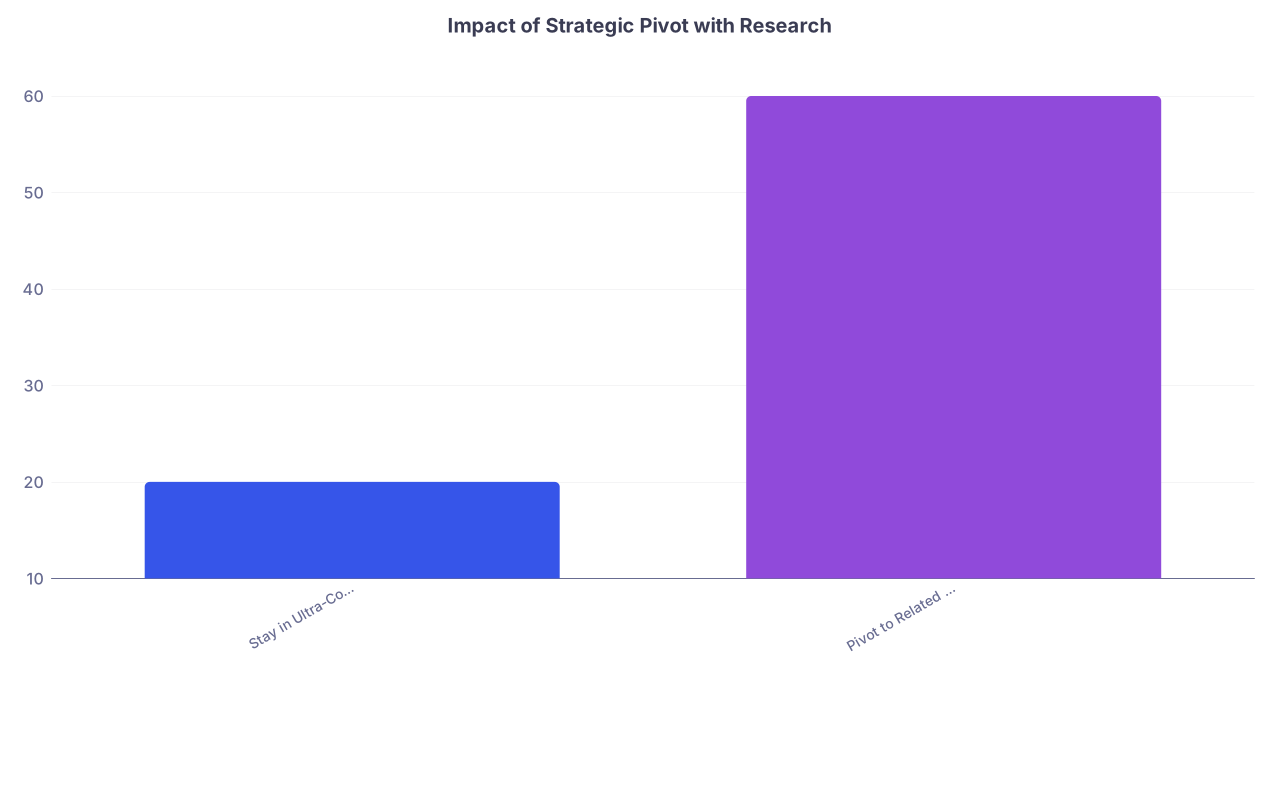
| Category | Value |
|---|---|
| Stay in Ultra-Competitive Field | 20 |
| Pivot to Related but Less Competitive Field | 60 |
Those numbers aren’t real data, they’re a reflection of the pattern: staying stubborn in an unrealistic specialty with low scores plus research usually fails. Pivoting smartly with the same research background? Very different story.
The Research “Quality” Myth
Another related myth: “If my research is high quality, it’ll matter more than the number of pubs and compensate for bad scores.”
Be careful. Program directors don’t have time to appraise the fine-grain quality of your work in detail for every applicant. They rely on simpler signals:
- Is it in a recognizable journal?
- Is it in the field I care about?
- Are you first or second author on anything?
- Do your letters actually say you contributed meaningfully?
They’re not sitting there reading your methods section to decide if you deserve a pass on that 205 CK.
High-quality, rigorous work does help, but mainly by:
- Getting you stronger advocacy from your mentor
- Giving you something substantive to talk about in interviews
- Demonstrating persistence, curiosity, and follow-through
It’s still not a blanket override for low scores. It’s a tiebreaker or a differentiator among already-viable candidates.

So What Should You Actually Do With Low Scores?
If your scores are lower than you’d like, the smart move is not “panic and find a PI.”
You want a cold, strategic approach:
Map your true competitiveness, not your fantasies.
Use NRMP Charting Outcomes, specialty score distributions, and PD survey data. If your Step 2 is 215 and the median in neurosurgery is 250+, pretending research will close that 35-point gap is wishful thinking.Decide whether score repair is still on the table.
For many US grads, Step 2 CK is the last big numeric signal. If you haven’t taken it yet and struggled on Step 1, your best “research year” is often a “learn how to test and fix your foundation” year instead.Target research only when it aligns with a realistic plan.
Research makes sense if:- You’re aiming at academic IM, EM, psych, or peds and your scores are modest but not catastrophic
- You already have a reliable mentor and projects in motion
- You’ve stabilized your test performance and are not avoiding your test problem with “productive” procrastination
Stop chasing line-item volume.
Ten abstract presentations at local meetings do not outweigh a failing or near-failing board score. One solid, first-author project with a strong letter often beats a laundry list of posters you barely remember.Pick specialties and programs that actually match your profile.
If you’re at risk of not matching at all, the highest-yield move is honest recalibration, not another year of precarious unpaid research hoping to crack a field that’s been telling you “no” in three different languages.
The Bottom Line
Research is powerful—but it’s not a universal cheat code, and it does not automatically compensate for low scores across all fields. Three takeaways:
- Programs screen on scores first in most specialties; research usually helps after you clear that bar, not before.
- A year of research that doesn’t fix your underlying test-taking weakness is often a bad trade, especially in non-ultra-competitive fields.
- Research helps most when it’s part of a realistic, specialty-appropriate strategy with good mentorship—not a last-ditch Hail Mary to rescue an otherwise uncompetitive profile.