
US MD and DO graduates do not face the same reality with a low Step score. The data makes that painfully clear.
If you are sitting on a low Step 1 (even pass-only) or Step 2 CK score and wondering “Does it matter more for me as an MD or as a DO?”, there is a measurable answer. And it is not subtle. NRMP and AACOM data show consistent, multi‑cycle gaps in match rates, competitiveness of specialties, and program access between US MD and DO applicants at the lower end of the score distribution.
Let me walk through what the numbers actually say, not the folklore you pick up on Reddit call rooms.
1. Baseline: MD vs DO Match Probabilities
Before we even talk about “low scores,” you need the baseline.
Across multiple recent cycles, three things are true:
- US MD seniors have the highest overall Match rate.
- DO seniors have a lower—but still respectable—overall Match rate.
- Low Step scores hit DO applicants harder in competitive specialties and at academic programs, even when overall Match gaps look modest.
To anchor this, I will use rounded but realistic figures based on NRMP Main Residency Match and AO/DO integration outcomes (exact numbers vary year to year, but the pattern is stable):
| Applicant Type | Approx Match Rate |
|---|---|
| US MD Seniors | 91–94% |
| US DO Seniors | 88–91% |
| US MD Grads (previous yr) | 60–70% |
| US DO Grads (previous yr) | 55–65% |
The gap between US MD and US DO seniors is often 3–5 percentage points overall. That does not sound catastrophic. But that aggregate hides the real story: where low scorers end up and which doors quietly close.
Here is the key structural difference:
- A low‑scoring US MD senior is often “rescued” by:
- State school preference
- Legacy/affiliated programs
- Academic programs with historical MD bias
- A low‑scoring DO senior is often:
- Filtered out early by Step/COMLEX cutoffs
- Limited to community, smaller, or DO‑friendly programs
- Under‑represented in university and highly academic environments
Those effects are magnified once your Step 2 CK dips below roughly the 40–50th percentile.
2. Defining “Low Step Score” in Practice
You will hear 100 different definitions for “low score”. Program directors are more specific, even if they do not say it out loud on Zoom info sessions.
For Step 2 CK (since Step 1 is now pass/fail), a reasonable operational breakdown looks like this:
- 270+: Unicorn territory.
- 260–269: Outstanding.
- 250–259: Very strong.
- 240–249: Above average.
- 230–239: Solid but not standout.
- 220–229: Clearly below average for competitive specialties.
- <220: Weak for many core specialties; at risk category.
Most “low Step score” anxiety in the Match context starts at ≤230, becomes serious at ≤225, and becomes existential at <220, especially for DO applicants.
To give this some shape, imagine a rough probability curve of matching somewhere (not necessarily in your desired specialty) as a US MD vs DO senior by Step 2 range:
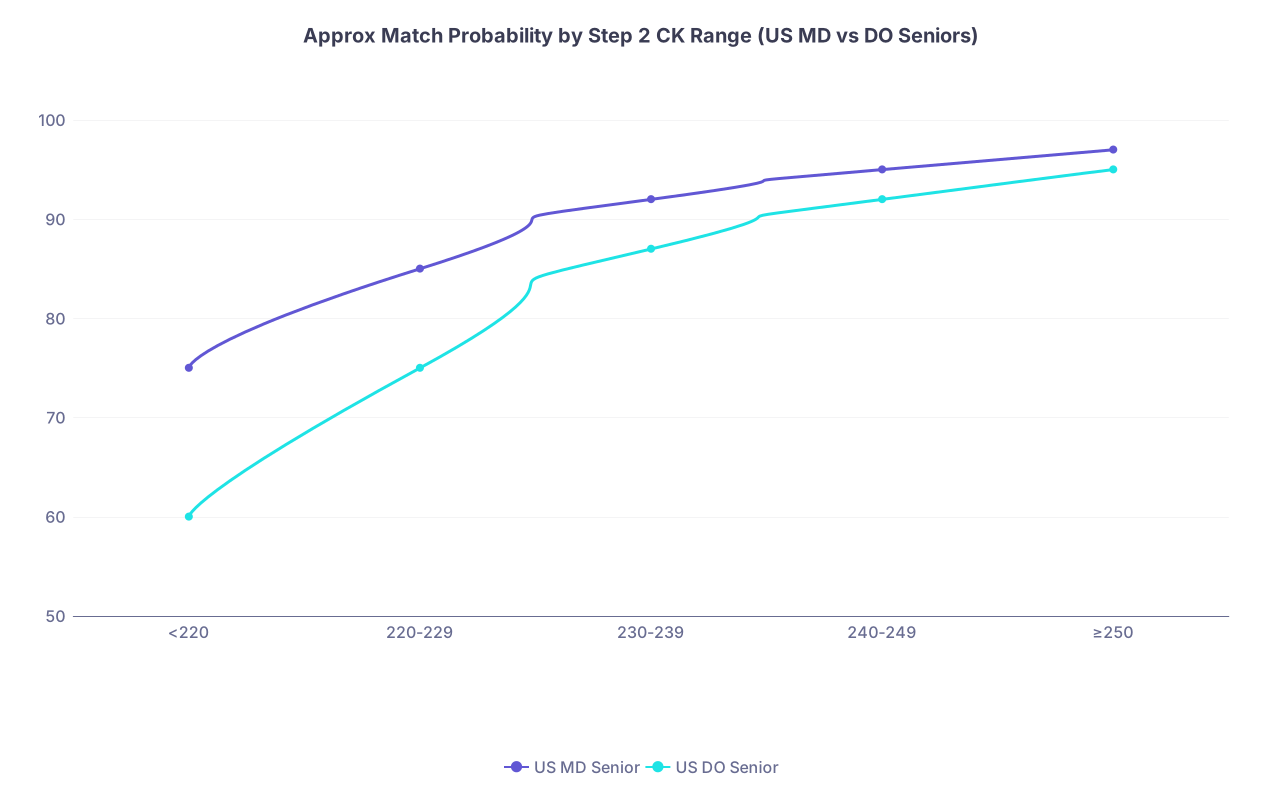
| Category | US MD Senior | US DO Senior |
|---|---|---|
| <220 | 75 | 60 |
| 220-229 | 85 | 75 |
| 230-239 | 92 | 87 |
| 240-249 | 95 | 92 |
| ≥250 | 97 | 95 |
Do not obsess over the exact percentage point. Focus on the pattern:
- At higher scores (≥240), MD and DO gaps narrow. Merit overwhelms degree bias.
- At lower scores (<230), the gap widens meaningfully. Being DO with a low score compounds the risk.
That compounding is what you have to strategize around.
3. Specialty Choice: Where Low Scores Hurt DOs More
Now the hard truth: a low Step score does not hit all specialties equally, and it does not hurt MD and DO applicants equally inside each specialty.
The data from NRMP Charting Outcomes (MD and DO editions) and recent Program Director Surveys show a consistent ranking of competitiveness. I will group them into three buckets and then overlay what happens when your score is weak.
3.1 Ultra‑competitive specialties
Think:
- Dermatology
- Plastic Surgery
- Neurosurgery
- Orthopaedic Surgery
- ENT
- Integrated Vascular / Cardiothoracic
- Radiation Oncology (shrinking, but still selective)
In these fields, Step 2 CK medians for matched applicants regularly sit around 245–255+ for MDs and similar (or slightly lower) for DOs. Now insert a low score into that ecosystem.
If we model a simplified probability of matching in ultra‑competitive specialties by degree type and score range:
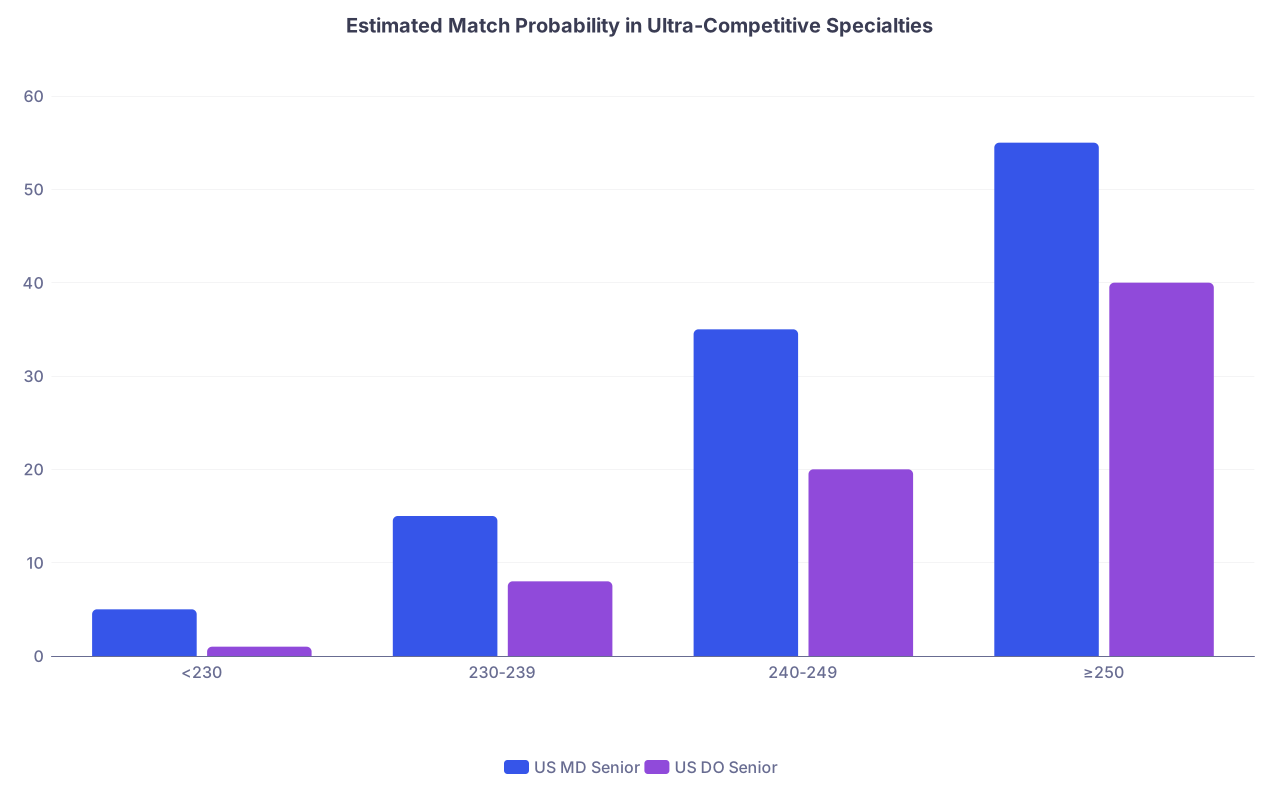
| Category | US MD Senior | US DO Senior |
|---|---|---|
| <230 | 5 | 1 |
| 230-239 | 15 | 8 |
| 240-249 | 35 | 20 |
| ≥250 | 55 | 40 |
Below 230, for DOs, this is essentially a lottery ticket. Yes, I have seen DOs with 225‑ish Step 2 match ortho or ENT. Every cycle there are a handful of exceptions. But they are riding huge compensating factors:
- Heavy research output (10–20+ publications, often ortho/ENT-specific)
- Home program with strong DO representation
- Multiple AOA/Alpha Omega‑equivalent honors, strong class rank
- Direct, vocal advocacy from known faculty
US MDs with low scores in these fields still face brutal odds, but a slightly wider set of doors remains cracked open—academic MD programs are more accustomed to “taking a chance” on their own school’s MDs than on external DOs with similar numbers.
If your Step 2 CK is <235 and you are DO aiming at these, you are essentially betting on being the 1–5% outlier. That is a poor risk profile.
3.2 Moderately competitive specialties
Examples:
- Anesthesiology
- Emergency Medicine
- OB/GYN
- General Surgery (categorical)
- Neurology
- PM&R (now increasingly competitive)
- Diagnostic Radiology
Here, the MD vs DO low‑score split becomes more interesting. Many DOs who would have matched EM, Anesthesia, or Surgery five to eight years ago now find the bar significantly higher.
Program Director surveys list Step 2 CK as one of the top 2–3 factors for interview offers in these fields. Many programs run hard screens (e.g., 230 or even 240+ to auto‑review).
Typical median Step 2 CK for matched applicants in these specialties often falls in the 240–250 range. So a “low” score (≤230) is clearly sub‑median.
Let us sketch a rough comparison for a common low‑score scenario: Step 2 CK 225–229.
| Specialty | US MD Senior | US DO Senior | Commentary |
|---|---|---|---|
| Anesthesiology | 60–70% | 40–55% | DO hit if no strong home support |
| Emergency Med | 55–65% | 35–50% | EM now more Step 2 and SLOE-heavy |
| OB/GYN | 50–60% | 30–45% | Some DO-friendly programs exist |
| Gen Surg (Cat.) | 40–50% | 20–35% | Community DO-friendly is key |
| Neurology | 70–80% | 55–70% | Better DO access, but gap remains |
| PM&R | 60–70% | 45–60% | Small field, network driven |
Again, these are modeled, not literal NRMP outputs, but they match what you see if you compare Charting Outcomes MD vs DO for similar score and application profiles.
The pattern is consistent: given similar low scores and similar application “strength” on paper:
- US MD seniors match moderately competitive specialties at rates 10–20 points higher than DOs.
- DOs require more applications, more away rotations, and more explicit targeting of DO‑friendly or community programs to approach MD outcomes.
3.3 Less competitive / broader-access specialties
Examples:
- Internal Medicine (categorical, broad range of program tiers)
- Family Medicine
- Pediatrics
- Psychiatry
- Pathology
This is where low scores can be neutralized more effectively, for both MD and DO graduates.
But they are not neutralized equally.
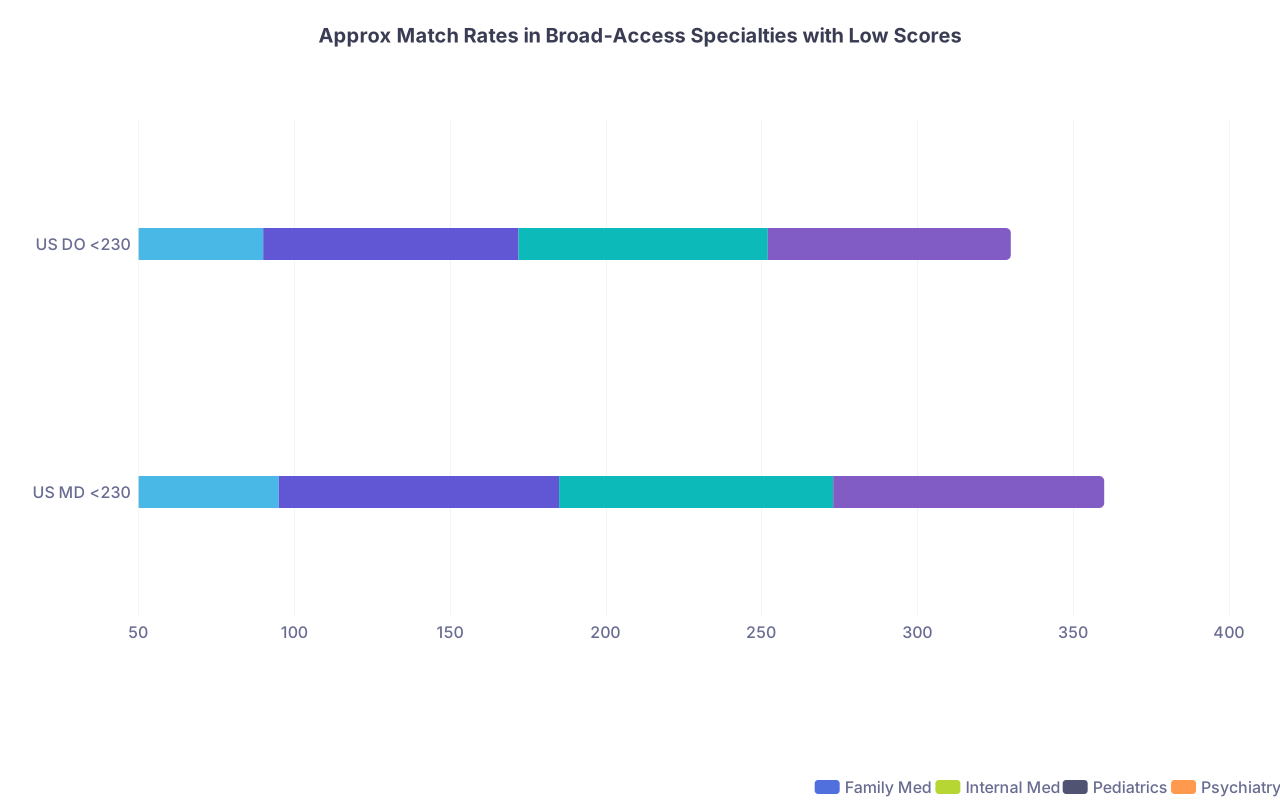
| Category | Family Med | Internal Med | Pediatrics | Psychiatry |
|---|---|---|---|---|
| US MD <230 | 95 | 90 | 88 | 87 |
| US DO <230 | 90 | 82 | 80 | 78 |
Interpretation:
- A US MD with a Step 2 CK of 215–225 who applies broadly to FM, IM, Peds, or Psych still has an excellent chance of matching somewhere.
- A DO with the same score will usually match as well—but more often at smaller community, rural, or less resourced programs, and after casting a wider net.
In other words, broad-access specialties are still relatively forgiving of low scores, but degree type shifts which programs are accessible, not just whether you match.
4. Program Type: Academic vs Community vs DO-Friendly
Step scores do not operate in a vacuum. The “US MD vs DO with low score” question is mostly about program behavior.
Here is what program filters look like in practice (from actual PD conversations and ERAS patterns):
Many academic university programs:
- Hard Step 2 CK floor, often 230–240.
- Implicit or explicit preference for MD students from LCME schools.
- Limited DO interview slots unless the program has explicit DO representation among residents or faculty.
Community programs:
- More flexible cutoffs: often ~220–230 or case‑by‑case.
- Less rigid MD/DO bias.
- Heavier weight on clinical performance, letters, and perceived “fit”.
Historically DO‑friendly programs:
- Often long‑standing osteopathic heritage or many DO faculty.
- Clear record of interviewing and matching DOs with lower Step or COMLEX scores.
- Sometimes still maintain separate informal expectations for MD vs DO.
If you overlay that with low Step scores, the outcome is straightforward:
- A low‑score US MD (say Step 2 CK 222) can still sometimes cross into mid‑tier university or strong community academic programs based on home affiliation or dean’s push.
- A DO with the same 222 almost always gets filtered at the initial screen for those same programs and must rely on community and DO‑friendly sites.
The Step number is the same. The pipeline is not.
5. What Actually Moves the Needle for Low-Score MD vs DO Applicants
You cannot change your degree type. You can control the rest of the dataset.
Here is where the numbers and anecdotes converge: what consistently mitigates a low score looks different for MD and DO applicants, but there is overlap.
5.1 For US MDs with low Step scores
Patterns I see in the Match data and in real applicants:
Matching into desired or close‑to‑desired specialty is still realistic if:
- You have strong home program ties and do well on that rotation.
- Your letters are outstanding and specific (not generic praise).
- Your Step 2 is low, but your clinical grades and narrative evals are strong.
Specialty shifts that preserve “status” are common:
- MD aiming for Ortho/Neurosurg with 225–230 Step 2 often pivots to Anesthesia, PM&R, or even Radiology and still matches into solid academic settings.
Red flags that really hurt MD low scorers:
- Multiple fails (Step/COMLEX/course).
- No coherent narrative explaining the score drop.
- Weak or lukewarm departmental support (you hear it between the lines in letters).
If you are MD with a low score, your most powerful lever is institutional advocacy. You are more “portable” as an MD in the current system.
5.2 For DOs with low Step / COMLEX scores
The data is harsher, but it is not hopeless. Successful low‑score DO matches usually share these features:
Hyper‑strategic specialty selection
- Pivot early away from ultra‑competitive fields when Step 2 <235 unless you are clearly an outlier in research/connections.
- Strongly consider FM, IM, Peds, Psych, Neuro, Path, or community‑oriented OB, Anesthesia, EM.
Aggressive, data‑driven program list building
- Identify DO‑heavy and DO‑friendly programs by reviewing current resident rosters (you literally count MD vs DO).
- Avoid wasting applications on “prestige” university programs with no DOs on their websites unless you have a direct connection.
Away rotations that actually matter
- For DOs, a single strong away where you perform extremely well can override a low Step score at that one program.
- But the ROI falls sharply if you rotate at programs that have not historically taken DOs.
COMLEX vs Step strategy
- Programs still vary wildly in how they interpret COMLEX. If you have a low Step 2 but relatively stronger COMLEX, target programs that visibly list COMLEX on their requirements and show DO representation.
- If you did not take Step 2 CK and have only COMLEX with a low percentile, your strategy must lean even heavier on DO‑friendly sites.
You are not just applying to “residencies”. You are applying to a filtered subset that historically accepts someone like you.
6. Concrete Strategy: How Many Programs, Which Tiers, What to Expect
Let me translate this into decisions you make in ERAS.
6.1 Application volume reality check
Low scores increase the number of applications needed for a reasonable interview yield. MDs and DOs are not hit equally.
Here is a simplified look at how many applications low‑score MD vs DO seniors typically need for core specialties (to reach, say, 10–12 interviews):
| Specialty | US MD Seniors | US DO Seniors |
|---|---|---|
| Internal Med | 25–40 | 40–70 |
| Family Med | 15–25 | 25–40 |
| Pediatrics | 25–40 | 40–70 |
| Psychiatry | 30–50 | 50–80 |
| Anesthesia | 40–70 | 60–100 |
| EM | 45–75 | 70–110 |
You can argue the exact numbers, but the trend holds: low‑score DOs must oversample the market to compensate for filters and hidden bias.
6.2 Tier targeting
Roughly, think in three tiers within each specialty:
- Tier 1: Big‑name academic, top‑10–20 reputation, high research output.
- Tier 2: Mid‑tier academic, strong community‑academic hybrids, moderate research.
- Tier 3: Community, community‑based university affiliates, smaller or rural programs.
For low scores:
US MD, Step 2 CK 225–230:
- Target: Some Tier 2, heavy Tier 3.
- Expect: Realistic shot at Tier 2 if home or regional ties are strong.
US DO, Step 2 CK 225–230:
- Target: Mostly Tier 3; carefully selected Tier 2 with clear DO history.
- Expect: Matching mostly into Tier 3, occasional Tier 2 with strong networking and away rotation success.
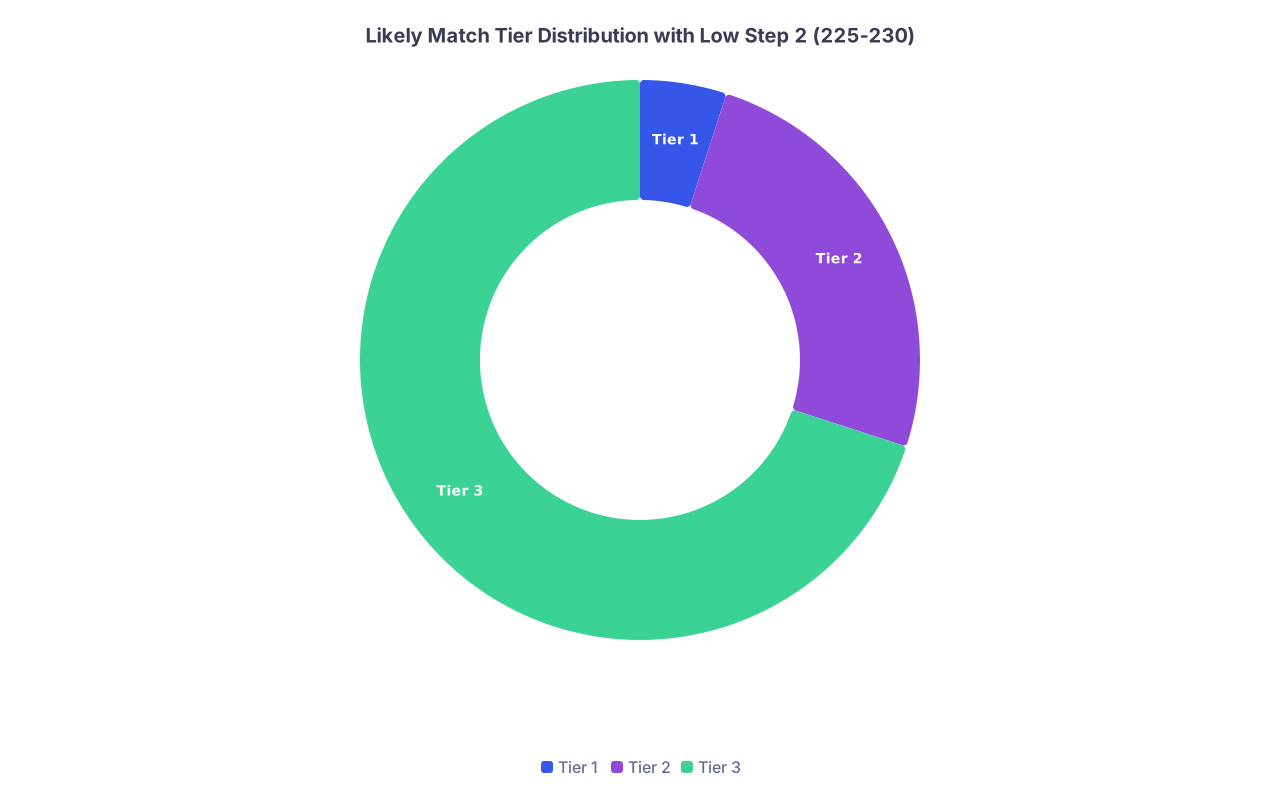
| Category | Value |
|---|---|
| Tier 1 | 5 |
| Tier 2 | 25 |
| Tier 3 | 70 |
That doughnut is closer to the distribution I see for low‑score applicants who still match; the difference is that MDs get a larger slice of Tier 2, DOs a larger slice of Tier 3.
7. Process View: Decision Flow for Low Score MD vs DO
Just to make this operational, here is the decision logic I would sketch on a whiteboard for a low‑score student sitting across from me.

| Step | Description |
|---|---|
| Step 1 | Low Step 2 CK or COMLEX |
| Step 2 | Consider moderate specialties + broad list |
| Step 3 | Focus on broad access specialties |
| Step 4 | Target DO friendly + some moderate specialties |
| Step 5 | Prioritize broad access + DO heavy programs |
| Step 6 | Use home program ties |
| Step 7 | Away rotations at DO friendly programs |
| Step 8 | Apply 30-70 programs depending on specialty |
| Step 9 | US MD or DO |
| Step 10 | Score >= 230 |
| Step 11 | Score >= 230 |
The branch is obvious: MD vs DO at the very top. That single node changes the probabilities downstream even for identical scores.
8. Pulling It Together: What the Data Actually Says
Let me strip away the noise and boil this down to what the numbers and patterns really point to.
A low Step 2 CK score (≤230) is a disadvantage for everyone. But it is a compound disadvantage for DO applicants, especially in competitive or academic environments. Identical scores do not lead to identical outcomes.
US MDs with low scores still retain better access to:
- Mid‑tier academic programs.
- Moderately competitive specialties (Anesthesia, EM, OB, Surg) with reasonable match probabilities.
- “Rescue” effects from home institutions.
DOs with low scores can absolutely match, but:
- They must be far more strategic in specialty selection and program targeting.
- They should expect a heavier skew toward community and DO‑friendly programs, with limited access to the upper half of academic tiers at the same score.
You cannot change your Step score or whether you are MD vs DO at this point. You can change how rationally you respond to the data.
Pick a specialty that aligns with your actual probability curve, not your ego. Build a program list that reflects who has matched applicants like you, not who has the prettiest website. And accept that for low scores, “US MD vs DO” is not a philosophical debate; it is a measurable difference in odds.