
The panic line for “low” Step scores is in the wrong place. The data shows that what applicants call “low” is often still safely in the matchable range—while the true danger zone starts later than most people think, and varies dramatically by specialty.
Let’s strip this down to numbers, not feelings.
1. How Step Percentiles Actually Map To Risk
First, anchor the scale. Most applicants talk in raw scores (“I got a 225”) while programs quietly think in distributions and cutoffs. You need both.
For simplicity, I will talk in Step 2 CK terms, since Step 1 is pass/fail. Score–percentile estimates based on recent NBME data and public reports (values are approximate but directionally reliable):
| Score | Approx Percentile | Description |
|---|---|---|
| 250 | ~85th–90th | Strong/competitive |
| 240 | ~70th–75th | Above average |
| 230 | ~50th–55th | Solid average |
| 220 | ~30th–35th | Below average |
| 210 | ~15th–20th | Low |
| 200 | ~5th–8th | Very low |
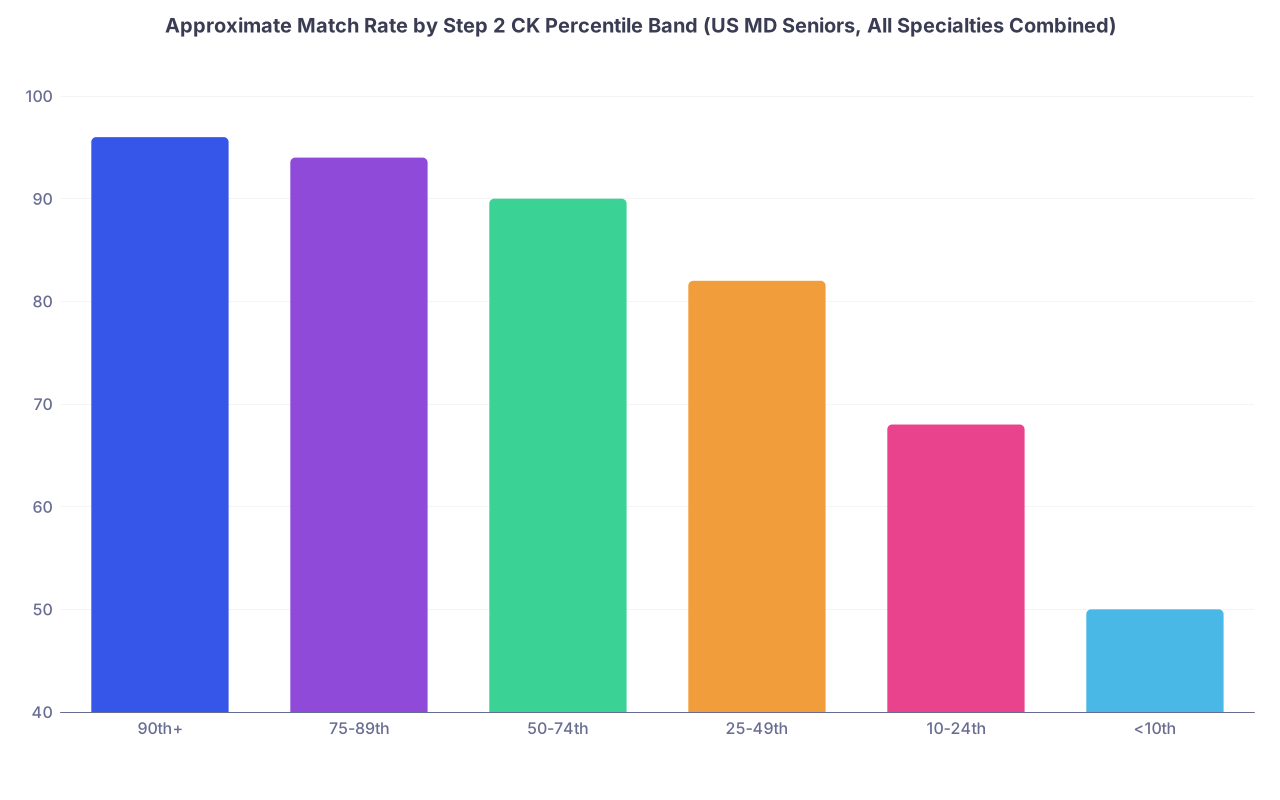
Now translate that into match outcomes. Based on NRMP Charting Outcomes and supplemental data, we can frame approximate match probabilities by Step 2 CK percentile, for U.S. MD seniors applying sensibly (appropriate specialty and realistic program list):
| Category | Value |
|---|---|
| 90th+ | 96 |
| 75-89th | 94 |
| 50-74th | 90 |
| 25-49th | 82 |
| 10-24th | 68 |
| <10th | 50 |
These are broad brushstrokes, but they illustrate three critical truths:
- The curve does not cliff-dive at 230.
- The dangerous inflection point is down around the 10–25th percentile band, not the 50th.
- “Low” realistically begins where match probability drops from “likely with sane strategy” into “coin flip without careful planning.”
If you want a single sentence:
- For most core specialties, true score-driven risk starts roughly below ~220 Step 2 CK (≈30th percentile), and becomes serious below ~210 (≈15–20th).
Everything above that is “suboptimal” in some fields, but not truly catastrophic.
2. Where “Low” Begins Depends Heavily on Specialty
People talk about low scores as if there is one threshold. That is wrong. The gap between primary care and plastics is enormous.
Here is a simplified, data-driven landscape of Step 2 CK score bands where risk meaningfully increases, using NRMP match rates, average matched scores, and program director survey reports. Values are approximate, but directionally correct for U.S. MD seniors:
| Specialty Group | Approx Avg Step 2 CK (Matched) | Where Risk Really Begins | Where It Becomes Severe |
|---|---|---|---|
| Family Med, Psych, Peds, IM | 235–245 | <220 | <210 |
| EM, Anesthesia, OB/GYN, Neuro | 240–250 | <225–230 | <215–220 |
| Gen Surg, Ortho, ENT, Urology | 245–255 | <235 | <225 |
| Derm, Plastics, Neurosurgery | 250–260+ | <240–245 | <235 |
Read that carefully.
If you are applying Family Medicine with a 222 Step 2 CK, you are in the “below average but very salvageable” zone.
If you are applying Dermatology with that same 222, you are in the “essentially non-viable on score grounds alone at most programs” zone.
Same number. Totally different meaning.
Example: Internal Medicine vs Orthopedic Surgery
Suppose two students both score 225 (roughly 25–30th percentile).
Internal Medicine (categorical):
- Average matched Step 2: mid-240s.
- A 225 is below average but still within “normal.”
- With strong clinical grades and a broad list, the data says match probability can still be well above 80 percent.
Orthopedic Surgery:
- Average matched Step 2: around 250.
- A 225 is 20–25 points below matched average.
- In NRMP data, orthopedics applicants in that range have sharply lower match rates, often under 40 percent, and that is for people who likely have strong research and home program support.
So on forums, both of these people will say “I have a low score.”
One is right. The other is mostly anxious.
3. Step 1 Pass/Fail: How Programs Now Use Step 2 CK
With Step 1 pass/fail, Step 2 CK picked up most of the numerical filtering duty. Program director surveys are blunt about this.
Trends from PD surveys and Charting Outcomes:
A majority of programs use explicit Step 2 CK cutoff scores, often around:
- 220–225 for less competitive specialties
- 230–240 for mid-tier specialties
- 240–245+ for highly competitive surgical subspecialties
For many surgical and “lifestyle” specialties (derm, plastics, ENT, some anesthesia and EM programs), Step 2 CK is now the primary standardized differentiator.
So what actually happens around those cutoffs?
- Score above the common cutoff: you are “in the pool,” and other factors (school, LORs, clinical grades, research) decide.
- Score near the cutoff: you are fragile; one weak letter or mediocre clerkship narrative can knock you out.
- Score below the cutoff: a non-trivial fraction of programs will never open your file.
That is why the real meaning of “low” is:
A score where many programs never see anything except your number.
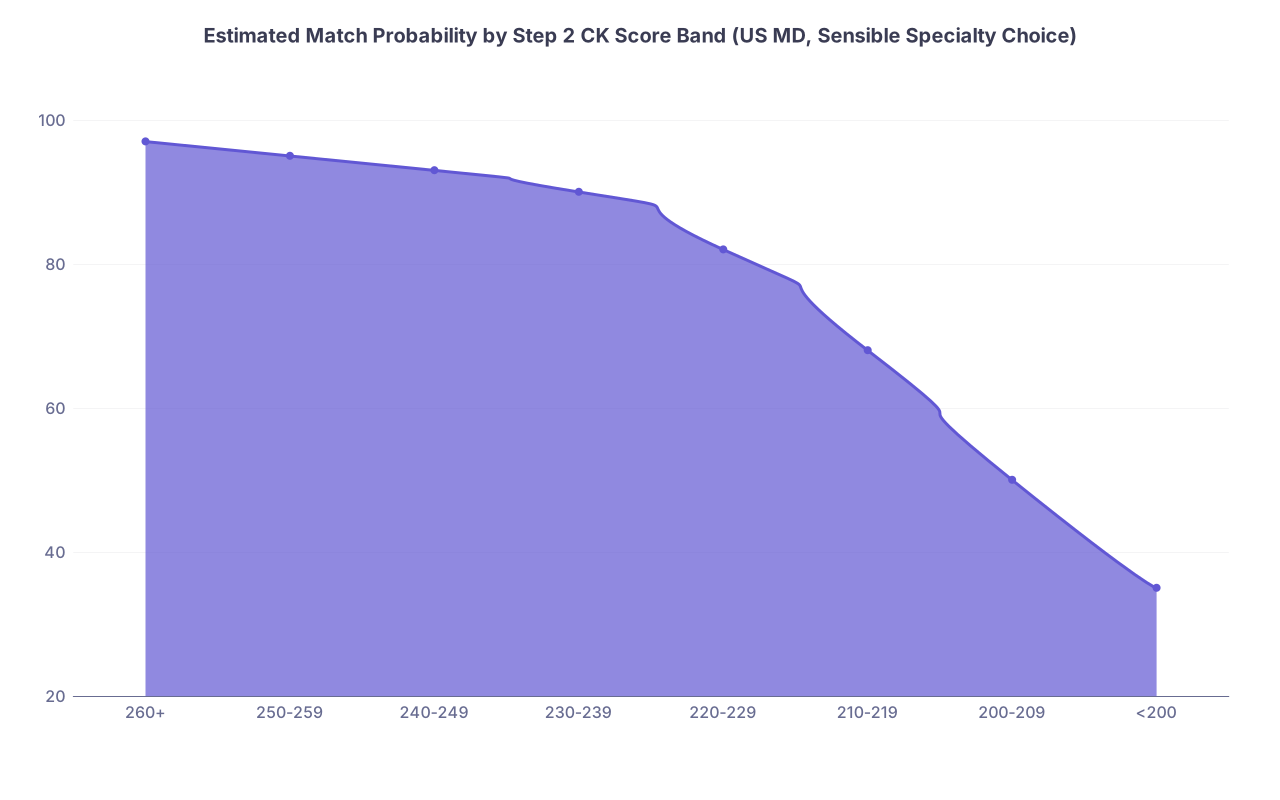
4. Quantifying Risk by Score Band
Let me simplify what the numbers say into discrete bands, focusing on Step 2 CK for U.S. MDs, assuming you choose a realistic specialty.
This is not exact, but it captures the shape of risk remarkably well.
| Category | Value |
|---|---|
| 260+ | 97 |
| 250-259 | 95 |
| 240-249 | 93 |
| 230-239 | 90 |
| 220-229 | 82 |
| 210-219 | 68 |
| 200-209 | 50 |
| <200 | 35 |
Interpretation for core fields like IM, Peds, Psych, FM, Neurology:
- 240+: Score not your limiting factor. “Low” is someone else’s problem.
- 230–239: Slightly below top tier, but squarely safe.
- 220–229: Below average; this is the start of what some PDs will call “low-ish,” but not fatal if other parts are strong.
- 210–219: This is where risk becomes visible in the data. Outcome now depends heavily on specialty choice, number of programs, and clinical performance.
- 200–209: True danger zone. Match becomes a coin flip even in less competitive fields without unusually strong compensatory factors.
- <200: Very high risk. Many program filters will never display your application.
So, to answer the original question bluntly:
For most applicants, “low Step 2 CK” in a way that actually moves match probability into dangerous territory starts at roughly ≤215–220.
Below 210 is where the probability curve really bends downward.
Most people calling 228 “horrible” are simply miscalibrated.
5. How Much a “Low” Score Hurts Depends on the Rest of Your File
Scores do not exist in a vacuum. I have seen two 215s produce completely different trajectories:
- Student A: 215 Step 2 CK, mid-tier U.S. MD, Honors in IM and Surgery, strong narrative comments, 2 posters, faculty who pick up the phone. Matched categorical IM at an academic program.
- Student B: 215 Step 2 CK, weaker school, mostly Passes, generic letters, scattershot application to over-competitive specialties. Scrambled into a prelim and had to reapply.
Same number. Different context.
The data and PD surveys consistently show that the buffering factors with the highest impact, especially when scores are borderline, are:
- Clinical performance (Honors in core rotations, strong narrative comments)
- Specialty-specific exposure (sub-internships, away rotations, strong home department)
- Letters from known or respected faculty
- Coherent story (aligned experiences and personal statement) instead of random padding
Step 2 CK is a blunt instrument. Those are your fine-tuning controls.
6. Strategy: What To Do at Each Score Level
Let’s move from diagnosis to treatment. Here is what the numbers suggest you should actually do given your Step 2 CK score, if matching is the priority.
A) 240+ (≈70th percentile and above)
You do not have a “low” score. You have a tool.
- You can apply to competitive specialties without scores being your bottleneck.
- You still need appropriate breadth in your list, but numeric filtering is mostly your friend.
If you miss with a 240+, it will usually be for non-score reasons: late application, poor letters, poor specialty fit, terrible interviewing, or unrealistic geographic constraints.
B) 230–239 (Around median to slightly above)
Still not low. But context matters.
- Competitive surgical subspecialties: you are around or slightly below average; you need strong research/letters and realistic reach/safety balance.
- Core specialties (IM, Peds, Psych, FM, Neuro, OB/GYN at many programs): your score is absolutely fine; focus on letters and fit.
Your main risk: “I have an okay score, so I will stretch too far and not build a safe floor.”
C) 220–229 (Below average, early warning zone)
This is where “low” starts socially, but not where it truly hurts mathematically.
The data-based strategy:
- Deprioritize the very top few specialties unless you have exceptional other metrics (AΩA, big-name research, home support).
- Build a robust list: 40–60+ programs for moderately competitive fields, 60–80+ for riskier ones, targeted wisely (mid-tier and community-heavy).
- Use clinical strengths to differentiate. High-performing rotations in the specialty can matter more than 5–10 points of Step 2.
If someone with 225 and good clinicals fails to match in IM/Peds/Psych/FM, the post-mortem almost always shows bad list construction or very late application, not just the score.
D) 210–219 (True danger zone for some, salvageable for others)
Now we are in the territory where the data clearly shows drop-off in match rates, especially if you choose wrong specialty or under-apply.
Your levers:
- Specialty selection:
- Safer bets: FM, Peds, Psych, IM, Path, sometimes Neuro.
- Higher risk: EM, Anesthesia, OB/GYN, any surgical field.
- Program volume and diversity:
- Think 60–100+ applications where appropriate.
- Heavy inclusion of community and newer programs.
- Evidence of upward trajectory:
- Strong clerkship grades after the exam.
- Possibly a later Step 2 date so that strong rotations are on the transcript.
For a 215 applying IM with Honors, wide net, and solid letters, the data does not say “hopeless.” It says “risky but very possible.”
E) 200–209 (High-risk band)
At this range, you are fighting a structurally unfavorable set of filters.
The numbers:
- Many programs, even in less competitive fields, quietly cut off around 210–215.
- Match probabilities in Charting Outcomes for applicants at the far left tail are consistently lower, often around or below 50 percent depending on specialty and school.
The strategy becomes more aggressive and pragmatic:
- Focus strongly on the least selective specialties and the broadest geographic range.
- Consider backup options explicitly (FM, prelim year with plan to reapply, research year, or frankly non-clinical paths if you are miserable).
- Maximize every controllable strength:
- Outstanding rotations and letters
- Clear, grounded narrative explaining trajectory
- Strong interviewing and realistic ranking
If someone in this range matches into a categorical spot, it is usually because of two things: relentless realism and strong human capital (mentors going to bat for them).
F) Below 200 (Extremely high risk)
At this point, Step 2 CK is sending a loud negative signal, regardless of whether it is fair. Many filters will block you. The outliers who match with these scores have:
- Strong institutional backing
- Strategic choice of specialty and programs
- Often a narrative (severe illness, documented life event) plus clear subsequent excellence
If you are here, you cannot rely on percentages. You need individual people advocating for you, plus a long-term plan that includes the possibility of an extra year or an alternative route.
7. Redefining “Low” So You Stop Lying to Yourself
Let me draw the line clearly.
Socially “low”:
- Anything under the average of your high-achieving peer group. The person with a 235 at a hyper-competitive med school calling themselves “low.”
- This usage is emotionally real but numerically meaningless.
Operationally “low” (my term):
- The range where many programs will filter you out and where your match probability drops due to score alone, even with decent other factors.
- For Step 2 CK, this is roughly ≤215–220 across most specialties.
Structurally “low” (truly dangerous):
- The range where systemic filters plus program culture will destroy your odds unless you radically adjust specialty and strategy.
- Roughly ≤210, and especially ≤205.
You are allowed to feel bad about a 228 if your friends all have 250s. But do not make life decisions as if 228 is in the same risk class as 205. It is not. The data is absolutely clear on that.
8. Final Calibration: What To Actually Call Your Score
Here is a simple framework you can use when someone asks, “Is my Step 2 score low?”
For your chosen specialty, relative to matched applicants:
- 0–5 points below average → “Slightly below mean, still competitive.”
- 6–10 points below average → “Below average; need strong other factors.”
- 11–15 points below average → “Low for this specialty; serious strategy needed.”
15 points below average → “Very low; consider different specialty or non-standard path.”
You can look up average matched Step 2 CK by specialty from recent NRMP Charting Outcomes and do that math yourself. No drama. Just subtraction.
Key Takeaways
- “Low” Step 2 CK in a way that truly moves match odds into dangerous territory generally starts around ≤215–220, and becomes critical below ~210.
- The meaning of any given score is specialty-specific; a 225 in Family Medicine and a 225 in Plastic Surgery are not the same thing.
- Match outcomes are a function of score band plus specialty choice, program list strategy, and clinical performance—not score alone.