
The panic about “low Step scores” is usually numerically uninformed. The data show something different: your odds vary massively by specialty, but almost never drop to zero just because of one number.
Let’s walk through how to read the NRMP “low score” charts like an analyst, not a catastrophizing intern on Reddit.
1. What the NRMP Charts Actually Show (And What They Don’t)
NRMP’s Charting Outcomes in the Match and the “Interactive Charting Outcomes” tools give you the closest thing we have to a risk calculator. They do not tell you if you will match. They tell you how people with similar profiles have done in the past.
The core data elements you should care about:
- USMLE Step 1 and Step 2 CK ranges
- Match rates by specialty and score bucket
- Number of contiguous ranks and programs applied to
- Applicant type: US MD, US DO, IMG
For “low Step score” strategy, the single most useful broad-strokes view is match rate by specialty for applicants with scores in the lower ranges (think Step 1 < 220 or Step 2 CK < 235, adjusted for the current pass/fail Step 1 climate by using Step 2 CK as the proxy).
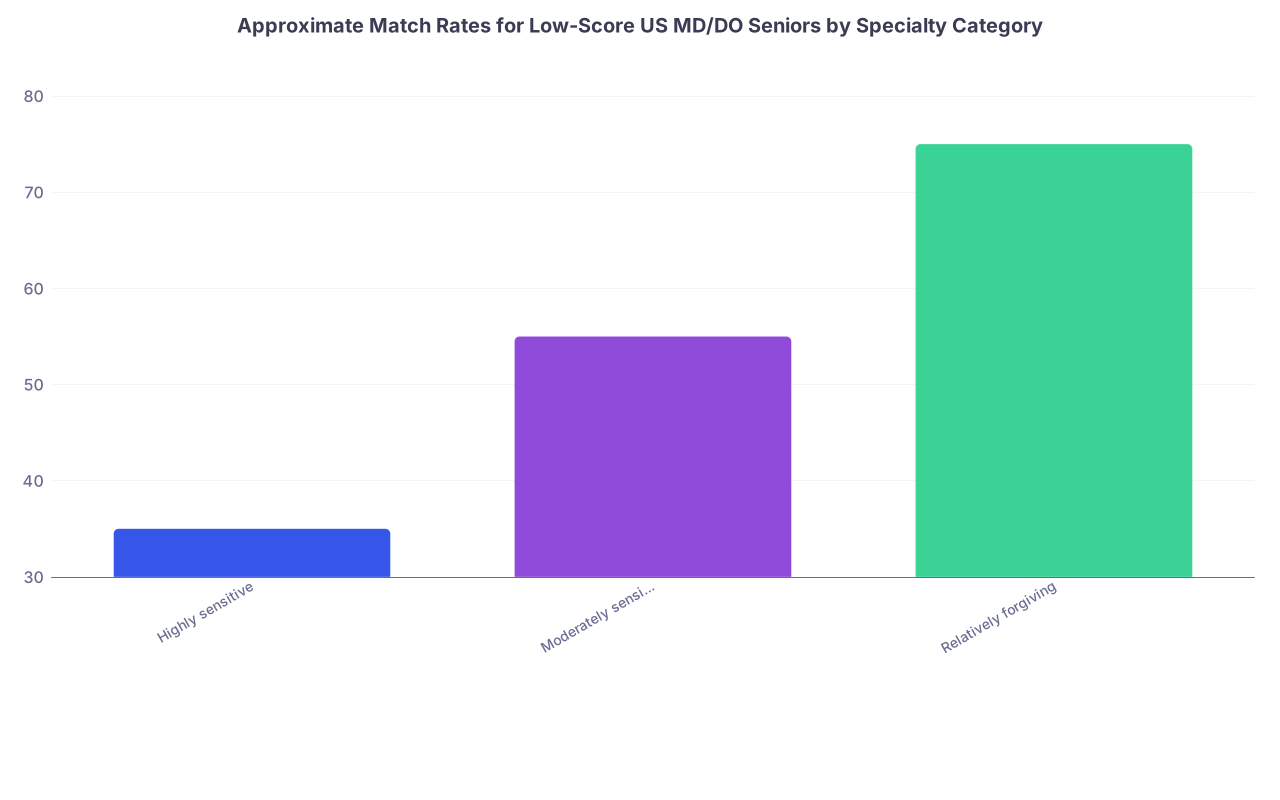
To simplify, let’s group specialties into three buckets based on how sharply match rates drop with lower scores: highly sensitive, moderately sensitive, and relatively forgiving.
| Category | Value |
|---|---|
| Highly sensitive | 35 |
| Moderately sensitive | 55 |
| Relatively forgiving | 75 |
These are approximate, aggregated numbers based on patterns from recent NRMP cycles, not exact per-specialty values. But the pattern is stable:
- “Highly sensitive” specialties see match rates around one‑third for low scorers
- “Moderately sensitive” specialties hover roughly around one‑half
- “Relatively forgiving” specialties are still often above two‑thirds
So if you are telling yourself “a low Step score means I will not match,” you are already ignoring the data.
The right question is: In which specialties do low scores crush match odds, and where can I bend the curve with strategy?
2. Specialty Buckets: Where Low Scores Hurt Most vs Least
Let’s assign real names to those buckets.
2.1 Highly score‑sensitive specialties
This group consistently shows steep declines in match probability as scores fall:
- Dermatology
- Plastic surgery
- Orthopedic surgery
- Neurosurgery
- ENT (otolaryngology)
- Integrated vascular surgery
- Integrated cardiothoracic surgery
For low Step scores, these are the numbers that should get your attention. Think roughly:
| Specialty | Typical Low-Score Step 2 CK Range | Approx Match Rate (Low-Score US Seniors) |
|---|---|---|
| Dermatology | < 240 | 20–35% |
| Plastic Surgery Int | < 245 | 15–30% |
| Orthopedic Surgery | < 235 | 25–40% |
| Neurosurgery | < 240 | 20–35% |
| ENT | < 235–240 | 25–40% |
Again, these are directional bands, not exact current-cycle numbers. But the trend is clear: once you drop into the bottom score quartiles for these specialties, the match rate collapses.
In real conversations, PDs in these fields have used phrases like:
- “We rarely interview below 240/245 unless there is something exceptional.”
- “Research output or home institution can offset, but not for everyone.”
Translation: If your Step 2 CK is sitting at 225 and you are dead-set on dermatology without a heavyweight research portfolio or strong home department, you are betting against the data.
You can still apply. You should not build a single‑track plan around this group unless you have unusually strong offsets (major publications, national awards, elite home institution advocacy).
2.2 Moderately score‑sensitive specialties
These react to Step scores, but not in the brutal, cliff‑like way of derm or ortho.
- Diagnostic radiology
- Anesthesiology
- Emergency medicine
- General surgery (categorical)
- OB/GYN
- PM&R (Physical Medicine & Rehabilitation)
- Urology (separate match, but similar concept)
For lower scores in these specialties, you see a more graded decline. For US MD/DO seniors:
- With “average” Step 2 CK scores (roughly 240–250): match rates are often in the 80–90% range.
- Drop to low 220s or below, and you will often see match rates fall to the 45–65% range.
That is still not hopeless. It just means you do not get to be casual.
2.3 Relatively forgiving specialties
This is where a low Step score hurts the least, especially for US MD/DO seniors:
- Internal medicine (categorical)
- Family medicine
- Pediatrics
- Psychiatry
- Pathology
- Neurology
- Transitional year / prelim medicine (as separate tracks)
These specialties still filter by score, but the distributions are wide and PDs usually care more about:
- Consistent performance on rotations
- Fit and communication skills
- Professionalism and reliability
- Genuine interest in the field (psychiatry and pediatrics in particular)
In the NRMP data, even applicants in the lowest quartile of Step scores in these fields often see match rates above 70% if they are US seniors and apply broadly enough.
3. How Match Rate Changes With Score: Shape, Not Just Thresholds
The biggest mistake I see is people looking for “cutoffs”: “Is 225 enough for X?” That is the wrong question.
The right question is: What does the curve look like for my score range in this specialty?
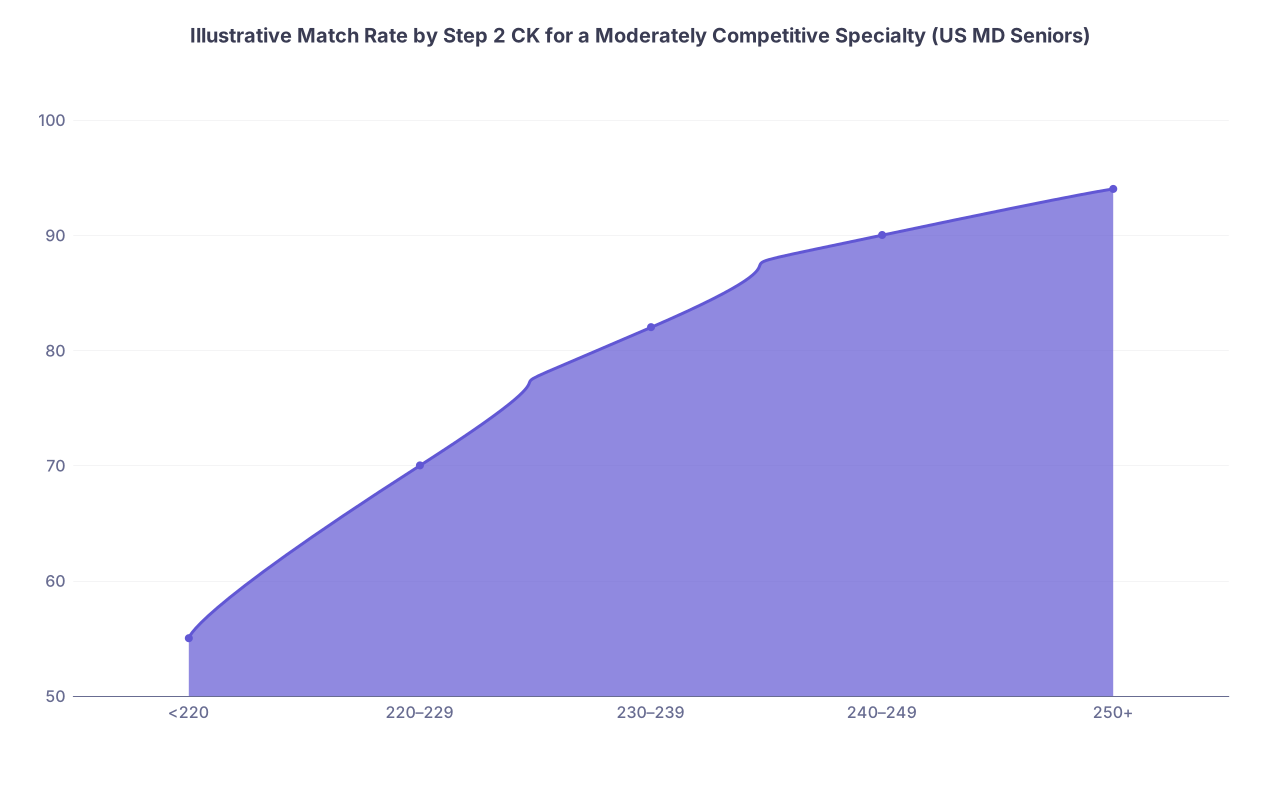
Let’s approximate a typical pattern for a moderately competitive specialty for US MD seniors, using Step 2 CK as the axis.
| Category | Value |
|---|---|
| <220 | 55 |
| 220–229 | 70 |
| 230–239 | 82 |
| 240–249 | 90 |
| 250+ | 94 |
You can see a few things:
- There is no cliff. The curve is smooth.
- Being below 220 does not produce a 10% match rate; it is often still 50%+.
- Every 10‑point band buys you roughly 10–15 percentage points in match probability, if everything else is equal.
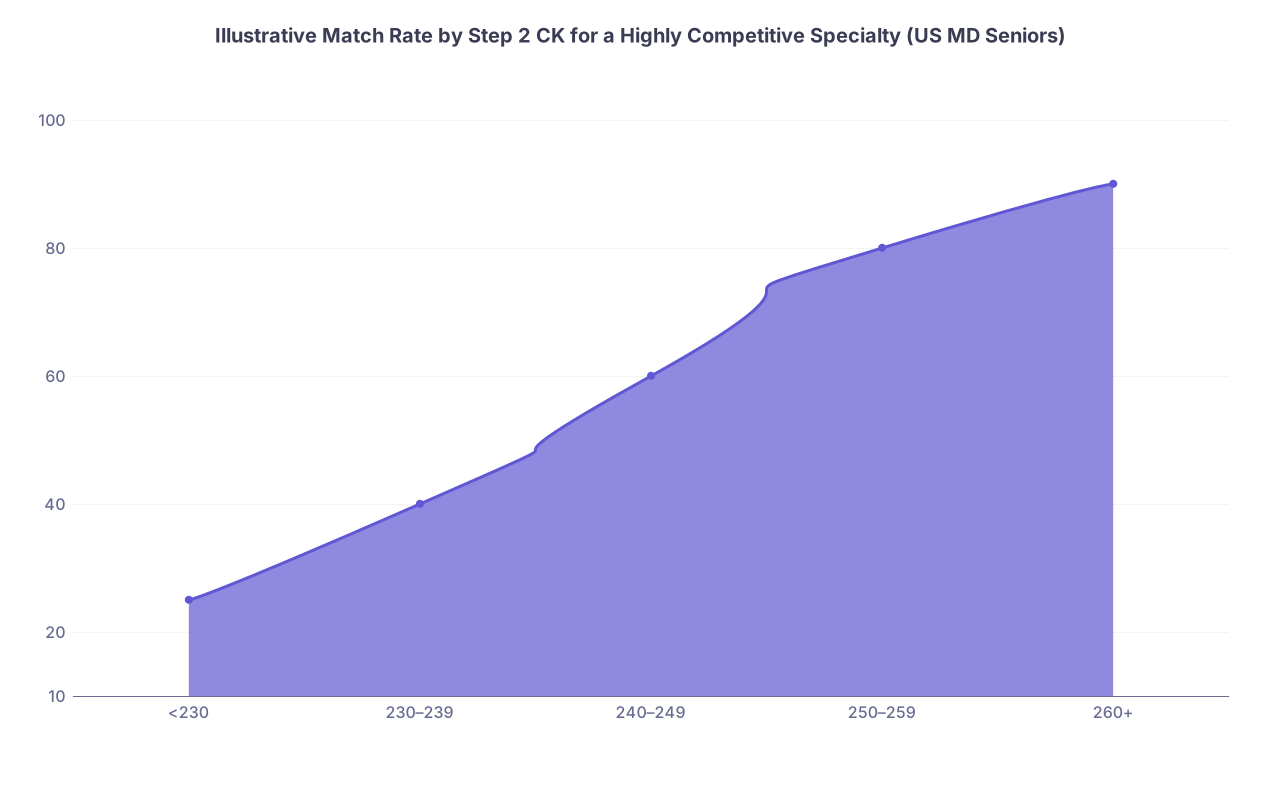
Now compare that to a highly competitive field like orthopedic surgery (again, approximate pattern, US MD seniors):
| Category | Value |
|---|---|
| <230 | 25 |
| 230–239 | 40 |
| 240–249 | 60 |
| 250–259 | 80 |
| 260+ | 90 |
Here the curve is steeper:
- Below 230: you are in “lottery ticket” territory unless you have strong compensating variables.
- 230–239: still disadvantaged but survivable with strong applications and heavy program lists.
- 250+: you are competing with most of the pool rather than from the basement.
So instead of asking “Is 233 enough?” you should be asking:
- Which curve am I on (specialty)?
- Where on the curve do I sit (score band)?
- What levers can I pull to move my personal probability up from the baseline?
4. Reading the NRMP Charts Like a Strategist, Not a Victim
If you open the NRMP Charting Outcomes PDFs or interactive tools, here is what you should be doing step by step.
Step 1: Fix your applicant type
US MD senior, US DO senior, US-IMG, non‑US IMG. These are different universes. A 225 for a US MD and a 225 for a non‑US IMG do not yield the same odds.
Do not average across these categories. Look at your column only.
Step 2: Anchor on Step 2 CK, not Step 1
With Step 1 now pass/fail, programs have shifted to Step 2 CK as the numeric differentiator. For older datasets where Step 1 scores are central:
- Use Step 2 CK as your main reference if available
- Translate Step 1 bands loosely (e.g., Step 1 220–229 ≈ Step 2 CK 230–239 zone for many schools, though not exact)
Bottom line: your numeric storytelling now lives or dies mostly on Step 2 CK.
Step 3: Identify your specialty’s score spread
Look up:
- Mean Step 2 CK score for matched applicants in your specialty
- 25th–75th percentile range for matched vs unmatched
You are asking: Am I below the 25th percentile, around the median, or above the 75th?
For example, for a recent internal medicine cohort (US MD seniors), something like:
- Mean Step 2 CK for matched: ~247
- 25th–75th percentile: roughly 238–255
- Matched applicants below 230: yes, plenty; they are just a smaller slice
For more competitive specialties, you often see:
- Match mean in the low‑to‑mid 250s
- Very few matched applicants below 240
If you are sitting 20 points below the match mean, you are not doomed. You are just playing on hard mode.
Step 4: Look at match probability by score range
NRMP often provides graphs by USMLE score deciles or buckets. This is where the reality check hits.
For your applicant type and specialty:
- Find the bucket containing your Step 2 CK score
- Read off the match rate for that bucket
- Compare it to the overall match rate for that specialty
Example:
- Overall match rate in Specialty X for US MD seniors: 80%
- Your score bucket match rate: 55%
You are not “done.” You just moved from “likely” to “coin flip.” That is when you compensate with number of applications, strength of letters, and backup options.
Step 5: Factor in number of contiguous ranks
One of the quiet killers in the NRMP data is applicants who interview too little and rank too few programs.
NRMP consistently shows a strong correlation:
- More contiguous ranks → higher match probability, even with lower scores.
For many core specialties:
- US MD seniors with 12–15+ contiguous ranks have match rates >90% even if their scores are not stellar.
- Those with <5 contiguous ranks often sit below 60% regardless of score.
So the equation is not simply “I have a 225, therefore X% chance.”
It is “I have a 225, I am applying to Specialty Y, and I will rank N programs.”
That trio determines your actual risk.
5. Strategy by Specialty Type When You Have a Low Step Score
Now we translate the charts into actual decision rules.
5.1 If your dream is in the “highly sensitive” group
Hard truth: the data will not support a pure‑play application to derm, ortho, plastics, neurosurgery, ENT, or integrated vascular/CT surgery with clearly low scores and no extraordinary offsets.
What I have seen work in real cycles:
Dual‑path strategy
- Primary-risk path: your dream specialty (e.g., ENT)
- Safety path: a more forgiving specialty you would genuinely be OK training in (e.g., internal medicine, PM&R, neurology)
- You commit mentally that if the high‑risk path fails, you will match the safety and consider future fellowships or niche practice to approximate your interests.
Over‑application within the competitive field
- If a typical applicant applies to 60 programs in ENT with strong scores, you are applying to 80–90, sometimes more, if allowed.
- You heavily lean on home program, away rotations, and faculty advocacy.
Brutally honest faculty input
- Ask your specialty advisors: “With my 225 Step 2 CK, what percentile of applicants with my stats matched here in the last 3 years?”
- If the answer is “almost none,” that is not a challenge, it is a signal.
If the NRMP charts and your advisors both say the same thing—your probability is in the 10–25% band—you need a backup plan you would not hate living with.
5.2 If you are in the “moderately sensitive” basket
This is where good strategy makes a gigantic difference.
For example, with Step 2 CK 225 in anesthesiology as a US MD senior:
- If you apply to 15–20 programs, late, with generic letters: your odds might realistically be <50%.
- If you apply to 40–50 programs, early, targeted to mid‑tier or community‑heavy programs, with strong clinical letters: your odds can push closer to the 60–80% territory.
Data‑driven actions:
- Apply to more programs than the median applicant in your specialty.
- Do not waste half your list on “top 10” academic powerhouses that select heavily on scores.
- Emphasize clinical performance and reliability in letters; these matter more at community and mid‑tier academic programs.
5.3 If your target is in the “relatively forgiving” group
Here the NRMP charts are almost always reassuring for US seniors who apply responsibly.
With a low Step score in internal medicine, family medicine, pediatrics, or psychiatry:
- Your risk rises mainly when you either under‑apply (too few programs) or over‑reach (almost all programs are elite, big‑name academic centers).
- Community‑oriented and many mid‑tier academic programs will routinely interview and rank applicants with below‑average scores if the rest of the file is solid.
Smart moves here:
- Do not obsess about your score in your personal statement. One short line acknowledging improvement (if Step 2 > Step 1) is plenty.
- Highlight clinical evaluations, sustained interest in the specialty, and any longitudinal work (e.g., outpatient clinic involvement, mental health advocacy, continuity clinics).
- Apply early to a mix of academic and community programs, with a tilt toward programs historically friendly to your school or applicant type.
6. Step Score Is One Variable, Not Your Entire Feature Set
NRMP data are very clear on this point: Step scores are highly predictive of matching within a specialty, but they are absolutely not the only variable.
The big co‑factors:
- Number of contiguous ranks
- Applicant type (US MD > US DO > IMG on average, though with many exceptions)
- Presence of red flags (failures, professionalism issues)
- Specialty‑relevant experiences and letters
- Home program vs no home program in highly competitive fields
If you want one mental model, use this: your Step score defines the default probability band for your application, but everything else can nudge you up or down within that band.
You are not replacing a 35% base probability with 90% just because you worked hard on your personal statement. But you can move from the bottom half of that band to the top half, which in borderline cases is the difference between matching and not.
7. A Simple Framework to Decide Your Specialty Strategy
Here is a very rough decision flow that reflects how I see rational applicants with lower scores succeed:

| Step | Description |
|---|---|
| Step 1 | Know Step 2 CK score |
| Step 2 | Choose target specialty |
| Step 3 | Check NRMP low score match rate |
| Step 4 | Plan broad, realistic list |
| Step 5 | Focus on fit and volume |
| Step 6 | Add backup specialty |
| Step 7 | Apply heavily in 1 specialty |
| Step 8 | Apply more than median programs |
| Step 9 | Target community and mid tier programs |
| Step 10 | Specialty sensitivity |
| Step 11 | Match rate < 35 percent? |
That is the logic you should be running, not “my score is low, therefore I am doomed.”
FAQ (3 Questions)
1. Is it even worth applying to a highly competitive specialty with a low Step score?
It can be, but only if you treat it as a calculated risk, not your only plan. If NRMP data show sub‑30–35% match rates in your score band for your applicant type, you should strongly consider a dual‑application strategy with a more forgiving specialty. Applying to derm or ortho “just to see” while refusing to apply broadly to a safer field is how people end up unmatched with completely predictable data.
2. Does a strong Step 2 CK completely fix a weak Step 1?
For most programs now, Step 2 CK carries more weight than an old Step 1 score, especially with Step 1 being pass/fail for newer cohorts. A strong Step 2 can move you closer to the average or even above it within your specialty. But it does not erase a prior failure, and in ultra‑competitive specialties, even a good Step 2 may not fully offset being far below the mean. You should still read the NRMP charts using your Step 2 CK band as the main predictor.
3. How many programs should I apply to if my Step score is low?
The data consistently show that more applications and more contiguous ranks increase match probability, especially for lower scorers. As a rule of thumb, aim to be above the NRMP‑reported median number of programs applied to and ranks listed for your specialty. For moderately competitive fields with a low score, this often means 40–60+ applications rather than 20–30. For more forgiving specialties, 25–40 well‑chosen programs may be enough, but you still want to avoid being below the median volumes for your cohort.