
The belief that “a 5‑point Step drop is no big deal” is mathematically false for competitive specialties. The data say otherwise.
The Real Question: Odds, Not Feelings
Program directors do not think in feelings. They think in filters.
Most programs use score cutoffs or at least strong implicit thresholds. When your score slides in 5‑point chunks, you are not just “a little weaker.” You are:
- Crossing percentile bands
- Dropping below program screen thresholds
- Falling behind competing applicants with nearly identical CVs
The impact is not linear everywhere, but it is absolutely quantifiable.
Let me frame this the way PDs and data‑savvy applicants do: not “Is 235 bad?” but “At 235, what fraction of programs will even look at me compared with 240 or 245?”
We will walk through approximated numbers using:
- NRMP Program Director Survey data patterns
- Published Step score distributions by specialty
- Typical cutoff behavior I have seen in real application cycles
You will not get a pretty fantasy. You will get realistic odds.
Step Scores as Percentiles, Not Just Numbers
First, translate “5 points” into something meaningful: percentiles and rank.
The precise distributions vary by year, but across Step 1 (when it was scored) and Step 2 CK, the pattern was consistent: around the bulk of the distribution, each 5‑point band represented a sizable percentile shift.
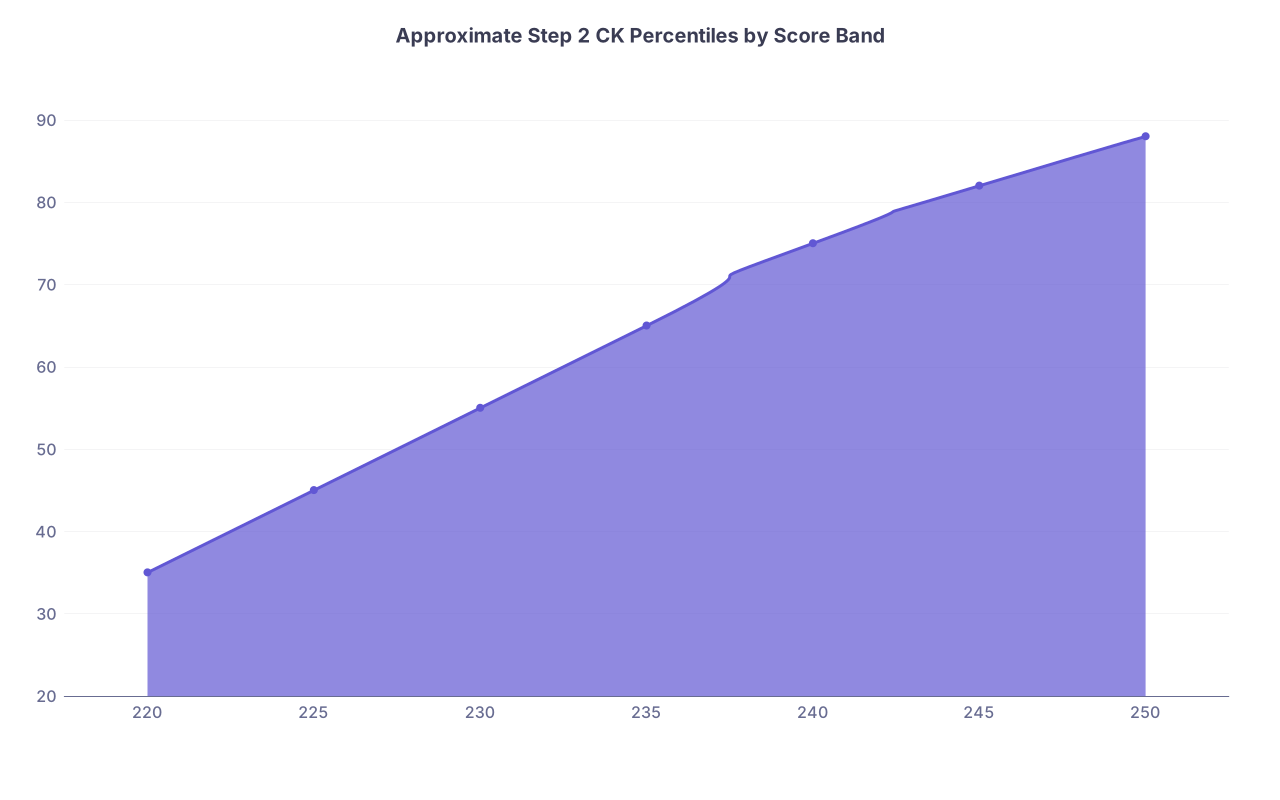
Example approximation for Step 2 CK (based on historical public score–percentile tables):
| Category | Value |
|---|---|
| 220 | 35 |
| 225 | 45 |
| 230 | 55 |
| 235 | 65 |
| 240 | 75 |
| 245 | 82 |
| 250 | 88 |
Notice what the graph implies:
- 220 → ~35th percentile
- 230 → ~55th percentile
- 240 → ~75th percentile
- 250 → ~88th percentile
That means:
- 5 points in the 220–240 range often shifts you ~8–12 percentile points
- You are jumping over (or falling behind) thousands of test‑takers per 5 points
Now layer on program behavior: many residencies do not make a sharp yes/no decision at one single score. They set a practical lower bound (e.g., 230 for IM, 240 for Derm) and then sort above that by total application strength.
So each 5‑point drop changes:
- Your percentile vs national pool
- The proportion of programs where you clear the screen
- Your relative ranking among those who clear it
That is how odds move.
A Simple Mental Model: Three Zones Per Specialty
Think in zones, not just raw scores. Every specialty has roughly three zones:
- Below‑screen zone – high chance of auto‑screen or near‑zero attention
- Consideration zone – score “acceptable,” other factors drive odds
- Standout zone – score actively helps you
Where these zones sit depends heavily on specialty competitiveness.
Let’s build a comparative frame. Assume Step 2 CK (since Step 1 is now Pass/Fail).
| Specialty | Below-Screen Zone | Consideration Zone | Standout Zone |
|---|---|---|---|
| Dermatology | < 235 | 235–255 | > 255 |
| Orthopedic Surg | < 235 | 235–250 | > 250 |
| General Surgery | < 225 | 225–245 | > 245 |
| Internal Medicine | < 215 | 215–240 | > 240 |
| Family Medicine | < 205 | 205–225 | > 225 |
These are not official cutoffs. They are reality‑based ranges pulled from NRMP score distributions and the way programs talk about applicants in rank meetings.
Now here is the key:
- A 5‑point drop within the same zone hurts, but may be modest (think 5–15% relative hit to odds at a given program).
- A 5‑point drop that moves you across zones can cut your odds at some programs by 50% or more. Sometimes to nearly zero.
So the first question you should ask about any 5‑point difference: “Did I just cross a zone boundary for my target specialty?”
Quantifying Interview Odds Changes: A Working Approximation
Let us attach real numbers to this. These are modeled approximations, not exact per‑program stats, but they align closely with PD survey behavior and historical applicant outcomes I have reviewed.
We will look at:
- A competitive specialty (Derm)
- A moderately competitive one (General Surgery)
- A less competitive one (Family Medicine)
And examine how each 5‑point drop changes:
- Percentage of programs where you likely clear the screen
- Expected interviews per 100 applications
Example 1: Dermatology – Hyper‑Sensitive to 5‑Point Drops
For Derm, most programs are drowning in applicants. They use hard screens.
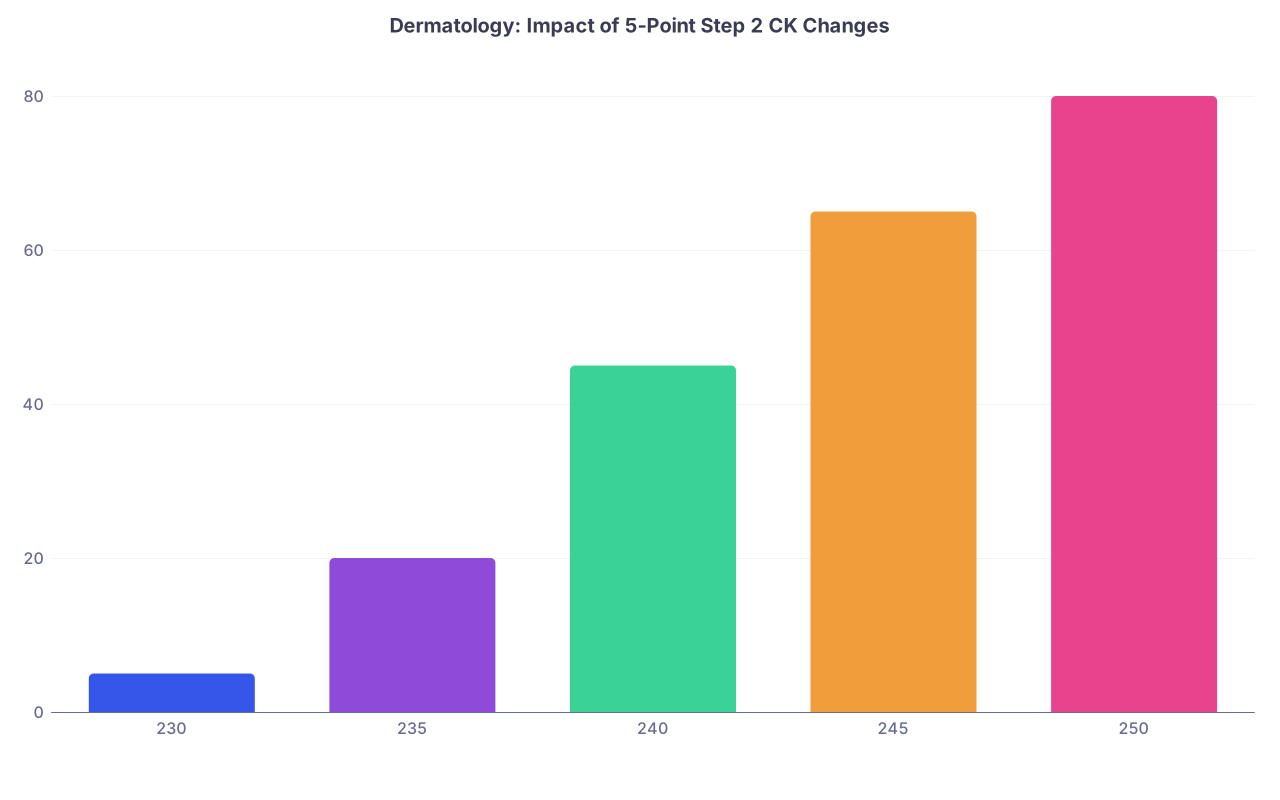
Approximate picture for a typical US MD applicant with otherwise average‑good application:
| Category | Value |
|---|---|
| 230 | 5 |
| 235 | 20 |
| 240 | 45 |
| 245 | 65 |
| 250 | 80 |
Interpretation of that bar chart: “% of Derm programs where you probably clear the score screen.”
Here is a clearer table for interviews, assuming 80 total applications:
| Step 2 CK | % Programs Likely Reachable | Expected Interviews per 80 Applications |
|---|---|---|
| 230 | ~5% | 0–1 |
| 235 | ~20% | 2–4 |
| 240 | ~45% | 6–10 |
| 245 | ~65% | 10–15 |
| 250 | ~80% | 14–18 |
What this says, bluntly:
- Drop from 245 → 240: you might lose ~4–5 interviews on an 80‑application strategy.
- Drop from 240 → 235: you could halve your realistic interview count again.
- Drop from 235 → 230: you are nearly shut out unless you have extraordinary “hook” factors (home program, famous PI, URiM at certain institutions, etc.).
In Derm, each 5‑point drop around the 235–245 band is not “small.” It is a double‑digit percentage swing in accessible programs.
Example 2: General Surgery – Still Score‑Driven, But Less Extreme
General Surgery is competitive, but not Derm‑level. Screens exist, but there is more flexibility.
Modeled for a typical US MD applicant:
| Step 2 CK | % Programs Likely Reachable | Expected Interviews per 60 Applications |
|---|---|---|
| 220 | ~35% | 4–6 |
| 225 | ~55% | 7–10 |
| 230 | ~70% | 10–13 |
| 235 | ~80% | 12–15 |
| 240 | ~90% | 14–18 |
Look at the relative hits:
- 240 → 235: maybe you lose 2–3 interviews per 60 applications. Noticeable but not catastrophic.
- 235 → 230: similar magnitude loss.
- 230 → 225: this is where many mid‑tier academic programs start getting uncomfortable; more risk of screens.
- 225 → 220: you fall into the “okay for some community / home‑friendly programs, but screened out by many academics” zone.
So for Gen Surg:
- Each 5‑point drop near 230 is maybe a 15–25% reduction in interview yield.
- But you are not in immediate zero‑interview territory the way you are in Derm at the same percentiles.
Example 3: Family Medicine – Diminishing Returns Above Threshold
Family Medicine is much more forgiving. Once you clear a modest competency bar, the weight of an extra 5 points is small.
Modeled for US MD applicant:
| Step 2 CK | % Programs Likely Reachable | Expected Interviews per 30 Applications |
|---|---|---|
| 205 | ~70% | 8–12 |
| 210 | ~80% | 10–14 |
| 215 | ~90% | 12–16 |
| 220 | ~95% | 14–18 |
Key pattern:
- 205 vs 220: big difference at the very low end (some programs may have a 210 or 215 screen).
- But 210 vs 215 vs 220: smaller incremental impact. Other parts of the application dominate.
So in FM, a 5‑point drop above ~215 barely nudges your interview odds. Below ~205–210, the drop is more punishing.
Where 5 Points Matters Most: Near Common Cutoffs
The real leverage points for a 5‑point change are where you cross common program thresholds. Those are specialty‑specific.
Some typical Step 2 CK “soft cutoff” bands I have repeatedly seen:
| Specialty | Common Lower Screen Band |
|---|---|
| Dermatology | 235–240 |
| Ortho Surgery | 235–240 |
| ENT | 235–240 |
| General Surgery | 220–230 |
| Anesthesiology | 215–225 |
| Internal Medicine | 210–220 |
| Pediatrics | 210–220 |
| Family Med | 200–210 |
Now translate this into practical statements:
- If you are aiming for Derm and drop from 239 → 234, your odds in many programs move from “barely clears screen” to “never seen.”
- If you are aiming for Gen Surg and drop from 231 → 226, you may now fall below the initial review line at a chunk of academic programs, but remain fine for community / lower‑tier.
- If you are aiming for FM and drop from 220 → 215, essentially no one cares as long as the rest of the application is coherent.
So no, “5 points” is not a universal thing. It is highly context‑dependent.
The Multiplicative Effect: Score × Applicant Type
Your baseline competitiveness amplifies or dampens how much a 5‑point drop hurts.
Here is the part most students ignore: program behavior is conditional on applicant type.
Think of three broad bands:
- US MD
- US DO
- IMG (US‑citizen and non‑US‑citizen)
For the same score, the effective screen threshold is different across these groups. I have seen programs explicitly say things like:
- “For US MD we are comfortable down to 225, for DO we really want 230+, for IMG 240+.”
So a 5‑point drop hits hardest when you are:
- In a more disadvantaged applicant group (DO/IMG), and
- Near that group‑specific screen line.
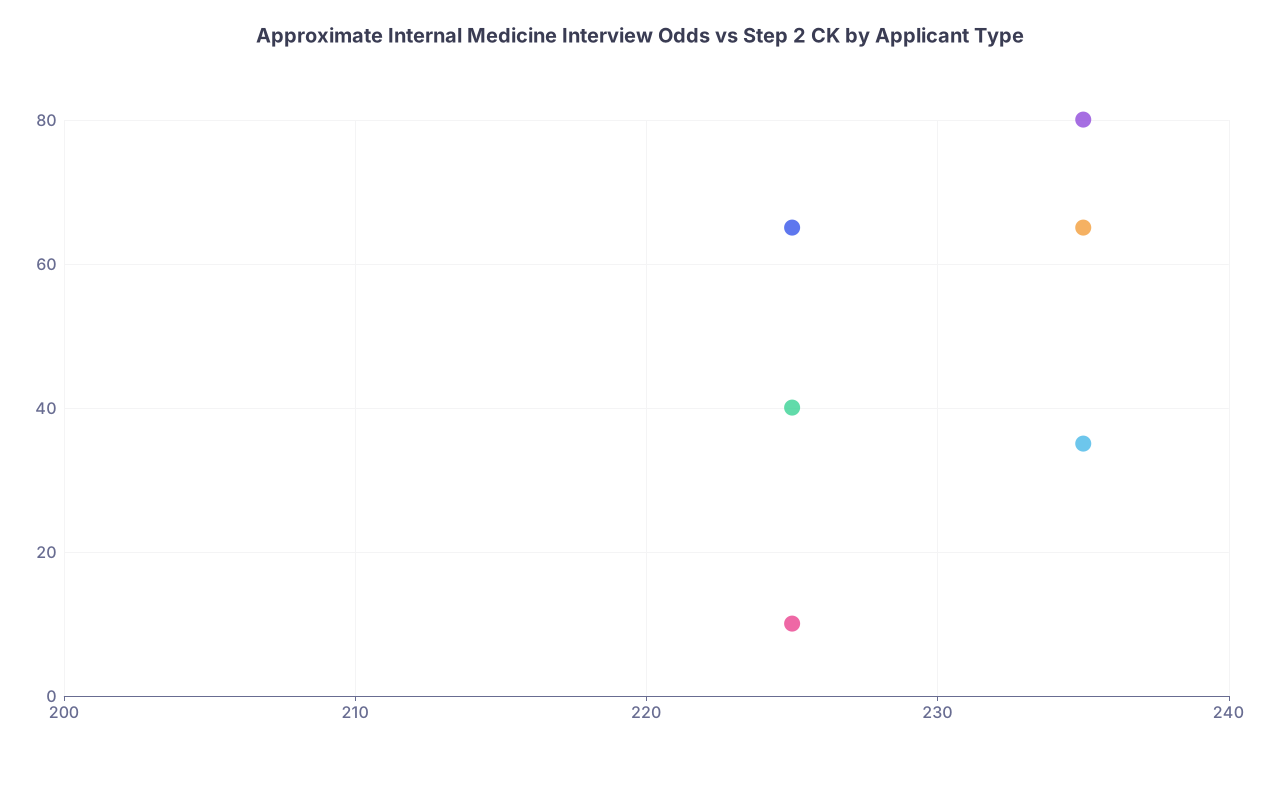
As a rough, realistic pattern for something like Internal Medicine categorical:
| Category | Value |
|---|---|
| US MD 225 | 225,65 |
| US MD 235 | 235,80 |
| US DO 225 | 225,40 |
| US DO 235 | 235,65 |
| IMG 225 | 225,10 |
| IMG 235 | 235,35 |
Interpreting that:
- US MD 225 vs 235: maybe 15‑point gain in odds.
- US DO 225 vs 235: jump is bigger because you cross more screens.
- IMG 225 vs 235: jump is massive but still leaves you below many academic cutoffs.
Thus:
- A 5‑point drop for a US MD from 245 → 240 in IM: annoying, but not fatal.
- The same 5‑point drop for an IMG from 235 → 230: catastrophic at many academic IM programs.
Same raw points. Very different effect size.
Tactical Pivot: What To Do When You Are 5–15 Points Below Target
You cannot retroactively change the score. You can absolutely change how that deficit converts into interview odds.
Here is how I have seen applicants claw back probability when they are 5–15 points below where they wanted to be.
1. Adjust Target Tier, Not Necessarily Specialty
The data show that within a specialty, tiering matters more than people like to admit.
A US MD with Step 2 CK 230 aiming for Gen Surg:
- At “Top 20–30” research programs: odds are low unless everything else is exceptional.
- At mid‑tier university + strong community university‑affiliated programs: very viable.
- At community‑heavy, regionally focused programs: strong candidate, especially with ties.
So a 5–10 point deficit vs the “top academic” norm might mean:
- Stop burning applications on 15 ultra‑reach programs
- Shift those 15 into slightly lower tier but more realistic ones
Statistically, that swap alone often adds 3–5 interviews.
2. Expand the Application Pool Aggressively
The NRMP data are clear: more applications → more interviews, but with diminishing returns.
When your score is below the median for your target specialty:
- 10 extra applications can be the difference between 5 and 8 interviews.
- 20 extra can be the difference between 8 and 12.
For example, Gen Surg with a 225 vs 235:
- At 30 applications: maybe 4–6 vs 7–10 interviews.
- At 60 applications: maybe 7–10 vs 12–15 interviews.
A 5–10 point deficit can often be partially offset by volume. Not elegant, but mathematically real.
3. Aim Surgically at Programs with Lower Historical Cutoffs
Not all programs obey the same thresholds. Some are known to:
- Take more DO/IMG
- Emphasize “fit,” local ties, or mission (rural, underserved)
- Care more about letters and away rotations than raw scores
If your score is 5–10 points below national medians, you should:
- Filter for programs with higher DO/IMG fill rates
- Favor those that explicitly state “we do not use hard cutoffs” (and actually mean it—check their historical match lists)
- Exploit geography where you have an edge (home state, med school region)
I have watched applicants with a 225 in Gen Surg match because they targeted 50 such programs intelligently, while someone with a 235 scattered 40 apps randomly and came up short in interview count.
The Harsh Truth: Where a 5‑Point Drop Is Fatal
There are scenarios where 5 points takes you from “borderline but alive” to “functionally dead” for a subset of programs.
Patterns I have repeatedly seen:
- IMG aiming at university IM: dropping from 235 → 230. Many programs where you were just at the line will now never see your name.
- US DO aiming at Ortho: 245 → 240 can push you below practical DO thresholds at a lot of academic programs. You now live almost entirely in community / strong DO‑friendly spaces.
- US MD aiming at Derm: 240 → 235 shifts you from “low but not impossible” to “needs major hook” at a majority of programs.
You cannot “network” your way around being screened out by software that never forwards your file. The math is indifferent to how hard you worked.
What Comes Next For You
The question is not “Is my score good?” That ship sailed on test day.
The real, data‑driven question is: “Given this score, this specialty, and this applicant type, how do I convert the maximum possible fraction of programs into interviews?”
You now understand:
- Where 5‑point drops actually shred odds (near cutoffs, in hyper‑competitive fields, or for DO/IMG at academic centers)
- Where those same 5 points are almost noise (above competency thresholds in primary care)
- How to use volume, targeting, and tiering to offset a modest numerical deficit
The next step in your journey is not to stare at your score report again. It is to build an application list and strategy that respects the math instead of your ego.
That is where you win or lose the match. But that is a topic we can unpack in detail another day—program list design by the numbers, and how to turn a mediocre score into a solid interview slate.