
You can absolutely match with a low Step score.
You can also absolutely sabotage yourself on the rank list and go unmatched for no good reason.
Most low-score applicants do not lose because of their number.
They lose because of preventable, predictable NRMP rank list mistakes.
Let me walk you through the traps I see every year.
The Most Dangerous Assumption: “Programs Will Protect Me If They Like Me”
This is the first mistake that ruins low-Step applicants:
Believing that interview vibes, nice emails, or “you’re a great fit” comments will somehow override the algorithm.
They will not.
The NRMP algorithm is applicant-proposing. That sounds friendly. It is not magic. It only works in your favor if you give it a smart, realistic rank list.
Here is how people with lower scores blow it:
- They over-rank “reach” programs based on flattery, not data.
- They under-rank or omit “safety” programs that actually ranked them.
- They treat “we loved meeting you” as equivalent to “we will rank you high enough to match.”
That is fantasy.
Programs:
- Are under zero obligation to rank you where they say they will.
- Do not “protect” you out of pity.
- Over-interview every year and cut aggressively when ranking.
You cannot control where they rank you.
You can control the structure and breadth of your rank list.
If your Step score is below the median for your specialty, assume:
- You are more replaceable than you feel.
- Any given interview is less secure than it seems.
- Your margin for rank list stupidity is almost zero.
Mistake #1: Building a Rank List for Ego, Not for Match Probability
The classic low-score disaster: a rank list that looks good on Instagram and terrible in real life.
Typical pattern:
- Top-heavy list of “brand name” programs.
- A few mid-tier places they did not really like.
- One or two true safeties buried at the bottom, if at all.
Then on Match Day: “I cannot believe I did not match; I had 9 interviews.”
I believe it. I have seen it.
The ego-based ranking logic
You will hear this from classmates verbatim:
- “I mean, I did not love that safety program. I would rather scramble than go there.”
- “I do not want to waste my top spots on community programs.”
- “If I rank it too high, it means I do not believe in myself.”
This is delusional. And costly.
The NRMP data is very clear: after a certain point, rank position hardly changes your chance of matching at a given program (because the real gate is whether they ranked you high enough, not whether you put them 3rd or 7th).
What does matter is:
- How many programs rank you.
- How many programs you rank back.
If your Step score is low and your interview count is modest (think single digits), you cannot afford to:
- Leave safeties off your list.
- Bury realistic options just to “shoot your shot” with reaches.
How to avoid this
Rank this way:
- At the top: Programs you genuinely like and where:
- Your score is at or near their historical averages, or
- They clearly demonstrated real interest (not just polite warmth).
- In the middle: Solid matches where:
- Your score is slightly below average but you fit other ways (IMG-friendly, research fit, home region, etc).
- Near the bottom (but still on the list): Programs you would tolerate attending if your only other option is going unmatched.
Do not assign rank positions based on:
- Prestige alone
- Your emotional high after interview day
- What your classmates will think when they see your Match Day announcement
You are not picking a vacation. You are trying not to become SOAP bait.
Mistake #2: Making a Short Rank List “Because They All Liked Me”
This one is brutal.
Every year, a low-score applicant says some version of:
“I only ranked 5 programs, but they all said they really liked me and would rank me highly.”
Then they do not match.
The data:
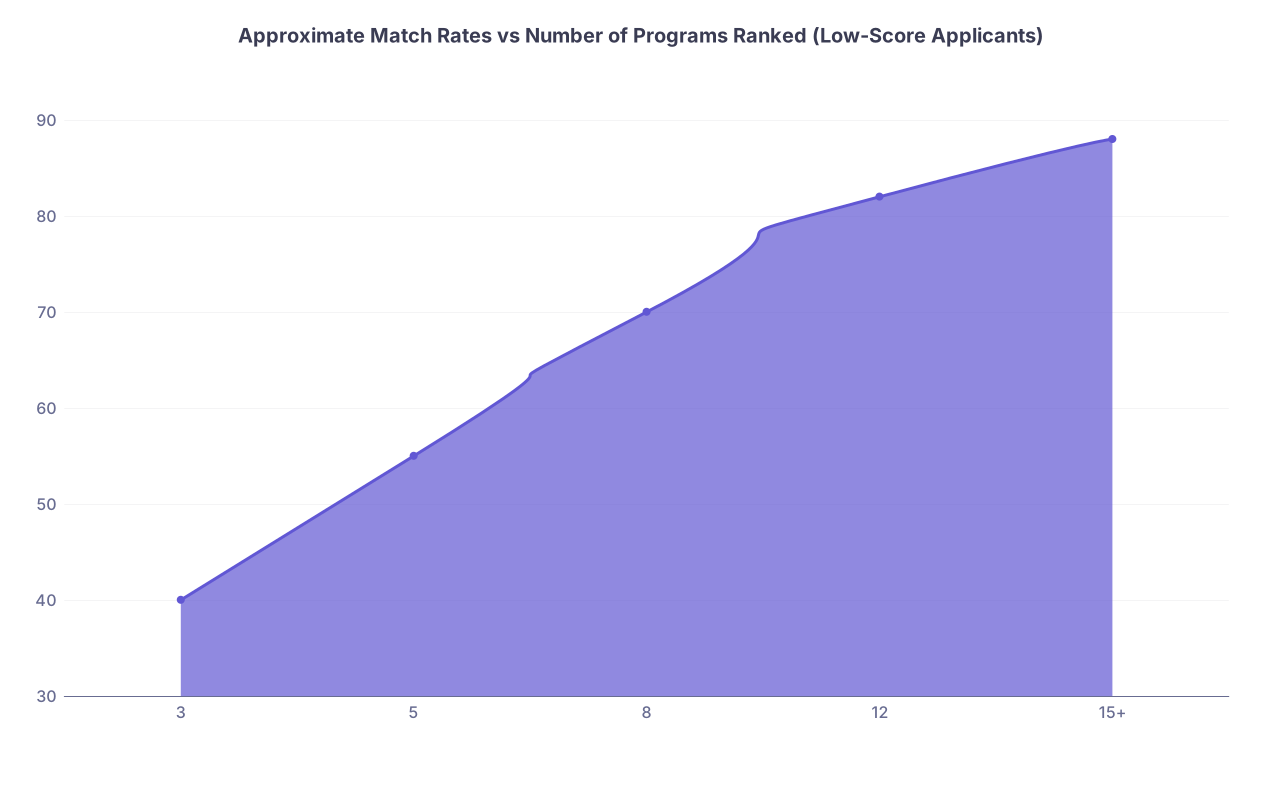
| Category | Value |
|---|---|
| 3 | 40 |
| 5 | 55 |
| 8 | 70 |
| 12 | 82 |
| 15+ | 88 |
Are those exact numbers? No. But that shape is real.
Fewer programs ranked = higher risk. Especially with a low Step score.
Why short lists are so dangerous for low scorers
Factors working against you:
- Programs use Step scores as an easy sorting filter.
- When they have many similarly “decent” applicants, the lower score loses.
- Interview love does not always make it onto the final rank list in a meaningful way.
The lower your score, the more likely you are:
- To end up lower on program lists.
- To lose tie-breakers.
- To be cut when a program trims its lower ranked applicants.
So when a low-score applicant ranks only 4–6 programs, they are effectively saying:
- “If these few programs do not place me high enough, I am comfortable going unmatched.”
They rarely realize that is what they are betting.
A simple rule if your Step score is low
- If you had:
- ≤ 5 interviews: you are already in the danger zone. Rank every single program that you could tolerate attending.
- 6–10 interviews: rank all of them unless there is a serious reason not to (location you truly cannot live in, malignant reputation with credible sources).
- > 10 interviews: you have some cushion, but you still rank widely. You are not a high-score applicant who can afford to be cute.
I have seen people go unmatched with 8 or 9 interviews because they:
- Left 2–3 programs off the list.
- Ranked “less desirable” ones very low.
- Assumed at least one “favorite” would work out.
Stop assuming. Start hedging.
Mistake #3: Treating Program “Signals” as Guarantees
Low-step applicants are desperate for hints that their score no longer matters. Programs know this. They are polite. They are vague. They are encouraging.
You misinterpret all of it.
Common signals that mean far less than you think:
- “We think you’d be a great fit here.”
- “We really enjoyed getting to know you.”
- “You’d do very well at our program.”
- An email saying, “We were impressed with you” in January.
- A resident telling you, “You’d totally survive here!” on a tour.
None of those equal: “We will rank you high enough to match.”
How this leads to rank list disaster
What I see low-score applicants do:
- Over-rank the one or two places that gave them strong verbal warmth.
- Assume those are “safe” because “they basically said they would rank me high.”
- Push more realistic programs much lower because “I have to honor my gut; they loved me the most.”
Then the program’s actual rank list comes out. You were above mid, but not high enough. You slide. Someone else slides into your spot. You fall through the cracks.
What does count as stronger evidence (still not guaranteed)
- A genuine, individualized follow-up from the PD mentioning specific details about you (not just canned compliments).
- Programs that:
- Took time for multiple faculty to meet you outside the typical schedule.
- Invited you for second looks and clearly prioritized your time.
- Have a track record (from seniors/graduates) of actually following through on what they say.
Even then: do not treat it like a contract.
Practical approach:
- Treat all verbal praise as a small positive bump, not a rank-list-defining factor.
- You can nudge a program up 1–2 spots if you feel there is genuine enthusiasm.
- Do not radically change your entire list structure based on a few kind words.
Mistake #4: Ignoring Program-Level Data and Relying on Vibes
If your Step score is low, you must stop pretending vibes are data.
You need to know:
- Where your score sits relative to the program’s usual range.
- Whether they are historically IMG/DO-friendly (if relevant to you).
- How many spots they have.
- How competitive their applicant pool typically is.
Yet most applicants never check even basic numbers. They only remember:
- “Attendings were nice.”
- “Residents seemed happy.”
- “They said they value holistic review.”
Holistic review still uses filters. Often Step is one of them.
Here is what you should actually be looking at:
| Factor | Why It Matters for Low Scores |
|---|---|
| Average Step/COMLEX | Shows how far below typical you are |
| Number of Positions | More spots = slightly better odds |
| IMG/DO Percentage | Reveals true openness to non-traditional profiles |
| Fill Rate | Chronic unfilled spots can suggest more opportunity (with caveats) |
| Location Desirability | Less desirable location = more margin for lower scores |
If you are a 215–220 Step 2 CK applicant:
- Ranking a program where the average matched CK is 245–250 and almost all are US MDs is reckless unless you have some truly exceptional, unique fit.
- Ranking a community program in a less popular city where several residents have scores near yours is rational.
Do not ignore:
- Program websites with posted resident profiles (many now list medical schools and sometimes data ranges).
- NRMP’s “Charting Outcomes” and specialty-specific match data.
- Word-of-mouth from recent grads who actually matched into those places.
Your rank list should reflect reality, not wishful thinking.
Mistake #5: Ranking Programs You Would Not Actually Attend
Match horror story I have seen in real life:
- Applicant with low Step score panics.
- Ranks every program, including:
- Places with known malignant culture.
- Cities they swore they would never live in.
- Programs they left on interview day saying, “I would be miserable here.”
- They match one of those.
- Now they are stuck for years or fighting an uphill battle to transfer.
Here is the trap: “I will just rank it low; I probably will not match there anyway.”
You might. And if you do, you are going.
The algorithm does not care that you planned to “just SOAP if it came to that.”
If you rank it, you are telling the system: I prefer this to remaining unmatched.
This is the exact order of preference the algorithm assumes:
- Your #1 program is where you most want to go.
- Your #2 is second most, etc.
- The last program is still better than going unmatched.
If that last statement is not true for any program on your list, delete it.
How to test this quickly
For every program on your list, ask:
“If this were the only place I matched, would I go?”
- If the honest answer is “yes, reluctantly, but yes” → keep it.
- If the answer is “no, I would rather reapply or change specialties” → remove it.
Do not let fear of being unmatched override basic self-preservation.
Mistake #6: Misunderstanding How the Algorithm Actually Works
A lot of low-score anxiety comes from simple misunderstanding. People think:
- Ranking a “reach” program high “wastes” spots and hurts their chances elsewhere.
- Ranking a program lower increases the chance of matching there (backwards logic).
- They should “put safer programs first” to lock them in.
All wrong.
A quick, stripped-down truth:
- The algorithm tries to place you in your highest-ranked program that also ranks you high enough.
- Ranking a reach program #1:
- Does not reduce your chance of matching #2, #3, etc.
- Only matters if #1 actually ranks you high enough to match.
- You cannot “protect” yourself by artificially pushing safeties up.
You only distort your own preferences.
Where low scores get hurt is not by wishing high. It is by:
- Having too few realistic options on the list at all.
- Leaving off programs that did rank them sufficiently.
- Overestimating who ranked them high enough.
To make this concrete, visualize the flow:

| Step | Description |
|---|---|
| Step 1 | Applicant submits rank list |
| Step 2 | Algorithm starts at top choice |
| Step 3 | Match tentatively placed |
| Step 4 | Move to next program on list |
| Step 5 | Final match |
| Step 6 | Did program rank applicant high enough |
| Step 7 | Higher priority applicant pushes them out |
The key for you with a low score: you are more likely to be pushed out at Step F.
So you protect yourself by:
- Having more programs to fall back to (E loops).
- Making sure those fallback programs actually exist on your list.
Mistake #7: Emotional, Last-Minute Rank List Changes
The NRMP rank list deadline hits. Stress is sky-high. This is when bad decisions happen.
Classic last-48-hours disasters:
- Moving a reach academic program from #5 to #1 because:
- “It would be so cool if I matched there.”
- “They have big-name attendings.”
- “My friend said prestige matters more than location.”
- Pushing a realistic community program down because your ego is hurt that they are not more “prestigious.”
- Dropping a “backup” program entirely because your friends teased you about the city.
The Step score reality:
- You are already in a more fragile position.
- You do not have the luxury of reordering your list based on impulse.
A better process:
- Draft your rank list the week before the deadline.
- Step away for 24–48 hours.
- Re-evaluate with:
- Your honest preferences.
- Program data (scores, positions, friendliness to your profile).
- Input from 1–2 trusted advisors max (not 10 classmates).
If you find yourself reordering your list at 11:45 pm the night of the deadline, you are not optimizing. You are panic-editing.
Putting This Together if Your Step Score Is Low
If your Step is below average for your specialty, here is what a mistake-avoiding approach looks like:
- Rank every program you interviewed at that you would genuinely attend.
- Do not leave “safeties” off the list. You are not too good for them if your alternative is no Match.
- Use data to inform your optimism:
- Where do your scores sit relative to typical residents?
- Are they IMG/DO-friendly if that is you?
- Treat interview compliments as weak evidence, not binding promises.
- Avoid tiny lists. Unless you had a double-digit number of interviews, a short list is basically rolling dice with your career.
- Do not rank any program you cannot see yourself attending under any circumstance.
- Make your first draft early and refuse last-minute emotional reshuffling.
Your low Step score is not the catastrophe you think it is.
Your sloppy rank list might be.
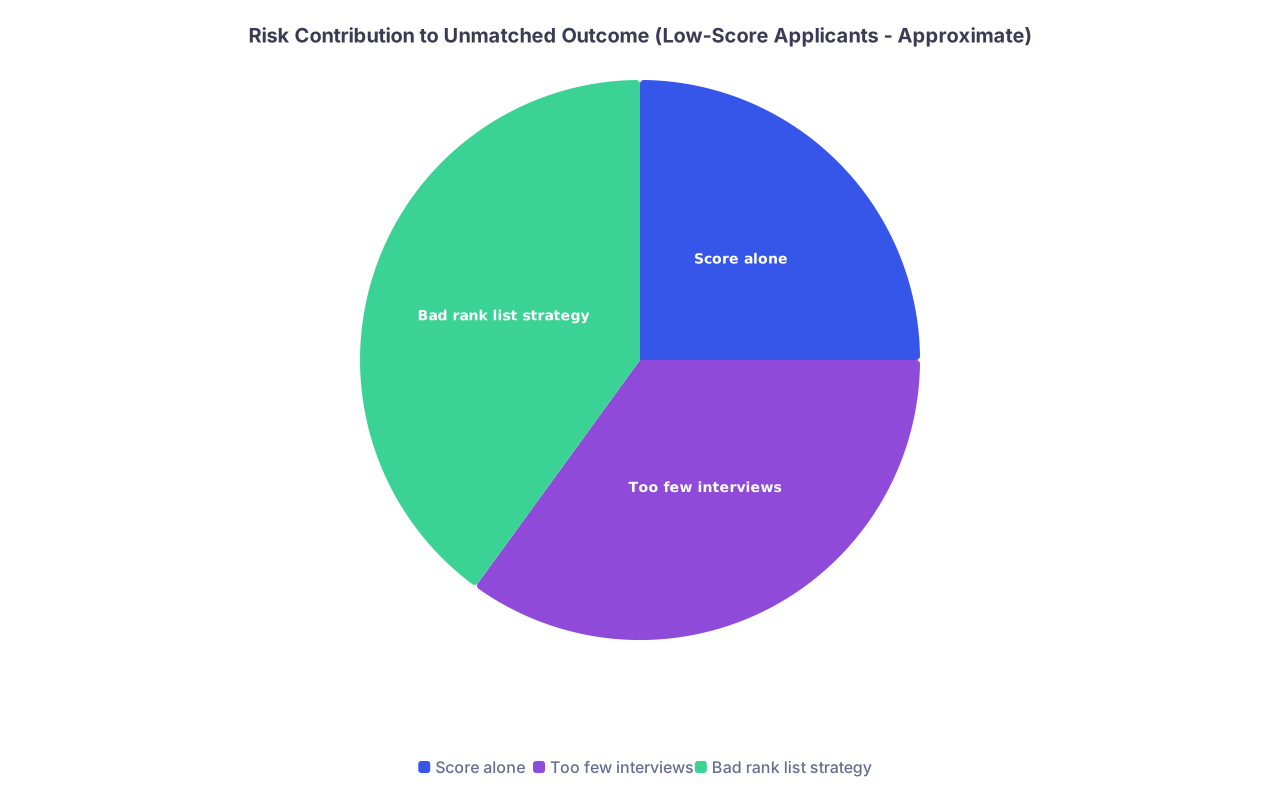
| Category | Value |
|---|---|
| Score alone | 25 |
| Too few interviews | 35 |
| Bad rank list strategy | 40 |
That pie is the uncomfortable truth: the rank list is more in your control than your score ever was. Do not squander that.
FAQ (Exactly 4 Questions)
1. If my Step score is low, should I rank “reach” programs at all?
Yes, you should. Ranking a reach program never hurts your chances at more realistic places. The algorithm will try to match you at the highest place on your list where the program also ranked you high enough. Put a few true reaches near the top if you genuinely prefer them. Just do not let them crowd out a healthy number of realistic programs that actually match your profile.
2. How many programs should I rank if I only had 5–6 interviews?
With 5–6 interviews, your situation is fragile. You should rank every single program you interviewed at that you would honestly attend. No games. No omissions. You cannot afford to remove places based on minor preferences. Each program you leave off your list is a potential match you are throwing away.
3. Should I trust a program if they tell me I will be “ranked to match”?
Treat “ranked to match” cautiously. Some programs use that phrase carefully and mean it; others use it loosely or to multiple applicants. The only safe approach is this: consider that strong positive evidence, maybe nudge them a bit higher if you also liked them, but do not reorganize your entire list around that promise. And absolutely do not drop realistic backups because of one such comment.
4. I hated a program, but I am scared of going unmatched. Should I keep it on my list?
Ask yourself bluntly: “Would I rather spend years training there or go unmatched and reapply / change paths?” If you truly would not go even if it is your only option, remove it. Ranking a program means you are telling NRMP you prefer that program over going unmatched. Do not lie to yourself about that. You can keep marginal programs that are not ideal but still tolerable. Delete the ones that would be truly unacceptable.
Open your current rank list right now and go line by line.
For each program, ask: “Would I genuinely go here rather than not match?”
If the honest answer is no, take it off—today.